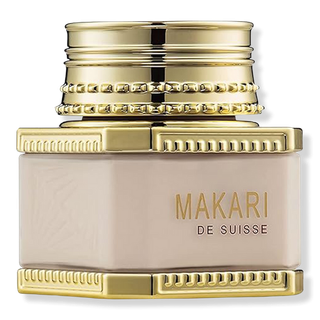
Works for
2 of 2 advertised claims delivered
Moisturizing10 ingredients credited for this claimGood support
“This rich, fast-absorbing moisturizer brightens, fades dark spots, and protects from sun damage.”
This product can help improve hydration of the skin with the two types of ingredients.
The first type is called “humectants”:
these ingredients help attract water.
When humectants are on the surface of the skin, they “pull in” the moisture from the outside environment, or from
within deeper layers of the skin. The following ingredients in this product do the job:
cyclomethicone, propylene glycol.
This product also contains ingredients called “occlusives”. They help reduce the speed with which our skin loses moisture to the outside environment. These ingredients also help soften the upper layer of the skin, so it feels less tight and nicer to the touch. The following ingredients in this product do the job: dimethicone, cyclomethicone.
Evens skin tone5 ingredients credited for this claimModerate support
“This rich, fast-absorbing moisturizer brightens, fades dark spots, and protects from sun damage.”
This product might be able to help reduce hyperpigmentation and even out the skin tone because it contains salicylic acid. The effect, if any, is likely to be small. Keep in mind that you would need to apply any topical skincare targetted at hypigmentation consistently for a couple of months to get a result. No topical skincare product can help get rid of hyperpigmentation (including post-acne marks and age spots) instantly.
The following ingredient (ingredients) in this product might be helpful, but there is no evidence to confirm that it actually works: arbutin, glycyrrhetinic acid, glycyrrhiza glabra root extract, retinyl propionate.
ExfoliationNot advertised by the brand · 2 ingredients credited for this claimStrong support
This product can help exfoliate the skin. In other words, it helps break down the bonds between dead cells on the surface of the skin and speed up the skin turnover. Skin often appears softer and brighter after exfoliation, but overdoing it can result in disrupted skin barrier. The following ingredient is doing the exfoliating job in this product: salicylic acid.
Anti-oxidationNot advertised by the brand · 5 ingredients credited for this claimStrong support
This product contains antioxidants (glycyrrhetinic acid) that can help neutralize free radicals in skin. By doing so, they can lessen the damage the skin gets from the UV light (sun).
The following ingredients - arbutin also can have an antioxidant effect, but there is less evidence to confirm their effectiveness in skin.
Anti-blemishNot advertised by the brand · 4 ingredients credited for this claimStrong support
This product can help reduce breakouts and clogged pores because it contains the following ingredient: salicylic acid. This ingredient is used for treating acne and can have a noticeable effect.
The following ingredient (ingredients) in this product might be helpful, but there is no evidence to confirm that it actually works: retinyl propionate
Anti-agingNot advertised by the brand · 1 ingredient credited for this claimModerate support
This product contains retinyl propionate. This ingredient might be able to help reduce and prevent fine lines and wrinkles, improve skin elasticity and firmness, but there is not enough evidence that it actually works.
Can it cause trouble?
Irritancy13 strong irritants: Lilium candidum flower extract, Dmdm hydantoin + 11 more — patch-test recommendedHigh risk
Comedogenic5 ingredients rated 2 or more on the 0–5 pore-clogging scale5 flagged

User reviews
Be the first — your take helps the next person decide.
Ingredients
Filter by role to see what each ingredient is doing.
Daucus carota sativa extract~23–34%
- Irritation risk
- Medium
Lilium candidum flower extract~5–7.6%
Citric acid~5–7.6%
- Irritation risk
- Medium
Can work as an exfoliant but is typically used to adjust the product pH
More about Citric acidMorus alba root extract~3.9–5.8%
- Irritation risk
- Low
Water~2.8–4.1%
Glyceryl stearate~2.2–3.3%
- Irritation risk
- Low
An emollient that softens the skin and forms a protective layer on its surface. Helps water and oil mix together
More about Glyceryl stearateCetearyl alcohol~1.7–2.6%
- Irritation risk
- Low
- Comedogenicity
- 2/5
A non-drying alcohol. Works as an emollient. Helps water and oil mix together and creates a nice product texture
More about Cetearyl alcoholStearic acid~1.5–2.2%
- Irritation risk
- Low
Helps oil and water mix together and works as an emollient
More about Stearic acidMyristic acid~1.2–1.7%
- Irritation risk
- Medium
- Comedogenicity
- 3/5
Helps oil and water mix together. Could be comedogenic
More about Myristic acidPalmitic acid~0.95–1.4%
- Irritation risk
- Low
An emollient that is naturally present in skin and helps soften it
More about Palmitic acidLauric acid~0.55–1.3%
- Irritation risk
- Medium
- Comedogenicity
- 3/5
Helps water and oil mix together. Has anti-bacterial properties that might be helpful in preventing blemishes
More about Lauric acidPropylene glycol~0.4–0.95%
- Irritation risk
- High
Helps oil and water mix together and can enhance the penetration of other ingredients into the skin. It can be irritating
More about Propylene glycolCetearyl glucoside~0.4–0.9%
- Irritation risk
- Medium
Helps water and oil in the product mix well together and improves product texture
More about Cetearyl glucosideMorus alba root extract~0.35–0.8%
- Irritation risk
- Low
Hydrogenated vegetable oil~0.35–0.85%
- Irritation risk
- Low
- Comedogenicity
- 2/5
An oil from a mixture of different vegetables. Helps soften the upper layer of the skin
More about Hydrogenated vegetable oilCyclomethicone~0.35–0.85%
- Irritation risk
- Low
A type of silicone that leaves a nice silky finish on the skin and can help soften its upper layer
More about CyclomethiconeDimethicone~0.4–0.9%
- Irritation risk
- Low
A silicone that helps to reduce water loss from the surface of the skin. Can temporarily "fill in" lines and wrinkles, absorb oil, and create a nice product finish
More about DimethiconeCeteareth-6~0.2–0.8%
Acrylamide/sodium acrylate copolymer~0.35–0.8%
- Irritation risk
- Low
Caprylic/capric triglyceride~0.3–0.75%
- Irritation risk
- Medium
A good mix of fatty acids that forms a protective layer on the skin. Improves the shelf life of products. Derived from coconut and glycerin
More about Caprylic/capric triglycerideDaucus carota sativa extract~0.15–0.55%
- Irritation risk
- Medium
Ammonium dimethicone peg-7 sulfate~0.15–0.6%
- Irritation risk
- Low
Glycyrrhetinic acid~0.15–0.55%
- Irritation risk
- Medium
Active compound of licorice root. Works to calm down inflammation, as an anti-oxidant, and might be helpful in lightening the skin and reducing hyperpigmentation
More about Glycyrrhetinic acidArbutin~0.15–0.55%
- Irritation risk
- Medium
Beta-arbutin. Can help to reduce hyperpigmentation and has an anti-oxidant effect when used in high enough concentration. Is less effective compared to alpha-arbutin
More about ArbutinCarrageenan~0.15–0.65%
- Irritation risk
- Medium
- Comedogenicity
- 3/5
Helps thicken the product formula and create a nice product formulation
More about CarrageenanDmdm hydantoin~0.15–0.55%
- Irritation risk
- High
A preservative that releases formaldehyde and can be irritating
More about Dmdm hydantoinRetinyl propionate~0.15–0.55%
- Irritation risk
- High
Three steps removed from the active form of vitamin A - retinoic acid. To have an effect in the skin, it first needs to be converted twice to become the retinoic acid. This means it is less potent than retinol, but could also be less irritating. Once converted to the retinoic acid in the skin, it helps against all signs of aging, improves skin cell turnover and helps fight blemishes and clogged pores, even thought its potency is not as well established as in case of retinol or retinaldehyde
More about Retinyl propionateCitrus aurantium amara leaf/twig extract~0.15–0.55%
- Irritation risk
- High
Ethylhexyl methoxycinnamate~0.3–0.7%
- Irritation risk
- High
Octinoxate. When used in higher concentrations, works as a sunscreen protecting the skin from UVB rays. When used in lower concentration, helps to preserve the product formulation. Is shown to be harmful to coral reefs - consider avoiding bathing in coral reef areas when wearing a product with this ingredient. It can be irritating
More about Ethylhexyl methoxycinnamateEthylhexyl salicylate~0.3–0.7%
- Irritation risk
- Low
Octisalate. A UV filter. It offers some protection against the sun rays that cause sunburn (UVB), but does not protect against the most aging sun rays (UVA). It loses its effectiveness quickly when exposed to sunlight. It is an organic, or so called "chemical" sunscreen
More about Ethylhexyl salicylateEthylhexyl triazone~0.3–0.7%
- Irritation risk
- Medium
Uvinul T. A UV filter. Effective against UVB rays. It is photostable. Can increase water resistance properties of the sunscreen. Unfortunately, not approved by the FDA (US) yet
More about Ethylhexyl triazoneTocopheryl acetate~0.15–0.6%
- Irritation risk
- Medium
A more stable but less bio-available form of vitamin E compared to Tocopherol. Might help moisturize and protect the skin from free radicals, but mostly used in low concentrations to stabilize other ingredients.
More about Tocopheryl acetateAllantoin~0.15–0.5%
- Irritation risk
- Low
Helps calm down inflammation in skin and can help reduce itching. Helps to repair the skin barrier and keep skin hydrated
More about AllantoinSalicylic acid~0.15–0.55%
- Irritation risk
- High
Used for skin exfoliation. It has an anti-inflammatory and anti-bacterial effect, helps to unclog pores, prevent blemishes and speed up healing of the existing ones. Sometimes referred to as a BHA (beta-hydroxy acid)
More about Salicylic acidLilium candidum flower extract~0.15–0.55%
Glycyrrhiza glabra root extract~0.15–0.65%
- Irritation risk
- Medium
A plant extract that can help lighten the skin and calm down inflammation. Might be helpful in neutralizing free radicals
More about Glycyrrhiza glabra root extractEscin~0.15–0.55%
- Irritation risk
- High
A compound obtained from horse chestnut. It is claimed that this chemical can improve circulation, but there is no evidence available that it works in skin
More about EscinPhenoxyethanol~0.15–0.6%
- Irritation risk
- Low
A preservative. It helps prevent bacterial growth in cosmetic products
More about PhenoxyethanolMethylparaben~0.15–0.3%
Citric acid~0.15–0.6%
- Irritation risk
- Medium
Can work as an exfoliant but is typically used to adjust the product pH
More about Citric acidParfum~0.15–0.55%
- Irritation risk
- High
An aromatic blend of unspecified and possibly irritating ingredients
More about ParfumHexyl cinnamal~0.15–0.5%
Alpha-isomethyl ionone~0.15–0.55%
- Irritation risk
- High
A fragrance. Potential allergen and can be irritating
More about Alpha-isomethyl iononeBenzyl benzoate~0.1–0.5%
- Irritation risk
- High
Fragrance with sweet balsamic smell. Help to preserve products and dissolve other ingredients. Could trigger allergic reactions and be irritating
More about Benzyl benzoateCitronellol~0.1–0.45%
Butylphenyl methylpropional~0.1–0.4%
- Irritation risk
- High
A fragrance. Can trigger allergic reactions and be irritating
More about Butylphenyl methylpropionalLimonene~0.1–0.5%
- Irritation risk
- High
A common frangrance that can easily irritate skin, especially if exposed to air, light or heat
More about LimoneneLinalool~0.1–0.45%
Hydroxyisohexyl 3-cyclohexene carboxaldehyde~0.1–0.35%
- Irritation risk
- High
A fragrance. Can be irritating
More about Hydroxyisohexyl 3-cyclohexene carboxaldehydeIngredient list view
Daucus carota sativa extract, Lilium candidum flower extract, Citric acid, Morus alba root extract, Water, Glyceryl stearate, Cetearyl alcohol, Stearic acid, Myristic acid, Palmitic acid, Lauric acid, Propylene glycol, Cetearyl glucoside, Morus alba root extract, Hydrogenated vegetable oil, Cyclomethicone, Dimethicone, Ceteareth-6, Acrylamide/sodium acrylate copolymer, Caprylic/capric triglyceride, Daucus carota sativa extract, Ammonium dimethicone peg-7 sulfate, Glycyrrhetinic acid, Arbutin, Carrageenan, Dmdm hydantoin, Retinyl propionate, Citrus aurantium amara leaf/twig extract, Ethylhexyl methoxycinnamate, Ethylhexyl salicylate, Ethylhexyl triazone, Tocopheryl acetate, Allantoin, Salicylic acid, Lilium candidum flower extract, Glycyrrhiza glabra root extract, Escin, Phenoxyethanol, Methylparaben, Citric acid, Parfum, Hexyl cinnamal, Alpha-isomethyl ionone, Benzyl benzoate, Citronellol, Butylphenyl methylpropional, Limonene, Linalool, Hydroxyisohexyl 3-cyclohexene carboxaldehyde
Compare prices
Retailers ranked by price — lowest first.

Affiliate links · prices updated regularly
Worth comparing, line by line.
Match % combines shared ingredients, the first five ingredients, shared actives and hero ingredients, irritancy (lower counts in the alternative's favour), texture and body area. Only products in the same routine step are compared.
| MakariDay Radiance Face CreamYOUR PRODUCT | BiodermaSebium Global Intensive Purifying Cream For Acne-Prone Skin | Radiant Glow BotanicalAnti Blemish Brightener | MG217Salicylic Acid Formula Cream | |
|---|---|---|---|---|
| Match | — | 86% | 85% | 82% |
| Price | $49.00 | $11.37−$37.63 | $16.99−$32.01 | $10.99−$38.01 |
| Shared key ingredients | — | 4 of 10 | 4 of 10 | 1 of 10 |
| Key difference | — | Bakuchiol | Isopropyl Myristate | Panthenol |
| Irritancy | High | Medium | Medium | Low |
| Drying alcohol | — | — | — | — |
| View product | Shop | Shop | Shop |


Sources cited in this review
Every concentration estimate and effectiveness label is anchored to one of these 18 studies and safety reviews.
- 1
- 2Surfactants and experimental irritant contact dermatitisncbi.nlm.nih.gov
- 3Propylene Glycolpubmed.ncbi.nlm.nih.gov
- 4Skin-sensitizing and irritant properties of propylene glycolonlinelibrary.wiley.com
- 5
- 6Final Report on the Safety Assessment of Dimethicone Copolyoljournals.sagepub.com

Affiliate links · As an Amazon Associate, WIMJ earns from qualifying purchases.