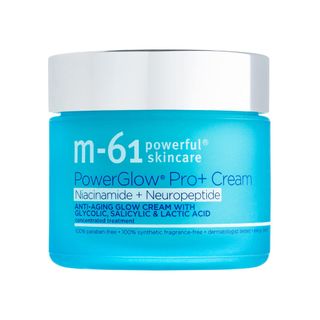
M-61 PowerGlow Pro+ Niacinamide+Neuropeptide Cream
Works for
2 of 3 advertised claims delivered
Anti-aging8 ingredients credited for this claimStrong support
“A Hexapeptide combined with Passionflower and White Tea Extract helps to visibly soften the appearance of expression lines and diminish the advanced signs of aging over time, effectively mimicking the results seen from botox without the toxic, injectable treatment.”
This product can help reduce and prevent fine lines and wrinkles, improve skin elasticity and firmness because it contains glycolic acid.
These ingredients in the product can also be helpful, even though there is less evidence for their effectiveness: acetyl hexapeptide-8, palmitoyl heptapeptide-18, palmitoyl hexapeptide-52.
Keep in mind that it typically takes at least 6 weeks to notice any results because the changes that are needed to improve fine lines and elasticity happen in the deeper layers of the skin. No topical anti-aging product can “erase” wrinkles or fully reverse signs of aging.
Exfoliation4 ingredients credited for this claimStrong support
“A power-house blend of Glycolic, Salicylic and Lactic Acid deeply exfoliates and removes dead skin cells for improved texture, tone and clarity.”
This product can help exfoliate the skin. In other words, it helps break down the bonds between dead cells on the surface of the skin and speed up the skin turnover. Skin often appears softer and brighter after exfoliation, but overdoing it can result in disrupted skin barrier. The following ingredient is doing the exfoliating job in this product: glycolic acid.
Anti-blemish5 ingredients credited for this claimLimited support
“A power-house blend of Glycolic, Salicylic and Lactic Acid deeply exfoliates and removes dead skin cells for improved texture, tone and clarity.”
This product contains ingredients (glycolic acid) that could help reduce blemishes and clogged pores in theory, but there is not enough evidence that they actually work.
MoisturizingNot advertised by the brand · 18 ingredients credited for this claimStrong support
This product can help improve hydration of the skin with the two types of ingredients.
The first type is called “humectants”:
these ingredients help attract water.
When humectants are on the surface of the skin, they “pull in” the moisture from the outside environment, or from
within deeper layers of the skin. The following ingredients in this product do the job:
glycerin.
This product also contains ingredients called “occlusives”. They help reduce the speed with which our skin loses moisture to the outside environment. These ingredients also help soften the upper layer of the skin, so it feels less tight and nicer to the touch. The following ingredients in this product do the job: butyrospermum parkii butter, helianthus annuus seed oil.
The following ingredients in this product are especially good for supporting the skin barrier and helping with the hydration level: acetyl hexapeptide-8, palmitoyl heptapeptide-18, palmitoyl hexapeptide-52
Evens skin toneNot advertised by the brand · 5 ingredients credited for this claimStrong support
This product can help reduce hypepigmentation and even out the skin tone because it contains the following effective ingredients: glycolic acid
Keep in mind that you would need to apply any topical skincare targetted at hypigmentation consistently for a couple of months to get a result. No topical skincare product can help get rid of hyperpigmentation (including post-acne marks and age spots) instantly.
Can it cause trouble?
Irritancy4 strong irritants: Lavandula angustifolia flower extract, Citrus aurantium dulcis fruit extract + 2 more — patch-test recommendedHigh risk
Comedogenic1 ingredient rated 2 or more on the 0–5 pore-clogging scale1 flagged


User reviews
Be the first — your take helps the next person decide.
Ingredients
Filter by role to see what each ingredient is doing.
Water~45–55%
Glycolic acid~5.5–6.7%
- Irritation risk
- High
An alpha-hydroxy acid (AHA) that helps to remove the dead skin cells on the surface of the skin reveling a more even, smoother complexation. It is also able to stimulate collagen production with long-term use. Could help to reduce pore congestion. It can be irritating to the skin. Apply sunscreen daily if using products with glycolic acid
More about Glycolic acidButyrospermum parkii butter~4.3–5.2%
- Irritation risk
- Low
- Comedogenicity
- 3/5
A great moisturising ingredient that softens the skin and reduces water loss from its upper layer. It also can be helpful in protecting skin from free radicals
More about Butyrospermum parkii butterDicaprylyl maleate~3.1–3.8%
- Irritation risk
- Medium
Used to dissolve other ingredients, create a nice product texture and soften the upper layer of the skin. Can be an allergen
More about Dicaprylyl maleateHelianthus annuus seed oil~2.4–3%
- Irritation risk
- Low
A great emollient due to its high linoleic acid content. One of the most effective plant oils in helping skin hydration and repairing skin barrier function
More about Helianthus annuus seed oilGlycerin~2–2.5%
- Irritation risk
- Low
One of the best moisturizing ingredients. Naturally present in skin. It attracts water to the upper layer of the skin working as a humectant
More about GlycerinC13-15 alkane~1.6–2%
Glyceryl stearates~1.5–1.8%
- Irritation risk
- Low
Help soften the upper layer of the skin
More about Glyceryl stearatesPotassium hydroxide~1.2–1.5%
Cetyl alcohol~1.1–1.3%
- Irritation risk
- Low
A non-drying alcohol that works to soften the skin and stabilize product formulations helping oil and water mix together
More about Cetyl alcoholSodium stearoyl glutamate~0.75–1.1%
- Irritation risk
- Medium
Helps oil and water mix together
More about Sodium stearoyl glutamateBis-diglyceryl polyacyladipate-1~0.6–0.9%
- Irritation risk
- Low
Squalane~0.6–0.85%
- Irritation risk
- Low
An oil naturally present in skin. Works as an emollient to soften the skin and form a protective layer on its surface without a greasy feeling.
More about SqualaneSclerotium gum~0.45–0.7%
- Irritation risk
- Low
Used to create gel-like formulas and stabilize emulsions
More about Sclerotium gumPentylene glycol~0.5–0.75%
- Irritation risk
- Medium
Used to preserve products, dissolve other ingredients and create a nice product texture
More about Pentylene glycolNiacinamide~0.45–0.65%
- Irritation risk
- Low
Is proven to be effective in reducing blemishes, evening out skin tone and helping to improve lines and wrinkles. It helps the skin to repair sun damage, calm down inflammation and keep maintain good levels of moisture. The concentration of about 2% is effective for supporting the skin barrier and evening out the skin tone. Concentration of 4-6% is better for helping with acne and balancing the sebum production
More about NiacinamideAcetyl hexapeptide-8~0.4–0.6%
- Irritation risk
- Low
A type of peptide. Peptides are excellent moisturizers and might be able support collagen production reducing fine lines and wrinkles
More about Acetyl hexapeptide-8Palmitoyl heptapeptide-18~0.35–0.6%
Palmitoyl hexapeptide-52~0.3–0.55%
- Irritation risk
- Low
A type of peptide. Peptides are excellent moisturizers and might be able support collagen production reducing fine lines and wrinkles
More about Palmitoyl hexapeptide-52Salicylic acid~0.3–0.55%
- Irritation risk
- High
Used for skin exfoliation. It has an anti-inflammatory and anti-bacterial effect, helps to unclog pores, prevent blemishes and speed up healing of the existing ones. Sometimes referred to as a BHA (beta-hydroxy acid)
More about Salicylic acidLactic acid~0.25–0.5%
- Irritation risk
- Medium
An exfoliating and moisturizing alpha-hydroxy acid (AHA). Typically causes less irritation than other AHAs, for example, glycolic acid. At high concentrations (about 15%), lactic acid can help reduce lines and wrinkles. Recent studies show that lactic acid can support the "good" bacteria living on skin's surface (healthy skin microbiome)
More about Lactic acidLactic acid/glycolic acid copolymer~0.25–0.5%
- Irritation risk
- Low
Passiflora incarnata flower extract~0.25–0.45%
- Irritation risk
- Low
Camellia sinensis leaf extract~0.25–0.5%
- Irritation risk
- Low
Can contain potent anti-oxidant compounds (abbreviated ECG, GCG, EGC, and EGCG) that might help protect the skin from free radicals. Can help calm down inflammation and has some anti-bacterial properties. Unfortunately, these antioxidants are unstable and lose their effectiveness very quickly in products. The concentration of the antioxidant compounds in the extract also tends to be low to be effective in topical formulation
More about Camellia sinensis leaf extractAllantoin~0.25–0.45%
- Irritation risk
- Low
Helps calm down inflammation in skin and can help reduce itching. Helps to repair the skin barrier and keep skin hydrated
More about AllantoinLavandula angustifolia flower extract~0.3–0.55%
- Irritation risk
- High
Essential oil that can be irritating
More about Lavandula angustifolia flower extractCitrus aurantium dulcis fruit extract~0.25–0.45%
- Irritation risk
- High
A plant extract that is used as a fragrance. Can be irritating and lead to photosensitivity
More about Citrus aurantium dulcis fruit extractCitrus limon fruit extract~0.25–0.45%
- Irritation risk
- High
Used as a fragrance. Can be irritating and cause photosensitivity
More about Citrus limon fruit extractAcer saccharum extract~0.25–0.45%
- Irritation risk
- Medium
A plant extract that contains small percentage of AHAs. Is unlikely to have any skin benefit due the small concentration of the active compounds
More about Acer saccharum extractSaccharum officinarum extract~0.25–0.4%
- Irritation risk
- Low
Sugar extract that helps attract water to the upper layer of the skin
More about Saccharum officinarum extractHamamelis virginiana leaf water~0.2–0.4%
- Irritation risk
- High
Vaccinium myrtillus fruit extract~0.2–0.4%
- Irritation risk
- Medium
A plant extract that might help neutralize free radicals in skin, but research on its efficacy in skin is lacking
More about Vaccinium myrtillus fruit extractTocopheryl acetate~0.2–0.4%
- Irritation risk
- Medium
A more stable but less bio-available form of vitamin E compared to Tocopherol. Might help moisturize and protect the skin from free radicals, but mostly used in low concentrations to stabilize other ingredients.
More about Tocopheryl acetatePalmitic acid~0.25–0.45%
- Irritation risk
- Low
An emollient that is naturally present in skin and helps soften it
More about Palmitic acidBisabolol~0.15–0.25%
- Irritation risk
- Low
An active component of chamomile plant that historically has been used to calm down irritated skin. A recent study shows that bisabolol indeed can have some anti-inflammatory effect on skin, even though conclusive data is lacking. Bisabolol has a sweet floral scent and can be added to products for its aromatic properties
More about BisabololPolyvinyl alcohol~0.2–0.35%
Sodium phytate~0.15–0.25%
Stearic acid~0.2–0.4%
- Irritation risk
- Low
Helps oil and water mix together and works as an emollient
More about Stearic acidXanthan gum~0.1–0.15%
- Irritation risk
- Low
Used to create a thicker product consistency
More about Xanthan gumPhenoxyethanol~0.1–0.2%
- Irritation risk
- Low
A preservative. It helps prevent bacterial growth in cosmetic products
More about PhenoxyethanolIngredient list view
Water, Glycolic acid, Butyrospermum parkii butter, Dicaprylyl maleate, Helianthus annuus seed oil, Glycerin, C13-15 alkane, Glyceryl stearates, Potassium hydroxide, Cetyl alcohol, Sodium stearoyl glutamate, Bis-diglyceryl polyacyladipate-1, Squalane, Sclerotium gum, Pentylene glycol, Niacinamide, Acetyl hexapeptide-8, Palmitoyl heptapeptide-18, Palmitoyl hexapeptide-52, Salicylic acid, Lactic acid, Lactic acid/glycolic acid copolymer, Passiflora incarnata flower extract, Camellia sinensis leaf extract, Allantoin, Lavandula angustifolia flower extract, Citrus aurantium dulcis fruit extract, Citrus limon fruit extract, Acer saccharum extract, Saccharum officinarum extract, Hamamelis virginiana leaf water, Vaccinium myrtillus fruit extract, Tocopheryl acetate, Palmitic acid, Bisabolol, Polyvinyl alcohol, Sodium phytate, Stearic acid, Xanthan gum, Phenoxyethanol
Compare prices
Retailers ranked by price — lowest first.

Worth comparing, line by line.
Match % combines shared ingredients, the first five ingredients, shared actives and hero ingredients, irritancy (lower counts in the alternative's favour), texture and body area. Only products in the same routine step are compared.
| M-61PowerGlow Pro+ Niacinamide+Neuropeptide CreamYOUR PRODUCT | UpCircle BeautyNight Cream with Blueberry Extract | CeraVeBlemish Control Gel Moisturiser with 2% Salicylic Acid & Niacinamide for Blemish-Prone Skin | PacificaGlow Baby Brightening Peel Pads | |
|---|---|---|---|---|
| Match | — | 64% | 63% | 63% |
| Price | $75.94 | — | $14.54−$61.40 | $12.32−$63.62 |
| Shared key ingredients | — | 5 of 15 | 5 of 15 | 5 of 15 |
| Key difference | — | Ricinus Communis Seed Oil | Ceramide Ap | Erythritol |
| Irritancy | High | Medium | Low | Medium |
| Drying alcohol | — | — | — | — |
| View product | Shop | Shop | Shop |


Product summary
Based on the ingredients included, "M-61 - PowerGlow Pro+ Niacinamide+Neuropeptide Cream" works well for moisturizing the skin. As we expect from a proper moisturizer, the formula includes a combo of effective humectants and emollients. These are the two different types of ingredients that are essential for improving the skin hydration and supporting a healthy skin barrier. Humectants in this product (acetyl hexapeptide-8 and glycerin) help to increase the water content in the upper layer of the skin. (These ingredients do so by "capturing" water molecules from the outside air or from within the deeper layers of the skin). Emollients in this formulation (butyrospermum parkii butter, helianthus annuus seed oil, squalane, cetyl alcohol and glyceryl stearates) help to reduce the moisture loss from the skin. They also soften the skin surface and relieve the feeling of dryness and tightness.
Ingredient callouts
- This moistruizer also contains peptides (palmitoyl hexapeptide-52 0.30% - 0.55%, palmitoyl heptapeptide-18 0.35% - 0.60% and acetyl hexapeptide-8 0.40% - 0.60%). Peptides is a very big group of ingredients. They all consist of a different combination of amino-acids. Our skin produces peptides naturally. Some of them work as natural anti-biotics, promote wound-healing and production of collagen. The scientists are still studying how effective the topical application of peptides is, but it is very likely that peptides in skincare are helpful. They might be able to support skin barrier restoration and even have an anti-aging benefit. At the very least, they certainly help attract water to the skin and support the hydration in this way.
Irritation risk
We assess the overall irritancy of this moisturizer to be high. For a detailed overview of all potential irritants: click here
You can see the detailed formula review with the breakdown of all actives in the product and the full ingredient list with estimated concentrations in the tables below.
Price
The product retails from 88.00$ up to 89.98$ in the United States.
For a detailed price comparison: click here.
Sources cited in this review
Every concentration estimate and effectiveness label is anchored to one of these 27 studies and safety reviews.
- 1
- 2Glycolic acid peel therapy – a current reviewncbi.nlm.nih.gov
- 3
- 4Allergic contact dermatitis from medium-chain triglyceridesonlinelibrary.wiley.com
- 5Dicaprylyl maleate--an emerging cosmetic allergenncbi.nlm.nih.gov
- 6

Affiliate links · As an Amazon Associate, WIMJ earns from qualifying purchases.