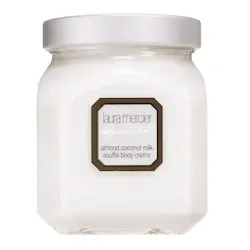
Laura Mercier Almond Coconut Souffl Body Crme
Works for
1 of 1 advertised claim delivered
Moisturizing26 ingredients credited for this claimGood support
“With a lightly whipped feel, the formula is enriched with vitamins, conditioning grape seed and rice bran oil, soothing vanilla and honey extracts, strengthening hydrolysed rice proteins and moisture-balancing pro-vitamin B5.”
This product can help improve hydration of the skin with the two types of ingredients.
The first type is called “humectants”:
these ingredients help attract water.
When humectants are on the surface of the skin, they “pull in” the moisture from the outside environment, or from
within deeper layers of the skin. The following ingredients in this product do the job:
glycerin, sodium hyaluronate.
This product also contains ingredients called “occlusives”. They help reduce the speed with which our skin loses moisture to the outside environment. These ingredients also help soften the upper layer of the skin, so it feels less tight and nicer to the touch. The following ingredients in this product do the job: caprylic/capric triglyceride, cocos nucifera oil.
Can it cause trouble?
Irritancy4 strong irritants: Parfum, Vanilla planifolia fruit extract + 2 more — patch-test recommendedHigh risk
Comedogenic6 ingredients rated 2 or more on the 0–5 pore-clogging scale6 flagged


User reviews
Be the first — your take helps the next person decide.
Ingredients
Filter by role to see what each ingredient is doing.
Water~45–55%
Caprylic/capric triglyceride~5.8–7.1%
- Irritation risk
- Medium
A good mix of fatty acids that forms a protective layer on the skin. Improves the shelf life of products. Derived from coconut and glycerin
More about Caprylic/capric triglycerideParfum~4.2–5.1%
- Irritation risk
- High
An aromatic blend of unspecified and possibly irritating ingredients
More about ParfumGlycerin~3.1–3.8%
- Irritation risk
- Low
One of the best moisturizing ingredients. Naturally present in skin. It attracts water to the upper layer of the skin working as a humectant
More about GlycerinC12-15 alkyl benzoate~2.4–2.9%
- Irritation risk
- Low
Enhances the product texture and makes it more spreadable. Helps reduce water loss from the outer layer of skin. Extands the shelf life by preventing bacteria growth
More about C12-15 alkyl benzoateGlyceryl stearate~2–2.4%
- Irritation risk
- Low
An emollient that softens the skin and forms a protective layer on its surface. Helps water and oil mix together
More about Glyceryl stearateIsocetyl stearate~1.7–2.1%
- Irritation risk
- Low
An emollient that helps soften the skin
More about Isocetyl stearateMyristyl myristate~1.6–1.9%
- Irritation risk
- Medium
- Comedogenicity
- 3/5
An emollient. Is not recommended for acne-prone skin as it can be comedogenic
More about Myristyl myristateButylene glycol~1.2–1.5%
- Irritation risk
- Low
Used to create a nice product texture and help delivery of other ingredients. Might be somewhat helpful in attracting water to the upper layer of the skin
More about Butylene glycolVitis vinifera seed oil~1–1.2%
- Irritation risk
- Medium
A great emollient that can also have anti-oxidant properties
More about Vitis vinifera seed oilCetearyl alcohol~0.8–1.15%
- Irritation risk
- Low
- Comedogenicity
- 2/5
A non-drying alcohol. Works as an emollient. Helps water and oil mix together and creates a nice product texture
More about Cetearyl alcoholDimethicone~0.65–0.95%
- Irritation risk
- Low
A silicone that helps to reduce water loss from the surface of the skin. Can temporarily "fill in" lines and wrinkles, absorb oil, and create a nice product finish
More about DimethiconeStearic acid~0.65–0.95%
- Irritation risk
- Low
Helps oil and water mix together and works as an emollient
More about Stearic acidMacadamia ternifolia seed oil~0.5–0.75%
- Irritation risk
- Medium
Plant oil from nuts that helps soften the upper layer of the skin. Contains a high concentration of oleic acid that can weaken skin's barrier function and increase water-loss while enhancing penetration of other ingredients
More about Macadamia ternifolia seed oilPrunus amygdalus dulcis seed~0.4–0.6%
- Irritation risk
- Low
Helps soften the upper layer of the skin
More about Prunus amygdalus dulcis seedCocos nucifera oil~0.4–0.6%
- Irritation risk
- Low
- Comedogenicity
- 3/5
An emollient. Found to be as effective as a moisturizer for dry skin as mineral oil. Could be comedogenic
More about Cocos nucifera oilOryza sativa bran oil~0.45–0.65%
- Irritation risk
- Low
Helps soften the upper layer of the skin and might have some anti-oxidant properties
More about Oryza sativa bran oilButyrospermum parkii butter~0.4–0.65%
- Irritation risk
- Low
- Comedogenicity
- 3/5
A great moisturising ingredient that softens the skin and reduces water loss from its upper layer. It also can be helpful in protecting skin from free radicals
More about Butyrospermum parkii butterShorea stenoptera seed butter~0.3–0.6%
- Irritation risk
- Low
Helps soften the upper layer of the skin and can be helpful in restoring the skin barrier function
More about Shorea stenoptera seed butterAcrylamide/sodium acryloyldimethyltaurate copolymer~0.3–0.5%
- Irritation risk
- Low
Helps water and oil mix together and create gel-like textures
More about Acrylamide/sodium acryloyldimethyltaurate copolymerIsohexadecane~0.35–0.65%
- Irritation risk
- Low
Improves the texture of the product and helps soften the skin. Helps oil and water mix together and can be used as a cleansing agent
More about IsohexadecaneSodium hyaluronate~0.25–0.45%
- Irritation risk
- Low
One of the best moisturizing ingredients. Attracts water into the upper layer of the skin
More about Sodium hyaluronateHoney~0.2–0.4%
- Irritation risk
- Low
Helps attract water to the skin and might have some anti-bacterial properties. Can be an allergen
More about HoneyMel~0.25–0.45%
- Irritation risk
- Low
Helps to soften the upper layer of the skin and attract water to it
More about MelAloe barbadensis leaf juice~0.2–0.4%
- Irritation risk
- Medium
Traditionally used to treat sunburns, dermatitis and inflammation, but evidence for its effectiveness is lacking. The extract can contain humectants that help attract water into the skin
More about Aloe barbadensis leaf juicePanthenol~0.2–0.4%
- Irritation risk
- Low
Helps attract water to the upper layer of the skin and can help improve skin barrier function
More about PanthenolVanilla planifolia fruit extract~0.2–0.4%
- Irritation risk
- High
A plant extract used as a fragrance. Can be irritating
More about Vanilla planifolia fruit extractCinnamomum cassia bark extract~0.25–0.45%
Coffea arabica seed extract~0.2–0.4%
- Irritation risk
- Low
Might be helpful in neutralizing free radicals in skin
More about Coffea arabica seed extractTheobroma cacao extract~0.2–0.4%
- Irritation risk
- Low
- Comedogenicity
- 3/5
Myristica fragrans extract~0.2–0.4%
- Irritation risk
- Low
Honey extract~0.2–0.4%
- Irritation risk
- Medium
Helps attract water to the upper layer of the skin
More about Honey extractPhospholipids~0.25–0.45%
- Irritation risk
- Low
Emollients that are naturaly present in skin. In addition, they help water and oil mix together in the product
More about PhospholipidsTocopheryl acetate~0.25–0.4%
- Irritation risk
- Medium
A more stable but less bio-available form of vitamin E compared to Tocopherol. Might help moisturize and protect the skin from free radicals, but mostly used in low concentrations to stabilize other ingredients.
More about Tocopheryl acetateRetinyl palmitate~0.2–0.35%
- Irritation risk
- High
Three steps removed from the active form of vitamin A - retinoic acid. To have an effect in the skin, it first needs to be converted twice to become the retinoic acid. This means it is less potent than retinol, but could also be less irritating. Once converted to the retinoic acid in the skin, it helps against all signs of aging, improves skin cell turnover and helps fight blemishes and clogged pores. However, in many cosmetic formulations, it is used in a concentration that is too low to have the full effect
More about Retinyl palmitateAscorbyl palmitate~0.2–0.4%
- Irritation risk
- Medium
Being a lipid soluble form of vitamin C, it is more stable and can penetrate the skin better than L-Ascorbic acid. It is effective in protecting the skin from free radicals, as well as evening the skin tone, but is less effective in stimulating collagen production compared to L-Ascorbic acid.
More about Ascorbyl palmitatePolysorbate 80~0.25–0.4%
Ceteareth-20~0.3–0.55%
- Irritation risk
- Medium
- Comedogenicity
- 2/5
Helps oil and water mix together. Has some emollient properties
More about Ceteareth-20Cetyl alcohol~0.25–0.45%
- Irritation risk
- Low
A non-drying alcohol that works to soften the skin and stabilize product formulations helping oil and water mix together
More about Cetyl alcoholXanthan gum~0.2–0.35%
- Irritation risk
- Low
Used to create a thicker product consistency
More about Xanthan gumTriethanolamine~0.2–0.35%
- Irritation risk
- Medium
Used to adjust pH of the product and can help improve the product's smell
More about TriethanolamineBht~0.15–0.3%
Trisodium edta~0.15–0.3%
Phenoxyethanol~0.2–0.35%
- Irritation risk
- Low
A preservative. It helps prevent bacterial growth in cosmetic products
More about PhenoxyethanolMethylparaben~0.15–0.25%
Propylparaben~0.15–0.25%
Ingredient list view
Water, Caprylic/capric triglyceride, Parfum, Glycerin, C12-15 alkyl benzoate, Glyceryl stearate, Isocetyl stearate, Myristyl myristate, Butylene glycol, Vitis vinifera seed oil, Cetearyl alcohol, Dimethicone, Stearic acid, Macadamia ternifolia seed oil, Prunus amygdalus dulcis seed, Cocos nucifera oil, Oryza sativa bran oil, Butyrospermum parkii butter, Shorea stenoptera seed butter, Acrylamide/sodium acryloyldimethyltaurate copolymer, Isohexadecane, Sodium hyaluronate, Honey, Mel, Aloe barbadensis leaf juice, Panthenol, Vanilla planifolia fruit extract, Cinnamomum cassia bark extract, Coffea arabica seed extract, Theobroma cacao extract, Myristica fragrans extract, Honey extract, Unknown, Phospholipids, Tocopheryl acetate, Retinyl palmitate, Ascorbyl palmitate, Polysorbate 80, Ceteareth-20, Cetyl alcohol, Xanthan gum, Triethanolamine, Bht, Trisodium edta, Phenoxyethanol, Methylparaben, Propylparaben
Compare prices
Retailers ranked by price — lowest first.

Worth comparing, line by line.
Match % combines shared ingredients, the first five ingredients, shared actives and hero ingredients, irritancy (lower counts in the alternative's favour), texture and body area. Only products in the same routine step are compared.
| Laura MercierAlmond Coconut Souffl Body CrmeYOUR PRODUCT | OribeValley of Flowers Body Creme | Too Cool For SchoolEgg Mellow Body Butter | NEST New YorkCitrine Body Cream | |
|---|---|---|---|---|
| Match | — | 58% | 57% | 56% |
| Price | $62.93 | $65.00+$2.07 | $25.00−$37.93 | $55.00−$7.93 |
| Shared key ingredients | — | 12 of 14 | 7 of 14 | 10 of 14 |
| Key difference | — | Glycine Soja Oil | Ceramide Np | Cassia Angustifolia Seed Polysaccharide |
| Irritancy | High | High | Medium | High |
| Drying alcohol | — | — | Contains drying alcohol | — |
| View product | Shop | Shop | Shop |


Sources cited in this review
Every concentration estimate and effectiveness label is anchored to one of these 11 studies and safety reviews.
- 1
- 2
- 3Final Report on the Safety Assessment of Dimethicone Copolyoljournals.sagepub.com
- 4
- 5
- 6Hyaluronic acid: A key molecule in skin agingncbi.nlm.nih.gov

Affiliate links · As an Amazon Associate, WIMJ earns from qualifying purchases.