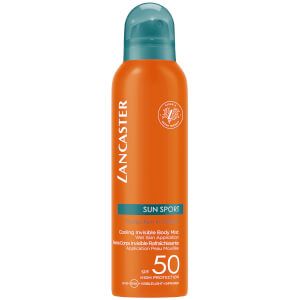
Lancaster Sun Sport Cooling Invisible Mist SPF50
Works for
2 of 2 advertised claims delivered
Sun protectionSPF 50 · 6 UV filtersBroad spectrum
This product offers a good level of protection against both UVB and UVA rays.
This sunscreen uses organic (so-called "chemical") sunscreen filters. Organic, or "chemical" filters usually provide reliable sun protection and rarely leave a white cast. Sunscreens with organic filters can sting eyes.
Evens skin tone2 ingredients credited for this claimStrong support
“Skin and ocean friendly, it targets 100% of the sun's spectrum and also helps repair sun damaged skin.Very easy and quick to apply, its transparent and light formula lets the skin breathe even during intense sports activities.”
This product offers broad spectrum sun protection. It means that it can prevent hyperpigmentation and help keep the skin tone even (sun damage is the main factor causing age spots, darkening of post-acne marks and other discolorations).
Anti-agingNot advertised by the brand · 4 ingredients credited for this claimStrong support
This product can help prevent early signs of skin aging because it offers a good level of broad spectrum sun protection. Sun damage is the main cause of premature skin aging, and protecting your skin from the sun is the best anti-aging strategy.
Anti-oxidationNot advertised by the brand · 7 ingredients credited for this claimStrong support
This product contains antioxidants (dimethylmethoxy chromanol, ubiquinone) that can help neutralize free radicals in skin. By doing so, they can lessen the damage the skin gets from the UV light (sun).
MoisturizingNot advertised by the brand · 15 ingredients credited for this claimGood support
This product can help improve hydration of the skin with the two types of ingredients.
The first type is called “humectants”:
these ingredients help attract water.
When humectants are on the surface of the skin, they “pull in” the moisture from the outside environment, or from
within deeper layers of the skin. The following ingredients in this product do the job:
glycerin, glycine.
This product also contains ingredients called “occlusives”. They help reduce the speed with which our skin loses moisture to the outside environment. These ingredients also help soften the upper layer of the skin, so it feels less tight and nicer to the touch. The following ingredients in this product do the job: dimethicone, squalane.
Can it cause trouble?
Irritancy10 strong irritants: Alpha-isomethyl ionone, Benzyl benzoate + 8 more — patch-test recommendedHigh risk
ComedogenicClean of flagged comedogenic ingredientsNone flagged


User reviews
Be the first — your take helps the next person decide.
Ingredients
Filter by role to see what each ingredient is doing.
Butane~25–31%
- Irritation risk
- Low
Water~13–16%
Diisopropyl adipate~5.8–7.1%
- Irritation risk
- Low
Helps soften the upper layer of the skin
More about Diisopropyl adipateOctocrylene~4.4–5.4%
- Irritation risk
- Medium
A weak sunscreen that protects against the sun rays that cause sunburn (UVB) and is somewhat effective against the UVA rays. It is quite stable and can help stabilize other, more vulnerable, sunscreen ingredients like Avobenzone. It is an organic, or so called "chemical" sunscreen
More about OctocryleneHomosalate~3.7–4.5%
- Irritation risk
- Medium
A weak sunscreen that offers some protection against the sun rays that cause sunburn (UVB), but does not offer meaningful protection against protect against the most aging sun rays (UVA). It loses its effectiveness quickly when exposed to sunlight. It is an organic, or so called "chemical" sunscreen. When used in low concentrations, helps to stabilize the product formulation
More about HomosalateGlycerin~2.1–2.6%
- Irritation risk
- Low
One of the best moisturizing ingredients. Naturally present in skin. It attracts water to the upper layer of the skin working as a humectant
More about GlycerinButyl methoxydibenzoylmethane~2–2.5%
- Irritation risk
- Medium
Avobenzone. An organic, or so-called "chemical" UV filter. Protects against both UVA and UVB rays. Needs to be combined with other filters in a formulation to be stable.
More about Butyl methoxydibenzoylmethaneNylon-12~1.5–1.8%
Peg-30 dipolyhydroxystearate~1.2–1.5%
- Irritation risk
- Medium
Helps oil and water mix together
More about Peg-30 dipolyhydroxystearateEthylhexyl methoxycinnamate~1.5–1.8%
- Irritation risk
- High
Octinoxate. When used in higher concentrations, works as a sunscreen protecting the skin from UVB rays. When used in lower concentration, helps to preserve the product formulation. Is shown to be harmful to coral reefs - consider avoiding bathing in coral reef areas when wearing a product with this ingredient. It can be irritating
More about Ethylhexyl methoxycinnamatePhenylbenzimidazole sulfonic acid~1.2–1.5%
- Irritation risk
- Medium
Ensulizole. A UV filter that is effective against UVB rays. Does not protect against UVA light. It is photostable and can be used to help stabilize other sunscreen ingredients. It is water-soluble meaning that it can help create lighter sunscreen formulations
More about Phenylbenzimidazole sulfonic acidCyclohexasiloxane~0.75–1.1%
- Irritation risk
- Low
A silicone that serves as an emollient. Helps create a nice non-greasy feels
More about CyclohexasiloxaneDimethicone~0.7–1.05%
- Irritation risk
- Low
A silicone that helps to reduce water loss from the surface of the skin. Can temporarily "fill in" lines and wrinkles, absorb oil, and create a nice product finish
More about DimethiconeBis-ethylhexyloxyphenol methoxyphenyl triazine~0.75–1.1%
- Irritation risk
- Medium
Tinosorb S. One of the most effective broad spectrum sunscreen ingredients. Protects from both UVA and UVB rays. It is photostable. Unfortunately, not approved by FDA (US) yet.
More about Bis-ethylhexyloxyphenol methoxyphenyl triazineIsododecane~0.6–0.85%
- Irritation risk
- Low
An emollient that helps soften the skin and can decrease moisture loss. Helps create a nice product texture
More about IsododecaneMenthone glycerin acetal~0.6–0.85%
- Irritation risk
- Low
1,2-hexanediol~0.55–0.85%
Alpha-isomethyl ionone~0.5–0.75%
- Irritation risk
- High
A fragrance. Potential allergen and can be irritating
More about Alpha-isomethyl iononeAscorbic acid~0.5–0.75%
- Irritation risk
- High
The most well-researched antioxidant that works in skin. Helps neutralize free radicals supporting collagen production, helping to even out the skin tone and preventing early signs of aging
More about Ascorbic acidAscorbyl palmitate~0.5–0.75%
- Irritation risk
- Medium
Being a lipid soluble form of vitamin C, it is more stable and can penetrate the skin better than L-Ascorbic acid. It is effective in protecting the skin from free radicals, as well as evening the skin tone, but is less effective in stimulating collagen production compared to L-Ascorbic acid.
More about Ascorbyl palmitateBenzyl benzoate~0.45–0.65%
- Irritation risk
- High
Fragrance with sweet balsamic smell. Help to preserve products and dissolve other ingredients. Could trigger allergic reactions and be irritating
More about Benzyl benzoateBht~0.45–0.7%
Butylene glycol~0.4–0.65%
- Irritation risk
- Low
Used to create a nice product texture and help delivery of other ingredients. Might be somewhat helpful in attracting water to the upper layer of the skin
More about Butylene glycolCaffeine~0.45–0.7%
- Irritation risk
- Medium
Might be helpful in neutralizing free radicals. Can have a dehydration effect that might somewhat decrease the look of puffy eyes
More about CaffeineCaprylyl glycol~0.45–0.7%
- Irritation risk
- Medium
Helps preserve products and creates a nice product texture
More about Caprylyl glycolCitric acid~0.45–0.65%
- Irritation risk
- Medium
Can work as an exfoliant but is typically used to adjust the product pH
More about Citric acidCitronellol~0.35–0.65%
Cyclopentasiloxane~0.45–0.7%
- Irritation risk
- Low
A silicone that helps improve the product texture and spreadability. Can absorb oil creating a short-term mattifying effect on the skin
More about CyclopentasiloxaneDimethylmethoxy chromanol~0.45–0.65%
- Irritation risk
- Low
Can help neutralize free radicals in skin
More about Dimethylmethoxy chromanolDisodium edta~0.45–0.65%
Geraniol~0.35–0.65%
Glycine~0.4–0.6%
- Irritation risk
- Low
Helps to attract water to the upper layer of the skin and can help restore the skin barrier function
More about GlycineHydrogenated lecithin~0.45–0.65%
- Irritation risk
- Low
Helps to retain moisture by creating a protective barrier on the skin. Rich in fatty acids. Improves product texture and helps with the penetration of other ingredients.
More about Hydrogenated lecithinHydrolyzed citrus aurantium dulcis fruit extract~0.45–0.65%
- Irritation risk
- High
Hydroxycitronellal~0.35–0.65%
- Irritation risk
- High
A fragrance. A likely allergen and can be irritating
More about HydroxycitronellalLinalool~0.35–0.65%
Menthoxypropanediol~0.45–0.65%
Menthyl lactate~0.45–0.65%
Palmitoyl hydroxypropyltrimonium amylopectin/glycerin crosspolymer~0.4–0.6%
Peg-8~0.4–0.6%
- Irritation risk
- Medium
Used to create a nice product consistency
More about Peg-8Peg/ppg-18/18 dimethicone~0.45–0.65%
- Irritation risk
- Low
A silicone that mixes with water creating nice light-weight product texture
More about Peg/ppg-18/18 dimethiconePoly c10-30 alkyl acrylate~0.4–0.6%
- Irritation risk
- Low
Polymethylsilsesquioxane~0.45–0.65%
- Irritation risk
- Low
A silicone that improves product texture and helps dissolve other ingredients. Can form a non-greasy film on the skin to prevent moisture loss
More about PolymethylsilsesquioxaneSodium chloride~0.4–0.6%
- Irritation risk
- Low
Used to stabilize mixtures of oil and water, and create thicker, gel-like product textures
More about Sodium chlorideSodium hydroxide~0.35–0.6%
Sodium lactate methylsilanol~0.35–0.6%
- Irritation risk
- Low
Squalane~0.45–0.65%
- Irritation risk
- Low
An oil naturally present in skin. Works as an emollient to soften the skin and form a protective layer on its surface without a greasy feeling.
More about SqualaneTocopherol~0.3–0.6%
- Irritation risk
- Low
Pure form of vitamin E. Can help moisturise and protect the skin from free radicals. Often used to help stabilise other ingredients or the formula itself
More about TocopherolTocopheryl acetate~0.3–0.6%
- Irritation risk
- Medium
A more stable but less bio-available form of vitamin E compared to Tocopherol. Might help moisturize and protect the skin from free radicals, but mostly used in low concentrations to stabilize other ingredients.
More about Tocopheryl acetateTrisiloxane~0.3–0.55%
Ubiquinone~0.2–0.4%
- Irritation risk
- Low
Coenzyme Q10. It helps neutralize free radicals in skin, improves skin hydration and might be helpful agains fine lines and wrinkles. It can be an allergen
More about UbiquinoneChlorphenesin~0.15–0.3%
Phenoxyethanol~0.2–0.4%
- Irritation risk
- Low
A preservative. It helps prevent bacterial growth in cosmetic products
More about PhenoxyethanolPotassium sorbate~0.2–0.4%
Salicylic acid~0.2–0.35%
- Irritation risk
- High
Used for skin exfoliation. It has an anti-inflammatory and anti-bacterial effect, helps to unclog pores, prevent blemishes and speed up healing of the existing ones. Sometimes referred to as a BHA (beta-hydroxy acid)
More about Salicylic acidParfum~0.15–0.25%
- Irritation risk
- High
An aromatic blend of unspecified and possibly irritating ingredients
More about ParfumIngredient list view
Butane, Water, Diisopropyl adipate, Octocrylene, Homosalate, Glycerin, Butyl methoxydibenzoylmethane, Nylon-12, Peg-30 dipolyhydroxystearate, Ethylhexyl methoxycinnamate, Phenylbenzimidazole sulfonic acid, Cyclohexasiloxane, Dimethicone, Bis-ethylhexyloxyphenol methoxyphenyl triazine, Isododecane, Menthone glycerin acetal, 1,2-hexanediol, Alpha-isomethyl ionone, Ascorbic acid, Ascorbyl palmitate, Benzyl benzoate, Bht, Butylene glycol, Caffeine, Caprylyl glycol, Citric acid, Citronellol, Cyclopentasiloxane, Dimethylmethoxy chromanol, Disodium edta, Geraniol, Glycine, Hydrogenated lecithin, Hydrolyzed citrus aurantium dulcis fruit extract, Hydroxycitronellal, Linalool, Menthoxypropanediol, Menthyl lactate, Palmitoyl hydroxypropyltrimonium amylopectin/glycerin crosspolymer, Peg-8, Peg/ppg-18/18 dimethicone, Poly c10-30 alkyl acrylate, Polymethylsilsesquioxane, Sodium chloride, Sodium hydroxide, Sodium lactate methylsilanol, Squalane, Tocopherol, Tocopheryl acetate, Trisiloxane, Ubiquinone, Chlorphenesin, Phenoxyethanol, Potassium sorbate, Salicylic acid, Parfum
Compare prices
Retailers ranked by price — lowest first.

Affiliate links · prices updated regularly
Worth comparing, line by line.
Match % combines shared ingredients, the first five ingredients, shared actives and hero ingredients, irritancy (lower counts in the alternative's favour), texture and body area. Only products in the same routine step are compared.
| LancasterSun Sport Cooling Invisible Mist SPF50YOUR PRODUCT | NeutrogenaClear Body Oil-Free Sunscreen Lotion with SPF 30 | EquateBeauty Oil-Free Sunscreen Stick, SPF 70 | |
|---|---|---|---|
| Match | — | 57% | 55% |
| Price | $25.00 | $20.38−$4.62 | $4.48−$20.52 |
| Shared key ingredients | — | 4 of 19 | 5 of 19 |
| Key difference | — | Bisabolol | Oxybenzone |
| Irritancy | High | Medium | Medium |
| SPF | SPF 50 | SPF 30 | SPF 70 |
| Drying alcohol | — | — | — |
| View product | Shop | Shop |

Product summary
The ingredient list suggests that "Lancaster - Sun Sport Cooling Invisible Mist SPF50" can provide reliable sun protection. We love that it can protect from both UVA and UVB rays (not all sunscreens with SPF ratings give UVA protection. UVA rays do not cause sunburn, but still damage our skin and lead to early aging).
Its formula is also hydrating, so you might not need an additional moistruizer during the day. Like all broad-spectrum sunscreens, this product helps prevent early signs of aging.
Sunscreen filters
This is a so-called "chemical" sunscreen. It means that it uses organic UV filters. They typically offer good sun protection and rarely leave a white cast, but they can be irritating for some people with sensitive skin. The UV filters in this sunscreen are: tinosorb s 0.75% - 1.10%, avobenzone 2.00% - 2.50%, octinoxate 1.50% - 1.80%, homosalate 3.70% - 4.50%, octocrylene 4.40% - 5.40% and ensulizole 1.20% - 1.50%.
Irritation risk
There are quite a few common irritants in this product, including ingredients without particular skin benefits. We would not recommend it for sensitive skin. We assess the overall irritancy of this product to be high. For a detailed overview of all potential irritants: click here
You can see the detailed formula review with the breakdown of all actives in the product and the full ingredient list with estimated concentrations in the tables below.
Price
The product retails from 25.00$ up to 37.60$ in the United States, from 27.20£ up to 32.00£ in the United Kingdom and for 47.60CA$ in Canada.
For a detailed price comparison: click here.
Sources cited in this review
Every concentration estimate and effectiveness label is anchored to one of these 15 studies and safety reviews.
- 1
- 2
- 3
- 4Final Report on the Safety Assessment of Dimethicone Copolyoljournals.sagepub.com
- 5
- 6

Affiliate links · As an Amazon Associate, WIMJ earns from qualifying purchases.