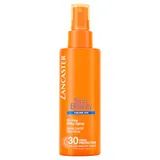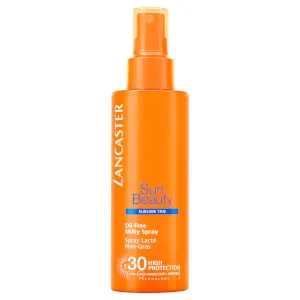
Lancaster Sun Beauty Oil Free Milky Spray SPF30

Lancaster Sun Beauty Oil Free Milky Spray SPF30

SPF 30Efficacy100/100IrritancyHigh·5 UV filters

Works for

Sun protection
SPF 30 · 5 UV filters
Broad spectrum
SPF 30Broad spectrumChemical filtersNano filters

This product offers a good level of protection against both UVB and UVA rays.

This sunscreen uses organic (so-called "chemical") sunscreen filters. Organic, or "chemical" filters usually provide reliable sun protection and rarely leave a white cast. Sunscreens with organic filters can sting eyes.

This product can be considered "reef safe" because it does not contain the UV filters (oxybenzone and octinoxate) that can be harmful to coral reefs when present in the water in high concentrations.

UV spectrum
UVB290–320 nmUVA II320–340 nmUVA I340–400 nm
Octocrylene
Amiloxate
Tinosorb S
Tinosorb M
Avobenzone
FilterCoverageWhat it doesEst. amount
OctocryleneUVB Photo-stable A weak sunscreen that protects against the sun rays that cause sunburn (UVB) and is somewhat effective against the UVA rays. It is quite stable and can help stabilize other, more vulnerable, sunscreen ingredients like Avobenzone. It is an organic, or so called "chemical" sunscreen~1.6–2%
AmiloxateIsoamyl P-methoxycinnamateUVBUVA2Amiloxate or Neo Heliopan E1000. A UV filter. It is effective against UVB and UVA II rays. Not available in the US. It can be irritating~3.3–4.1%
Tinosorb SBis-ethylhexyloxyphenol Methoxyphenyl TriazineUVBUVA Photo-stable Tinosorb S. One of the most effective broad spectrum sunscreen ingredients. Protects from both UVA and UVB rays. It is photostable. Approved by the US FDA in 2026 (listed as bemotrizinol on US labels).~2.2–2.6%
Tinosorb MMethylene Bis-benzotriazolyl TetramethylbutylphenolUVBUVA Photo-stable Tinosorb M. A UV filter. Is effective against both UVA and UVB rays. It also provides some protection against visible light. It is photostable and can also be used to improve photostability of other sunscreen ingredients. Its physical properties help to create lightweight sunscreen formulations. It can leave a slight white cast. Unfortunately, it is not approved by the FDA (US) yet~1.1–1.3%
AvobenzoneButyl MethoxydibenzoylmethaneUVA1Avobenzone. An organic, or so-called "chemical" UV filter. Protects against both UVA and UVB rays. Needs to be combined with other filters in a formulation to be stable.~2–2.4%
~ marks concentrations estimated from label position and typical use levels
Reef-safe
No oxybenzone or octinoxate — the two filters banned in Hawaii, Florida Keys and Aruba.
Anti-aging
Side benefit · Ascorbyl palmitate, Camellia sinensis leaf extract + 2 more
Works well

This product can help prevent early signs of skin aging because it offers a good level of broad spectrum sun protection. Sun damage is the main cause of premature skin aging, and protecting your skin from the sun is the best anti-aging strategy.

Ascorbyl palmitateEffect: Low, below effective doseBeing a lipid soluble form of vitamin C, it is more stable and can penetrate the skin better than L-Ascorbic acid. It is effective in protecting the skin from free radicals, as well as evening the skin tone, but is less effective in stimulating collagen production compared to L-Ascorbic acid.~0.45–0.65%
Camellia sinensis leaf extractEffect: Low, below effective doseCan contain potent anti-oxidant compounds (abbreviated ECG, GCG, EGC, and EGCG) that might help protect the skin from free radicals. Can help calm down inflammation and has some anti-bacterial properties. Unfortunately, these antioxidants are unstable and lose their effectiveness very quickly in products. The concentration of the antioxidant compounds in the extract also tends to be low to be effective in topical formulation~0.35–0.6%
TocopherolEffect: Low, below effective dosePure form of vitamin E. Can help moisturise and protect the skin from free radicals. Often used to help stabilise other ingredients or the formula itself~0.15–0.3%
Ascorbic acidUnder-dosedThe most well-researched antioxidant that works in skin. Helps neutralize free radicals supporting collagen production, helping to even out the skin tone and preventing early signs of aging~0.45–0.65%
Evens skin tone
Side benefit · Camellia sinensis leaf extract, Salicylic acid + 1 more
Works well

This product offers broad spectrum sun protection. It means that it can prevent hyperpigmentation and help keep the skin tone even (sun damage is the main factor causing age spots, darkening of post-acne marks and other discolorations).

Camellia sinensis leaf extractEffect: Low, below effective doseCan contain potent anti-oxidant compounds (abbreviated ECG, GCG, EGC, and EGCG) that might help protect the skin from free radicals. Can help calm down inflammation and has some anti-bacterial properties. Unfortunately, these antioxidants are unstable and lose their effectiveness very quickly in products. The concentration of the antioxidant compounds in the extract also tends to be low to be effective in topical formulation~0.35–0.6%
Salicylic acidEffect: Low, below effective doseUsed for skin exfoliation. It has an anti-inflammatory and anti-bacterial effect, helps to unclog pores, prevent blemishes and speed up healing of the existing ones. Sometimes referred to as a BHA (beta-hydroxy acid)~0.15–0.25%
Ascorbic acidUnder-dosedThe most well-researched antioxidant that works in skin. Helps neutralize free radicals supporting collagen production, helping to even out the skin tone and preventing early signs of aging~0.45–0.65%
Anti-oxidation
Side benefit · Dimethylmethoxy chromanol, Caffeine + 5 more
Works well

This product contains antioxidants (dimethylmethoxy chromanol) that can help neutralize free radicals in skin. By doing so, they can lessen the damage the skin gets from the UV light (sun).

Dimethylmethoxy chromanolKey activeEffect: HighCan help neutralize free radicals in skin~0.25–0.5%
CaffeineEffect: LowMight be helpful in neutralizing free radicals. Can have a dehydration effect that might somewhat decrease the look of puffy eyes~0.35–0.65%
Coffea arabica seed extractEffect: LowMight be helpful in neutralizing free radicals in skin~0.25–0.45%
Ascorbyl palmitateEffect: Low, below effective doseBeing a lipid soluble form of vitamin C, it is more stable and can penetrate the skin better than L-Ascorbic acid. It is effective in protecting the skin from free radicals, as well as evening the skin tone, but is less effective in stimulating collagen production compared to L-Ascorbic acid.~0.45–0.65%
Ascorbic acidUnder-dosedThe most well-researched antioxidant that works in skin. Helps neutralize free radicals supporting collagen production, helping to even out the skin tone and preventing early signs of aging~0.45–0.65%
Camellia sinensis leaf extractUnder-dosedCan contain potent anti-oxidant compounds (abbreviated ECG, GCG, EGC, and EGCG) that might help protect the skin from free radicals. Can help calm down inflammation and has some anti-bacterial properties. Unfortunately, these antioxidants are unstable and lose their effectiveness very quickly in products. The concentration of the antioxidant compounds in the extract also tends to be low to be effective in topical formulation~0.35–0.6%
TocopherolUnder-dosedPure form of vitamin E. Can help moisturise and protect the skin from free radicals. Often used to help stabilise other ingredients or the formula itself~0.15–0.3%
Moisturizing
Side benefit · Glycerin, Glycine + 4 more
Works

This product contains good ingredients to attract water to the upper layer of the skin. These ingredients are called "humectants": glycerin, glycine.

When humectants are on the surface of the skin, they “pull in” the moisture from the outside environment, or from within deeper layers of the skin. If the air is dry, humectants can speed up the moisture loss from the skin. This is why it is a good idea to use another product on top of this one to help "seal in" the moisture (look for ingredients like dimethicone, squalane, oils and butters).

GlycerinKey active· HumectantEffect: HighOne of the best moisturizing ingredients. Naturally present in skin. It attracts water to the upper layer of the skin working as a humectant~3.2–3.9%
GlycineKey active· HumectantEffect: HighHelps to attract water to the upper layer of the skin and can help restore the skin barrier function~0.25–0.45%
Dibutyl adipate· EmollientEffect: LowHelps soften the upper layer of the skin and create a nice product consistency~5.6–6.8%
Peg-8· HumectantEffect: LowUsed to create a nice product consistency~0.25–0.45%
Camellia sinensis leaf extractEffect: Low, below effective doseCan contain potent anti-oxidant compounds (abbreviated ECG, GCG, EGC, and EGCG) that might help protect the skin from free radicals. Can help calm down inflammation and has some anti-bacterial properties. Unfortunately, these antioxidants are unstable and lose their effectiveness very quickly in products. The concentration of the antioxidant compounds in the extract also tends to be low to be effective in topical formulation~0.35–0.6%
TocopherolEffect: Low, below effective dosePure form of vitamin E. Can help moisturise and protect the skin from free radicals. Often used to help stabilise other ingredients or the formula itself~0.15–0.3%

Can it cause trouble?

Irritancy
11 strong irritants: Alcohol, Isoamyl p-methoxycinnamate + 9 more — patch-test recommended
High risk
We flagged 25 ingredients with irritancy potential. Severity depends on your sensitivity threshold; the table lists the worst offenders first.
IngredientFunctionIrritationEst. amount
AlcoholCan be drying and contribute to skin irritation. Used in formulars to dissolve other ingredients, create a thinner product consistency or for its antibacterial propertiesHigh~4.5–5.5%est.
Isoamyl p-methoxycinnamateAmiloxate or Neo Heliopan E1000. A UV filter. It is effective against UVB and UVA II rays. Not available in the US. It can be irritatingHigh~3.3–4.1%est.
Alpha-isomethyl iononeA fragrance. Potential allergen and can be irritatingHigh~0.5–0.75%est.
Ascorbic acidThe most well-researched antioxidant that works in skin. Helps neutralize free radicals supporting collagen production, helping to even out the skin tone and preventing early signs of agingHigh~0.45–0.65%est.
Benzyl benzoateFragrance with sweet balsamic smell. Help to preserve products and dissolve other ingredients. Could trigger allergic reactions and be irritatingHigh~0.4–0.6%est.
CitronellolA fragrance. Can be irritatingHigh~0.25–0.5%est.
Decyl glucosideHelps oil and water mix together. Can be irritatingHigh~0.45–0.7%est.
GeraniolA fragrance. Can be irritatingHigh~0.25–0.45%est.
HydroxycitronellalA fragrance. A likely allergen and can be irritatingHigh~0.2–0.4%est.
LinaloolA fragrance. Can be irritatingHigh~0.25–0.4%est.
Propylene glycolHelps oil and water mix together and can enhance the penetration of other ingredients into the skin. It can be irritatingHigh~0.25–0.4%est.
Salicylic acidUsed for skin exfoliation. It has an anti-inflammatory and anti-bacterial effect, helps to unclog pores, prevent blemishes and speed up healing of the existing ones. Sometimes referred to as a BHA (beta-hydroxy acid)High~0.15–0.25%est.
ParfumAn aromatic blend of unspecified and possibly irritating ingredientsHigh~0.1–0.15%est.
Bis-ethylhexyloxyphenol methoxyphenyl triazineTinosorb S. One of the most effective broad spectrum sunscreen ingredients. Protects from both UVA and UVB rays. It is photostable. Unfortunately, not approved by FDA (US) yet.Medium~2.2–2.6%est.
Butyl methoxydibenzoylmethaneAvobenzone. An organic, or so-called "chemical" UV filter. Protects against both UVA and UVB rays. Needs to be combined with other filters in a formulation to be stable.Medium~2–2.4%est.
OctocryleneA weak sunscreen that protects against the sun rays that cause sunburn (UVB) and is somewhat effective against the UVA rays. It is quite stable and can help stabilize other, more vulnerable, sunscreen ingredients like Avobenzone. It is an organic, or so called "chemical" sunscreenMedium~1.6–2%est.
Methylene bis-benzotriazolyl tetramethylbutylphenolTinosorb M. A UV filter. Is effective against both UVA and UVB rays. It also provides some protection against visible light. It is photostable and can also be used to improve photostability of other sunscreen ingredients. Its physical properties help to create lightweight sunscreen formulations. It can leave a slight white cast. Unfortunately, it is not approved by the FDA (US) yetMedium~1.1–1.3%est.
Ascorbyl palmitateBeing a lipid soluble form of vitamin C, it is more stable and can penetrate the skin better than L-Ascorbic acid. It is effective in protecting the skin from free radicals, as well as evening the skin tone, but is less effective in stimulating collagen production compared to L-Ascorbic acid.Medium~0.45–0.65%est.
CaffeineMight be helpful in neutralizing free radicals. Can have a dehydration effect that might somewhat decrease the look of puffy eyesMedium~0.35–0.65%est.
Citric acidCan work as an exfoliant but is typically used to adjust the product pHMedium~0.3–0.55%est.
Disodium edtaStabilizes the product formulationMedium~0.25–0.5%est.
EthylhexylglycerinA preservativeMedium~0.25–0.5%est.
Peg-8Used to create a nice product consistencyMedium~0.25–0.45%est.
Comedogenic
Clean of flagged comedogenic ingredients
None flagged
Did this help you decide?

User reviews

Would you recommend?
No community reviews yet.

Be the first — your take helps the next person decide.

Ingredients

Filter by role to see what each ingredient is doing.

Water~45–55%
Formula
Irritation risk
Low

Plain old water

More about Water
Dibutyl adipate~5.6–6.8%
Formula
Irritation risk
Low
Works for
Moisturizing

Helps soften the upper layer of the skin and create a nice product consistency

More about Dibutyl adipate
Alcohol~4.5–5.5%
Irritant · high
Irritation risk
High
Works for
Antibacterial

Can be drying and contribute to skin irritation. Used in formulars to dissolve other ingredients, create a thinner product consistency or for its antibacterial properties

More about Alcohol
Glycerin~3.2–3.9%
Key active
Irritation risk
Low
Works for
Moisturizing

One of the best moisturizing ingredients. Naturally present in skin. It attracts water to the upper layer of the skin working as a humectant

More about Glycerin
Isoamyl p-methoxycinnamate~3.3–4.1%
UV filterKey activeIrritant · high
Irritation risk
High
Works for
Sun protection

Amiloxate or Neo Heliopan E1000. A UV filter. It is effective against UVB and UVA II rays. Not available in the US. It can be irritating

More about Isoamyl p-methoxycinnamate
Decyl cocoate~2.1–2.5%
Formula
Irritation risk
Low
More about Decyl cocoate
Bis-ethylhexyloxyphenol methoxyphenyl triazine~2.2–2.6%
UV filterKey activeIrritant · medium
Irritation risk
Medium
Works for
Sun protection

Tinosorb S. One of the most effective broad spectrum sunscreen ingredients. Protects from both UVA and UVB rays. It is photostable. Unfortunately, not approved by FDA (US) yet.

More about Bis-ethylhexyloxyphenol methoxyphenyl triazine
Butyl methoxydibenzoylmethane~2–2.4%
UV filterKey activeIrritant · medium
Irritation risk
Medium
Works for
Sun protection

Avobenzone. An organic, or so-called "chemical" UV filter. Protects against both UVA and UVB rays. Needs to be combined with other filters in a formulation to be stable.

More about Butyl methoxydibenzoylmethane
Octocrylene~1.6–2%
UV filterKey activeIrritant · medium
Irritation risk
Medium
Works for
Sun protection

A weak sunscreen that protects against the sun rays that cause sunburn (UVB) and is somewhat effective against the UVA rays. It is quite stable and can help stabilize other, more vulnerable, sunscreen ingredients like Avobenzone. It is an organic, or so called "chemical" sunscreen

More about Octocrylene
Polyester-5~1–1.3%
Formula
Irritation risk
Low
More about Polyester-5
Methylene bis-benzotriazolyl tetramethylbutylphenol~1.1–1.3%
UV filterKey activeIrritant · medium
Irritation risk
Medium
Works for
Sun protection

Tinosorb M. A UV filter. Is effective against both UVA and UVB rays. It also provides some protection against visible light. It is photostable and can also be used to improve photostability of other sunscreen ingredients. Its physical properties help to create lightweight sunscreen formulations. It can leave a slight white cast. Unfortunately, it is not approved by the FDA (US) yet

More about Methylene bis-benzotriazolyl tetramethylbutylphenol
Acrylates/vinyl neodecanoate crosspolymer~0.65–0.95%
Formula
Alpha-isomethyl ionone~0.5–0.75%
Irritant · high
Irritation risk
High

A fragrance. Potential allergen and can be irritating

More about Alpha-isomethyl ionone
Angelica archangelica root extract~0.45–0.65%
Formula
Ascorbic acid~0.45–0.65%
Under-dosedIrritant · high
Irritation risk
High
Works for
Anti-agingEvens skin toneAnti-oxidation

The most well-researched antioxidant that works in skin. Helps neutralize free radicals supporting collagen production, helping to even out the skin tone and preventing early signs of aging

More about Ascorbic acid
Ascorbyl palmitate~0.45–0.65%
Irritant · medium
Irritation risk
Medium
Works for
Anti-agingAnti-oxidation

Being a lipid soluble form of vitamin C, it is more stable and can penetrate the skin better than L-Ascorbic acid. It is effective in protecting the skin from free radicals, as well as evening the skin tone, but is less effective in stimulating collagen production compared to L-Ascorbic acid.

More about Ascorbyl palmitate
Benzyl benzoate~0.4–0.6%
Irritant · high
Irritation risk
High

Fragrance with sweet balsamic smell. Help to preserve products and dissolve other ingredients. Could trigger allergic reactions and be irritating

More about Benzyl benzoate
Caffeine~0.35–0.65%
Irritant · medium
Irritation risk
Medium
Works for
De-puffingAnti-oxidation

Might be helpful in neutralizing free radicals. Can have a dehydration effect that might somewhat decrease the look of puffy eyes

More about Caffeine
Camellia sinensis leaf extract~0.35–0.6%
Under-dosed
Irritation risk
Low
Works for
Anti-oxidationAntibacterialAnti-agingMoisturizingEvens skin toneAnti-blemish

Can contain potent anti-oxidant compounds (abbreviated ECG, GCG, EGC, and EGCG) that might help protect the skin from free radicals. Can help calm down inflammation and has some anti-bacterial properties. Unfortunately, these antioxidants are unstable and lose their effectiveness very quickly in products. The concentration of the antioxidant compounds in the extract also tends to be low to be effective in topical formulation

More about Camellia sinensis leaf extract
Citric acid~0.3–0.55%
Irritant · medium
Irritation risk
Medium

Can work as an exfoliant but is typically used to adjust the product pH

More about Citric acid
Citronellol~0.25–0.5%
Irritant · high
Irritation risk
High

A fragrance. Can be irritating

More about Citronellol
Citrus aurantium amara peel extract~0.25–0.5%
Irritant · high
Coffea arabica seed extract~0.25–0.45%
Formula
Irritation risk
Low
Works for
Anti-oxidation

Might be helpful in neutralizing free radicals in skin

More about Coffea arabica seed extract
Decyl glucoside~0.45–0.7%
Irritant · high
Irritation risk
High
Works for
Cleansing

Helps oil and water mix together. Can be irritating

More about Decyl glucoside
Dimethylmethoxy chromanol~0.25–0.5%
Key active
Irritation risk
Low
Works for
Anti-oxidation

Can help neutralize free radicals in skin

More about Dimethylmethoxy chromanol
Disodium edta~0.25–0.5%
Irritant · medium
Irritation risk
Medium

Stabilizes the product formulation

More about Disodium edta
Ethylhexylglycerin~0.25–0.5%
Irritant · medium
Irritation risk
Medium

A preservative

More about Ethylhexylglycerin
Geraniol~0.25–0.45%
Irritant · high
Irritation risk
High

A fragrance. Can be irritating

More about Geraniol
Glycine~0.25–0.45%
Key active
Irritation risk
Low
Works for
Moisturizing

Helps to attract water to the upper layer of the skin and can help restore the skin barrier function

More about Glycine
Hydrolyzed citrus aurantium dulcis fruit extract~0.25–0.5%
Irritant · high
Hydroxycitronellal~0.2–0.4%
Irritant · high
Irritation risk
High

A fragrance. A likely allergen and can be irritating

More about Hydroxycitronellal
Linalool~0.25–0.4%
Irritant · high
Irritation risk
High

A fragrance. Can be irritating

More about Linalool
Peg-8~0.25–0.45%
Irritant · medium
Irritation risk
Medium
Works for
Moisturizing

Used to create a nice product consistency

More about Peg-8
Pongamia pinnata seed extract~0.25–0.45%
Formula
Propylene glycol~0.25–0.4%
Irritant · high
Irritation risk
High
Works for
Moisturizing

Helps oil and water mix together and can enhance the penetration of other ingredients into the skin. It can be irritating

More about Propylene glycol
Sodium hydroxide~0.2–0.4%
Formula
Irritation risk
Low

Used to adjust the product's pH

More about Sodium hydroxide
Sodium lactate methylsilanol~0.2–0.4%
Formula
Sodium silicoaluminate~0.3–0.5%
Formula
Tocopherol~0.15–0.3%
Under-dosed
Irritation risk
Low
Works for
Anti-oxidationAnti-agingMoisturizingAnti-inflammatory

Pure form of vitamin E. Can help moisturise and protect the skin from free radicals. Often used to help stabilise other ingredients or the formula itself

More about Tocopherol
Xanthan gum~0.15–0.3%
Formula
Irritation risk
Low
Works for
Cleansing

Used to create a thicker product consistency

More about Xanthan gum
Phenoxyethanol~0.2–0.35%
Formula
Irritation risk
Low

A preservative. It helps prevent bacterial growth in cosmetic products

More about Phenoxyethanol
Salicylic acid~0.15–0.25%
Irritant · high
Irritation risk
High
Works for
Anti-inflammatoryExfoliationAnti-blemishAntibacterialEvens skin tone

Used for skin exfoliation. It has an anti-inflammatory and anti-bacterial effect, helps to unclog pores, prevent blemishes and speed up healing of the existing ones. Sometimes referred to as a BHA (beta-hydroxy acid)

More about Salicylic acid
Parfum~0.1–0.15%
Irritant · high
Irritation risk
High

An aromatic blend of unspecified and possibly irritating ingredients

More about Parfum
Ingredient list view

Water, Dibutyl adipate, Alcohol, Glycerin, Isoamyl p-methoxycinnamate, Decyl cocoate, Bis-ethylhexyloxyphenol methoxyphenyl triazine, Butyl methoxydibenzoylmethane, Octocrylene, Polyester-5, Methylene bis-benzotriazolyl tetramethylbutylphenol, Acrylates/vinyl neodecanoate crosspolymer, Alpha-isomethyl ionone, Angelica archangelica root extract, Ascorbic acid, Ascorbyl palmitate, Benzyl benzoate, Caffeine, Camellia sinensis leaf extract, Citric acid, Citronellol, Citrus aurantium amara peel extract, Coffea arabica seed extract, Decyl glucoside, Dimethylmethoxy chromanol, Disodium edta, Ethylhexylglycerin, Geraniol, Glycine, Hydrolyzed citrus aurantium dulcis fruit extract, Hydroxycitronellal, Linalool, Peg-8, Pongamia pinnata seed extract, Propylene glycol, Sodium hydroxide, Sodium lactate methylsilanol, Sodium silicoaluminate, Tocopherol, Xanthan gum, Phenoxyethanol, Salicylic acid, Parfum

Compare prices

Retailers ranked by price — lowest first.

No pricing data available yet for this product.

Worth comparing, line by line.

Match % combines shared ingredients, the first five ingredients, shared actives and hero ingredients, irritancy (lower counts in the alternative's favour), texture and body area. Only products in the same routine step are compared.

Side-by-side comparison of this product against its closest alternatives
LancasterSun Beauty Oil Free Milky Spray SPF30YOUR PRODUCTBiodermaPigmentbio Brightening Face Cream SPF50+La Roche-PosayEffaclar Duo+ SPF 30CliniqueNEW UV Solutions Mattifying Sunscreen SPF 50
Match—58%57%55%
Price—$25.50$18.07$29.42
Shared key ingredients—6 of 124 of 124 of 12
Key difference—Azelaic AcidNiacinamideHomosalate
Irritancy High Medium Medium Low
SPFSPF 30SPF 50SPF 30SPF 50
Drying alcohol Contains drying alcohol — Contains drying alcohol —
View product Shop Shop Shop

More alternatives: SVR SEBIACLEAR Crème SPF50Skin79 Water Wrapping Moist Cool Sun Stick SPF50+ PA++++

Cheaper alternatives? Browse formulas in the same category.
We compare ingredient profiles across our catalog — pick the closest match for your budget.
Open dupe finder

Product summary

Based on the ingredient list, we assess that "Lancaster - Sun Beauty Oil Free Milky Spray SPF30" can provide reliable sun protection. We love that it can protect from both UVA and UVB rays (not all sunscreens with SPF ratings give UVA protection. UVA rays do not cause sunburn, but still damage our skin and lead to early aging).

As a plus, this sunscreen uses some of the new generation UV filters (Tinosorb M). These filters are more stable and more gentle on the skin.

It contains good moisturizing ingredients and can double as a hydrating day cream. This product prevents early signs of aging by protecting against sun damage (all broad spectrum sunscreens do that).

Sunscreen filters

This is a so-called "chemical" sunscreen. It means that it uses organic UV filters. They typically offer good sun protection and rarely leave a white cast, but they can be irritating for some people with sensitive skin. These are the sun protection ingredients in this sunscreen: tinosorb s 2.20% - 2.60%, avobenzone 2.00% - 2.40%, amiloxate 3.30% - 4.10%, tinosorb m 1.10% - 1.30% and octocrylene 1.60% - 2.00%.

Irritation risk

There are quite a few common irritants in this product, including ingredients without particular skin benefits. We would not recommend it for sensitive skin. We assess the overall irritancy of it to be high. For a detailed overview of all potential irritants: click here

You can see the detailed formula review with the breakdown of all actives in the product and the full ingredient list with estimated concentrations in the tables below.

Sources cited in this review

Every concentration estimate and effectiveness label is anchored to one of these 17 studies and safety reviews.

  1. 1
  2. 2
  3. 3
  4. 4
  5. 5
  6. 6
Lancaster Sun Beauty Oil Free Milky Spray SPF30
LancasterSun Beauty Oil Free Milky Spray SPF30

Affiliate links · As an Amazon Associate, WIMJ earns from qualifying purchases.

As an Amazon Associate, WIMJ earns from qualifying purchases.