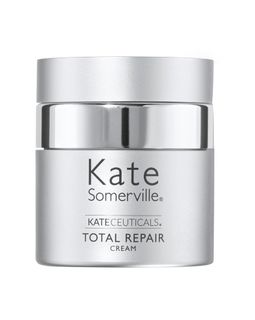
Kate Somerville Kateceuticals Total Repair Cream
Works for
2 of 2 advertised claims delivered
Moisturizing28 ingredients credited for this claimStrong support
“skin hydration + repair”
This product can help improve hydration of the skin with the two types of ingredients.
The first type is called “humectants”:
these ingredients help attract water.
When humectants are on the surface of the skin, they “pull in” the moisture from the outside environment, or from
within deeper layers of the skin. The following ingredients in this product do the job:
copper pca, glycerin.
This product also contains ingredients called “occlusives”. They help reduce the speed with which our skin loses moisture to the outside environment. These ingredients also help soften the upper layer of the skin, so it feels less tight and nicer to the touch. The following ingredients in this product do the job: dimethicone, squalane.
The following ingredients in this product are especially good for supporting the skin barrier and helping with the hydration level: ceramide ng, palmitoyl hexapeptide-12, urea
Anti-aging4 ingredients credited for this claimStrong support
“softens the appearance of wrinkles”
This product can help reduce and prevent fine lines and wrinkles, improve skin elasticity and firmness because it contains adenosine, palmitoyl hexapeptide-12.
Keep in mind that it typically takes at least 6 weeks to notice any results because the changes that are needed to improve fine lines and elasticity happen in the deeper layers of the skin. No topical anti-aging product can “erase” wrinkles or fully reverse signs of aging.
Can it cause trouble?
Irritancy4 strong irritants: Citrus paradisi peel oil, Geraniol + 2 more — patch-test recommendedHigh risk
Comedogenic3 ingredients rated 2 or more on the 0–5 pore-clogging scale3 flagged

User reviews
Be the first — your take helps the next person decide.
Ingredients
Filter by role to see what each ingredient is doing.
Water~45–55%
Cetearyl alcohol~5.3–6.5%
- Irritation risk
- Low
- Comedogenicity
- 2/5
A non-drying alcohol. Works as an emollient. Helps water and oil mix together and creates a nice product texture
More about Cetearyl alcoholDimethicone~4.2–5.2%
- Irritation risk
- Low
A silicone that helps to reduce water loss from the surface of the skin. Can temporarily "fill in" lines and wrinkles, absorb oil, and create a nice product finish
More about DimethiconeStearic acid~2.8–3.4%
- Irritation risk
- Low
Helps oil and water mix together and works as an emollient
More about Stearic acidCeteareth-20~2.4–2.9%
- Irritation risk
- Medium
- Comedogenicity
- 2/5
Helps oil and water mix together. Has some emollient properties
More about Ceteareth-20Glycerin~2–2.5%
- Irritation risk
- Low
One of the best moisturizing ingredients. Naturally present in skin. It attracts water to the upper layer of the skin working as a humectant
More about GlycerinIsocetyl stearoyl stearate~1.7–2%
- Irritation risk
- Low
Helps soften the upper layer of the skin
More about Isocetyl stearoyl stearateIsopropyl myristate~1.4–1.8%
- Irritation risk
- Low
- Comedogenicity
- 3/5
An emollient that helps soften the skin. Could be comedogenic
More about Isopropyl myristateC12-15 alkyl benzoate~1.2–1.4%
- Irritation risk
- Low
Enhances the product texture and makes it more spreadable. Helps reduce water loss from the outer layer of skin. Extands the shelf life by preventing bacteria growth
More about C12-15 alkyl benzoateCannabis sativa seed oil~0.95–1.15%
- Irritation risk
- Medium
A plant oil that due to its high linoleic acid content can help strengthen skin's barrier function and soften its upper layer
More about Cannabis sativa seed oilCaprylic/capric triglyceride~0.7–1.05%
- Irritation risk
- Medium
A good mix of fatty acids that forms a protective layer on the skin. Improves the shelf life of products. Derived from coconut and glycerin
More about Caprylic/capric triglycerideOrbignya oleifera seed oil~0.6–0.9%
- Irritation risk
- Low
A plant oil that can help soften the upper layer of the skin. Might be helpful in calming down inflammation in skin
More about Orbignya oleifera seed oilCeramide ng~0.5–0.75%
- Irritation risk
- Low
A type of lipid similar to ceramides naturally present in skin. Helps to soften the upper layer of the skin and supports the skin barrier function to keep it hydrated. Can help to prevent inflammation in skin
More about Ceramide ngCholesterol~0.5–0.75%
- Irritation risk
- Low
An emollient that is naturally found in skin
More about CholesterolAdenosine~0.35–0.65%
- Irritation risk
- Low
Might help improve cell turnover and reduce inflammation in skin. One study shows that the ingredients might be able to help reduce dynamic wrinkles (for example, in the corners of the eyes or on the forehead)
More about AdenosineSqualane~0.45–0.7%
- Irritation risk
- Low
An oil naturally present in skin. Works as an emollient to soften the skin and form a protective layer on its surface without a greasy feeling.
More about SqualaneMacadamia ternifolia seed oil~0.45–0.65%
- Irritation risk
- Medium
Plant oil from nuts that helps soften the upper layer of the skin. Contains a high concentration of oleic acid that can weaken skin's barrier function and increase water-loss while enhancing penetration of other ingredients
More about Macadamia ternifolia seed oilCopper pca~0.3–0.55%
- Irritation risk
- Low
Helps attract water to the upper layer of the skin
More about Copper pcaSodium hyaluronate~0.3–0.5%
- Irritation risk
- Low
One of the best moisturizing ingredients. Attracts water into the upper layer of the skin
More about Sodium hyaluronatePalmitoyl hexapeptide-12~0.25–0.5%
- Irritation risk
- Low
A type of peptide. Peptides are excellent moisturizers and might be able support collagen production reducing fine lines and wrinkles
More about Palmitoyl hexapeptide-12Allantoin~0.25–0.45%
- Irritation risk
- Low
Helps calm down inflammation in skin and can help reduce itching. Helps to repair the skin barrier and keep skin hydrated
More about AllantoinSimmondsia chinensis seed oil~0.3–0.55%
- Irritation risk
- Medium
Softens the upper layer of skin and helps restore the healthy skin barrier. Has shown to help calm down inflammation in skin. It is a stable oil, meaning that it retains its properties even when exposed to air.
More about Simmondsia chinensis seed oilCitrus paradisi peel oil~0.2–0.4%
Ascorbyl palmitate~0.25–0.4%
- Irritation risk
- Medium
Being a lipid soluble form of vitamin C, it is more stable and can penetrate the skin better than L-Ascorbic acid. It is effective in protecting the skin from free radicals, as well as evening the skin tone, but is less effective in stimulating collagen production compared to L-Ascorbic acid.
More about Ascorbyl palmitateTriacetin~0.25–0.45%
Peg-10 phytosterol~0.25–0.45%
- Irritation risk
- Medium
Helps oil and water mix together
More about Peg-10 phytosterolSodium pca~0.25–0.4%
- Irritation risk
- Low
Naturally present in skin and helps to attract water to its upper layer
More about Sodium pcaTribehenin~0.25–0.45%
- Irritation risk
- Low
Used to create a thicker product consistency and soften the upper layer of the skin
More about TribeheninUrea~0.25–0.4%
- Irritation risk
- Low
Naturally present in skin (urea makes up about 7% of natural moisturizing factors in skin). Attracts water to the upper layer of the skin. Also has a positive effect on the skin barrier beyond the humectant action. Can enhance penetration of other ingredients. Is an exfoliating ingredient when used in high concentrations
More about UreaPolyquaternium-51~0.25–0.45%
- Irritation risk
- Low
An emollient that helps create a nice silky finish on the skin
More about Polyquaternium-51Butylene glycol~0.25–0.4%
- Irritation risk
- Low
Used to create a nice product texture and help delivery of other ingredients. Might be somewhat helpful in attracting water to the upper layer of the skin
More about Butylene glycolTrehalose~0.2–0.4%
- Irritation risk
- Low
A sugar that attracts water to the upper layer of the skin
More about TrehalosePotassium sorbate~0.25–0.45%
Sodium benzoate~0.25–0.45%
Disodium edta~0.2–0.4%
Tocopheryl acetate~0.25–0.45%
- Irritation risk
- Medium
A more stable but less bio-available form of vitamin E compared to Tocopherol. Might help moisturize and protect the skin from free radicals, but mostly used in low concentrations to stabilize other ingredients.
More about Tocopheryl acetateHexylene glycol~0.2–0.35%
- Irritation risk
- Medium
Helps create a more spreadable product texture
More about Hexylene glycolLactic acid~0.2–0.35%
- Irritation risk
- Medium
An exfoliating and moisturizing alpha-hydroxy acid (AHA). Typically causes less irritation than other AHAs, for example, glycolic acid. At high concentrations (about 15%), lactic acid can help reduce lines and wrinkles. Recent studies show that lactic acid can support the "good" bacteria living on skin's surface (healthy skin microbiome)
More about Lactic acidAminomethyl propanol~0.2–0.35%
Xanthan gum~0.2–0.35%
- Irritation risk
- Low
Used to create a thicker product consistency
More about Xanthan gumBht~0.15–0.3%
Caprylyl glycol~0.15–0.3%
- Irritation risk
- Medium
Helps preserve products and creates a nice product texture
More about Caprylyl glycolChlorphenesin~0.1–0.25%
Geraniol~0.1–0.2%
Hexyl cinnamal~0.05–0.1%
Limonene~0.05–0.1%
- Irritation risk
- High
A common frangrance that can easily irritate skin, especially if exposed to air, light or heat
More about LimoneneIngredient list view
Water, Cetearyl alcohol, Dimethicone, Stearic acid, Ceteareth-20, Glycerin, Isocetyl stearoyl stearate, Isopropyl myristate, C12-15 alkyl benzoate, Cannabis sativa seed oil, Caprylic/capric triglyceride, Orbignya oleifera seed oil, Ceramide ng, Cholesterol, Adenosine, Squalane, Macadamia ternifolia seed oil, Copper pca, Unknown, Sodium hyaluronate, Palmitoyl hexapeptide-12, Allantoin, Simmondsia chinensis seed oil, Citrus paradisi peel oil, Ascorbyl palmitate, Triacetin, Peg-10 phytosterol, Sodium pca, Tribehenin, Urea, Polyquaternium-51, Butylene glycol, Trehalose, Potassium sorbate, Sodium benzoate, Disodium edta, Tocopheryl acetate, Unknown, Hexylene glycol, Lactic acid, Aminomethyl propanol, Xanthan gum, Bht, Caprylyl glycol, Chlorphenesin, Geraniol, Hexyl cinnamal, Limonene
Compare prices
Retailers ranked by price — lowest first.


Worth comparing, line by line.
Match % combines shared ingredients, the first five ingredients, shared actives and hero ingredients, irritancy (lower counts in the alternative's favour), texture and body area. Only products in the same routine step are compared.
| Kate SomervilleKateceuticals Total Repair CreamYOUR PRODUCT | DieuxMini Instant Angel Lipid-Rich Firming Moisturizer | Dieux SkinInstant Angel | Paula's choiceResist Intensive Repair Cream | |
|---|---|---|---|---|
| Match | — | 54% | 54% | 53% |
| Price | $46.71 | $46.27 | $8.98−$37.73 | $26.40−$20.31 |
| Shared key ingredients | — | 9 of 18 | 9 of 18 | 9 of 18 |
| Key difference | — | Linoleic Acid | Linoleic Acid | Niacinamide |
| Irritancy | High | Medium | Medium | Medium |
| Drying alcohol | — | — | — | — |
| View product | Shop | Shop | Shop |


Product summary
Based on the ingredients included, "Kate Somerville - Kateceuticals Total Repair Cream" works well for moisturizing the skin. To work well, any moisturizer needs to include a combination of water-binding and emollient ingredients. Kate Somerville - Kateceuticals Total Repair Cream ticks this box. Urea, copper pca, glycerin, sodium hyaluronate and sodium pca in this product (humectants) attract water molecules to the upper layer of the skin (the water comes from the outside air or from the deeper layers of the skin if the air is dry). Emollients in this formulation (ceramide ng, cannabis sativa seed oil, cholesterol, isopropyl myristate and dimethicone) help to reduce the moisture loss from the skin. They also soften the skin surface and relieve the feeling of dryness and tightness.
Ingredient callouts
- Another benefit is that this moisturizer contain ceramides (ceramide ng 0.50% - 0.75%). Ceramides are an important part of our natural skin barrier. The Ceramides used in skincare are synthetic or come from plants. They help soften the skin and can help "fill the gaps" in the skin barrier, keeping the skin hydrated and resilient for longer.
- We like that this moisturizer contains peptides (palmitoyl hexapeptide-12 0.25% - 0.50%). There are many different kind of Peptides and they are naturally present in our skin. They all are a combination of aminoacids. Some of them work as natural antibiotics, promote wound-healing and production of collagen. The science is still not settled on how effective Peptides are in skincare, but it is very likely that they have a benefit. Peptides might help restore the skin barrier and fight the signs of aging. At the very least, Peptides work as humectants: they attract water to the upper layer of the skin and improve its hydration.
- Adenosine 0.35% - 0.65%. It is a chemical present inside our skin cells. A clinical trial confirmed that topical application of Adenosine in a low concentration can reduce dynamic wrinkles (these are the wrinkles that appear with age in a places where our mimic is the most active, for example, in the corners of the eyes or on the forehead).
Irritation risk
This moisturizer contains a bunch of common irritants, including ingredients that do not provide any known benefit for the skin. It might not be the best choice if your skin is sensitive. We assess the overall irritancy of this moisturizer to be high. For a detailed overview of all potential irritants: click here
You can see the detailed formula review with the breakdown of all actives in the product and the full ingredient list with estimated concentrations in the tables below.
About the brand
According to Cruelty-Free Kitty "Kate Somerville" is cruelty free, but its parent company is not.
Price
The product retails from 50.00$ up to 143.00$ in the United States, for 149.99CA$ in Canada and from 35.00£ up to 858.00£ in the United Kingdom.
For a detailed price comparison: click here.
Sources cited in this review
Every concentration estimate and effectiveness label is anchored to one of these 18 studies and safety reviews.
- 1
- 2Final Report on the Safety Assessment of Dimethicone Copolyoljournals.sagepub.com
- 3
- 4
- 5Hemp (Cannabis sativa L.) as a Resource for Green Cosmeticstandfonline.com
- 6

Affiliate links · As an Amazon Associate, WIMJ earns from qualifying purchases.