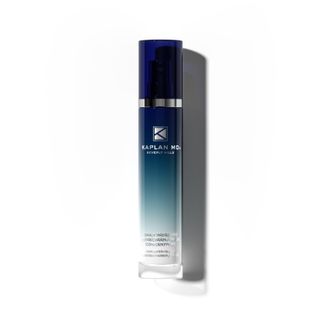
Kaplan MD Shop DAILY MOISTURE SPF 30 CONCENTRATE
Works for
2 of 5 advertised claims delivered
Sun protectionSPF 30 · 1 UV filter · Partial spectrumWeak protectionLow filter dose
This product does not offer good protection against UVA rays.
This product can be considered "reef safe" because it does not contain the UV filters (oxybenzone and octinoxate) that can be harmful to coral reefs when present in the water in high concentrations.
Moisturizing26 ingredients credited for this claimStrong support
“DAILY MOISTURE SPF 30 CONCENTRATE”
This product can help improve hydration of the skin with the two types of ingredients.
The first type is called “humectants”:
these ingredients help attract water.
When humectants are on the surface of the skin, they “pull in” the moisture from the outside environment, or from
within deeper layers of the skin. The following ingredients in this product do the job:
glycerin, isomalt.
This product also contains ingredients called “occlusives”. They help reduce the speed with which our skin loses moisture to the outside environment. These ingredients also help soften the upper layer of the skin, so it feels less tight and nicer to the touch. The following ingredients in this product do the job: caprylic/capric triglyceride, dimethicone.
The following ingredients in this product are especially good for supporting the skin barrier and helping with the hydration level: palmitoyl tripeptide-38
Anti-aging9 ingredients credited for this claimModerate support
“Hydrates, combats free radicals, smooths fine lines and wrinkles and offers broad spectrum sun protection .”
This product contains atelocollagen, palmitoyl tripeptide-38. These ingredients might be able to help reduce and prevent fine lines and wrinkles, improve skin elasticity and firmness, but there is not enough evidence that it actually works. The biggest anti-aging effect in this product comes from sun protection. Sun damage is the main factor causing early signs of skin aging. We, however, do not recommend using this product as a sunscreen because the protection it offers is not strong enough).
Evens skin tone4 ingredients credited for this claimLimited support
“The result is all day luminous complexion with visibly smoother skin tone.”
This product contains ingredients () that could help reduce hyperpigmentation (for example, post-acne marks or age spots) in theory, but there is not enough evidence that they actually work.
The biggest effect for evening out skin tone in this product comes from sun protection. Sun damage is the main factor causing age spots, darkening of post-acne marks and other discolorations. This is why sun protection is the best strategy for maintaining an even skin tone. We, however, do not recommend using this product as a sunscreen because the protection it offers is not strong enough).
Anti-blemish1 ingredient credited for this claimWeak support
“Whether to address extra dry skin, mild acne blemishes, or a dull complexion, the result is healthy, glowing skin.”
Effective ingredients missing or their concentration is too low.
Anti-oxidationNot advertised by the brand · 8 ingredients credited for this claimModerate support
This product contains antioxidants (camellia sinensis extract, ilex paraguariensis leaf extract) that might be able to help neutralize free radicals in skin to lessen the damage it gets from the UV light (sun). There is not enough evidence to confirm their effectiveness in skin though.
Can it cause trouble?
Irritancy13 strong irritants: Salvia officinalis extract, Rosmarinus officinalis extract + 11 more — patch-test recommendedHigh risk
Comedogenic3 ingredients rated 2 or more on the 0–5 pore-clogging scale3 flagged
User reviews
Be the first — your take helps the next person decide.
Ingredients
Filter by role to see what each ingredient is doing.
Water~45–55%
Cyclopentasiloxane~6.4–7.8%
- Irritation risk
- Low
A silicone that helps improve the product texture and spreadability. Can absorb oil creating a short-term mattifying effect on the skin
More about CyclopentasiloxaneDiethylhexyl maleate~4.3–5.3%
- Irritation risk
- Low
Titanium dioxide~3.7–4.6%
- Irritation risk
- Low
Works as a UV filter when used in high concentrations. It is photostable and is effective mostly against the UVB light, with some protection in the UVA range. In small concentrations, used for its ability to improve the color of cosmetic products. Is usually well tolerated by the skin
More about Titanium dioxideButylene glycol~2.5–3%
- Irritation risk
- Low
Used to create a nice product texture and help delivery of other ingredients. Might be somewhat helpful in attracting water to the upper layer of the skin
More about Butylene glycolPolyglyceryl-3 polydimethylsiloxyethyl dimethicone~2.1–2.5%
- Irritation risk
- Low
Glycerin~1.8–2.1%
- Irritation risk
- Low
One of the best moisturizing ingredients. Naturally present in skin. It attracts water to the upper layer of the skin working as a humectant
More about GlycerinCaprylic/capric triglyceride~1.5–1.8%
- Irritation risk
- Medium
A good mix of fatty acids that forms a protective layer on the skin. Improves the shelf life of products. Derived from coconut and glycerin
More about Caprylic/capric triglycerideAluminum hydroxide~1.2–1.5%
- Irritation risk
- Low
Is used to add opaque (non-transparent) appearance to formulations. Can be used to coat other ingredients for even dispersion. This is a different ingredient compared to the ones used in antipersperants (aluminium chloride and aluminium chlorohydrate)
More about Aluminum hydroxideStearic acid~0.95–1.2%
- Irritation risk
- Low
Helps oil and water mix together and works as an emollient
More about Stearic acidButyrospermum parkii butter~0.65–0.95%
- Irritation risk
- Low
- Comedogenicity
- 3/5
A great moisturising ingredient that softens the skin and reduces water loss from its upper layer. It also can be helpful in protecting skin from free radicals
More about Butyrospermum parkii butterCarthamus tinctorius oleosomes~0.5–0.75%
- Irritation risk
- Low
Helps soften the upper layer of the skin
More about Carthamus tinctorius oleosomesDimethicone~0.45–0.7%
- Irritation risk
- Low
A silicone that helps to reduce water loss from the surface of the skin. Can temporarily "fill in" lines and wrinkles, absorb oil, and create a nice product finish
More about DimethiconeAtelocollagen~0.3–0.55%
- Irritation risk
- Low
A protein that helps to attract moisture to the upper layer of the skin and might be helpful in reducing fine lines and wrinkles
More about AtelocollagenDna~0.3–0.5%
- Irritation risk
- Low
Sodium hyaluronate~0.3–0.5%
- Irritation risk
- Low
One of the best moisturizing ingredients. Attracts water into the upper layer of the skin
More about Sodium hyaluronatePalmitoyl tripeptide-38~0.25–0.5%
- Irritation risk
- Low
A type of peptide. Peptides are excellent moisturizers and might be able support collagen production reducing fine lines and wrinkles
More about Palmitoyl tripeptide-38Isopropyl alcohol~0.2–0.4%
- Irritation risk
- High
A drying alcohol. Can increase skin's sensitivity and cause dryness and irritation
More about Isopropyl alcoholRhododendron ferrugineum leaf cell culture extract~0.2–0.4%
- Irritation risk
- Low
Malus domestica fruit cell culture extract~0.2–0.35%
- Irritation risk
- Low
Vitis vinifera callus culture extract~0.2–0.35%
- Irritation risk
- Low
Aloe barbadensis leaf extract~0.25–0.4%
- Irritation risk
- Medium
Traditionally used to treat sunburns, dermatitis and inflammation, but evidence for its effectiveness is lacking. The extract can contain humectants that help attract water into the skin
More about Aloe barbadensis leaf extractCamellia sinensis extract~0.15–0.25%
- Irritation risk
- Low
Tea extract. Might be helpful in neutralizing free radicals in skin
More about Camellia sinensis extractSalvia officinalis extract~0.2–0.35%
- Irritation risk
- High
Pelargonium graveolens extract~0.15–0.3%
- Irritation risk
- Low
Melissa officinalis extract~0.15–0.25%
- Irritation risk
- Low
Ginkgo biloba nut extract~0.15–0.25%
- Irritation risk
- Low
Lavandula intermedia extract~0.15–0.3%
- Irritation risk
- Low
Rosmarinus officinalis extract~0.15–0.3%
- Irritation risk
- High
Mentha piperita extract~0.2–0.4%
Thymus vulgaris extract~0.1–0.2%
- Irritation risk
- High
Chamomilla recutita extract~0.15–0.25%
- Irritation risk
- High
Plant extract that can have healing and anti-inflammatory properties. It is a potential allergen and can be irritating
More about Chamomilla recutita extractTrifolium pratense extract~0.15–0.25%
- Irritation risk
- Low
Rosa canina seed extract~0.15–0.3%
- Irritation risk
- Low
Borago officinalis extract~0.15–0.3%
- Irritation risk
- Low
Macrocystis pyrifera extract~0.15–0.25%
- Irritation risk
- Low
- Comedogenicity
- 3/5
Panax ginseng root extract~0.2–0.35%
- Irritation risk
- High
A plant extract that might have some anti-inflammatory properties, but solid evidence is lacking. It can be irritating
More about Panax ginseng root extractCamellia sinensis extract~0.15–0.25%
- Irritation risk
- Low
Tea extract. Might be helpful in neutralizing free radicals in skin
More about Camellia sinensis extractIlex paraguariensis leaf extract~0.1–0.2%
- Irritation risk
- High
A plant extract that can help neutralize free radicals in skin. Can contain fragrand compounds like linalool that can be irritating
More about Ilex paraguariensis leaf extractLippia citriodora leaf extract~0.15–0.25%
- Irritation risk
- Low
Rosa damascena extract~0.15–0.3%
- Irritation risk
- High
Oil of a very fragrant pink rose used as fragrance in cosmetics. Extensive research has shown it has mixed benefits. In the pro column, inhaling this flower’s scent seems to have relaxing properties and the plant’s petals contain skin-soothing and antioxidant compounds that can benefit skin. On the flipside, the numerous chemicals that create this rose’s distinctive fragrance pose a risk of causing skin aggravation.
More about Rosa damascena extractCitrus grandis extract~0.15–0.25%
- Irritation risk
- High
Sambucus nigra extract~0.15–0.3%
- Irritation risk
- Low
Fucus vesiculosus extract~0.15–0.3%
- Irritation risk
- Low
- Comedogenicity
- 3/5
Helianthus annuus seed oil~0.2–0.35%
- Irritation risk
- Low
A great emollient due to its high linoleic acid content. One of the most effective plant oils in helping skin hydration and repairing skin barrier function
More about Helianthus annuus seed oilPentaerythrityl tetraisostearate~0.2–0.4%
- Irritation risk
- Medium
Used to create a thicker product consistency
More about Pentaerythrityl tetraisostearateC20-22 alkyl phosphate~0.2–0.35%
C20-22 alcohols~0.15–0.3%
- Irritation risk
- Low
Glyceryl stearate~0.2–0.4%
- Irritation risk
- Low
An emollient that softens the skin and forms a protective layer on its surface. Helps water and oil mix together
More about Glyceryl stearatePeg-100 stearate~0.25–0.45%
- Irritation risk
- Low
Helps oil and water mix togehter and creates a nice product texture
More about Peg-100 stearateHydrogenated lecithin~0.2–0.35%
- Irritation risk
- Low
Helps to retain moisture by creating a protective barrier on the skin. Rich in fatty acids. Improves product texture and helps with the penetration of other ingredients.
More about Hydrogenated lecithinSodium dihydroxycetyl phosphate~0.2–0.35%
Silica~0.25–0.5%
Hydroxypropyl cyclodextrin~0.2–0.4%
- Irritation risk
- Medium
Used to stabilize product formulations and help soften the upper layer of the skin
More about Hydroxypropyl cyclodextrinLecithin~0.2–0.4%
- Irritation risk
- Low
Used mostly for creating emulsions - helping oil and water mix together. Helps soften the upper layer of the skin
More about LecithinPolysorbate 80~0.2–0.4%
Carbomer~0.2–0.35%
- Irritation risk
- Low
Helps create a thicker or gel-like product texture. It is not a surfactant but can be used in gentle cleansing formulations
More about CarbomerTetrahexyldecyl ascorbate~0.2–0.35%
- Irritation risk
- Medium
Being a lipid soluble form of vitamin C, it is more stable than ascorbic acid, but still degrades quickly and needs to be stabilized in a formulation with another ingredient. It is claimed to penetrate skin better than pure vitamin C and have the the similar benefits, but solid studies of its effectiveness are lacking. Is likely to require a higher concentration in a product than pure vitamin C to be effective. It might be able to help reduce pore clogging.
More about Tetrahexyldecyl ascorbateTocopheryl acetate~0.2–0.35%
- Irritation risk
- Medium
A more stable but less bio-available form of vitamin E compared to Tocopherol. Might help moisturize and protect the skin from free radicals, but mostly used in low concentrations to stabilize other ingredients.
More about Tocopheryl acetateXanthan gum~0.2–0.35%
- Irritation risk
- Low
Used to create a thicker product consistency
More about Xanthan gumMagnesium aluminum silicate~0.2–0.35%
- Irritation risk
- Low
Might be helpful in restoring skin barrier function and, when combined with zinc carbonate and malonic acid, reducing fine lines and wrinkles by stimulating elastin production. Also helps stabilize the product formulation
More about Magnesium aluminum silicateSilica dimethyl silylate~0.2–0.4%
Sodium chondroitin sulfate~0.15–0.3%
- Irritation risk
- Low
Is naturally present in skin. Helps to attract water to its upper layer
More about Sodium chondroitin sulfateDimethicone/peg-10/15 crosspolymer~0.15–0.3%
Hydrogenated palm glycerides~0.25–0.45%
- Irritation risk
- Low
An emollient that softens the skin
More about Hydrogenated palm glyceridesPentylene glycol~0.25–0.4%
- Irritation risk
- Medium
Used to preserve products, dissolve other ingredients and create a nice product texture
More about Pentylene glycolBenzyl salicylate~0.15–0.3%
Dipropylene glycol~0.15–0.3%
- Irritation risk
- Low
Helps to dissolve other ingredients in a formulation. Slows down the rate of product drying
More about Dipropylene glycolHexyl cinnamal~0.15–0.3%
Linalool~0.15–0.3%
Limonene~0.15–0.3%
- Irritation risk
- High
A common frangrance that can easily irritate skin, especially if exposed to air, light or heat
More about LimoneneBenzyl benzoate~0.15–0.3%
- Irritation risk
- High
Fragrance with sweet balsamic smell. Help to preserve products and dissolve other ingredients. Could trigger allergic reactions and be irritating
More about Benzyl benzoateSodium citrate~0.2–0.35%
- Irritation risk
- Medium
Helps to control the skin's pH level. Maintains the skin's natural film of amino-lactic acids and oils. Helps to preserve products
More about Sodium citrateTocopherol~0.2–0.35%
- Irritation risk
- Low
Pure form of vitamin E. Can help moisturise and protect the skin from free radicals. Often used to help stabilise other ingredients or the formula itself
More about TocopherolAscorbyl tetraisopalmitate~0.2–0.4%
- Irritation risk
- Medium
A vitamin C derivative. Studies show that is might be effective in reducing hyperpigmentation, but there are no studies confirming that it is effectively converted into the bioavailable form of Vitamin C in skin. It is not clear how this derivative compares in effectiveness to the topical application of bioavailable form of vitamin C (L-ascorbic acid)
More about Ascorbyl tetraisopalmitateSodium benzoate~0.2–0.35%
Caprylyl glycol~0.2–0.4%
- Irritation risk
- Medium
Helps preserve products and creates a nice product texture
More about Caprylyl glycolPhenoxyethanol~0.2–0.35%
- Irritation risk
- Low
A preservative. It helps prevent bacterial growth in cosmetic products
More about PhenoxyethanolAlcohol~0.2–0.35%
- Irritation risk
- High
Can be drying and contribute to skin irritation. Used in formulars to dissolve other ingredients, create a thinner product consistency or for its antibacterial properties
More about AlcoholIsomalt~0.2–0.35%
- Irritation risk
- Low
Helps attract water to the upper layer of the skin
More about IsomaltChlorphenesin~0.15–0.25%
Dipotassium glycyrrhizate~0.15–0.25%
- Irritation risk
- Low
A salt derived from licorice. Works as an emollient to soften the upper layer of the skin and can help calm down inflammation. Might be helpful for skin lightening
More about Dipotassium glycyrrhizateLactic acid~0.15–0.3%
- Irritation risk
- Medium
An exfoliating and moisturizing alpha-hydroxy acid (AHA). Typically causes less irritation than other AHAs, for example, glycolic acid. At high concentrations (about 15%), lactic acid can help reduce lines and wrinkles. Recent studies show that lactic acid can support the "good" bacteria living on skin's surface (healthy skin microbiome)
More about Lactic acidParfum~0.1–0.2%
- Irritation risk
- High
An aromatic blend of unspecified and possibly irritating ingredients
More about ParfumSoy isoflavones~0.1–0.15%
- Irritation risk
- Low
Panthenol~0.1–0.15%
- Irritation risk
- Low
Helps attract water to the upper layer of the skin and can help improve skin barrier function
More about PanthenolIngredient list view
Water, Cyclopentasiloxane, Diethylhexyl maleate, Titanium dioxide, Butylene glycol, Polyglyceryl-3 polydimethylsiloxyethyl dimethicone, Glycerin, Caprylic/capric triglyceride, Aluminum hydroxide, Stearic acid, Butyrospermum parkii butter, Carthamus tinctorius oleosomes, Dimethicone, Atelocollagen, Dna, Sodium hyaluronate, Palmitoyl tripeptide-38, Isopropyl alcohol, Rhododendron ferrugineum leaf cell culture extract, Malus domestica fruit cell culture extract, Vitis vinifera callus culture extract, Aloe barbadensis leaf extract, Camellia sinensis extract, Salvia officinalis extract, Pelargonium graveolens extract, Melissa officinalis extract, Ginkgo biloba nut extract, Lavandula intermedia extract, Rosmarinus officinalis extract, Mentha piperita extract, Thymus vulgaris extract, Chamomilla recutita extract, Trifolium pratense extract, Rosa canina seed extract, Borago officinalis extract, Macrocystis pyrifera extract, Panax ginseng root extract, Camellia sinensis extract, Ilex paraguariensis leaf extract, Lippia citriodora leaf extract, Rosa damascena extract, Citrus grandis extract, Sambucus nigra extract, Fucus vesiculosus extract, Helianthus annuus seed oil, Pentaerythrityl tetraisostearate, C20-22 alkyl phosphate, C20-22 alcohols, Glyceryl stearate, Peg-100 stearate, Hydrogenated lecithin, Sodium dihydroxycetyl phosphate, Silica, Hydroxypropyl cyclodextrin, Lecithin, Polysorbate 80, Carbomer, Tetrahexyldecyl ascorbate, Tocopheryl acetate, Xanthan gum, Magnesium aluminum silicate, Silica dimethyl silylate, Sodium chondroitin sulfate, Dimethicone/peg-10/15 crosspolymer, Hydrogenated palm glycerides, Pentylene glycol, Benzyl salicylate, Dipropylene glycol, Hexyl cinnamal, Linalool, Limonene, Benzyl benzoate, Sodium citrate, Tocopherol, Ascorbyl tetraisopalmitate, Sodium benzoate, Caprylyl glycol, Phenoxyethanol, Alcohol, Isomalt, Chlorphenesin, Dipotassium glycyrrhizate, Lactic acid, Parfum, Soy isoflavones, Panthenol
Compare prices
Retailers ranked by price — lowest first.

Affiliate links · prices updated regularly
Product summary
"Kaplan MD Shop - DAILY MOISTURE SPF 30 CONCENTRATE" does not provide enough UVA protection. UVA rays do not cause sunburn, but still damage the skin, leading to early signs of aging and pigmentation issues.
Its formula is also hydrating, so you might not need an additional moistruizer during the day.
Sunscreen filters
This sunscreen is a mineral sunscreen. It uses titanium dioxide for sun protection. Titanium dioxide almost never irritates the skin or stings eyes, but it can leave a white cast.
Irritation risk
There are quite a few common irritants in this product, including ingredients without particular skin benefits. We would not recommend it for sensitive skin. We assess the overall irritancy of it to be high. For a detailed overview of all potential irritants: click here
You can see the detailed formula review with the breakdown of all actives in the product and the full ingredient list with estimated concentrations in the tables below.
Price
The product retails for 75.00$ in the United States.
For a detailed price comparison: click here.
Sources cited in this review
Every concentration estimate and effectiveness label is anchored to one of these 34 studies and safety reviews.
- 1
- 2
- 3
- 4Final Report on the Safety Assessment of Dimethicone Copolyoljournals.sagepub.com
- 5
- 6Hyaluronic acid: A key molecule in skin agingncbi.nlm.nih.gov

Affiliate links · As an Amazon Associate, WIMJ earns from qualifying purchases.