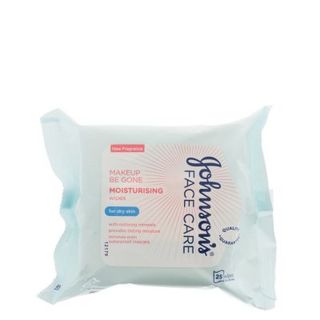
Johnson's Baby Face Care Moisturising Wipes Dry Skin - 25 wipes
Works for
1 of 1 advertised claim delivered
MoisturizingPanthenol, Glycerin + 7 moreStrong evidence
“Face Care Moisturising Wipes Dry Skin .”
This product contains good ingredients to attract water to the upper layer of the skin. These ingredients are called "humectants": glycerin.
When humectants are on the surface of the skin, they “pull in” the moisture from the outside environment, or from within deeper layers of the skin. If the air is dry, humectants can speed up the moisture loss from the skin. This is why it is a good idea to use another product on top of this one to help "seal in" the moisture (look for ingredients like dimethicone, squalane, oils and butters).
The following ingredients in this product are especially good for supporting the skin barrier and helping with the hydration level: panthenol
Can it cause trouble?
Irritancy2 strong irritants: Iodopropynyl butylcarbamate, ParfumMedium risk
ComedogenicClean of flagged comedogenic ingredientsNone flagged

User reviews
Be the first — your take helps the next person decide.
Ingredients
Filter by role to see what each ingredient is doing.
Water~40–60%
Glycerin~4.1–6.2%
- Irritation risk
- Low
One of the best moisturizing ingredients. Naturally present in skin. It attracts water to the upper layer of the skin working as a humectant
More about GlycerinCyclopentasiloxane~3.7–5.5%
- Irritation risk
- Low
A silicone that helps improve the product texture and spreadability. Can absorb oil creating a short-term mattifying effect on the skin
More about CyclopentasiloxaneIsononyl isononanoate~2.8–4.1%
- Irritation risk
- Low
Forms a protective film on the surface of the skin to prevent moisture loss. Gives a velvety feel to products while reducing tackiness
More about Isononyl isononanoatePentaerythrityl tetraethylhexanoate~2.1–3.1%
- Irritation risk
- Low
Used to create a nice product consistency while softening the upper layer of the skin
More about Pentaerythrityl tetraethylhexanoateIsostearyl palmitate~1.7–2.5%
- Irritation risk
- Low
Cetyl ethylhexanoate~1.4–2.1%
- Irritation risk
- Medium
An emollient that helps soften the skin and creates a thicker product texture
More about Cetyl ethylhexanoateHexylene glycol~1.2–1.7%
- Irritation risk
- Medium
Helps create a more spreadable product texture
More about Hexylene glycolStearyl ethylhexanoate~1–1.5%
- Irritation risk
- Low
Peg-6 caprylic/capric glycerides~0.8–1.2%
- Irritation risk
- Low
Helps dissolve other ingredients
More about Peg-6 caprylic/capric glyceridesSucrose cocoate~0.5–1.1%
Tocopheryl acetate~0.4–0.95%
- Irritation risk
- Medium
A more stable but less bio-available form of vitamin E compared to Tocopherol. Might help moisturize and protect the skin from free radicals, but mostly used in low concentrations to stabilize other ingredients.
More about Tocopheryl acetatePanthenol~0.35–0.85%
- Irritation risk
- Low
Helps attract water to the upper layer of the skin and can help improve skin barrier function
More about PanthenolMagnesium aspartate~0.3–0.75%
- Irritation risk
- Low
Might be helpful in restoring skin barrier function and calm down inflammation in skin
More about Magnesium aspartateZinc gluconate~0.2–0.8%
- Irritation risk
- Medium
Typically used to stabilize the product formulations. It is a salt of a polyhydroxy acid (PHA) and in larger concentrations, can help shed the dead cells from the skin surface revealing smoother skin. It can help attract water to the upper layer of the skin. Might to be helpful against acne and clogged pores. Could be helpful in neutralizing free radicals, but solid research is missing. Due to the zinc content, might help calm down inflammation in skin
More about Zinc gluconateCopper gluconate~0.2–0.8%
- Irritation risk
- Medium
Typically used to stabilize the product formulations. It is a salt of polyhydroxy acid (PHA) and in larger concentrations, can help shed the dead cells from the skin surface revealing smoother skin. It can help attract water to the upper layer of the skin. Might to be helpful against acne and clogged pores. Could be helpful in neutralizing free radicals, but solid research is missing
More about Copper gluconateGlyceryl oleate~0.3–0.75%
- Irritation risk
- High
Helps oil and water mix together. Can be irritating
More about Glyceryl oleateAscorbyl glucoside~0.2–0.7%
- Irritation risk
- Medium
A vitamin C derivative that is more stable but less potent than pure form of vitamin C. Has a potential to boost collagen production, nutralise free radicals and reduce hyperpigmentation, but the required concentration is likely to be much higher than for the pure form of vitamin C, limiting the ingredient's effectiveness in products
More about Ascorbyl glucosideCoco-glucoside~0.3–0.75%
- Irritation risk
- High
Used as a cleansing agent (surfactant) in cleansers. Helps water and oil mix together in lotions. Can be irritating
More about Coco-glucosideHydrogenated palm glycerides citrate~0.15–0.65%
- Irritation risk
- Low
Helps soften the upper layer of the skin
More about Hydrogenated palm glycerides citrateCarbomer~0.15–0.55%
- Irritation risk
- Low
Helps create a thicker or gel-like product texture. It is not a surfactant but can be used in gentle cleansing formulations
More about CarbomerPeg-4 laurate~0.15–0.5%
Ethylhexylglycerin~0.1–0.45%
Citric acid~0.1–0.4%
- Irritation risk
- Medium
Can work as an exfoliant but is typically used to adjust the product pH
More about Citric acidSodium hydroxide~0.1–0.4%
Benzoic acid~0.1–0.3%
Phenoxyethanol~0.05–0.25%
- Irritation risk
- Low
A preservative. It helps prevent bacterial growth in cosmetic products
More about PhenoxyethanolDehydroacetic acid~0.05–0.2%
Iodopropynyl butylcarbamate~0.01–0.02%
Polyaminopropyl biguanide~0.05–0.2%
- Irritation risk
- High
A preservative. There seem to be an increasing number of cases of allergic reactions to it
More about Polyaminopropyl biguanideParfum~0.01–0.05%
- Irritation risk
- High
An aromatic blend of unspecified and possibly irritating ingredients
More about ParfumIngredient list view
Water, Glycerin, Cyclopentasiloxane, Isononyl isononanoate, Pentaerythrityl tetraethylhexanoate, Isostearyl palmitate, Cetyl ethylhexanoate, Hexylene glycol, Stearyl ethylhexanoate, Peg-6 caprylic/capric glycerides, Sucrose cocoate, Tocopheryl acetate, Panthenol, Magnesium aspartate, Zinc gluconate, Copper gluconate, Glyceryl oleate, Ascorbyl glucoside, Coco-glucoside, Hydrogenated palm glycerides citrate, Carbomer, Peg-4 laurate, Ethylhexylglycerin, Citric acid, Sodium hydroxide, Benzoic acid, Phenoxyethanol, Dehydroacetic acid, Iodopropynyl butylcarbamate, Polyaminopropyl biguanide, Parfum
Compare prices
Retailers ranked by price — lowest first.
Worth comparing, line by line.
Match % combines shared ingredients, the first five ingredients, shared actives and hero ingredients, irritancy (lower counts in the alternative's favour), texture and body area. Only products in the same routine step are compared.
| Johnson's BabyFace Care Moisturising Wipes Dry Skin - 25 wipesYOUR PRODUCT | UriageBariederm-Cica Daily Gel-Cream | La Roche-PosayCicaplast Baume B5 For Dry Skin Irritations | ObagiHydrate Facial Moisturizer | |
|---|---|---|---|---|
| Match | — | 55% | 55% | 55% |
| Price | — | $24.06 | $10.69 | $70.00 |
| Shared key ingredients | — | 3 of 7 | 4 of 7 | 3 of 7 |
| Key difference | — | Diglycerin | Madecassoside | Bisabolol |
| Irritancy | Medium | Low | Low | Low |
| Drying alcohol | — | — | — | — |
| View product | Shop | Shop | Shop |


Product summary
Judging from the ingredient list, "Johnson's Baby - Face Care Moisturising Wipes Dry Skin - 25 wipes" works well for improving skin hydration The formulation is based on a combination of good humectants and emollients. Both are needed to increase the skin hydration level. Panthenol and glycerin in this product (humectants) attract water molecules to the upper layer of the skin (the water comes from the outside air or from the deeper layers of the skin if the air is dry). Cyclopentasiloxane, cetyl ethylhexanoate, pentaerythrityl tetraethylhexanoate and isononyl isononanoate in this product help decrease the water evoporation from the skin, so that it stays hydrated for longer. These ingredients also soften the skin and take away the feeling of tightness and dryness.
Ingredient callouts
- This formulation also includes panthenol (pro-vitamin B5) at about 0.35% - 0.85% concentration. In this concentration, panthenol works effectively to improve the skin barrier and reduce inflammation.
Irritation risk
There are some common irritants in this product, including ingredients that do not have benefits for the skin. We assess the overall irritancy of this moisturizer to be medium. For a detailed overview of all potential irritants: click here
You can see the detailed formula review with the breakdown of all actives in the product and the full ingredient list with estimated concentrations in the tables below.
Price
The product retails for 2.49£ in the United Kingdom.
For a detailed price comparison: click here.
Sources cited in this review
Every concentration estimate and effectiveness label is anchored to one of these 19 studies and safety reviews.
- 1
- 2Safety Assessment of Pentaerythrityl Tetraesters as Used in Cosmeticsjournals.sagepub.com
- 3Skin moisturizing effects of panthenol-based formulationspdfs.semanticscholar.org
- 4
- 5
- 6Zinc salts in dermatologyncbi.nlm.nih.gov

Affiliate links · As an Amazon Associate, WIMJ earns from qualifying purchases.