Works for
Sun protectionSPF 20 · 3 UV filters · Broad spectrumWeak protectionSPF under 30
This product offers broad spectrum sun protection, but it is weak. We recommend to use a broad spectrum sunscreen with at least SPF 30.
MoisturizingPetrolatum, Dimethicone + 28 moreWorks well
“Lightweight, emollient moisturizer is an advanced facial treatment and broad-spectrum sunscreen in one easy-to-use product.”
This product can help improve hydration of the skin with the two types of ingredients.
The first type is called “humectants”:
these ingredients help attract water.
When humectants are on the surface of the skin, they “pull in” the moisture from the outside environment, or from
within deeper layers of the skin. The following ingredients in this product do the job:
glycerin, sodium hyaluronate.
This product also contains ingredients called “occlusives”. They help reduce the speed with which our skin loses moisture to the outside environment. These ingredients also help soften the upper layer of the skin, so it feels less tight and nicer to the touch. The following ingredients in this product do the job: beeswax, dimethicone.
The following ingredients in this product are especially good for supporting the skin barrier and helping with the hydration level: petrolatum
ExfoliationPolylactic acid, Retinyl palmitate + 1 moreNot delivered
“A pre-shave cleanser and facial scrub in one that gently exfoliates for an easier, closer shave.”
This product might help exfoliate the skin with polylactic acid, retinyl palmitate, but these ingredients are not the most effective.
Evens skin toneSide benefit · Retinyl palmitate, Glycyrrhiza glabra root extract + 2 moreMay help
The following ingredient (ingredients) in this product might be helpful, but there is no evidence to confirm that it actually works: glycyrrhiza glabra root extract, retinyl palmitate.
The biggest effect for evening out skin tone in this product comes from sun protection. Sun damage is the main factor causing age spots, darkening of post-acne marks and other discolorations. This is why sun protection is the best strategy for maintaining an even skin tone. We, however, do not recommend using this product as a sunscreen because the protection it offers is not strong enough).
Anti-agingSide benefit · Retinyl palmitate, Magnesium aluminum silicate + 5 moreMay help
This product contains retinyl palmitate. There is some human evidence that this ingredient helps reduce and prevent fine lines and wrinkles and improve skin elasticity and firmness, though it is smaller or less consistent than the evidence for the best anti-aging ingredients. The biggest anti-aging effect in this product comes from sun protection. Sun damage is the main factor causing early signs of skin aging. We, however, do not recommend using this product as a sunscreen because the protection it offers is not strong enough).
Can it cause trouble?
Irritancy23 strong irritants: Lavandula angustifolia flower extract, Salvia officinalis leaf extract + 21 more — patch-test recommendedHigh risk
Comedogenic5 ingredients rated 2 or more on the 0–5 pore-clogging scale5 flagged
User reviews
Be the first — your take helps the next person decide.
Ingredients
Filter by role to see what each ingredient is doing.
Water~40–60%
Sodium c14-16 olefin sulfonate~9–13.6%
- Irritation risk
- High
Helps oil and water mix together and used as a cleansing agent. Can be irritating and is better avoided for sensitive skin
More about Sodium c14-16 olefin sulfonateDisodium cocoamphodiacetate~4.9–7.3%
- Irritation risk
- Medium
Helps oil and water mix together and works as a cleansing agent
More about Disodium cocoamphodiacetateGlycol distearate~2.6–3.9%
- Irritation risk
- Medium
Helps water and oil mix together
More about Glycol distearateGlycerin~2.1–3.2%
- Irritation risk
- Low
One of the best moisturizing ingredients. Naturally present in skin. It attracts water to the upper layer of the skin working as a humectant
More about GlycerinSodium chloride~1.7–2.6%
- Irritation risk
- Low
Used to stabilize mixtures of oil and water, and create thicker, gel-like product textures
More about Sodium chlorideCocamidopropyl betaine~1.9–2.9%
- Irritation risk
- High
Helps water and oil mix together. Used as a cleansing ingredient. Could be an allergen
More about Cocamidopropyl betaineSodium lauroyl oat amino acids~1.3–1.9%
Aloe barbadensis leaf juice powder~1–1.5%
- Irritation risk
- Medium
Traditionally used to treat sunburns, dermatitis and inflammation, but evidence for its effectiveness is lacking. The extract can contain humectants that help attract water into the skin
More about Aloe barbadensis leaf juice powderAloe barbadensis leaf powder~0.8–1.2%
- Irritation risk
- Medium
A plant extract that might help attract water to the upper layer of the skin
More about Aloe barbadensis leaf powderLavandula angustifolia flower extract~0.55–1.25%
- Irritation risk
- High
Essential oil that can be irritating
More about Lavandula angustifolia flower extractSalvia officinalis leaf extract~0.45–1.05%
- Irritation risk
- High
Sage leaf extract. It can be irritating
More about Salvia officinalis leaf extractRosmarinus officinalis leaf oil~0.4–0.9%
- Irritation risk
- High
A plant oil with high content of volatile compounds that can irritate the skin. Can be used as a fragrance. Has anti-bacterial properties and might help neutralize free radicals on the surface of the skin
More about Rosmarinus officinalis leaf oilSalvia officinalis oil~0.35–0.8%
- Irritation risk
- High
Backhousia citriodora leaf oil~0.3–0.75%
- Irritation risk
- High
A plant oil containing volatile compounds. Used as a fragrance and can be irritating
More about Backhousia citriodora leaf oilHamamelis virginiana leaf extract~0.35–0.75%
- Irritation risk
- High
A plant extract that can help calm down inflammation in skin. Can, however, itself be irritating
More about Hamamelis virginiana leaf extractChamomilla recutita flower extract~0.3–0.75%
- Irritation risk
- High
Plant extract that can have healing and anti-inflammatory properties. It is a potential allergen and can be irritating
More about Chamomilla recutita flower extractBenzyl alcohol~0.2–0.75%
- Irritation risk
- High
A preservative. Can be used to mask unpleasant smell. Can be irritating
More about Benzyl alcoholCetyl alcohol~0.3–0.75%
- Irritation risk
- Low
A non-drying alcohol that works to soften the skin and stabilize product formulations helping oil and water mix together
More about Cetyl alcoholPeg-150 distearate~0.2–0.75%
- Irritation risk
- Medium
Helps oil and water mix together
More about Peg-150 distearateSodium pca~0.15–0.65%
- Irritation risk
- Low
Naturally present in skin and helps to attract water to its upper layer
More about Sodium pcaCitric acid~0.15–0.65%
- Irritation risk
- Medium
Can work as an exfoliant but is typically used to adjust the product pH
More about Citric acidPeg-8 dimethicone~0.15–0.6%
- Irritation risk
- Low
A type of silicone that can help create nice product texture and soften the upper layer of the skin
More about Peg-8 dimethiconeDehydroacetic acid~0.15–0.6%
Tocopherol~0.15–0.65%
- Irritation risk
- Low
Pure form of vitamin E. Can help moisturise and protect the skin from free radicals. Often used to help stabilise other ingredients or the formula itself
More about TocopherolPhenoxyethanol~0.15–0.65%
- Irritation risk
- Low
A preservative. It helps prevent bacterial growth in cosmetic products
More about PhenoxyethanolWater~0.15–0.6%
Glyceryl stearate~0.2–0.7%
- Irritation risk
- Low
An emollient that softens the skin and forms a protective layer on its surface. Helps water and oil mix together
More about Glyceryl stearateHexylene glycol~0.15–0.6%
- Irritation risk
- Medium
Helps create a more spreadable product texture
More about Hexylene glycolPolylactic acid~0.3–0.7%
- Irritation risk
- Medium
Used as an abrasive ingredient for physical (mechanical) exfoliation
More about Polylactic acidCetyl alcohol~0.2–0.7%
- Irritation risk
- Low
A non-drying alcohol that works to soften the skin and stabilize product formulations helping oil and water mix together
More about Cetyl alcoholCeteth-2~0.15–0.65%
Disodium cocoamphodiacetate~0.2–0.75%
- Irritation risk
- Medium
Helps oil and water mix together and works as a cleansing agent
More about Disodium cocoamphodiacetateSodium c14-16 olefin sulfonate~0.3–0.75%
- Irritation risk
- High
Helps oil and water mix together and used as a cleansing agent. Can be irritating and is better avoided for sensitive skin
More about Sodium c14-16 olefin sulfonateMenthyl lactate~0.15–0.6%
Caprylic/capric triglyceride~0.2–0.75%
- Irritation risk
- Medium
A good mix of fatty acids that forms a protective layer on the skin. Improves the shelf life of products. Derived from coconut and glycerin
More about Caprylic/capric triglycerideAllantoin~0.15–0.55%
- Irritation risk
- Low
Helps calm down inflammation in skin and can help reduce itching. Helps to repair the skin barrier and keep skin hydrated
More about AllantoinMentha piperita oil~0.15–0.55%
Glycerin~0.15–0.7%
- Irritation risk
- Low
One of the best moisturizing ingredients. Naturally present in skin. It attracts water to the upper layer of the skin working as a humectant
More about GlycerinAloe barbadensis leaf juice~0.15–0.6%
- Irritation risk
- Medium
Traditionally used to treat sunburns, dermatitis and inflammation, but evidence for its effectiveness is lacking. The extract can contain humectants that help attract water into the skin
More about Aloe barbadensis leaf juiceCucumis sativus fruit extract~0.15–0.6%
- Irritation risk
- Medium
Might be somewhat helpful in reducing hyperpigmentation and neutralizing free radicals but its typical concentration in a product is too low for having an effect
More about Cucumis sativus fruit extractGlycyrrhiza glabra root extract~0.15–0.55%
- Irritation risk
- Medium
A plant extract that can help lighten the skin and calm down inflammation. Might be helpful in neutralizing free radicals
More about Glycyrrhiza glabra root extractCalendula officinalis flower extract~0.15–0.55%
- Irritation risk
- High
A plant extract that has some anti-oxidant and anti-bacterial properties. Can be irritating
More about Calendula officinalis flower extractSqualane~0.2–0.7%
- Irritation risk
- Low
An oil naturally present in skin. Works as an emollient to soften the skin and form a protective layer on its surface without a greasy feeling.
More about SqualaneBambusa arundinacea stem powder~0.2–0.8%
- Irritation risk
- Medium
Abrasive ingredient used for physical exfoliation (scrubing)
More about Bambusa arundinacea stem powderHydroxyethyl acrylate/sodium acryloyldimethyl taurate copolymer~0.15–0.6%
- Irritation risk
- Medium
A gelling agent that thickens the product consistency and leaves the skin with a velvety finish
More about Hydroxyethyl acrylate/sodium acryloyldimethyl taurate copolymerMagnesium aluminum silicate~0.15–0.65%
- Irritation risk
- Low
Might be helpful in restoring skin barrier function and, when combined with zinc carbonate and malonic acid, reducing fine lines and wrinkles by stimulating elastin production. Also helps stabilize the product formulation
More about Magnesium aluminum silicateAscorbic acid~0.15–0.6%
- Irritation risk
- High
The most well-researched antioxidant that works in skin. Helps neutralize free radicals supporting collagen production, helping to even out the skin tone and preventing early signs of aging
More about Ascorbic acidParfum~0.15–0.55%
- Irritation risk
- High
An aromatic blend of unspecified and possibly irritating ingredients
More about ParfumPolysorbate 60~0.15–0.65%
Ethylhexylglycerin~0.15–0.6%
Phenoxyethanol~0.15–0.65%
- Irritation risk
- Low
A preservative. It helps prevent bacterial growth in cosmetic products
More about PhenoxyethanolSodium glycolate~0.15–0.6%
- Irritation risk
- Low
Coconut acid~0.3–0.75%
Sodium glycolate~0.15–0.6%
- Irritation risk
- Low
Hexadecene~0.15–0.6%
- Irritation risk
- Low
Tetradecene~0.15–0.7%
- Irritation risk
- Low
Myristyl alcohol~0.15–0.65%
- Irritation risk
- High
Helps to stabilize the product formulation while softening the upper layer of the skin. Can be irritating
More about Myristyl alcoholStearyl alcohol~0.2–0.7%
- Irritation risk
- Low
An emollient that helps soften the skin
More about Stearyl alcoholSorbitan isostearate~0.15–0.65%
- Irritation risk
- Low
Helps oil and water mix together
More about Sorbitan isostearateTitanium dioxide~0.3–0.7%
- Irritation risk
- Low
Works as a UV filter when used in high concentrations. It is photostable and is effective mostly against the UVB light, with some protection in the UVA range. In small concentrations, used for its ability to improve the color of cosmetic products. Is usually well tolerated by the skin
More about Titanium dioxideSodium sulfate~0.15–0.65%
- Irritation risk
- Medium
Used to improve the product consistency and stabilize formulations
More about Sodium sulfateQuartz~0.2–0.75%
Sodium benzoate~0.25–0.5%
Butylphenyl methylpropional~0.15–0.55%
- Irritation risk
- High
A fragrance. Can trigger allergic reactions and be irritating
More about Butylphenyl methylpropionalHydroxyisohexyl 3-cyclohexene carboxaldehyde~0.15–0.55%
- Irritation risk
- High
A fragrance. Can be irritating
More about Hydroxyisohexyl 3-cyclohexene carboxaldehydeBenzyl salicylate~0.15–0.55%
Citronellol~0.15–0.55%
Coumarin~0.15–0.55%
Limonene~0.15–0.55%
- Irritation risk
- High
A common frangrance that can easily irritate skin, especially if exposed to air, light or heat
More about LimoneneGeraniol~0.15–0.55%
Hydroxycitronellal~0.15–0.55%
- Irritation risk
- High
A fragrance. A likely allergen and can be irritating
More about HydroxycitronellalLinalool~0.15–0.55%
Water~0.15–0.6%
Cyclopentasiloxane~0.2–0.75%
- Irritation risk
- Low
A silicone that helps improve the product texture and spreadability. Can absorb oil creating a short-term mattifying effect on the skin
More about CyclopentasiloxaneOctyldodecyl neopentanoate~0.2–0.75%
- Irritation risk
- Low
An emollient that helps soften the skin. Often used to stabilize other ingredients, for example, sunscreen
More about Octyldodecyl neopentanoatePhenethyl benzoate~0.2–0.75%
Dimethicone~0.3–0.7%
- Irritation risk
- Low
A silicone that helps to reduce water loss from the surface of the skin. Can temporarily "fill in" lines and wrinkles, absorb oil, and create a nice product finish
More about DimethiconeGlycereth-26~0.15–0.7%
Hydroxyethyl acrylate/sodium acryloyldimethyl taurate copolymer~0.15–0.7%
- Irritation risk
- Medium
A gelling agent that thickens the product consistency and leaves the skin with a velvety finish
More about Hydroxyethyl acrylate/sodium acryloyldimethyl taurate copolymerPhenoxyethanol~0.2–0.7%
- Irritation risk
- Low
A preservative. It helps prevent bacterial growth in cosmetic products
More about PhenoxyethanolHydroxypropyl starch phosphate~0.2–0.8%
- Irritation risk
- Medium
Helps oil and water mix together and used to stabilize product formulations
More about Hydroxypropyl starch phosphateCetearyl glucoside~0.2–0.7%
- Irritation risk
- Medium
Helps water and oil in the product mix well together and improves product texture
More about Cetearyl glucosideCarbomer~0.15–0.7%
- Irritation risk
- Low
Helps create a thicker or gel-like product texture. It is not a surfactant but can be used in gentle cleansing formulations
More about CarbomerPyrus malus fruit extract~0.15–0.65%
- Irritation risk
- Medium
Can have some moisturizing properties due to its sugar content
More about Pyrus malus fruit extractButylene glycol~0.15–0.7%
- Irritation risk
- Low
Used to create a nice product texture and help delivery of other ingredients. Might be somewhat helpful in attracting water to the upper layer of the skin
More about Butylene glycolSodium hydroxide~0.15–0.7%
Disodium edta~0.15–0.7%
Sodium hyaluronate~0.15–0.7%
- Irritation risk
- Low
One of the best moisturizing ingredients. Attracts water into the upper layer of the skin
More about Sodium hyaluronateLavandula angustifolia oil~0.15–0.65%
- Irritation risk
- High
An essential oil. Potential allergen and can be irritating. It has some anti-bacterial properties
More about Lavandula angustifolia oilIodopropynyl butylcarbamate~0.01–0.02%
Pelargonium graveolens flower oil~0.2–0.7%
- Irritation risk
- High
An essential oil. Can be irritating. Can become an allergen with oxidation
More about Pelargonium graveolens flower oilRosmarinus officinalis leaf oil~0.15–0.65%
- Irritation risk
- High
A plant oil with high content of volatile compounds that can irritate the skin. Can be used as a fragrance. Has anti-bacterial properties and might help neutralize free radicals on the surface of the skin
More about Rosmarinus officinalis leaf oilLecithin~0.2–0.75%
- Irritation risk
- Low
Used mostly for creating emulsions - helping oil and water mix together. Helps soften the upper layer of the skin
More about LecithinMelissa officinalis extract~0.15–0.65%
- Irritation risk
- Low
Haslea ostrearia extract~0.15–0.65%
- Irritation risk
- Low
- Comedogenicity
- 3/5
Palmaria palmata extract~0.15–0.7%
- Irritation risk
- Low
- Comedogenicity
- 3/5
Red algae extract that helps attract water to the upper layer of the skin
More about Palmaria palmata extractCalendula officinalis flower extract~0.15–0.6%
- Irritation risk
- High
A plant extract that has some anti-oxidant and anti-bacterial properties. Can be irritating
More about Calendula officinalis flower extractGlycerin~0.2–0.75%
- Irritation risk
- Low
One of the best moisturizing ingredients. Naturally present in skin. It attracts water to the upper layer of the skin working as a humectant
More about GlycerinLeontopodium alpinum extract~0.15–0.65%
- Irritation risk
- Low
Retinyl palmitate~0.15–0.65%
- Irritation risk
- High
Three steps removed from the active form of vitamin A - retinoic acid. To have an effect in the skin, it first needs to be converted twice to become the retinoic acid. This means it is less potent than retinol, but could also be less irritating. Once converted to the retinoic acid in the skin, it helps against all signs of aging, improves skin cell turnover and helps fight blemishes and clogged pores. However, in many cosmetic formulations, it is used in a concentration that is too low to have the full effect
More about Retinyl palmitateTocopheryl acetate~0.2–0.7%
- Irritation risk
- Medium
A more stable but less bio-available form of vitamin E compared to Tocopherol. Might help moisturize and protect the skin from free radicals, but mostly used in low concentrations to stabilize other ingredients.
More about Tocopheryl acetateAnthemis nobilis flower oil~0.15–0.6%
- Irritation risk
- High
An essential oil that is used as a fragrance and can be irritating. It might have some anti-oxidant effect in skin
More about Anthemis nobilis flower oilPeucedanum ostruthium leaf extract~0.15–0.7%
- Irritation risk
- Low
Buddleja davidii leaf extract~0.15–0.65%
- Irritation risk
- Low
Artemisia umbelliformis extract~0.15–0.65%
- Irritation risk
- Low
Butyrospermum parkii butter~0.2–0.8%
- Irritation risk
- Low
- Comedogenicity
- 3/5
A great moisturising ingredient that softens the skin and reduces water loss from its upper layer. It also can be helpful in protecting skin from free radicals
More about Butyrospermum parkii butterButyl methoxydibenzoylmethane2.2%
- Irritation risk
- Medium
Avobenzone. An organic, or so-called "chemical" UV filter. Protects against both UVA and UVB rays. Needs to be combined with other filters in a formulation to be stable.
More about Butyl methoxydibenzoylmethaneEthylhexyl methoxycinnamate7.5%
- Irritation risk
- High
Octinoxate. When used in higher concentrations, works as a sunscreen protecting the skin from UVB rays. When used in lower concentration, helps to preserve the product formulation. Is shown to be harmful to coral reefs - consider avoiding bathing in coral reef areas when wearing a product with this ingredient. It can be irritating
More about Ethylhexyl methoxycinnamatePetrolatum40.2%
- Irritation risk
- Low
One of the most effective and the most studied occlusive ingredients that creates a protective layer on top of the skin preventing moisture loss
More about PetrolatumTheobroma cacao seed butter~0.2–0.75%
- Irritation risk
- Low
- Comedogenicity
- 3/5
Helps soften the upper layer of the skin and can be helpful in restoring the skin barrier function. Might have some anti-oxidant effect
More about Theobroma cacao seed butterLanolin oil~0.2–0.7%
- Irritation risk
- Low
Sebum of wool-bearing animals (most commonly sheep). Helps soften the upper layer of the skin and reduce the skin water loss. In rare cases could be an allergen. Not suitable for vegans
More about Lanolin oilBeeswax~0.2–0.75%
- Irritation risk
- Low
Forms a protective barrier that holds water and keeps dry skin hydrated. Keeps an emulsion from separating into its oil and liquid components, and increases the thickness of a product. Can be an allergen
More about BeeswaxOzokerite~0.15–0.65%
Polyglyceryl-3 beeswax~0.15–0.65%
- Irritation risk
- Medium
Helps water and oil mix together. Could be an allergen (beeswax)
More about Polyglyceryl-3 beeswaxParfum~0.1–0.45%
- Irritation risk
- High
An aromatic blend of unspecified and possibly irritating ingredients
More about ParfumButyrospermum parkii butter~0.15–0.65%
- Irritation risk
- Low
- Comedogenicity
- 3/5
A great moisturising ingredient that softens the skin and reduces water loss from its upper layer. It also can be helpful in protecting skin from free radicals
More about Butyrospermum parkii butterC18-38 alkyl hydroxystearoyl stearate~0.15–0.55%
- Irritation risk
- Low
Persea gratissima oil~0.1–0.5%
- Irritation risk
- Medium
An emollient that helps soften the skin and could be helpful in repairing its barrier function
More about Persea gratissima oilTocopheryl acetate~0.1–0.35%
- Irritation risk
- Medium
A more stable but less bio-available form of vitamin E compared to Tocopherol. Might help moisturize and protect the skin from free radicals, but mostly used in low concentrations to stabilize other ingredients.
More about Tocopheryl acetateCyclopentasiloxane~0.1–0.45%
- Irritation risk
- Low
A silicone that helps improve the product texture and spreadability. Can absorb oil creating a short-term mattifying effect on the skin
More about CyclopentasiloxaneMicrocrystalline wax~0.1–0.3%
Camellia sinensis leaf extract~0.05–0.25%
- Irritation risk
- Low
Can contain potent anti-oxidant compounds (abbreviated ECG, GCG, EGC, and EGCG) that might help protect the skin from free radicals. Can help calm down inflammation and has some anti-bacterial properties. Unfortunately, these antioxidants are unstable and lose their effectiveness very quickly in products. The concentration of the antioxidant compounds in the extract also tends to be low to be effective in topical formulation
More about Camellia sinensis leaf extractCyclohexasiloxane~0.1–0.3%
- Irritation risk
- Low
A silicone that serves as an emollient. Helps create a nice non-greasy feels
More about CyclohexasiloxaneIngredient list view
Water, Sodium c14-16 olefin sulfonate, Disodium cocoamphodiacetate, Glycol distearate, Glycerin, Sodium chloride, Cocamidopropyl betaine, Sodium lauroyl oat amino acids, Aloe barbadensis leaf juice powder, Aloe barbadensis leaf powder, Lavandula angustifolia flower extract, Salvia officinalis leaf extract, Rosmarinus officinalis leaf oil, Salvia officinalis oil, Backhousia citriodora leaf oil, Hamamelis virginiana leaf extract, Chamomilla recutita flower extract, Benzyl alcohol, Cetyl alcohol, Peg-150 distearate, Sodium pca, Citric acid, Peg-8 dimethicone, Dehydroacetic acid, Tocopherol, Phenoxyethanol, Water, Glyceryl stearate, Hexylene glycol, Polylactic acid, Cetyl alcohol, Ceteth-2, Disodium cocoamphodiacetate, Sodium c14-16 olefin sulfonate, Menthyl lactate, Caprylic/capric triglyceride, Allantoin, Mentha piperita oil, Glycerin, Aloe barbadensis leaf juice, Cucumis sativus fruit extract, Glycyrrhiza glabra root extract, Calendula officinalis flower extract, Squalane, Bambusa arundinacea stem powder, Hydroxyethyl acrylate/sodium acryloyldimethyl taurate copolymer, Magnesium aluminum silicate, Ascorbic acid, Parfum, Polysorbate 60, Ethylhexylglycerin, Phenoxyethanol, Sodium glycolate, Coconut acid, Sodium glycolate, Hexadecene, Tetradecene, Myristyl alcohol, Stearyl alcohol, Sorbitan isostearate, Titanium dioxide, Sodium sulfate, Quartz, Sodium benzoate, Butylphenyl methylpropional, Hydroxyisohexyl 3-cyclohexene carboxaldehyde, Benzyl salicylate, Citronellol, Coumarin, Limonene, Geraniol, Hydroxycitronellal, Linalool, Water, Cyclopentasiloxane, Octyldodecyl neopentanoate, Phenethyl benzoate, Dimethicone, Glycereth-26, Hydroxyethyl acrylate/sodium acryloyldimethyl taurate copolymer, Phenoxyethanol, Hydroxypropyl starch phosphate, Cetearyl glucoside, Carbomer, Pyrus malus fruit extract, Butylene glycol, Sodium hydroxide, Disodium edta, Sodium hyaluronate, Lavandula angustifolia oil, Iodopropynyl butylcarbamate, Pelargonium graveolens flower oil, Rosmarinus officinalis leaf oil, Lecithin, Melissa officinalis extract, Haslea ostrearia extract, Palmaria palmata extract, Calendula officinalis flower extract, Glycerin, Leontopodium alpinum extract, Retinyl palmitate, Tocopheryl acetate, Anthemis nobilis flower oil, Peucedanum ostruthium leaf extract, Buddleja davidii leaf extract, Artemisia umbelliformis extract, Butyrospermum parkii butter, Butyl methoxydibenzoylmethane, Ethylhexyl methoxycinnamate, Petrolatum, Theobroma cacao seed butter, Lanolin oil, Beeswax, Ozokerite, Polyglyceryl-3 beeswax, Parfum, Butyrospermum parkii butter, C18-38 alkyl hydroxystearoyl stearate, Persea gratissima oil, Tocopheryl acetate, Cyclopentasiloxane, Microcrystalline wax, Camellia sinensis leaf extract, Cyclohexasiloxane
Worth comparing, line by line.
Match % combines shared ingredients, the first five ingredients, shared actives and hero ingredients, irritancy (lower counts in the alternative's favour), texture and body area. Only products in the same routine step are compared.
| Jack BlackSkin SaviorsYOUR PRODUCT | EltaMDUV Facial Broad-Spectrum SPF30+ - Jar | KaoAtrix Beauty Charge Premium Hand Cream Fragrance Free SPF 20 PA+ | Revolution XXXX Revolution Defence XX Pollution & Blue Light Protecting Serum SPF30 | |
|---|---|---|---|---|
| Match | — | 46% | 39% | 30% |
| Price | $37.00 | — | — | — |
| Shared key ingredients | — | 4 of 20 | 7 of 20 | 7 of 20 |
| Key difference | — | Zinc Oxide | Diglycerin | Panthenol |
| Irritancy | High | Medium | Low | Low |
| SPF | SPF 20 | SPF 30 | SPF 20 | SPF 30 |
| Drying alcohol | — | — | — | — |
| View product | Shop | Shop | Shop |


More alternatives: Etude House [ Etude House ] Face Blur - Moisturizing SPF 28 PA++Shiseido Synchro Skin Self-Refreshing Tint SPF 20
Product summary
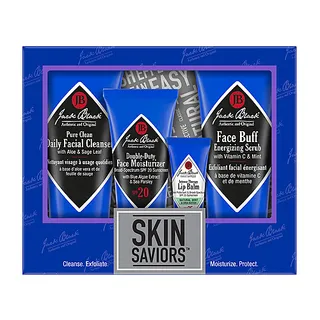
"Jack Black - Skin Saviors" offers broad spectrum protection. It means that it protects from both UVA and UVB rays (you can remember UVB as "burning" sunlight - they cause sunburn. You can remember UVA rays as "aging" - they do not lead to sunburn, but they cause photodamage and contribute to early signs of skin aging and hyperpigmentation). On the negative side, the SPF of this sunscreen is not high enough. We recommend to use a sunscreen with at least SPF 30 daily.
Because it includes good moisturizing ingredients, it can also work as a hydrating day cream.
Sunscreen filters
This sunscreen uses so-called "chemical", or organic UV filters (organic simply means that their molecules contain atoms of carbon). These filters typically give good sun protection and rarely leave a white cast, but they can be irritating for sensitive skin. The UV filters in this sunscreen are: avobenzone 2.20% (declared) and octinoxate 7.50% (declared).
Irritation risk
It contains a bunch of common irritants, including ingredients that do not provide any known benefit for the skin. It might not be the best choice if your skin is sensitive. We assess the overall irritancy of this product to be high. For a detailed overview of all potential irritants: click here
You can see the detailed formula review with the breakdown of all actives in the product and the full ingredient list with estimated concentrations in the tables below.
Price
The product retails for 133.36A$ in Australia, for 37.00$ in the United States and for 328.00HK$ in Hong Kong.
For a detailed price comparison: click here.
Sources cited in this review
Every concentration estimate and effectiveness label is anchored to one of these 37 studies and safety reviews.
- 1Final Report On the Safety Assessment of Sodium Alpha-Olefin Sulfonatesjournals.sagepub.com
- 2
- 3
- 4
- 5Allergic contact dermatitis caused by Salvia officinalis extractpubmed.ncbi.nlm.nih.gov
- 6
