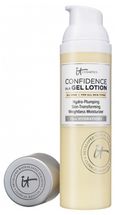
It Cosmetics Confidence in a Gel Lotion Soin Hydratant
Works for
2 of 2 advertised claims delivered
MoisturizingCeramide eos, Ceramide np + 20 moreStrong evidence
“Confidence in a Gel Lotion Soin Hydratant”
This product can help improve hydration of the skin with the two types of ingredients.
The first type is called “humectants”:
these ingredients help attract water.
When humectants are on the surface of the skin, they “pull in” the moisture from the outside environment, or from
within deeper layers of the skin. The following ingredients in this product do the job:
glycerin, sodium hyaluronate.
This product also contains ingredients called “occlusives”. They help reduce the speed with which our skin loses moisture to the outside environment. These ingredients also help soften the upper layer of the skin, so it feels less tight and nicer to the touch. The following ingredients in this product do the job: dimethicone, peg-10 dimethicone.
The following ingredients in this product are especially good for supporting the skin barrier and helping with the hydration level: caprooyl phytosphingosine, caprooyl sphingosine, ceramide ap, ceramide eop, ceramide eos, ceramide np, ceramide ns, dipeptide diaminobutyroyl benzylamide diacetate
Anti-agingAdenosine, Dipeptide diaminobutyroyl benzylamide diacetate + 4 moreStrong evidence
“Enriched with ceramides, glycerine and cactus flower extract, this light lotion reduces the appearance of fine lines and adds radiance to the skin, while preparing it for make-up application.Allergy-tested.”
This product can help reduce and prevent fine lines and wrinkles, improve skin elasticity and firmness because it contains adenosine.
These ingredients in the product can also be helpful, even though there is less evidence for their effectiveness: dipeptide diaminobutyroyl benzylamide diacetate.
Keep in mind that it typically takes at least 6 weeks to notice any results because the changes that are needed to improve fine lines and elasticity happen in the deeper layers of the skin. No topical anti-aging product can “erase” wrinkles or fully reverse signs of aging.
Anti-oxidationNot advertised by the brand · Cereus grandiflorus flower extract, Adenosine + 2 moreModerate evidence
This product contains antioxidants (cereus grandiflorus flower extract) that might be able to help neutralize free radicals in skin to lessen the damage it gets from the UV light (sun). There is not enough evidence to confirm their effectiveness in skin though.
Can it cause trouble?
Irritancy16 flagged ingredientsMedium risk
ComedogenicClean of flagged comedogenic ingredientsNone flagged
User reviews
Be the first — your take helps the next person decide.
Ingredients
Filter by role to see what each ingredient is doing.
Water~45–55%
Glycerin~4.7–5.7%
- Irritation risk
- Low
One of the best moisturizing ingredients. Naturally present in skin. It attracts water to the upper layer of the skin working as a humectant
More about GlycerinDimethicone~4.2–5.1%
- Irritation risk
- Low
A silicone that helps to reduce water loss from the surface of the skin. Can temporarily "fill in" lines and wrinkles, absorb oil, and create a nice product finish
More about DimethiconePropanediol~3–3.7%
- Irritation risk
- Low
Acts as a solvent for other ingredients. Speeds up the absorption of other ingredients into the skin
More about PropanediolDimethicone/peg-10/15 crosspolymer~2.2–2.7%
Polymethylsilsesquioxane~1.9–2.3%
- Irritation risk
- Low
A silicone that improves product texture and helps dissolve other ingredients. Can form a non-greasy film on the skin to prevent moisture loss
More about PolymethylsilsesquioxanePhenoxyethanol~0.5–1%
- Irritation risk
- Low
A preservative. It helps prevent bacterial growth in cosmetic products
More about PhenoxyethanolCitric acid~1.4–1.7%
- Irritation risk
- Medium
Can work as an exfoliant but is typically used to adjust the product pH
More about Citric acidSodium chloride~1.2–1.5%
- Irritation risk
- Low
Used to stabilize mixtures of oil and water, and create thicker, gel-like product textures
More about Sodium chlorideChlorphenesin~0.16–0.32%
Sodium citrate~0.65–1%
- Irritation risk
- Medium
Helps to control the skin's pH level. Maintains the skin's natural film of amino-lactic acids and oils. Helps to preserve products
More about Sodium citrateP-anisic acid~0.55–0.85%
- Irritation risk
- High
Helps preserve products. Can mask unpleasant smell. Could be irritating
More about P-anisic acidDisodium edta~0.5–0.75%
Peg-10 dimethicone~0.5–0.75%
- Irritation risk
- Low
A silicone that works to soften the upper layer of the skin and reduce its water loss
More about Peg-10 dimethiconeTocopherol~0.45–0.65%
- Irritation risk
- Low
Pure form of vitamin E. Can help moisturise and protect the skin from free radicals. Often used to help stabilise other ingredients or the formula itself
More about TocopherolSodium hyaluronate~0.4–0.65%
- Irritation risk
- Low
One of the best moisturizing ingredients. Attracts water into the upper layer of the skin
More about Sodium hyaluronateSodium hydroxide~0.4–0.6%
Aloe barbadensis leaf juice~0.35–0.6%
- Irritation risk
- Medium
Traditionally used to treat sunburns, dermatitis and inflammation, but evidence for its effectiveness is lacking. The extract can contain humectants that help attract water into the skin
More about Aloe barbadensis leaf juiceAdenosine~0.3–0.55%
- Irritation risk
- Low
Might help improve cell turnover and reduce inflammation in skin. One study shows that the ingredients might be able to help reduce dynamic wrinkles (for example, in the corners of the eyes or on the forehead)
More about AdenosineDipropylene glycol~0.25–0.5%
- Irritation risk
- Low
Helps to dissolve other ingredients in a formulation. Slows down the rate of product drying
More about Dipropylene glycolPropylene glycol~0.25–0.45%
- Irritation risk
- High
Helps oil and water mix together and can enhance the penetration of other ingredients into the skin. It can be irritating
More about Propylene glycolCereus grandiflorus flower extract~0.25–0.45%
- Irritation risk
- Medium
A cactus extract that can help neutralize free radicals because it contains a chemical compound called betacyanins and flavonolglycosides. Can help make the surface of the skin dryer helping make pores look smaller for a very short period of time. The concentrations usually used in cosmetics are too small to have any effect
More about Cereus grandiflorus flower extractCeteareth-25~0.3–0.6%
Soluble collagen~0.25–0.45%
- Irritation risk
- Low
A typically plant-derived compound that is supposed mimic human collagen. Cannot penetrate the skin barrier so is not particularly useful in skincare products beyond attracting water to the upper layer of the skin
More about Soluble collagenGlucose~0.25–0.45%
- Irritation risk
- Low
Helps attract water to the upper layer of the skin. Could be helpful in restoring the skin barrier function
More about GlucoseSodium benzoate~0.25–0.45%
Lactic acid~0.25–0.45%
- Irritation risk
- Medium
An exfoliating and moisturizing alpha-hydroxy acid (AHA). Typically causes less irritation than other AHAs, for example, glycolic acid. At high concentrations (about 15%), lactic acid can help reduce lines and wrinkles. Recent studies show that lactic acid can support the "good" bacteria living on skin's surface (healthy skin microbiome)
More about Lactic acidCi 19140~0.25–0.45%
Cetyl alcohol~0.3–0.5%
- Irritation risk
- Low
A non-drying alcohol that works to soften the skin and stabilize product formulations helping oil and water mix together
More about Cetyl alcoholPotassium sorbate~0.25–0.45%
Dipeptide diaminobutyroyl benzylamide diacetate~0.2–0.4%
- Irritation risk
- Low
A type of peptide. Peptides are excellent moisturizers and might be able support collagen production reducing fine lines and wrinkles
More about Dipeptide diaminobutyroyl benzylamide diacetateCeramide np~0.25–0.5%
- Irritation risk
- Low
A type of lipid similar to ceramides naturally present in skin. Helps to soften the upper layer of the skin and supports the skin barrier function to keep it hydrated. Can help to prevent inflammation in skin
More about Ceramide npBehenic acid~0.3–0.6%
Cholesterol~0.25–0.5%
- Irritation risk
- Low
An emollient that is naturally found in skin
More about CholesterolTrisodium edta~0.2–0.4%
Ceramide ns~0.25–0.45%
- Irritation risk
- Low
A type of lipid similar to ceramides naturally present in skin. Helps to soften the upper layer of the skin and supports the skin barrier function to keep it hydrated. Can help to prevent inflammation in skin
More about Ceramide nsEthylhexylglycerin~0.2–0.35%
Ceramide ap~0.15–0.3%
- Irritation risk
- Low
A type of lipid similar to ceramides naturally present in skin. Helps to soften the upper layer of the skin and supports the skin barrier function to keep it hydrated. Can help to prevent inflammation in skin
More about Ceramide apCeramide eop~0.2–0.35%
- Irritation risk
- Low
A type of lipid similar to ceramides naturally present in skin. Helps to soften the upper layer of the skin and supports the skin barrier function to keep it hydrated. Can help to prevent inflammation in skin
More about Ceramide eopCeramide eos~0.15–0.3%
- Irritation risk
- Low
A type of lipid similar to ceramides naturally present in skin. Helps to soften the upper layer of the skin and supports the skin barrier function to keep it hydrated. Can help to prevent inflammation in skin
More about Ceramide eosCaprooyl phytosphingosine~0.2–0.35%
- Irritation risk
- Low
A component of ceramides. Helps to soften the upper layer of the skin and supports the skin barrier function to keep it hydrated. Can help to prevent inflammation in skin
More about Caprooyl phytosphingosineCaprooyl sphingosine~0.1–0.15%
- Irritation risk
- Low
A component of ceramides. Helps to soften the upper layer of the skin and supports the skin barrier function to keep it hydrated. Can help to prevent inflammation in skin
More about Caprooyl sphingosineAscorbyl palmitate~0.05–0.1%
- Irritation risk
- Medium
Being a lipid soluble form of vitamin C, it is more stable and can penetrate the skin better than L-Ascorbic acid. It is effective in protecting the skin from free radicals, as well as evening the skin tone, but is less effective in stimulating collagen production compared to L-Ascorbic acid.
More about Ascorbyl palmitateIngredient list view
Water, Glycerin, Dimethicone, Propanediol, Dimethicone/peg-10/15 crosspolymer, Polymethylsilsesquioxane, Phenoxyethanol, Citric acid, Sodium chloride, Chlorphenesin, Sodium citrate, P-anisic acid, Disodium edta, Peg-10 dimethicone, Tocopherol, Sodium hyaluronate, Sodium hydroxide, Aloe barbadensis leaf juice, Adenosine, Dipropylene glycol, Propylene glycol, Cereus grandiflorus flower extract, Ceteareth-25, Soluble collagen, Glucose, Sodium benzoate, Lactic acid, Ci 19140, Cetyl alcohol, Potassium sorbate, Dipeptide diaminobutyroyl benzylamide diacetate, Ceramide np, Behenic acid, Cholesterol, Trisodium edta, Ceramide ns, Ethylhexylglycerin, Ceramide ap, Ceramide eop, Ceramide eos, Caprooyl phytosphingosine, Caprooyl sphingosine, Ascorbyl palmitate
Compare prices
Retailers ranked by price — lowest first.

Affiliate links · prices updated regularly
Product summary
"It Cosmetics - Confidence in a Gel Lotion Soin Hydratant" is a well-rounded moisturizing product. To work well, any moisturizer needs to include a combination of water-binding and emollient ingredients. It Cosmetics - Confidence in a Gel Lotion Soin Hydratant ticks this box. Humectants in this product (glycerin, sodium hyaluronate, soluble collagen, glucose and propylene glycol) help to increase the water content in the upper layer of the skin. (These ingredients do so by "capturing" water molecules from the outside air or from within the deeper layers of the skin). Caprooyl phytosphingosine, ceramide eop, ceramide np, ceramide ns and cholesterol in this product help decrease the water evoporation from the skin, so that it stays hydrated for longer. These ingredients also soften the skin and take away the feeling of tightness and dryness.
Ingredient callouts
- Another benefit is that this moisturizer contain ceramides (caprooyl sphingosine 0.10% - 0.15%, caprooyl phytosphingosine 0.20% - 0.35%, ceramide eos 0.15% - 0.30%, ceramide eop 0.20% - 0.35%, ceramide ap 0.15% - 0.30%, ceramide ns 0.25% - 0.45% and ceramide np 0.25% - 0.50%). Ceramides are an important part of our natural skin barrier. The Ceramides used in skincare are synthetic or come from plants. They help soften the skin and can help "fill the gaps" in the skin barrier, keeping the skin hydrated and resilient for longer.
- We like that this moisturizer contains peptides (dipeptide diaminobutyroyl benzylamide diacetate 0.20% - 0.40%). There are many different kind of Peptides and they are naturally present in our skin. They all are a combination of aminoacids. Some of them work as natural antibiotics, promote wound-healing and production of collagen. The science is still not settled on how effective Peptides are in skincare, but it is very likely that they have a benefit. Peptides might help restore the skin barrier and fight the signs of aging. At the very least, Peptides work as humectants: they attract water to the upper layer of the skin and improve its hydration.
- Adenosine 0.30% - 0.55%. It is a chemical present inside our skin cells. A clinical trial confirmed that topical application of Adenosine in a low concentration can reduce dynamic wrinkles (these are the wrinkles that appear with age in a places where our mimic is the most active, for example, in the corners of the eyes or on the forehead).
Irritation risk
This formulation includes some common irritants, including ingredients that do not provide a benefit for the skin. We assess the overall irritancy of this moisturizer to be medium. For a detailed overview of all potential irritants: click here
You can see the detailed formula review with the breakdown of all actives in the product and the full ingredient list with estimated concentrations in the tables below.
About the brand
According to Cruelty-Free Kitty "It Cosmetics" is cruelty free, but its parent company is not.
Price
The product retails for 35.35£ in the United Kingdom.
For a detailed price comparison: click here.
Sources cited in this review
Every concentration estimate and effectiveness label is anchored to one of these 22 studies and safety reviews.
- 1
- 2
- 3Final Report on the Safety Assessment of Dimethicone Copolyoljournals.sagepub.com
- 4Sodium anisateecha.europa.eu
- 5Vitamin E in dermatologyncbi.nlm.nih.gov
- 6Vitamin E and Skin Healthlpi.oregonstate.edu

Affiliate links · As an Amazon Associate, WIMJ earns from qualifying purchases.