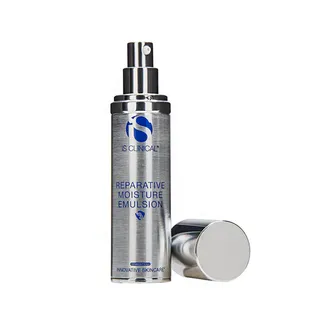
iS Clinical Reparative Moisture Emulsion

iS Clinical Reparative Moisture Emulsion

Efficacy91/100IrritancyMedium

Works for

Moisturizing
Tripeptide-1, Tripeptide-10 citrulline + 25 more
Works well
What the product description says
“A moisturizer that smooths, rehydrates and plumps skin.”
Source: Dermstore

This product can help improve hydration of the skin with the two types of ingredients.

The first type is called “humectants”:
these ingredients help attract water. When humectants are on the surface of the skin, they “pull in” the moisture from the outside environment, or from within deeper layers of the skin. The following ingredients in this product do the job: cyclomethicone, glycerin.

This product also contains ingredients called “occlusives”. They help reduce the speed with which our skin loses moisture to the outside environment. These ingredients also help soften the upper layer of the skin, so it feels less tight and nicer to the touch. The following ingredients in this product do the job: caprylic/capric triglyceride, dimethicone.

The following ingredients in this product are especially good for supporting the skin barrier and helping with the hydration level: panthenol, tripeptide-1, tripeptide-10 citrulline, urea

Tripeptide-1Hero· EmollientEffect: HighA type of peptide. Peptides are excellent moisturizers and might be able support collagen production reducing fine lines and wrinkles~0.4–0.6%
Tripeptide-10 citrullineHeroEffect: HighA type of peptide. Peptides are excellent moisturizers and might be able support collagen production reducing fine lines and wrinkles~0.4–0.6%
UreaHero· HumectantEffect: HighNaturally present in skin (urea makes up about 7% of natural moisturizing factors in skin). Attracts water to the upper layer of the skin. Also has a positive effect on the skin barrier beyond the humectant action. Can enhance penetration of other ingredients. Is an exfoliating ingredient when used in high concentrations~0.25–0.45%
PanthenolHero· HumectantEffect: HighHelps attract water to the upper layer of the skin and can help improve skin barrier function~0.2–0.4%
Sodium hyaluronateKey active· HumectantEffect: HighOne of the best moisturizing ingredients. Attracts water into the upper layer of the skin~6.6–8%
GlycerinKey active· HumectantEffect: HighOne of the best moisturizing ingredients. Naturally present in skin. It attracts water to the upper layer of the skin working as a humectant~3.9–4.8%
SqualaneKey active· Emollient, OcclusiveEffect: HighAn oil naturally present in skin. Works as an emollient to soften the skin and form a protective layer on its surface without a greasy feeling.~3.2–3.9%
Caprylic/capric triglycerideKey active· Emollient, OcclusiveEffect: HighA good mix of fatty acids that forms a protective layer on the skin. Improves the shelf life of products. Derived from coconut and glycerin~2.4–2.9%
Faex extractKey activeEffect: HighYeast extract. Helps attract water to the upper layer of the skin~1.4–1.7%
Panthenyl triacetateKey activeEffect: HighA stable oil-soluble derivative of vitamin B5. It can help support skin barrier and reduce inflammation in skin~0.9–1.1%
Ethyl linoleateKey active· EmollientEffect: HighHelps reduce acne and blemishes. Helps to soften the upper layer of the skin and reduce inflammation. Might be helpful in reducing hyperpigmentation and evening out the skin tone, but evidence of effectiveness in skin are lacking~0.65–1%
ProlineKey activeEffect: Medium~0.5–0.7%
Hydrolyzed soy proteinKey active· HumectantEffect: MediumHelps attract water to the upper layer of the skin. Might have some anti-aging, anti-oxidant, and skin lightening properties, but solid evidence is missing~0.45–0.65%
Hydrolyzed vegetable proteinKey activeEffect: Medium~0.45–0.65%
DimethiconeKey active· Emollient, OcclusiveEffect: HighA silicone that helps to reduce water loss from the surface of the skin. Can temporarily "fill in" lines and wrinkles, absorb oil, and create a nice product finish~0.3–0.55%
GlycosaminoglycansKey active· EmollientEffect: HighLong sugars that help attract water to the upper layer of the skin~0.3–0.55%
Cetearyl alcoholKey active· EmollientEffect: MediumA non-drying alcohol. Works as an emollient. Helps water and oil mix together and creates a nice product texture~0.3–0.55%
CyclomethiconeKey active· Humectant, EmollientEffect: HighA type of silicone that leaves a nice silky finish on the skin and can help soften its upper layer~0.25–0.5%
Superoxide dismutaseKey activeEffect: HighAn antioxidant enzyme that is naturally present in skin. It can help support skin barrier function and reduce inflammation in skin. It is used in topical medications for inflammatory skin conditions including atopic dermatitis (eczema) and psoriasis. There are three types of natural Superoxide Dismutase in human skin. The compound used in topical treatments and cosmetics are mimics of typically one of these natural variants~0.25–0.45%
Dipalmitoyl hydroxyprolineKey activeEffect: MediumIs claimed to stimulate collagen and elastin production, as well as work as an anti-oxidant. There is however not enough evidence for its effectiveness~0.25–0.45%
GlucoseKey active· HumectantEffect: MediumHelps attract water to the upper layer of the skin. Could be helpful in restoring the skin barrier function~0.25–0.45%
PhospholipidsKey activeEffect: MediumEmollients that are naturaly present in skin. In addition, they help water and oil mix together in the product~0.2–0.4%
Pantothenic acidKey activeEffect: HighHelps attract water to the upper layer of the skin and may help reduce inflammation in skin~0.1–0.25%
Butylene glycol· HumectantEffect: LowUsed to create a nice product texture and help delivery of other ingredients. Might be somewhat helpful in attracting water to the upper layer of the skin~0.55–0.85%
Caprylyl glycol· Humectant, EmollientEffect: LowHelps preserve products and creates a nice product texture~0.1–0.2%
TocopherolEffect: Low, below effective dosePure form of vitamin E. Can help moisturise and protect the skin from free radicals. Often used to help stabilise other ingredients or the formula itself~1.1–1.3%
LecithinEffect: Low, below effective doseUsed mostly for creating emulsions - helping oil and water mix together. Helps soften the upper layer of the skin~0.4–0.6%
Anti-oxidation
Superoxide dismutase, Ethylbisiminomethylguaiacol manganese chloride + 7 more
Works well

This product contains antioxidants (ethylbisiminomethylguaiacol manganese chloride, superoxide dismutase) that can help neutralize free radicals in skin. By doing so, they can lessen the damage the skin gets from the UV light (sun).

Superoxide dismutaseKey activeEffect: HighAn antioxidant enzyme that is naturally present in skin. It can help support skin barrier function and reduce inflammation in skin. It is used in topical medications for inflammatory skin conditions including atopic dermatitis (eczema) and psoriasis. There are three types of natural Superoxide Dismutase in human skin. The compound used in topical treatments and cosmetics are mimics of typically one of these natural variants~0.25–0.45%
Ethylbisiminomethylguaiacol manganese chlorideKey activeEffect: HighA potent anti-oxidant that can help neutralize free radicals in skin and protect from harmful effects of sun exposure, even though more studies are needed to confirm its effectiveness in topical applications~0.1–0.2%
Hydrolyzed soy proteinEffect: LowHelps attract water to the upper layer of the skin. Might have some anti-aging, anti-oxidant, and skin lightening properties, but solid evidence is missing~0.45–0.65%
Dipalmitoyl hydroxyprolineEffect: LowIs claimed to stimulate collagen and elastin production, as well as work as an anti-oxidant. There is however not enough evidence for its effectiveness~0.25–0.45%
Beta vulgaris root extractEffect: Low, below effective doseA plant extract that might have some antioxidant properties, but mostly used in cosmetics for its color~1.9–2.3%
Tocopheryl acetateEffect: Low, below effective doseA more stable but less bio-available form of vitamin E compared to Tocopherol. Might help moisturize and protect the skin from free radicals, but mostly used in low concentrations to stabilize other ingredients.~0.2–0.35%
Ascorbyl palmitateEffect: Low, below effective doseBeing a lipid soluble form of vitamin C, it is more stable and can penetrate the skin better than L-Ascorbic acid. It is effective in protecting the skin from free radicals, as well as evening the skin tone, but is less effective in stimulating collagen production compared to L-Ascorbic acid.~0.15–0.25%
Haberlea rhodopensis leaf extractUnder-dosedA plant extract that if used in high concentration might help to neutralize free radicals in skin~1.6–1.9%
TocopherolUnder-dosedPure form of vitamin E. Can help moisturise and protect the skin from free radicals. Often used to help stabilise other ingredients or the formula itself~1.1–1.3%
Anti-aging
Tripeptide-1, Tripeptide-10 citrulline + 5 more
May help
What the product description says
“These potent ingredients help keep skin smooth while fighting signs of aging and fine lines that can result from overly dry skin.”
Source: Dermstore

This product contains tripeptide-1, tripeptide-10 citrulline. There is some human evidence that these ingredients help reduce and prevent fine lines and wrinkles and improve skin elasticity and firmness, though it is smaller or less consistent than the evidence for the best anti-aging ingredients.

Tripeptide-1Key activeEffect: MediumA type of peptide. Peptides are excellent moisturizers and might be able support collagen production reducing fine lines and wrinkles~0.4–0.6%
Tripeptide-10 citrullineKey activeEffect: MediumA type of peptide. Peptides are excellent moisturizers and might be able support collagen production reducing fine lines and wrinkles~0.4–0.6%
Panthenyl triacetateEffect: LowA stable oil-soluble derivative of vitamin B5. It can help support skin barrier and reduce inflammation in skin~0.9–1.1%
Dipalmitoyl hydroxyprolineEffect: LowIs claimed to stimulate collagen and elastin production, as well as work as an anti-oxidant. There is however not enough evidence for its effectiveness~0.25–0.45%
TocopherolEffect: Low, below effective dosePure form of vitamin E. Can help moisturise and protect the skin from free radicals. Often used to help stabilise other ingredients or the formula itself~1.1–1.3%
Ascorbyl palmitateEffect: Low, below effective doseBeing a lipid soluble form of vitamin C, it is more stable and can penetrate the skin better than L-Ascorbic acid. It is effective in protecting the skin from free radicals, as well as evening the skin tone, but is less effective in stimulating collagen production compared to L-Ascorbic acid.~0.15–0.25%
Retinyl palmitateUnder-dosedThree steps removed from the active form of vitamin A - retinoic acid. To have an effect in the skin, it first needs to be converted twice to become the retinoic acid. This means it is less potent than retinol, but could also be less irritating. Once converted to the retinoic acid in the skin, it helps against all signs of aging, improves skin cell turnover and helps fight blemishes and clogged pores. However, in many cosmetic formulations, it is used in a concentration that is too low to have the full effect~0.15–0.3%
Anti-blemish
Side benefit · Ethyl linoleate, Pantothenic acid + 1 more
May help

This product might be able to help reduce blemishes and clogged pores because it contains ethyl linoleate.

The following ingredient (ingredients) in this product might be helpful, but there is no evidence to confirm that it actually works: pantothenic acid

Ethyl linoleateKey activeEffect: HighHelps reduce acne and blemishes. Helps to soften the upper layer of the skin and reduce inflammation. Might be helpful in reducing hyperpigmentation and evening out the skin tone, but evidence of effectiveness in skin are lacking~0.65–1%
Pantothenic acidKey activeEffect: MediumHelps attract water to the upper layer of the skin and may help reduce inflammation in skin~0.1–0.25%
Retinyl palmitateUnder-dosedThree steps removed from the active form of vitamin A - retinoic acid. To have an effect in the skin, it first needs to be converted twice to become the retinoic acid. This means it is less potent than retinol, but could also be less irritating. Once converted to the retinoic acid in the skin, it helps against all signs of aging, improves skin cell turnover and helps fight blemishes and clogged pores. However, in many cosmetic formulations, it is used in a concentration that is too low to have the full effect~0.15–0.3%

Can it cause trouble?

Irritancy
1 strong irritant: Retinyl palmitate
Medium risk
We flagged 16 ingredients with irritancy potential. Severity depends on your sensitivity threshold; the table lists the worst offenders first.
IngredientFunctionIrritationEst. amount
Retinyl palmitateThree steps removed from the active form of vitamin A - retinoic acid. To have an effect in the skin, it first needs to be converted twice to become the retinoic acid. This means it is less potent than retinol, but could also be less irritating. Once converted to the retinoic acid in the skin, it helps against all signs of aging, improves skin cell turnover and helps fight blemishes and clogged pores. However, in many cosmetic formulations, it is used in a concentration that is too low to have the full effectHigh~0.15–0.3%est.
Caprylic/capric triglycerideA good mix of fatty acids that forms a protective layer on the skin. Improves the shelf life of products. Derived from coconut and glycerinMedium~2.4–2.9%est.
Beta vulgaris root extractA plant extract that might have some antioxidant properties, but mostly used in cosmetics for its colorMedium~1.9–2.3%est.
Haberlea rhodopensis leaf extractA plant extract that if used in high concentration might help to neutralize free radicals in skinMedium~1.6–1.9%est.
Ethyl linoleateHelps reduce acne and blemishes. Helps to soften the upper layer of the skin and reduce inflammation. Might be helpful in reducing hyperpigmentation and evening out the skin tone, but evidence of effectiveness in skin are lackingMedium~0.65–1%est.
TriethanolamineUsed to adjust pH of the product and can help improve the product's smellMedium~0.3–0.55%est.
Guanidine hclUsed to preserve product formulationsMedium~0.25–0.45%est.
Ceteareth-20Helps oil and water mix together. Has some emollient propertiesMedium~0.3–0.6%est.
Polysorbate 40Helps oil and water mix togetherMedium~0.25–0.5%est.
PvpHelps evenly disperse other ingredients in a formulation and create an even layer on the surface of the skinMedium~0.25–0.45%est.
Tocopheryl acetateA more stable but less bio-available form of vitamin E compared to Tocopherol. Might help moisturize and protect the skin from free radicals, but mostly used in low concentrations to stabilize other ingredients.Medium~0.2–0.35%est.
Ascorbyl palmitateBeing a lipid soluble form of vitamin C, it is more stable and can penetrate the skin better than L-Ascorbic acid. It is effective in protecting the skin from free radicals, as well as evening the skin tone, but is less effective in stimulating collagen production compared to L-Ascorbic acid.Medium~0.15–0.25%est.
Ethylbisiminomethylguaiacol manganese chlorideA potent anti-oxidant that can help neutralize free radicals in skin and protect from harmful effects of sun exposure, even though more studies are needed to confirm its effectiveness in topical applicationsMedium~0.1–0.2%est.
1,2-hexanediolA preservativeMedium~0.1–0.2%est.
Caprylyl glycolHelps preserve products and creates a nice product textureMedium~0.1–0.2%est.
Disodium edtaStabilizes the product formulationMedium~0.05%est.
Comedogenic
2 ingredients rated 2 or more on the 0–5 pore-clogging scale
2 flagged
These ingredients have a comedogenic rating of 2 or more on a 0–5 scale; the table shows each one's rating. In leave-on products they can clog pores in acne-prone skin.
IngredientFunctionRatingEst. amount
Cetearyl alcoholA non-drying alcohol. Works as an emollient. Helps water and oil mix together and creates a nice product texture2/5~0.3–0.55%est.
Ceteareth-20Helps oil and water mix together. Has some emollient properties2/5~0.3–0.6%est.
Did this help you decide?

User reviews

Would you recommend?
No community reviews yet.

Be the first — your take helps the next person decide.

Ingredients

Filter by role to see what each ingredient is doing.

Water~45–55%
Formula
Irritation risk
Low

Plain old water

More about Water
Sodium hyaluronate~6.6–8%
Key active
Irritation risk
Low
Works for
Moisturizing

One of the best moisturizing ingredients. Attracts water into the upper layer of the skin

More about Sodium hyaluronate
Glycerin~3.9–4.8%
Key active
Irritation risk
Low
Works for
Moisturizing

One of the best moisturizing ingredients. Naturally present in skin. It attracts water to the upper layer of the skin working as a humectant

More about Glycerin
Squalane~3.2–3.9%
Key active
Irritation risk
Low
Works for
Moisturizing

An oil naturally present in skin. Works as an emollient to soften the skin and form a protective layer on its surface without a greasy feeling.

More about Squalane
Caprylic/capric triglyceride~2.4–2.9%
Key activeIrritant · medium
Irritation risk
Medium
Works for
Moisturizing

A good mix of fatty acids that forms a protective layer on the skin. Improves the shelf life of products. Derived from coconut and glycerin

More about Caprylic/capric triglyceride
Beta vulgaris root extract~1.9–2.3%
Irritant · medium
Irritation risk
Medium
Works for
Anti-oxidation

A plant extract that might have some antioxidant properties, but mostly used in cosmetics for its color

More about Beta vulgaris root extract
Haberlea rhodopensis leaf extract~1.6–1.9%
Under-dosedIrritant · medium
Irritation risk
Medium
Works for
Anti-oxidation

A plant extract that if used in high concentration might help to neutralize free radicals in skin

More about Haberlea rhodopensis leaf extract
Faex extract~1.4–1.7%
Key active
Irritation risk
Low
Works for
Moisturizing

Yeast extract. Helps attract water to the upper layer of the skin

More about Faex extract
Tocopherol~1.1–1.3%
Under-dosed
Irritation risk
Low
Works for
Anti-oxidationAnti-agingAnti-inflammatoryMoisturizing

Pure form of vitamin E. Can help moisturise and protect the skin from free radicals. Often used to help stabilise other ingredients or the formula itself

More about Tocopherol
Panthenyl triacetate~0.9–1.1%
Key active
Irritation risk
Low
Works for
MoisturizingAnti-aging

A stable oil-soluble derivative of vitamin B5. It can help support skin barrier and reduce inflammation in skin

More about Panthenyl triacetate
Ethyl linoleate~0.65–1%
Key activeIrritant · medium
Irritation risk
Medium
Works for
Anti-blemishMoisturizingAnti-inflammatoryEvens skin tone

Helps reduce acne and blemishes. Helps to soften the upper layer of the skin and reduce inflammation. Might be helpful in reducing hyperpigmentation and evening out the skin tone, but evidence of effectiveness in skin are lacking

More about Ethyl linoleate
Butylene glycol~0.55–0.85%
Formula
Irritation risk
Low
Works for
Moisturizing

Used to create a nice product texture and help delivery of other ingredients. Might be somewhat helpful in attracting water to the upper layer of the skin

More about Butylene glycol
Acetyl tyrosine~0.5–0.75%
Formula
Proline~0.5–0.7%
Key active
Irritation risk
Low
Works for
Moisturizing
More about Proline
Hydrolyzed vegetable protein~0.45–0.65%
Key active
Irritation risk
Low
Works for
Moisturizing
More about Hydrolyzed vegetable protein
Hydrolyzed soy protein~0.45–0.65%
Key active
Irritation risk
Low
Works for
MoisturizingEvens skin toneAnti-oxidationAnti-inflammatory

Helps attract water to the upper layer of the skin. Might have some anti-aging, anti-oxidant, and skin lightening properties, but solid evidence is missing

More about Hydrolyzed soy protein
Tripeptide-10 citrulline~0.4–0.6%
Hero · Moisturizing
Irritation risk
Low
Works for
MoisturizingAnti-aging

A type of peptide. Peptides are excellent moisturizers and might be able support collagen production reducing fine lines and wrinkles

More about Tripeptide-10 citrulline
Tripeptide-1~0.4–0.6%
Hero · Moisturizing
Irritation risk
Low
Works for
MoisturizingAnti-aging

A type of peptide. Peptides are excellent moisturizers and might be able support collagen production reducing fine lines and wrinkles

More about Tripeptide-1
Lecithin~0.4–0.6%
Formula
Irritation risk
Low
Works for
CleansingMoisturizing

Used mostly for creating emulsions - helping oil and water mix together. Helps soften the upper layer of the skin

More about Lecithin
Xanthan gum~0.3–0.55%
Formula
Irritation risk
Low
Works for
Cleansing

Used to create a thicker product consistency

More about Xanthan gum
Carbomer~0.3–0.55%
Formula
Irritation risk
Low
Works for
Cleansing

Helps create a thicker or gel-like product texture. It is not a surfactant but can be used in gentle cleansing formulations

More about Carbomer
Triethanolamine~0.3–0.55%
Irritant · medium
Irritation risk
Medium
Works for
Cleansing

Used to adjust pH of the product and can help improve the product's smell

More about Triethanolamine
Glycosaminoglycans~0.3–0.55%
Key active
Irritation risk
Low
Works for
Moisturizing

Long sugars that help attract water to the upper layer of the skin

More about Glycosaminoglycans
Urea~0.25–0.45%
Hero · Moisturizing
Irritation risk
Low
Works for
MoisturizingExfoliation

Naturally present in skin (urea makes up about 7% of natural moisturizing factors in skin). Attracts water to the upper layer of the skin. Also has a positive effect on the skin barrier beyond the humectant action. Can enhance penetration of other ingredients. Is an exfoliating ingredient when used in high concentrations

More about Urea
Glucose~0.25–0.45%
Key active
Irritation risk
Low
Works for
Moisturizing

Helps attract water to the upper layer of the skin. Could be helpful in restoring the skin barrier function

More about Glucose
Guanidine hcl~0.25–0.45%
Irritant · medium
Irritation risk
Medium

Used to preserve product formulations

More about Guanidine hcl
Cetearyl alcohol~0.3–0.55%
Key activeComedogenic 2/5
Irritation risk
Low
Comedogenicity
2/5
Works for
CleansingMoisturizing

A non-drying alcohol. Works as an emollient. Helps water and oil mix together and creates a nice product texture

More about Cetearyl alcohol
Ceteareth-20~0.3–0.6%
Comedogenic 2/5Irritant · medium
Irritation risk
Medium
Comedogenicity
2/5
Works for
Cleansing

Helps oil and water mix together. Has some emollient properties

More about Ceteareth-20
Dimethicone~0.3–0.55%
Key active
Irritation risk
Low
Works for
MoisturizingMattifying

A silicone that helps to reduce water loss from the surface of the skin. Can temporarily "fill in" lines and wrinkles, absorb oil, and create a nice product finish

More about Dimethicone
Dipalmitoyl hydroxyproline~0.25–0.45%
Key active
Irritation risk
Low
Works for
MoisturizingAnti-oxidationAnti-aging

Is claimed to stimulate collagen and elastin production, as well as work as an anti-oxidant. There is however not enough evidence for its effectiveness

More about Dipalmitoyl hydroxyproline
Cyclomethicone~0.25–0.5%
Key active
Irritation risk
Low
Works for
Moisturizing

A type of silicone that leaves a nice silky finish on the skin and can help soften its upper layer

More about Cyclomethicone
Polysorbate 40~0.25–0.5%
Irritant · medium
Irritation risk
Medium
Works for
Cleansing

Helps oil and water mix together

More about Polysorbate 40
Superoxide dismutase~0.25–0.45%
Key active
Irritation risk
Low
Works for
Anti-oxidationMoisturizingAnti-inflammatory

An antioxidant enzyme that is naturally present in skin. It can help support skin barrier function and reduce inflammation in skin. It is used in topical medications for inflammatory skin conditions including atopic dermatitis (eczema) and psoriasis. There are three types of natural Superoxide Dismutase in human skin. The compound used in topical treatments and cosmetics are mimics of typically one of these natural variants

More about Superoxide dismutase
Pvp~0.25–0.45%
Irritant · medium
Irritation risk
Medium

Helps evenly disperse other ingredients in a formulation and create an even layer on the surface of the skin

More about Pvp
Panthenol~0.2–0.4%
Hero · Moisturizing
Irritation risk
Low
Works for
MoisturizingReduces rednessReduces irritation

Helps attract water to the upper layer of the skin and can help improve skin barrier function

More about Panthenol
Phospholipids~0.2–0.4%
Key active
Irritation risk
Low
Works for
Moisturizing

Emollients that are naturaly present in skin. In addition, they help water and oil mix together in the product

More about Phospholipids
Retinyl palmitate~0.15–0.3%
Under-dosedIrritant · high
Irritation risk
High
Works for
Evens skin toneAnti-blemishAnti-agingExfoliation

Three steps removed from the active form of vitamin A - retinoic acid. To have an effect in the skin, it first needs to be converted twice to become the retinoic acid. This means it is less potent than retinol, but could also be less irritating. Once converted to the retinoic acid in the skin, it helps against all signs of aging, improves skin cell turnover and helps fight blemishes and clogged pores. However, in many cosmetic formulations, it is used in a concentration that is too low to have the full effect

More about Retinyl palmitate
Tocopheryl acetate~0.2–0.35%
Irritant · medium
Irritation risk
Medium
Works for
Anti-oxidation

A more stable but less bio-available form of vitamin E compared to Tocopherol. Might help moisturize and protect the skin from free radicals, but mostly used in low concentrations to stabilize other ingredients.

More about Tocopheryl acetate
Ascorbyl palmitate~0.15–0.25%
Irritant · medium
Irritation risk
Medium
Works for
Anti-oxidationAnti-aging

Being a lipid soluble form of vitamin C, it is more stable and can penetrate the skin better than L-Ascorbic acid. It is effective in protecting the skin from free radicals, as well as evening the skin tone, but is less effective in stimulating collagen production compared to L-Ascorbic acid.

More about Ascorbyl palmitate
Pantothenic acid~0.1–0.25%
Key active
Irritation risk
Low
Works for
MoisturizingReduces irritationAnti-blemishReduces redness

Helps attract water to the upper layer of the skin and may help reduce inflammation in skin

More about Pantothenic acid
Ethylbisiminomethylguaiacol manganese chloride~0.1–0.2%
Key activeIrritant · medium
Irritation risk
Medium
Works for
Anti-oxidation

A potent anti-oxidant that can help neutralize free radicals in skin and protect from harmful effects of sun exposure, even though more studies are needed to confirm its effectiveness in topical applications

More about Ethylbisiminomethylguaiacol manganese chloride
1,2-hexanediol~0.1–0.2%
Irritant · medium
Irritation risk
Medium

A preservative

More about 1,2-hexanediol
Caprylyl glycol~0.1–0.2%
Irritant · medium
Irritation risk
Medium
Works for
Moisturizing

Helps preserve products and creates a nice product texture

More about Caprylyl glycol
Disodium edta~0.05%
Irritant · medium
Irritation risk
Medium

Stabilizes the product formulation

More about Disodium edta
Ingredient list view

Water, Sodium hyaluronate, Glycerin, Squalane, Caprylic/capric triglyceride, Beta vulgaris root extract, Haberlea rhodopensis leaf extract, Faex extract, Tocopherol, Panthenyl triacetate, Ethyl linoleate, Butylene glycol, Acetyl tyrosine, Proline, Hydrolyzed vegetable protein, Hydrolyzed soy protein, Tripeptide-10 citrulline, Tripeptide-1, Lecithin, Xanthan gum, Carbomer, Triethanolamine, Glycosaminoglycans, Urea, Glucose, Guanidine hcl, Cetearyl alcohol, Ceteareth-20, Dimethicone, Dipalmitoyl hydroxyproline, Cyclomethicone, Polysorbate 40, Superoxide dismutase, Pvp, Panthenol, Phospholipids, Retinyl palmitate, Tocopheryl acetate, Ascorbyl palmitate, Pantothenic acid, Ethylbisiminomethylguaiacol manganese chloride, 1,2-hexanediol, Caprylyl glycol, Disodium edta

Compare prices

Retailers ranked by price — lowest first.

Bluemercury
$116.00
Buy
Amazon USPrice as of 11/23 06:11 GMT
$116.00
Buy
Dermstore1.7 oz
$116.00
Buy

Affiliate links · As an Amazon Associate, WIMJ earns from qualifying purchases.

Worth comparing, line by line.

Match % combines shared ingredients, the first five ingredients, shared actives and hero ingredients, irritancy (lower counts in the alternative's favour), texture and body area. Only products in the same routine step are compared.

Side-by-side comparison of this product against its closest alternatives
iS ClinicalReparative Moisture EmulsionYOUR PRODUCTPanthenol extraFace and Eye CreamAtwaterHeavy Armor Facial MoisturizerSimpleX Kindness Hydrating Light Facial Moisturiser
Match—44%44%44%
Price$116.00$36.74−$79.26$29.60−$86.40$2.61−$113.39
Shared key ingredients—7 of 208 of 204 of 20
Key difference—Butyrospermum Parkii ButterNiacinamideNiacinamide
Irritancy Medium Medium Medium Low
Drying alcohol————
View product Shop Shop Shop

More alternatives: BANOBAGI Milk Thistle Repair LotionCyrène Skincare Skin Rescue Moisturiser

Cheaper alternatives? See how this stacks up against similar formulas.
We compare ingredient profiles across our catalog — pick the closest match for your budget.
Open dupe finder

Product summary

Based on the ingredients included, "iS Clinical - Reparative Moisture Emulsion" works well for moisturizing the skin. As we expect from a proper moisturizer, the formula includes a combo of effective humectants and emollients. These are the two different types of ingredients that are essential for improving the skin hydration and supporting a healthy skin barrier. Urea, cyclomethicone, glycerin, sodium hyaluronate and glucose in this product (humectants) attract water molecules to the upper layer of the skin (the water comes from the outside air or from the deeper layers of the skin if the air is dry). Emollients in this formulation (tripeptide-1, cyclomethicone, ethyl linoleate, glycosaminoglycans and caprylic/capric triglyceride) help to reduce the moisture loss from the skin. They also soften the skin surface and relieve the feeling of dryness and tightness.

Ingredient callouts

  • this moisturizer includes a form of retinoids (vitamin A) - retinyl palmitate 0.15% - 0.30%, but this type of vitamin A is not very effective. It could in theory help with fine lines and wrinkles, but the effect is most likely minimal.
  • This moistruizer also contains peptides (tripeptide-1 0.30% - 0.60% and tripeptide-10 citrulline 0.30% - 0.55%). Peptides is a very big group of ingredients. They all consist of a different combination of amino-acids. Our skin produces peptides naturally. Some of them work as natural anti-biotics, promote wound-healing and production of collagen. The scientists are still studying how effective the topical application of peptides is, but it is very likely that peptides in skincare are helpful. They might be able to support skin barrier restoration and even have an anti-aging benefit. At the very least, they certainly help attract water to the skin and support the hydration in this way.

Irritation risk

There are actives in this product that can be irritating. We assess the overall irritancy of this moisturizer to be medium. For a detailed overview of all potential irritants: click here

You can see the detailed formula review with the breakdown of all actives in the product and the full ingredient list with estimated concentrations in the tables below.

Price

The product retails for 105.00$ in the United States, for 251.72A$ in Australia and from 61.02£ up to 84.00£ in the United Kingdom.

For a detailed price comparison: click here.

Sources cited in this review

Every concentration estimate and effectiveness label is anchored to one of these 29 studies and safety reviews.

  1. 1
  2. 2
  3. 3
  4. 4
  5. 5
    Vitamin E in dermatologyncbi.nlm.nih.gov
  6. 6
    Vitamin E and Skin Healthlpi.oregonstate.edu
iS Clinical Reparative Moisture Emulsion
iS ClinicalReparative Moisture Emulsion

Affiliate links · As an Amazon Associate, WIMJ earns from qualifying purchases.

As an Amazon Associate, WIMJ earns from qualifying purchases.