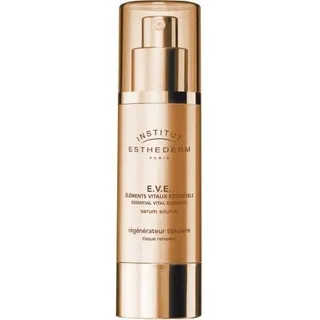
Institut Esthederm E.V.E. "Essential Vital Elements" Serum Source
Works for
Anti-agingAlanyl glutamine, Serine + 9 moreWorks well
“Day after day, the skin regains greater definition, which it lacks due to premature aging.”
This product can help reduce and prevent fine lines and wrinkles, improve skin elasticity and firmness because it contains adenosine.
These ingredients in the product can also be helpful, even though there is less evidence for their effectiveness: alanyl glutamine, aspartic acid, folic acid, serine, threonine.
Keep in mind that it typically takes at least 6 weeks to notice any results because the changes that are needed to improve fine lines and elasticity happen in the deeper layers of the skin. No topical anti-aging product can “erase” wrinkles or fully reverse signs of aging.
MoisturizingGlycerin, Sodium hyaluronate + 25 moreWorks
“including 21 amino acids, 6 minerals salts, 6 trace elements, 9 vitamins, 3 carbohydrates, 5 nucleopeptides and 1 peptide.”
This product contains good ingredients to attract water to the upper layer of the skin. These ingredients are called "humectants": alanine, alanyl glutamine.
When humectants are on the surface of the skin, they “pull in” the moisture from the outside environment, or from within deeper layers of the skin. If the air is dry, humectants can speed up the moisture loss from the skin. This is why it is a good idea to use another product on top of this one to help "seal in" the moisture (look for ingredients like dimethicone, squalane, oils and butters).
Anti-oxidationSide benefit · Thioctic acid, Adenosine + 3 moreWorks well
This product contains antioxidants (thioctic acid) that can help neutralize free radicals in skin. By doing so, they can lessen the damage the skin gets from the UV light (sun).
Can it cause trouble?
Irritancy15 flagged ingredientsMedium risk
ComedogenicClean of flagged comedogenic ingredientsNone flagged

User reviews
Be the first — your take helps the next person decide.
Ingredients
Filter by role to see what each ingredient is doing.
Water~45–55%
Maltodextrin~5.3–6.5%
- Irritation risk
- Low
Used to stabilize the product formulation and can help absorb oil
More about MaltodextrinGlycerin~4.4–5.4%
- Irritation risk
- Low
One of the best moisturizing ingredients. Naturally present in skin. It attracts water to the upper layer of the skin working as a humectant
More about GlycerinSodium hyaluronate~3.2–3.9%
- Irritation risk
- Low
One of the best moisturizing ingredients. Attracts water into the upper layer of the skin
More about Sodium hyaluronateXylitol~2.4–3%
- Irritation risk
- Low
Helps attract water to the upper layer of the skin and repair the skin barrier function
More about XylitolGlucose~2–2.5%
- Irritation risk
- Low
Helps attract water to the upper layer of the skin. Could be helpful in restoring the skin barrier function
More about GlucoseAlanyl glutamine~1.7–2%
- Irritation risk
- Low
A type of peptide. Peptides are excellent moisturizers and might be able support collagen production reducing fine lines and wrinkles
More about Alanyl glutamineLactic acid~1.4–1.8%
- Irritation risk
- Medium
An exfoliating and moisturizing alpha-hydroxy acid (AHA). Typically causes less irritation than other AHAs, for example, glycolic acid. At high concentrations (about 15%), lactic acid can help reduce lines and wrinkles. Recent studies show that lactic acid can support the "good" bacteria living on skin's surface (healthy skin microbiome)
More about Lactic acidSodium citrate~1.2–1.4%
- Irritation risk
- Medium
Helps to control the skin's pH level. Maintains the skin's natural film of amino-lactic acids and oils. Helps to preserve products
More about Sodium citrateSodium lauroyl glutamate~0.95–1.15%
- Irritation risk
- Medium
Used as a cleansing agent. It creates foam
More about Sodium lauroyl glutamateDecyl glucoside~0.75–1.15%
- Irritation risk
- High
Helps oil and water mix together. Can be irritating
More about Decyl glucosideDiglycerin~0.55–0.85%
- Irritation risk
- Low
Helps attract water to the upper layer of the skin
More about DiglycerinArginine hcl~0.5–0.75%
- Irritation risk
- Low
An amino acid that is naturally present in skin and helps keep it hydrated. When used together with AHAs, it can reduce their irritating effect on the skin
More about Arginine hclLactis proteinum~0.45–0.65%
- Irritation risk
- Low
Whey protein~0.45–0.7%
- Irritation risk
- Low
A protein derived from milk. In skincare products, might help to soften the upper layer of the skin
More about Whey proteinSerine~0.4–0.6%
- Irritation risk
- Low
An amino-acid that helps to attract water to the upper layer of the skin. In combination with other amino-acids, might help to reduce fine lines and wrinkles
More about SerineLeucine~0.4–0.6%
- Irritation risk
- Low
Magnesium chloride~0.35–0.6%
Potassium chloride~0.3–0.6%
- Irritation risk
- Low
Valine~0.3–0.5%
- Irritation risk
- Low
Sodium pyruvate~0.25–0.5%
- Irritation risk
- Low
Lysine hcl~0.25–0.5%
Histidine hcl~0.25–0.45%
- Irritation risk
- Low
A salt of an amino-acid that helps attract water to the upper layer of the skin. Might be helpful in restoring the skin barrier function
More about Histidine hclProline~0.25–0.5%
Cysteine hcl~0.25–0.5%
- Irritation risk
- Low
Hydroxyproline~0.25–0.45%
- Irritation risk
- Low
Is helpful in restoring skin barrier function supporting its moisture levels. Is claimed to stimulte collagen production in skin but evidence is lacking
More about HydroxyprolineGlutamic acid~0.25–0.5%
- Irritation risk
- Low
An amino-acid that helps attract water to the upper layer of the skin
More about Glutamic acidAsparagine~0.25–0.45%
- Irritation risk
- Low
Cyanocobalamin~0.25–0.45%
- Irritation risk
- Low
Can support skin barrier function and reduce inflammation in skin
More about CyanocobalaminThreonine~0.25–0.5%
- Irritation risk
- Low
An amino-acid that helps to attract water to the upper layer of the skin. In combination with other amino-acids, might help to reduce fine lines and wrinkles
More about ThreonineInositol~0.25–0.5%
Adenine~0.25–0.45%
- Irritation risk
- Low
Alanine~0.25–0.45%
- Irritation risk
- Low
An amino-acid that helps to attract water to the upper layer of the skin and might help to lighten the skin, but solid evidence is lacking
More about AlanineAspartic acid~0.25–0.45%
- Irritation risk
- Low
An amino-acid that helps increase skin hydration and might help to slightly improve skin firmness, potentially reducing lines and wrinkles
More about Aspartic acidGlycine~0.25–0.45%
- Irritation risk
- Low
Helps to attract water to the upper layer of the skin and can help restore the skin barrier function
More about GlycineMethionine~0.25–0.45%
- Irritation risk
- Low
Tyrosine~0.25–0.45%
Phenylalanine~0.25–0.5%
- Irritation risk
- Low
Tryptophan~0.25–0.5%
- Irritation risk
- Low
Isoleucine~0.25–0.45%
- Irritation risk
- Low
An amino acid that can help attract water to the upper layer of the skin and support skin's barrier function
More about IsoleucineSodium sulfate~0.3–0.5%
- Irritation risk
- Medium
Used to improve the product consistency and stabilize formulations
More about Sodium sulfateFolic acid~0.25–0.45%
- Irritation risk
- Low
Can help stimulate collagen production in skin. While available studies are promising, more research is needed to confirm the efficacy in skin
More about Folic acidFerrous sulfate~0.25–0.5%
- Irritation risk
- Low
Calcium pantothenate~0.25–0.5%
- Irritation risk
- Low
Helps support skin barrier function improving skin hydration and reducing sensitivity
More about Calcium pantothenateThiamine hcl~0.25–0.45%
- Irritation risk
- Medium
Can help attract water to the upper layer of the skin. Is studied as a mosquito repellent
More about Thiamine hclPyridoxine hcl~0.25–0.45%
- Irritation risk
- Medium
Might help neutralize free radicals in skin
More about Pyridoxine hclNiacinamide~0.25–0.5%
- Irritation risk
- Low
Is proven to be effective in reducing blemishes, evening out skin tone and helping to improve lines and wrinkles. It helps the skin to repair sun damage, calm down inflammation and keep maintain good levels of moisture. The concentration of about 2% is effective for supporting the skin barrier and evening out the skin tone. Concentration of 4-6% is better for helping with acne and balancing the sebum production
More about NiacinamideAscorbic acid~0.25–0.5%
- Irritation risk
- High
The most well-researched antioxidant that works in skin. Helps neutralize free radicals supporting collagen production, helping to even out the skin tone and preventing early signs of aging
More about Ascorbic acidThymidine~0.25–0.45%
- Irritation risk
- Low
Thioctic acid~0.25–0.5%
Riboflavin~0.25–0.45%
- Irritation risk
- Low
Sodium metasilicate~0.25–0.5%
- Irritation risk
- Low
Zinc sulfate~0.25–0.45%
Adenosine~0.25–0.45%
- Irritation risk
- Low
Might help improve cell turnover and reduce inflammation in skin. One study shows that the ingredients might be able to help reduce dynamic wrinkles (for example, in the corners of the eyes or on the forehead)
More about AdenosineGuanine~0.3–0.5%
- Irritation risk
- Low
Ribose~0.25–0.45%
- Irritation risk
- Low
Biotin~0.25–0.45%
- Irritation risk
- Low
Might have some moisturising properties. Is not effective when applied topically beyond some moisturizing effect
More about BiotinAmmonium molybdate~0.25–0.5%
- Irritation risk
- Low
Ammonium vanadate~0.25–0.5%
- Irritation risk
- Low
Copper sulfate~0.25–0.45%
- Irritation risk
- Low
Manganese chloride~0.25–0.5%
- Irritation risk
- Low
Sodium chloride~0.25–0.5%
- Irritation risk
- Low
Used to stabilize mixtures of oil and water, and create thicker, gel-like product textures
More about Sodium chlorideSodium lactate~0.25–0.45%
- Irritation risk
- Medium
Helps attract water to the upper layer of the skin. Is often used to adjust the pH level of the product
More about Sodium lactateAminoethanesulfinic acid~0.25–0.45%
- Irritation risk
- Low
Citric acid~0.25–0.45%
- Irritation risk
- Medium
Can work as an exfoliant but is typically used to adjust the product pH
More about Citric acidSodium acetate~0.2–0.4%
- Irritation risk
- Low
Leuconostoc/radish root ferment filtrate~0.2–0.35%
- Irritation risk
- Medium
A preservative that comes from radishes fermented by a bacteria. New research suggests that the preservation properties in the ingredient come from an ammonium salt that is not present naturally in radish root but used in its cultivation. Is problematic because the exact amount of the preservative agents is difficult to determine
More about Leuconostoc/radish root ferment filtrateSalix alba bark extract~0.2–0.35%
- Irritation risk
- High
A plant extract that can help neutralize free radicals in skin. It contains a compound salicin that can theoretically be converted into salicylic acid that, in turn, helps reduce inflammation in skin, but the evidence of effectiveness in skin is lacking and the extract is usually not used in a concentration that would enable an exfoliating effect
More about Salix alba bark extractPolyglyceryl-4 caprylate~0.2–0.4%
Disodium phosphate~0.1–0.2%
- Irritation risk
- Low
Helps adjust the product pH and stabilize the formulation
More about Disodium phosphateSodium benzoate~0.1–0.2%
Potassium sorbate~0.15–0.25%
Parfum~0.05%
- Irritation risk
- High
An aromatic blend of unspecified and possibly irritating ingredients
More about ParfumIngredient list view
Water, Maltodextrin, Glycerin, Sodium hyaluronate, Xylitol, Glucose, Alanyl glutamine, Lactic acid, Sodium citrate, Sodium lauroyl glutamate, Decyl glucoside, Diglycerin, Arginine hcl, Lactis proteinum, Whey protein, Serine, Leucine, Magnesium chloride, Potassium chloride, Valine, Sodium pyruvate, Lysine hcl, Histidine hcl, Proline, Cysteine hcl, Hydroxyproline, Glutamic acid, Asparagine, Cyanocobalamin, Threonine, Inositol, Adenine, Alanine, Aspartic acid, Glycine, Methionine, Tyrosine, Phenylalanine, Tryptophan, Isoleucine, Sodium sulfate, Folic acid, Ferrous sulfate, Calcium pantothenate, Thiamine hcl, Pyridoxine hcl, Niacinamide, Ascorbic acid, Thymidine, Thioctic acid, Riboflavin, Sodium metasilicate, Zinc sulfate, Adenosine, Guanine, Ribose, Biotin, Ammonium molybdate, Ammonium vanadate, Copper sulfate, Manganese chloride, Sodium chloride, Sodium lactate, Aminoethanesulfinic acid, Citric acid, Sodium acetate, Leuconostoc/radish root ferment filtrate, Salix alba bark extract, Polyglyceryl-4 caprylate, Disodium phosphate, Sodium benzoate, Potassium sorbate, Parfum
Compare prices
Retailers ranked by price — lowest first.

Worth comparing, line by line.
Match % combines shared ingredients, the first five ingredients, shared actives and hero ingredients, irritancy (lower counts in the alternative's favour), texture and body area. Only products in the same routine step are compared.
| Institut EsthedermE.V.E. "Essential Vital Elements" Serum SourceYOUR PRODUCT | AHCHydrating Korean Skincare Aqualuronic Face Serum | FULLightRe:dence Hyaluron Ectoin Serum | AvèneHyaluron Activ B3 Concentrated Plumping Serum | |
|---|---|---|---|---|
| Match | — | 79% | 78% | 78% |
| Price | $123.00 | $25.99−$97.01 | $12.06−$110.94 | $31.10−$91.90 |
| Shared key ingredients | — | 13 of 25 | 13 of 25 | 4 of 25 |
| Key difference | — | Copper Tripeptide-1 | Copper Tripeptide-1 | — |
| Irritancy | Medium | Medium | Medium | Low |
| Drying alcohol | — | — | — | — |
| View product | Shop | Shop | Shop |


More alternatives: Purito SEOUL PURE HYALURONIC ACID 90 SERUMArencia Deep Water Surge Serum 30
Sources cited in this review
Every concentration estimate and effectiveness label is anchored to one of these 31 studies and safety reviews.
- 1
- 2Hyaluronic acid: A key molecule in skin agingncbi.nlm.nih.gov
- 3
- 4
- 5Epidermal and dermal effects of topical lactic acidncbi.nlm.nih.gov
- 6Dual Effects of Alpha-Hydroxy Acids on the Skinpdfs.semanticscholar.org

Affiliate links · As an Amazon Associate, WIMJ earns from qualifying purchases.