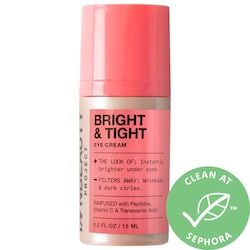
INNBEAUTY PROJECT Bright & Tight Dark Circle Firming Eye Cream with Vitamin C & Peptides
Works for
2 of 2 advertised claims delivered
Evens skin tone6 ingredients credited for this claimStrong support
“What it is: A brightening eye cream that works to visibly reduce dark circles and hyperpigmentation over time.”
This product can help reduce hypepigmentation and even out the skin tone because it contains the following effective ingredients: bakuchiol, tranexamic acid
The following ingredient (ingredients) in this product might be helpful, but there is no evidence to confirm that it actually can help even out the skin tone: glycyrrhiza glabra root extract.
Keep in mind that you would need to apply any topical skincare targetted at hypigmentation consistently for a couple of months to get a result. No topical skincare product can help get rid of hyperpigmentation (including post-acne marks and age spots) instantly.
Anti-aging7 ingredients credited for this claimStrong support
“- Peptides and Bakuchiol: Visibly firm and reduce wrinkles and under-eye bags.”
This product can help reduce and prevent fine lines and wrinkles, improve skin elasticity and firmness because it contains bakuchiol.
These ingredients in the product can also be helpful, even though there is less evidence for their effectiveness: palmitoyl tripeptide-5.
Keep in mind that it typically takes at least 6 weeks to notice any results because the changes that are needed to improve fine lines and elasticity happen in the deeper layers of the skin. No topical anti-aging product can “erase” wrinkles or fully reverse signs of aging.
Anti-oxidationNot advertised by the brand · 12 ingredients credited for this claimStrong support
This product contains antioxidants (bakuchiol) that can help neutralize free radicals in skin. By doing so, they can lessen the damage the skin gets from the UV light (sun).
MoisturizingNot advertised by the brand · 31 ingredients credited for this claimStrong support
This product can help improve hydration of the skin with the two types of ingredients.
The first type is called “humectants”:
these ingredients help attract water.
When humectants are on the surface of the skin, they “pull in” the moisture from the outside environment, or from
within deeper layers of the skin. The following ingredients in this product do the job:
glycerin, sodium hyaluronate.
This product also contains ingredients called “occlusives”. They help reduce the speed with which our skin loses moisture to the outside environment. These ingredients also help soften the upper layer of the skin, so it feels less tight and nicer to the touch. The following ingredients in this product do the job: bis-diglyceryl polyacyladipate-2, caprylic/capric triglyceride.
The following ingredients in this product are especially good for supporting the skin barrier and helping with the hydration level: palmitoyl tripeptide-5
Can it cause trouble?
Irritancy2 strong irritants: Rosmarinus officinalis leaf extract, Sorbitan sesquioleateMedium risk
Comedogenic2 ingredients rated 2 or more on the 0–5 pore-clogging scale2 flagged


User reviews
Ingredients
Filter by role to see what each ingredient is doing.
Water~45–55%
Propanediol~4.6–5.6%
- Irritation risk
- Low
Acts as a solvent for other ingredients. Speeds up the absorption of other ingredients into the skin
More about PropanediolCaprylic/capric triglyceride~4.2–5.2%
- Irritation risk
- Medium
A good mix of fatty acids that forms a protective layer on the skin. Improves the shelf life of products. Derived from coconut and glycerin
More about Caprylic/capric triglycerideCoco-caprylate~2.9–3.6%
- Irritation risk
- Medium
An emollient that softens skin and creates a nice product texture
More about Coco-caprylateTranexamic acid~2.2–2.6%
- Irritation risk
- Low
An amino acid that is effective in reducing hyperpigmentation and evening out the skin tone. It can also help in skin barrier recovery. It is used to treat melasma, especially with injections and when taken orally
More about Tranexamic acidDimethicone~1.9–2.3%
- Irritation risk
- Low
A silicone that helps to reduce water loss from the surface of the skin. Can temporarily "fill in" lines and wrinkles, absorb oil, and create a nice product finish
More about DimethiconeGlycerin~1.5–1.9%
- Irritation risk
- Low
One of the best moisturizing ingredients. Naturally present in skin. It attracts water to the upper layer of the skin working as a humectant
More about GlycerinSqualane~1.3–1.6%
- Irritation risk
- Low
An oil naturally present in skin. Works as an emollient to soften the skin and form a protective layer on its surface without a greasy feeling.
More about SqualaneMangifera indica seed butter~1–1.2%
- Irritation risk
- Low
Helps to soften the upper layer of the skin and might have some anti-oxidant effect
More about Mangifera indica seed butterStearic acid~0.95–1.15%
- Irritation risk
- Low
Helps oil and water mix together and works as an emollient
More about Stearic acidCetearyl alcohol~0.7–1.05%
- Irritation risk
- Low
- Comedogenicity
- 2/5
A non-drying alcohol. Works as an emollient. Helps water and oil mix together and creates a nice product texture
More about Cetearyl alcoholDilinoleic acid/propanediol copolymer~0.6–0.85%
- Irritation risk
- Low
Arachidyl alcohol~0.45–0.7%
- Irritation risk
- Low
Used to soften the upper layer of the skin and create a thicker product consistency
More about Arachidyl alcoholButylene glycol~0.35–0.65%
- Irritation risk
- Low
Used to create a nice product texture and help delivery of other ingredients. Might be somewhat helpful in attracting water to the upper layer of the skin
More about Butylene glycolHydrogenated polydecene~0.3–0.6%
- Irritation risk
- Low
Helps to soften the upper layer of the skin and create a nice product texture
More about Hydrogenated polydeceneBis-diglyceryl polyacyladipate-2~0.4–0.6%
- Irritation risk
- Low
Helps soften the upper layer of the skin and reduce water loss from its surface
More about Bis-diglyceryl polyacyladipate-2Tetrahexyldecyl ascorbate~0.3–0.6%
- Irritation risk
- Medium
Being a lipid soluble form of vitamin C, it is more stable than ascorbic acid, but still degrades quickly and needs to be stabilized in a formulation with another ingredient. It is claimed to penetrate skin better than pure vitamin C and have the the similar benefits, but solid studies of its effectiveness are lacking. Is likely to require a higher concentration in a product than pure vitamin C to be effective. It might be able to help reduce pore clogging.
More about Tetrahexyldecyl ascorbateBakuchiol~0.3–0.55%
- Irritation risk
- Medium
A plant extract that is, though different in chemical structure, acts similar to retinoids. First studies show that it can help reduce fine lines and wrinkles, improve skin tone, reduce clogged pores and blemishes, and reduce inflammation. There is no conclusive evidence that bakuchiol is as effective as retinol however. The study that directly compared retinol with bakuchiol used bakuchiol applied twice daily compared to once per day for the retinol. According to this study, bakuchiol is less irritating than retinol. Bakuchiol is extracted from seeds of Babchi plant. Other parts of the plant contain coumarins that could cause allergic and irritant reactions. These compounds should be removed in the extraction process when bakuchiol is produced, but it is a good idea to be cautious and stay away from products that include the Babchi plant extracts other than purified bakuchiol to avoid irritation
More about BakuchiolNicotiana benthamiana hexapeptide-40 sh-polypeptide-76~0.25–0.45%
- Irritation risk
- Low
A fusion peptide that combines peptides produced by human and plant cells. It might have anti-aging effect in skin and can help the skin moisturization
More about Nicotiana benthamiana hexapeptide-40 sh-polypeptide-76Palmitoyl tripeptide-5~0.25–0.45%
- Irritation risk
- Low
A type of peptide. Peptides are excellent moisturizers and might be able support collagen production reducing fine lines and wrinkles
More about Palmitoyl tripeptide-5Ascorbyl glucoside~0.25–0.45%
- Irritation risk
- Medium
A vitamin C derivative that is more stable but less potent than pure form of vitamin C. Has a potential to boost collagen production, nutralise free radicals and reduce hyperpigmentation, but the required concentration is likely to be much higher than for the pure form of vitamin C, limiting the ingredient's effectiveness in products
More about Ascorbyl glucoside3-o-ethyl ascorbic acid~0.25–0.4%
- Irritation risk
- High
A vitamin C derivative that is more stable but less potent than pure form of vitamin C. Can help neutralize free radicals and help reduce hyperpigmentation, but the required concentration is likely to be much higher than for the pure form of vitamin C, limiting the ingredient's effectiveness in products
More about 3-o-ethyl ascorbic acidCoffea arabica seed extract~0.2–0.4%
- Irritation risk
- Low
Might be helpful in neutralizing free radicals in skin
More about Coffea arabica seed extractSodium hyaluronate~0.2–0.4%
- Irritation risk
- Low
One of the best moisturizing ingredients. Attracts water into the upper layer of the skin
More about Sodium hyaluronateGlycyrrhiza glabra root extract~0.2–0.35%
- Irritation risk
- Medium
A plant extract that can help lighten the skin and calm down inflammation. Might be helpful in neutralizing free radicals
More about Glycyrrhiza glabra root extractCedrus atlantica bark extract~0.2–0.35%
- Irritation risk
- Low
Caffeine~0.2–0.4%
- Irritation risk
- Medium
Might be helpful in neutralizing free radicals. Can have a dehydration effect that might somewhat decrease the look of puffy eyes
More about CaffeineOryza sativa bran extract~0.2–0.4%
Pistacia lentiscus gum~0.25–0.45%
- Irritation risk
- High
A tree rasin that could temporarily tighten the skin and might help regulate sebum production, but the research on its effectiveness in skin is lacking
More about Pistacia lentiscus gumBacillus ferment~0.2–0.4%
- Irritation risk
- Low
A product of bacterial fermentation. Can help attract water to the upper layer of the skin
More about Bacillus fermentLeuconostoc/radish root ferment filtrate~0.2–0.4%
- Irritation risk
- Medium
A preservative that comes from radishes fermented by a bacteria. New research suggests that the preservation properties in the ingredient come from an ammonium salt that is not present naturally in radish root but used in its cultivation. Is problematic because the exact amount of the preservative agents is difficult to determine
More about Leuconostoc/radish root ferment filtrateVaccinium myrtillus fruit extract~0.2–0.4%
- Irritation risk
- Medium
A plant extract that might help neutralize free radicals in skin, but research on its efficacy in skin is lacking
More about Vaccinium myrtillus fruit extractSodium pca~0.2–0.4%
- Irritation risk
- Low
Naturally present in skin and helps to attract water to its upper layer
More about Sodium pcaAllantoin~0.2–0.35%
- Irritation risk
- Low
Helps calm down inflammation in skin and can help reduce itching. Helps to repair the skin barrier and keep skin hydrated
More about AllantoinSilica~0.35–0.6%
Rosmarinus officinalis leaf extract~0.2–0.35%
- Irritation risk
- High
Can be helpful in reducing inflammation in skin, including inflamed acne. It can be irritating
More about Rosmarinus officinalis leaf extractBisabolol~0.2–0.35%
- Irritation risk
- Low
An active component of chamomile plant that historically has been used to calm down irritated skin. A recent study shows that bisabolol indeed can have some anti-inflammatory effect on skin, even though conclusive data is lacking. Bisabolol has a sweet floral scent and can be added to products for its aromatic properties
More about BisabololHelianthus annuus extract~0.25–0.45%
- Irritation risk
- Low
Helps soften the upper layer of the skin
More about Helianthus annuus extractXanthan gum~0.25–0.45%
- Irritation risk
- Low
Used to create a thicker product consistency
More about Xanthan gumGlucose~0.2–0.4%
- Irritation risk
- Low
Helps attract water to the upper layer of the skin. Could be helpful in restoring the skin barrier function
More about GlucoseTocopherol~0.25–0.45%
- Irritation risk
- Low
Pure form of vitamin E. Can help moisturise and protect the skin from free radicals. Often used to help stabilise other ingredients or the formula itself
More about TocopherolSorbitan isostearate~0.25–0.45%
- Irritation risk
- Low
Helps oil and water mix together
More about Sorbitan isostearatePhospholipids~0.2–0.4%
- Irritation risk
- Low
Emollients that are naturaly present in skin. In addition, they help water and oil mix together in the product
More about PhospholipidsPhytonadione~0.2–0.35%
- Irritation risk
- Low
Lecithin~0.25–0.45%
- Irritation risk
- Low
Used mostly for creating emulsions - helping oil and water mix together. Helps soften the upper layer of the skin
More about LecithinGlyceryl caprylate~0.25–0.5%
- Irritation risk
- Low
An emollient that can also help water and oil mix together, as well as prevent bacteria growth in products
More about Glyceryl caprylatePolyglyceryl-3 caprate~0.25–0.45%
- Irritation risk
- Medium
Helps oil and water mix together
More about Polyglyceryl-3 caprateGlyceryl caprylate/caprate~0.25–0.5%
Ethylhexyl palmitate~0.25–0.45%
- Irritation risk
- Low
- Comedogenicity
- 3/5
An emollient that helps soften the skin and create a nice product texture
More about Ethylhexyl palmitateC12-15 alkyl benzoate~0.25–0.45%
- Irritation risk
- Low
Enhances the product texture and makes it more spreadable. Helps reduce water loss from the outer layer of skin. Extands the shelf life by preventing bacteria growth
More about C12-15 alkyl benzoateBehenyl alcohol~0.25–0.5%
- Irritation risk
- Low
Non-drying alcohol that helps water and oil mix together. Also serves as an emollient
More about Behenyl alcoholPhenoxyethanol~0.25–0.45%
- Irritation risk
- Low
A preservative. It helps prevent bacterial growth in cosmetic products
More about PhenoxyethanolSorbitan sesquioleate~0.25–0.45%
- Irritation risk
- High
Used to help oil and water mix together. Can be irritating
More about Sorbitan sesquioleate1,2-hexanediol~0.2–0.4%
Caprylyl glycol~0.25–0.45%
- Irritation risk
- Medium
Helps preserve products and creates a nice product texture
More about Caprylyl glycolCetearyl glucoside~0.25–0.45%
- Irritation risk
- Medium
Helps water and oil in the product mix well together and improves product texture
More about Cetearyl glucosideArachidyl glucoside~0.25–0.45%
Hydroxyacetophenone~0.25–0.4%
Citric acid~0.2–0.4%
- Irritation risk
- Medium
Can work as an exfoliant but is typically used to adjust the product pH
More about Citric acidHydroxyethyl acrylate/sodium acryloyldimethyl taurate copolymer~0.2–0.4%
- Irritation risk
- Medium
A gelling agent that thickens the product consistency and leaves the skin with a velvety finish
More about Hydroxyethyl acrylate/sodium acryloyldimethyl taurate copolymerSodium phytate~0.2–0.4%
Sodium polyacrylate~0.25–0.45%
- Irritation risk
- Low
Used to create a gel-like product texture, as well as to stabilize emulsions
More about Sodium polyacrylatePentylene glycol~0.2–0.4%
- Irritation risk
- Medium
Used to preserve products, dissolve other ingredients and create a nice product texture
More about Pentylene glycolDicaprylyl carbonate~0.15–0.3%
- Irritation risk
- Low
Helps products spread more easily and works as an emollient to soften skin
More about Dicaprylyl carbonateSilica dimethyl silylate~0.15–0.25%
Titanium dioxide~0.2–0.35%
- Irritation risk
- Low
Works as a UV filter when used in high concentrations. It is photostable and is effective mostly against the UVB light, with some protection in the UVA range. In small concentrations, used for its ability to improve the color of cosmetic products. Is usually well tolerated by the skin
More about Titanium dioxideMica~0.1–0.2%
- Irritation risk
- Low
Creates an illusion of smoother and more radiant skin tone. Adds shimmer to the skin by reflecting light
More about MicaIron oxides~0.1–0.15%
- Irritation risk
- Low
An umbrella term for the following three colorants: CI 77491, CI 77492, CI 77499. They might be able to offer some protection against visible light, but the degree of the protection is not clear
More about Iron oxidesIron oxides~0.1–0.15%
- Irritation risk
- Low
An umbrella term for the following three colorants: CI 77491, CI 77492, CI 77499. They might be able to offer some protection against visible light, but the degree of the protection is not clear
More about Iron oxidesIngredient list view
Water, Propanediol, Caprylic/capric triglyceride, Coco-caprylate, Tranexamic acid, Dimethicone, Glycerin, Squalane, Mangifera indica seed butter, Stearic acid, Cetearyl alcohol, Dilinoleic acid/propanediol copolymer, Arachidyl alcohol, Butylene glycol, Hydrogenated polydecene, Bis-diglyceryl polyacyladipate-2, Tetrahexyldecyl ascorbate, Bakuchiol, Nicotiana benthamiana hexapeptide-40 sh-polypeptide-76, Palmitoyl tripeptide-5, Ascorbyl glucoside, 3-o-ethyl ascorbic acid, Coffea arabica seed extract, Sodium hyaluronate, Glycyrrhiza glabra root extract, Cedrus atlantica bark extract, Caffeine, Oryza sativa bran extract, Pistacia lentiscus gum, Bacillus ferment, Leuconostoc/radish root ferment filtrate, Vaccinium myrtillus fruit extract, Sodium pca, Allantoin, Silica, Rosmarinus officinalis leaf extract, Bisabolol, Helianthus annuus extract, Xanthan gum, Glucose, Tocopherol, Sorbitan isostearate, Phospholipids, Phytonadione, Lecithin, Glyceryl caprylate, Polyglyceryl-3 caprate, Glyceryl caprylate/caprate, Ethylhexyl palmitate, C12-15 alkyl benzoate, Behenyl alcohol, Phenoxyethanol, Sorbitan sesquioleate, 1,2-hexanediol, Caprylyl glycol, Cetearyl glucoside, Arachidyl glucoside, Hydroxyacetophenone, Citric acid, Hydroxyethyl acrylate/sodium acryloyldimethyl taurate copolymer, Sodium phytate, Sodium polyacrylate, Pentylene glycol, Dicaprylyl carbonate, Silica dimethyl silylate, Titanium dioxide, Mica, Iron oxides, Iron oxides
Compare prices
Retailers ranked by price — lowest first.
Worth comparing, line by line.
Match % combines shared ingredients, the first five ingredients, shared actives and hero ingredients, irritancy (lower counts in the alternative's favour), texture and body area. Only products in the same routine step are compared.
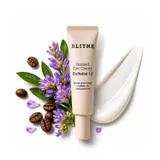
| INNBEAUTY PROJECTBright & Tight Dark Circle Firming Eye Cream with Vitamin C & PeptidesYOUR PRODUCT | AbibCollagen Eye Creme Jericho Rose Tube | BlithePressed eye cream caffeine | AgeWellEnriching Eye Cream with Caffeine + Bakuchiol | |
|---|---|---|---|---|
| Match | — | 75% | 73% | 72% |
| Price | $40.00 | $16.52−$23.48 | — | $15.85−$24.15 |
| Shared key ingredients | — | 11 of 23 | 6 of 23 | 6 of 23 |
| Key difference | — | Niacinamide | Niacinamide | Niacinamide |
| Irritancy | Medium | Medium | Medium | Medium |
| Drying alcohol | — | — | — | — |
| View product | Shop | Shop | Shop |

Product summary
Judging from the ingredient list, "INNBEAUTY PROJECT - Bright & Tight Dark Circle Firming Eye Cream with Vitamin C & Peptides" works well for improving skin hydration To work well, any moisturizer needs to include a combination of water-binding and emollient ingredients. INNBEAUTY PROJECT - Bright & Tight Dark Circle Firming Eye Cream with Vitamin C & Peptides ticks this box. Humectants in this product (glycerin, sodium hyaluronate, sodium pca, glucose and butylene glycol) help to increase the water content in the upper layer of the skin. (These ingredients do so by "capturing" water molecules from the outside air or from within the deeper layers of the skin). Emollients in this formulation (helianthus annuus extract, bis-diglyceryl polyacyladipate-2, caprylic/capric triglyceride, dimethicone and squalane) help to reduce the moisture loss from the skin. They also soften the skin surface and relieve the feeling of dryness and tightness.
Ingredient callouts
- Bakuchiol in this moisturizer (the concentration is about 0.30% - 0.55%). Helps fight photodamage (wrinkles, elasticity loss and pigmentation) and can reduce clogged pores and blemishes. Bakuchiol is a compound extracted from a plant Babchi. It acts similar to retinoids, but with less irritation risk.
- We like that this moisturizer contains peptides (palmitoyl tripeptide-5 0.20% - 0.40%). There are many different kind of Peptides and they are naturally present in our skin. They all are a combination of aminoacids. Some of them work as natural antibiotics, promote wound-healing and production of collagen. The science is still not settled on how effective Peptides are in skincare, but it is very likely that they have a benefit. Peptides might help restore the skin barrier and fight the signs of aging. At the very least, Peptides work as humectants: they attract water to the upper layer of the skin and improve its hydration.
Irritation risk
This moisturizer contains some common irritants, including those without a benefit for the skin. We assess the overall irritancy of this moisturizer to be medium. For a detailed overview of all potential irritants: click here
You can see the detailed formula review with the breakdown of all actives in the product and the full ingredient list with estimated concentrations in the tables below.
What our users say
Based on 1 review 0% recommend this productPrice
The product retails for 40.23$ in the United States and for 46.00CA$ in Canada.
For a detailed price comparison: click here.
Sources cited in this review
Every concentration estimate and effectiveness label is anchored to one of these 36 studies and safety reviews.
- 1Effect of tranexamic acid on melasma: a clinical trial with histological evaluationonlinelibrary.wiley.com
- 2Tranexamic acid accelerates skin barrier recovery and upregulates occludin in damaged skinonlinelibrary.wiley.com
- 3
- 4Efficacy and possible mechanisms of topical tranexamic acid in melasmaonlinelibrary.wiley.com
- 5
- 6Final Report on the Safety Assessment of Dimethicone Copolyoljournals.sagepub.com

Affiliate links · As an Amazon Associate, WIMJ earns from qualifying purchases.