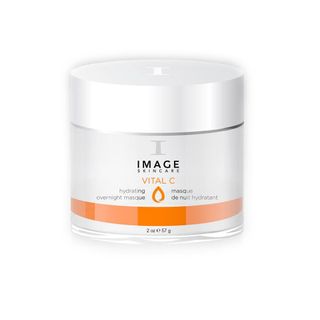
Image skincare Vital C Hydrating Overnight Masque
Works for
1 of 3 advertised claims delivered
Moisturizing16 ingredients credited for this claimGood support
“Vital C Hydrating Overnight Masque”
This product can help improve hydration of the skin with the two types of ingredients.
The first type is called “humectants”:
these ingredients help attract water.
When humectants are on the surface of the skin, they “pull in” the moisture from the outside environment, or from
within deeper layers of the skin. The following ingredients in this product do the job:
algae extract, biosaccharide gum-1.
This product also contains ingredients called “occlusives”. They help reduce the speed with which our skin loses moisture to the outside environment. These ingredients also help soften the upper layer of the skin, so it feels less tight and nicer to the touch. The following ingredients in this product do the job: dimethicone, algae extract.
Evens skin tone4 ingredients credited for this claimWeak support
“Physician formulated, this smoothing overnight treatment is infused with a triple mineral complex that energizes, blue-green algae extract that smooths and minimizes the appearance of wrinkles and hematite that restores, evens and revitalizes the skin's tone.Key Ingredients Blue Green Algae Extract smooths the skin and reduces wrinkles Hematite helps restore skin's tone Malachite provides antioxidant benefits Key Benefits Boosts the appearance of dull skin Delivers maximum antioxidants for radiant, healthy-looking skin Brightens the skin and supports firmness and tone Improves the appearance of fine lines, crepey skin and dryness”
Effective ingredients missing or their concentration is too low
Anti-aging7 ingredients credited for this claimWeak support
“The Vital C Hydrating Overnight Masque uses a triple mineral complex alongside blue-green algae to support the skin, reducing wrinkles and smoothing the skin.”
Effective ingredients missing or their concentration is too low.
Can it cause trouble?
Irritancy5 strong irritants: Citrus aurantium dulcis peel oil, Retinyl palmitate + 3 more — patch-test recommendedHigh risk
Comedogenic1 ingredient rated 2 or more on the 0–5 pore-clogging scale1 flagged
User reviews
Be the first — your take helps the next person decide.
Ingredients
Filter by role to see what each ingredient is doing.
Water~45–55%
Butylene glycol~6.8–8.3%
- Irritation risk
- Low
Used to create a nice product texture and help delivery of other ingredients. Might be somewhat helpful in attracting water to the upper layer of the skin
More about Butylene glycolDimethicone~4.3–5.3%
- Irritation risk
- Low
A silicone that helps to reduce water loss from the surface of the skin. Can temporarily "fill in" lines and wrinkles, absorb oil, and create a nice product finish
More about DimethiconeAmmonium acryloyldimethyltaurate/vp copolymer~3.1–3.8%
- Irritation risk
- Low
Increases thickness of a product. Texture enhancer for oil-in-water emulsions
More about Ammonium acryloyldimethyltaurate/vp copolymerGlycerin~2.4–2.9%
- Irritation risk
- Low
One of the best moisturizing ingredients. Naturally present in skin. It attracts water to the upper layer of the skin working as a humectant
More about GlycerinPolyglyceryl-3 methylglucose distearate~1.9–2.3%
- Irritation risk
- Medium
Helps water and oil mix together
More about Polyglyceryl-3 methylglucose distearatePropanediol~1.6–1.9%
- Irritation risk
- Low
Acts as a solvent for other ingredients. Speeds up the absorption of other ingredients into the skin
More about PropanediolCyclopentasiloxane~1.4–1.7%
- Irritation risk
- Low
A silicone that helps improve the product texture and spreadability. Can absorb oil creating a short-term mattifying effect on the skin
More about CyclopentasiloxaneHippophae rhamnoides fruit oil~1.1–1.4%
- Irritation risk
- High
A plant oil that might somewhat help to neutralize free radicals. It could be irritating
More about Hippophae rhamnoides fruit oilCitrus aurantium dulcis peel oil~0.8–1.2%
- Irritation risk
- High
An essentil oil from orange peel. Potential allergen and can be irritating
More about Citrus aurantium dulcis peel oilAllantoin~0.5–0.8%
- Irritation risk
- Low
Helps calm down inflammation in skin and can help reduce itching. Helps to repair the skin barrier and keep skin hydrated
More about AllantoinSoluble collagen~0.55–0.85%
- Irritation risk
- Low
A typically plant-derived compound that is supposed mimic human collagen. Cannot penetrate the skin barrier so is not particularly useful in skincare products beyond attracting water to the upper layer of the skin
More about Soluble collagenEthylhexylglycerin~0.5–0.7%
Dimethicone/vinyl dimethicone crosspolymer~0.45–0.65%
- Irritation risk
- Low
Used to stabilize product formulations and create a nice product texture
More about Dimethicone/vinyl dimethicone crosspolymerPentylene glycol~0.45–0.7%
- Irritation risk
- Medium
Used to preserve products, dissolve other ingredients and create a nice product texture
More about Pentylene glycolTocopherol~0.4–0.6%
- Irritation risk
- Low
Pure form of vitamin E. Can help moisturise and protect the skin from free radicals. Often used to help stabilise other ingredients or the formula itself
More about TocopherolRetinyl palmitate~0.3–0.6%
- Irritation risk
- High
Three steps removed from the active form of vitamin A - retinoic acid. To have an effect in the skin, it first needs to be converted twice to become the retinoic acid. This means it is less potent than retinol, but could also be less irritating. Once converted to the retinoic acid in the skin, it helps against all signs of aging, improves skin cell turnover and helps fight blemishes and clogged pores. However, in many cosmetic formulations, it is used in a concentration that is too low to have the full effect
More about Retinyl palmitateTetrahexyldecyl ascorbate~0.3–0.6%
- Irritation risk
- Medium
Being a lipid soluble form of vitamin C, it is more stable than ascorbic acid, but still degrades quickly and needs to be stabilized in a formulation with another ingredient. It is claimed to penetrate skin better than pure vitamin C and have the the similar benefits, but solid studies of its effectiveness are lacking. Is likely to require a higher concentration in a product than pure vitamin C to be effective. It might be able to help reduce pore clogging.
More about Tetrahexyldecyl ascorbateHematite extract~0.3–0.55%
- Irritation risk
- Low
Hydrogenated starch hydrolysate~0.25–0.5%
- Irritation risk
- Low
Helps to attract water to the upper layer of the skin. Can add sweet taste to lip products
More about Hydrogenated starch hydrolysateBiosaccharide gum-1~0.25–0.45%
- Irritation risk
- Low
Helps attract water to the upper layer of the skin and is claimed to provide a longer-lasting hydration because of its ability to create a water-binding film on the surface of the skin
More about Biosaccharide gum-1Leuconostoc/radish root ferment filtrate~0.25–0.45%
- Irritation risk
- Medium
A preservative that comes from radishes fermented by a bacteria. New research suggests that the preservation properties in the ingredient come from an ammonium salt that is not present naturally in radish root but used in its cultivation. Is problematic because the exact amount of the preservative agents is difficult to determine
More about Leuconostoc/radish root ferment filtrateDisodium edta-copper~0.2–0.4%
- Irritation risk
- Low
Anthemis nobilis flower extract~0.2–0.35%
- Irritation risk
- High
A plant extract that one one hand, can contain compounds that can help calm down skin irritation, but, on the other hand, its other compounds (especially fragrant ones) can themselves be irritating
More about Anthemis nobilis flower extractEchinacea angustifolia extract~0.2–0.35%
- Irritation risk
- High
Plant extract that might contain antioxidants, have antibacterial effect and help reduce inflammation, but solid evidence is lacking. Can be irritating
More about Echinacea angustifolia extractMagnesium aspartate~0.2–0.4%
- Irritation risk
- Low
Might be helpful in restoring skin barrier function and calm down inflammation in skin
More about Magnesium aspartateMalachite extract~0.25–0.4%
- Irritation risk
- Low
A mineral that is claimed to be able to support collagen product in skin, but evidence of effectiveness is missing
More about Malachite extractSodium hyaluronate crosspolymer~0.2–0.4%
- Irritation risk
- Medium
Attracts water into the upper layer of the skin
More about Sodium hyaluronate crosspolymerSymphytum officinale rhizome/root extract~0.2–0.4%
- Irritation risk
- Low
Zinc gluconate~0.2–0.35%
- Irritation risk
- Medium
Typically used to stabilize the product formulations. It is a salt of a polyhydroxy acid (PHA) and in larger concentrations, can help shed the dead cells from the skin surface revealing smoother skin. It can help attract water to the upper layer of the skin. Might to be helpful against acne and clogged pores. Could be helpful in neutralizing free radicals, but solid research is missing. Due to the zinc content, might help calm down inflammation in skin
More about Zinc gluconateAlgae extract~0.25–0.45%
- Irritation risk
- Low
- Comedogenicity
- 3/5
Plant extract that helps the skin to attract water and make it more smooth for touch. Also shows promise of anti-aging properties, but research is not extensive yet
More about Algae extractCopper gluconate~0.15–0.3%
- Irritation risk
- Medium
Typically used to stabilize the product formulations. It is a salt of polyhydroxy acid (PHA) and in larger concentrations, can help shed the dead cells from the skin surface revealing smoother skin. It can help attract water to the upper layer of the skin. Might to be helpful against acne and clogged pores. Could be helpful in neutralizing free radicals, but solid research is missing
More about Copper gluconatePhenoxyethanol~0.1–0.2%
- Irritation risk
- Low
A preservative. It helps prevent bacterial growth in cosmetic products
More about PhenoxyethanolPotassium sorbate~0.1–0.25%
Sorbic acid~0.1–0.2%
Limonene~0.05–0.1%
- Irritation risk
- High
A common frangrance that can easily irritate skin, especially if exposed to air, light or heat
More about LimoneneLinalool~0.05–0.1%
Ingredient list view
Water, Butylene glycol, Dimethicone, Ammonium acryloyldimethyltaurate/vp copolymer, Glycerin, Polyglyceryl-3 methylglucose distearate, Propanediol, Cyclopentasiloxane, Hippophae rhamnoides fruit oil, Citrus aurantium dulcis peel oil, Allantoin, Soluble collagen, Ethylhexylglycerin, Dimethicone/vinyl dimethicone crosspolymer, Pentylene glycol, Tocopherol, Retinyl palmitate, Tetrahexyldecyl ascorbate, Hematite extract, Hydrogenated starch hydrolysate, Biosaccharide gum-1, Leuconostoc/radish root ferment filtrate, Disodium edta-copper, Anthemis nobilis flower extract, Echinacea angustifolia extract, Magnesium aspartate, Malachite extract, Sodium hyaluronate crosspolymer, Symphytum officinale rhizome/root extract, Zinc gluconate, Algae extract, Copper gluconate, Phenoxyethanol, Potassium sorbate, Sorbic acid, Limonene, Linalool
Compare prices
Retailers ranked by price — lowest first.


Sources cited in this review
Every concentration estimate and effectiveness label is anchored to one of these 19 studies and safety reviews.
- 1
- 2Final Report on the Safety Assessment of Dimethicone Copolyoljournals.sagepub.com
- 3
- 4
- 5Vitamin E in dermatologyncbi.nlm.nih.gov
- 6Vitamin E and Skin Healthlpi.oregonstate.edu

Affiliate links · As an Amazon Associate, WIMJ earns from qualifying purchases.