Works for
2 of 2 advertised claims delivered
Moisturizing31 ingredients credited for this claimStrong support
“Penetrates deeply with moisture with prolonged moisturizing effect.”
This product can help improve hydration of the skin with the two types of ingredients.
The first type is called “humectants”:
these ingredients help attract water.
When humectants are on the surface of the skin, they “pull in” the moisture from the outside environment, or from
within deeper layers of the skin. The following ingredients in this product do the job:
arginine, betaine.
This product also contains ingredients called “occlusives”. They help reduce the speed with which our skin loses moisture to the outside environment. These ingredients also help soften the upper layer of the skin, so it feels less tight and nicer to the touch. The following ingredients in this product do the job: arginine, dimethicone.
The following ingredients in this product are especially good for supporting the skin barrier and helping with the hydration level: acetyl tetrapeptide-11, copper tripeptide-1
Anti-aging11 ingredients credited for this claimStrong support
“Brand from South Korea HERA. Benefits An anti-aging emulsion enriched with collagen, offers prolonged nourishing effect while leaving skin supple and full of elasticity.”
This product can help reduce and prevent fine lines and wrinkles, improve skin elasticity and firmness because it contains adenosine.
These ingredients in the product can also be helpful, even though there is less evidence for their effectiveness: acetyl tetrapeptide-11, copper tripeptide-1, lysine.
Keep in mind that it typically takes at least 6 weeks to notice any results because the changes that are needed to improve fine lines and elasticity happen in the deeper layers of the skin. No topical anti-aging product can “erase” wrinkles or fully reverse signs of aging.
Can it cause trouble?
Irritancy5 strong irritants: Alcohol denat., Parfum + 3 more — patch-test recommendedHigh risk
ComedogenicClean of flagged comedogenic ingredientsNone flagged


User reviews
Be the first — your take helps the next person decide.
Ingredients
Filter by role to see what each ingredient is doing.
Water~45–55%
Propanediol~4.2–5.2%
- Irritation risk
- Low
Acts as a solvent for other ingredients. Speeds up the absorption of other ingredients into the skin
More about PropanediolAlcohol denat.~4–4.9%
- Irritation risk
- High
Produces temporary toning effect. Can help dissolve other ingredients or preserve products
More about Alcohol denat.Glycerin~2.9–3.6%
- Irritation risk
- Low
One of the best moisturizing ingredients. Naturally present in skin. It attracts water to the upper layer of the skin working as a humectant
More about GlycerinPeg/ppg-17/6 copolymer~2.3–2.8%
- Irritation risk
- Low
Glycereth-26~1.8–2.2%
Betaine~1.5–1.8%
- Irritation risk
- Low
Helps attract water to the upper layer of the skin and improves the product texture
More about BetaineMethyl gluceth-20~1.3–1.6%
- Irritation risk
- Low
Helps attract water to the upper layer of the skin and soften it
More about Methyl gluceth-20Ppg-13-decyltetradeceth-24~1.1–1.4%
- Irritation risk
- Medium
Helps oil and water mix together
More about Ppg-13-decyltetradeceth-24Niacinamide~0.9–1.1%
- Irritation risk
- Low
Is proven to be effective in reducing blemishes, evening out skin tone and helping to improve lines and wrinkles. It helps the skin to repair sun damage, calm down inflammation and keep maintain good levels of moisture. The concentration of about 2% is effective for supporting the skin barrier and evening out the skin tone. Concentration of 4-6% is better for helping with acne and balancing the sebum production
More about Niacinamide1,2-hexanediol~0.6–0.9%
Bis-peg-18 methyl ether dimethyl silane~0.55–0.85%
- Irritation risk
- Low
A type of silicone that helps soften the upper layer of the skin and create a nice product texture
More about Bis-peg-18 methyl ether dimethyl silaneDimethicone~0.55–0.85%
- Irritation risk
- Low
A silicone that helps to reduce water loss from the surface of the skin. Can temporarily "fill in" lines and wrinkles, absorb oil, and create a nice product finish
More about DimethiconeOctyldodeceth-16~0.5–0.7%
Carbomer~0.45–0.65%
- Irritation risk
- Low
Helps create a thicker or gel-like product texture. It is not a surfactant but can be used in gentle cleansing formulations
More about CarbomerGlyceryl caprylate~0.5–0.7%
- Irritation risk
- Low
An emollient that can also help water and oil mix together, as well as prevent bacteria growth in products
More about Glyceryl caprylateButylene glycol~0.4–0.6%
- Irritation risk
- Low
Used to create a nice product texture and help delivery of other ingredients. Might be somewhat helpful in attracting water to the upper layer of the skin
More about Butylene glycolXanthan gum~0.35–0.65%
- Irritation risk
- Low
Used to create a thicker product consistency
More about Xanthan gumTromethamine~0.3–0.6%
Parfum~0.25–0.5%
- Irritation risk
- High
An aromatic blend of unspecified and possibly irritating ingredients
More about ParfumAlcohol~0.3–0.5%
- Irritation risk
- High
Can be drying and contribute to skin irritation. Used in formulars to dissolve other ingredients, create a thinner product consistency or for its antibacterial properties
More about AlcoholEthylhexylglycerin~0.25–0.5%
Adenosine~0.25–0.45%
- Irritation risk
- Low
Might help improve cell turnover and reduce inflammation in skin. One study shows that the ingredients might be able to help reduce dynamic wrinkles (for example, in the corners of the eyes or on the forehead)
More about AdenosineHydrogenated lecithin~0.25–0.5%
- Irritation risk
- Low
Helps to retain moisture by creating a protective barrier on the skin. Rich in fatty acids. Improves product texture and helps with the penetration of other ingredients.
More about Hydrogenated lecithinDisodium edta~0.25–0.45%
Cellulose gum~0.3–0.55%
- Irritation risk
- Low
Used to create thicker product consistency and stabilize emulsions
More about Cellulose gumHyaluronic acid~0.3–0.5%
- Irritation risk
- Low
One of the best moisturizing ingredients. Attracts water into the upper layer of the skin. Naturally present in skin. Typically has large molecule size unless advertised otherwise on the product label. Helps support skin's barrier function and may help to reduce inflammation
More about Hyaluronic acidMannitol~0.25–0.5%
- Irritation risk
- Low
Helps to attract water to the upper layer of the skin
More about MannitolLimonene~0.25–0.5%
- Irritation risk
- High
A common frangrance that can easily irritate skin, especially if exposed to air, light or heat
More about LimoneneHydroxypropyl cyclodextrin~0.3–0.6%
- Irritation risk
- Medium
Used to stabilize product formulations and help soften the upper layer of the skin
More about Hydroxypropyl cyclodextrinSodium hyaluronate~0.3–0.5%
- Irritation risk
- Low
One of the best moisturizing ingredients. Attracts water into the upper layer of the skin
More about Sodium hyaluronateTrisodium fructose diphosphate~0.3–0.55%
- Irritation risk
- Low
Butylphenyl methylpropional~0.25–0.5%
- Irritation risk
- High
A fragrance. Can trigger allergic reactions and be irritating
More about Butylphenyl methylpropionalSodium methyl stearoyl taurate~0.65–0.95%
Pvp~0.3–0.55%
- Irritation risk
- Medium
Helps evenly disperse other ingredients in a formulation and create an even layer on the surface of the skin
More about PvpYeast extract~0.3–0.5%
- Irritation risk
- Low
Helps attract water to the upper layer of the skin and might have some anti-oxidant and skin lightening properties. It can help calm down inflammation in skin
More about Yeast extractPhytantriol~0.3–0.55%
- Irritation risk
- Low
Potassium hydroxide~0.3–0.55%
Acetic acid~0.3–0.55%
- Irritation risk
- Low
Bht~0.3–0.5%
Sodium pca~0.3–0.5%
- Irritation risk
- Low
Naturally present in skin and helps to attract water to its upper layer
More about Sodium pcaZinc pca~0.25–0.45%
- Irritation risk
- Low
A compound that combines zinc with a hydrating ingredient PCA. Might to be helpful against acne and clogged pores. Can help calm down inflammation in skin. Could be helpful in reducing the formation of free radicals in skin. Might help to reduce fine lines in wrinkles, but solid evidence is missing
More about Zinc pcaPoloxamer 407~0.3–0.55%
Phenoxyethanol~0.3–0.55%
- Irritation risk
- Low
A preservative. It helps prevent bacterial growth in cosmetic products
More about PhenoxyethanolMethoxy peg-114/polyepsilon caprolactone~0.3–0.55%
- Irritation risk
- Low
Tocopherol~0.3–0.55%
- Irritation risk
- Low
Pure form of vitamin E. Can help moisturise and protect the skin from free radicals. Often used to help stabilise other ingredients or the formula itself
More about TocopherolHydroxyethyl acrylate/sodium acryloyldimethyl taurate copolymer~0.3–0.55%
- Irritation risk
- Medium
A gelling agent that thickens the product consistency and leaves the skin with a velvety finish
More about Hydroxyethyl acrylate/sodium acryloyldimethyl taurate copolymerCaprylyl glycol~0.3–0.55%
- Irritation risk
- Medium
Helps preserve products and creates a nice product texture
More about Caprylyl glycolAmmonium acryloyldimethyltaurate/vp copolymer~0.3–0.55%
- Irritation risk
- Low
Increases thickness of a product. Texture enhancer for oil-in-water emulsions
More about Ammonium acryloyldimethyltaurate/vp copolymerPrunus persica leaf extract~0.3–0.6%
- Irritation risk
- High
Might be helpful in supporting collagen and ellastin production but solid research is lacking. Could be irritating
More about Prunus persica leaf extractLysine~0.25–0.5%
- Irritation risk
- Low
An amino-acid that helps to attract water to the upper layer of the skin. In combination with other amino-acids, might help to reduce fine lines and wrinkles
More about LysineArginine~0.25–0.5%
- Irritation risk
- Low
An amino acid that is naturally present in skin and helps keep it hydrated. When used together with AHAs, it can reduce their irritating effect on the skin
More about ArginineHistidine~0.25–0.5%
Acetyl tetrapeptide-11~0.25–0.5%
- Irritation risk
- Low
A type of peptide. Peptides are excellent moisturizers and might be able support collagen production reducing fine lines and wrinkles
More about Acetyl tetrapeptide-11Glucose~0.3–0.5%
- Irritation risk
- Low
Helps attract water to the upper layer of the skin. Could be helpful in restoring the skin barrier function
More about GlucoseXylose~0.25–0.5%
- Irritation risk
- Low
Hydrolyzed collagen~0.3–0.6%
- Irritation risk
- Low
A typically plant-derived compound that is supposed mimic human collagen. Cannot penetrate the skin barrier so is not particularly useful in skincare products beyond attracting water to the upper layer of the skin
More about Hydrolyzed collagenMannose~0.3–0.5%
- Irritation risk
- Low
Sodium chloride~0.3–0.55%
- Irritation risk
- Low
Used to stabilize mixtures of oil and water, and create thicker, gel-like product textures
More about Sodium chlorideLecithin~0.3–0.6%
- Irritation risk
- Low
Used mostly for creating emulsions - helping oil and water mix together. Helps soften the upper layer of the skin
More about LecithinPentylene glycol~0.3–0.6%
- Irritation risk
- Medium
Used to preserve products, dissolve other ingredients and create a nice product texture
More about Pentylene glycolHydrogenated phosphatidylcholine~0.3–0.55%
- Irritation risk
- Medium
Helps oil and water mix together
More about Hydrogenated phosphatidylcholineCopper tripeptide-1~0.25–0.5%
- Irritation risk
- Low
A naturally occurring peptide. One of the most studied peptides in dermatology. It is sometimes abbreviated GHK-Cu. Belongs to the class of carrier peptides. It stimulates both synthesis and breakdown of collagen in skin. It is released in skin wounds and inflammation to support healing. It accelerates wound-healing of the skin and can stimulate hair growth. There are preliminary studies that confirm that copper tripeptide can help support collagen production reducing fine lines and wrinkles and decrease inflammation in skin.
More about Copper tripeptide-1Sodium phosphate~0.25–0.5%
Dextrin~0.25–0.5%
- Irritation risk
- Low
A sugar that is used to stabilize the product formulation. Can help attract water to the upper layer of the skin
More about DextrinHydrolyzed hibiscus esculentus extract~0.25–0.45%
- Irritation risk
- Medium
A plant extract that might contain a peptide (Myoxinol). It could be helpful in attracting water to the upper layer of the skin and might have some anti-aging effect, but the research is lacking and it is rarely used in a high enough concentration
More about Hydrolyzed hibiscus esculentus extractCholesterol~0.25–0.5%
- Irritation risk
- Low
An emollient that is naturally found in skin
More about CholesterolFucose~0.2–0.35%
- Irritation risk
- Low
Dipalmitoyl hydroxyproline~0.15–0.3%
- Irritation risk
- Low
Is claimed to stimulate collagen and elastin production, as well as work as an anti-oxidant. There is however not enough evidence for its effectiveness
More about Dipalmitoyl hydroxyprolineAcrylates/stearyl methacrylate copolymer~0.15–0.25%
- Irritation risk
- Low
Calcium chloride~0.15–0.25%
- Irritation risk
- Medium
Helps create a thicker product consistency. Might be irritating
More about Calcium chloridePotassium chloride~0.15–0.25%
- Irritation risk
- Low
Potassium phosphate~0.15–0.25%
Magnesium chloride~0.05–0.15%
Hydrolyzed millet~0.05–0.15%
- Irritation risk
- Low
Ingredient list view
Water, Propanediol, Alcohol denat., Glycerin, Peg/ppg-17/6 copolymer, Glycereth-26, Betaine, Methyl gluceth-20, Ppg-13-decyltetradeceth-24, Niacinamide, 1,2-hexanediol, Bis-peg-18 methyl ether dimethyl silane, Dimethicone, Octyldodeceth-16, Carbomer, Glyceryl caprylate, Butylene glycol, Xanthan gum, Tromethamine, Parfum, Alcohol, Ethylhexylglycerin, Adenosine, Hydrogenated lecithin, Disodium edta, Cellulose gum, Hyaluronic acid, Mannitol, Limonene, Hydroxypropyl cyclodextrin, Sodium hyaluronate, Trisodium fructose diphosphate, Butylphenyl methylpropional, Sodium methyl stearoyl taurate, Pvp, Yeast extract, Phytantriol, Potassium hydroxide, Acetic acid, Bht, Sodium pca, Zinc pca, Poloxamer 407, Phenoxyethanol, Methoxy peg-114/polyepsilon caprolactone, Tocopherol, Hydroxyethyl acrylate/sodium acryloyldimethyl taurate copolymer, Caprylyl glycol, Ammonium acryloyldimethyltaurate/vp copolymer, Prunus persica leaf extract, Lysine, Arginine, Histidine, Acetyl tetrapeptide-11, Glucose, Xylose, Hydrolyzed collagen, Mannose, Sodium chloride, Lecithin, Pentylene glycol, Hydrogenated phosphatidylcholine, Copper tripeptide-1, Sodium phosphate, Dextrin, Hydrolyzed hibiscus esculentus extract, Cholesterol, Fucose, Dipalmitoyl hydroxyproline, Acrylates/stearyl methacrylate copolymer, Calcium chloride, Potassium chloride, Potassium phosphate, Magnesium chloride, Hydrolyzed millet
Compare prices
Retailers ranked by price — lowest first.

Affiliate links · prices updated regularly
Worth comparing, line by line.
Match % combines shared ingredients, the first five ingredients, shared actives and hero ingredients, irritancy (lower counts in the alternative's favour), texture and body area. Only products in the same routine step are compared.
| HERAAge Away Collagenic EmulsionYOUR PRODUCT | NEOGEN X SUR.MEDICProbiotics Youth Repair Cream | TROIAREUKESeoul Aesthetic Cushion - 2 Colors | MISSHAActibarrier Strong Moist Cream INTENSIVE | |
|---|---|---|---|---|
| Match | — | 82% | 79% | 79% |
| Price | $57.60 | $24.30−$33.30 | $46.40−$11.20 | $28.11−$29.49 |
| Shared key ingredients | — | 14 of 19 | 6 of 19 | 9 of 19 |
| Key difference | — | Hexapeptide-11 | Acetyl Hexapeptide-8 | Ceramide Np |
| Irritancy | High | Medium | Medium | Medium |
| Drying alcohol | Contains drying alcohol | — | — | — |
| View product | Shop | Shop | Shop |


Product summary
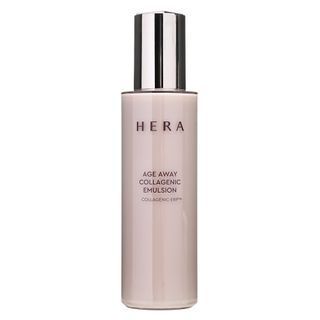
"HERA - Age Away Collagenic Emulsion" is a well-rounded moisturizing product. As we expect from a proper moisturizer, the formula includes a combo of effective humectants and emollients. These are the two different types of ingredients that are essential for improving the skin hydration and supporting a healthy skin barrier. Arginine, betaine, glycerin, histidine and hyaluronic acid in this product (humectants) attract water molecules to the upper layer of the skin (the water comes from the outside air or from the deeper layers of the skin if the air is dry). Cholesterol, hydrolyzed collagen, arginine, dimethicone and bis-peg-18 methyl ether dimethyl silane in this product help decrease the water evoporation from the skin, so that it stays hydrated for longer. These ingredients also soften the skin and take away the feeling of tightness and dryness.
Ingredient callouts
- We like that this moisturizer contains peptides (copper tripeptide-1 0.25% - 0.50% and acetyl tetrapeptide-11 0.25% - 0.50%). There are many different kind of Peptides and they are naturally present in our skin. They all are a combination of aminoacids. Some of them work as natural antibiotics, promote wound-healing and production of collagen. The science is still not settled on how effective Peptides are in skincare, but it is very likely that they have a benefit. Peptides might help restore the skin barrier and fight the signs of aging. At the very least, Peptides work as humectants: they attract water to the upper layer of the skin and improve its hydration.
- Adenosine 0.25% - 0.45%. It is a compound that in involved in many biological processes inside the skin cells. According one high-quality clinical trial, topical Adenosine in low concentrations can somewhat help improve "deep wrinkles" - the wrinkles that appear with age in places where our faces are most dynamic (for example, on the forehead or in the corners of the eyes).
Irritation risk
There are quite a few common irritants in this product, including ingredients without particular skin benefits. We would not recommend it for sensitive skin. We assess the overall irritancy of this moisturizer to be high. For a detailed overview of all potential irritants: click here
You can see the detailed formula review with the breakdown of all actives in the product and the full ingredient list with estimated concentrations in the tables below.
Price
The product retails for 121.00CA$ in Canada, for 155.00A$ in Australia and for 57.60$ in the United States.
For a detailed price comparison: click here.
Sources cited in this review
Every concentration estimate and effectiveness label is anchored to one of these 27 studies and safety reviews.
- 1
- 2
- 3
- 4
- 5
- 6

Affiliate links · As an Amazon Associate, WIMJ earns from qualifying purchases.