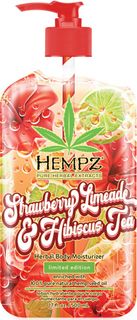
Hempz Limited Edition Strawberry Limeade & Hibiscus Tea Herbal Body Moisturizer
Works for
1 of 1 advertised claim delivered
MoisturizingButyrospermum parkii butter, Helianthus annuus seed oil + 8 moreGood evidence
“Limited Edition Strawberry Limeade & Hibiscus Tea Herbal Body Moisturizer”
This product can help improve hydration of the skin with the two types of ingredients.
The first type is called “humectants”:
these ingredients help attract water.
When humectants are on the surface of the skin, they “pull in” the moisture from the outside environment, or from
within deeper layers of the skin. The following ingredients in this product do the job:
glycerin.
This product also contains ingredients called “occlusives”. They help reduce the speed with which our skin loses moisture to the outside environment. These ingredients also help soften the upper layer of the skin, so it feels less tight and nicer to the touch. The following ingredients in this product do the job: butyrospermum parkii butter, dimethicone.
Can it cause trouble?
Irritancy12 strong irritants: Parfum, Citrus aurantifolia fruit extract + 10 more — patch-test recommendedHigh risk
Comedogenic2 ingredients rated 2 or more on the 0–5 pore-clogging scale2 flagged
User reviews
Be the first — your take helps the next person decide.
Ingredients
Filter by role to see what each ingredient is doing.
Water~45–55%
Propanediol~4.7–5.8%
- Irritation risk
- Low
Acts as a solvent for other ingredients. Speeds up the absorption of other ingredients into the skin
More about PropanediolIsopropyl palmitate~4.1–5%
- Irritation risk
- Medium
- Comedogenicity
- 3/5
Helps soften the upper layer of the skin and create a thicker product consistency
More about Isopropyl palmitateGlycerin~3–3.6%
- Irritation risk
- Low
One of the best moisturizing ingredients. Naturally present in skin. It attracts water to the upper layer of the skin working as a humectant
More about GlycerinButyrospermum parkii butter~2.4–2.9%
- Irritation risk
- Low
- Comedogenicity
- 3/5
A great moisturising ingredient that softens the skin and reduces water loss from its upper layer. It also can be helpful in protecting skin from free radicals
More about Butyrospermum parkii butterDimethicone~2–2.4%
- Irritation risk
- Low
A silicone that helps to reduce water loss from the surface of the skin. Can temporarily "fill in" lines and wrinkles, absorb oil, and create a nice product finish
More about DimethiconeSorbitan stearate~1.6–1.9%
Parfum~1.4–1.7%
- Irritation risk
- High
An aromatic blend of unspecified and possibly irritating ingredients
More about ParfumStearic acid~1.3–1.5%
- Irritation risk
- Low
Helps oil and water mix together and works as an emollient
More about Stearic acidGlyceryl stearate~1–1.2%
- Irritation risk
- Low
An emollient that softens the skin and forms a protective layer on its surface. Helps water and oil mix together
More about Glyceryl stearatePeg-100 stearate~0.75–1.15%
- Irritation risk
- Low
Helps oil and water mix togehter and creates a nice product texture
More about Peg-100 stearateCannabis sativa seed oil~0.6–0.9%
- Irritation risk
- Medium
A plant oil that due to its high linoleic acid content can help strengthen skin's barrier function and soften its upper layer
More about Cannabis sativa seed oilFragaria vesca fruit extract~0.5–0.8%
- Irritation risk
- Medium
A plant extract that might help neutralize free radicals in skin, but research on its effectiveness is lacking
More about Fragaria vesca fruit extractCitrus aurantifolia fruit extract~0.5–0.7%
Hibiscus sabdariffa flower extract~0.45–0.7%
- Irritation risk
- High
A plant extract that can be irritating. It might contain a compound anthocyanin that could be helpful in neutralizing free radicals
More about Hibiscus sabdariffa flower extractAloe barbadensis leaf juice~0.45–0.7%
- Irritation risk
- Medium
Traditionally used to treat sunburns, dermatitis and inflammation, but evidence for its effectiveness is lacking. The extract can contain humectants that help attract water into the skin
More about Aloe barbadensis leaf juiceHelianthus annuus seed oil~0.45–0.7%
- Irritation risk
- Low
A great emollient due to its high linoleic acid content. One of the most effective plant oils in helping skin hydration and repairing skin barrier function
More about Helianthus annuus seed oilAscorbic acid~0.4–0.6%
- Irritation risk
- High
The most well-researched antioxidant that works in skin. Helps neutralize free radicals supporting collagen production, helping to even out the skin tone and preventing early signs of aging
More about Ascorbic acidRetinyl palmitate~0.3–0.6%
- Irritation risk
- High
Three steps removed from the active form of vitamin A - retinoic acid. To have an effect in the skin, it first needs to be converted twice to become the retinoic acid. This means it is less potent than retinol, but could also be less irritating. Once converted to the retinoic acid in the skin, it helps against all signs of aging, improves skin cell turnover and helps fight blemishes and clogged pores. However, in many cosmetic formulations, it is used in a concentration that is too low to have the full effect
More about Retinyl palmitateCitric acid~0.3–0.55%
- Irritation risk
- Medium
Can work as an exfoliant but is typically used to adjust the product pH
More about Citric acidLeuconostoc/radish root ferment filtrate~0.3–0.55%
- Irritation risk
- Medium
A preservative that comes from radishes fermented by a bacteria. New research suggests that the preservation properties in the ingredient come from an ammonium salt that is not present naturally in radish root but used in its cultivation. Is problematic because the exact amount of the preservative agents is difficult to determine
More about Leuconostoc/radish root ferment filtratePhenoxyethanol~0.3–0.55%
- Irritation risk
- Low
A preservative. It helps prevent bacterial growth in cosmetic products
More about PhenoxyethanolCetyl alcohol~0.3–0.55%
- Irritation risk
- Low
A non-drying alcohol that works to soften the skin and stabilize product formulations helping oil and water mix together
More about Cetyl alcoholPolysorbate 40~0.25–0.5%
Nylon-12~0.25–0.5%
Carbomer~0.25–0.45%
- Irritation risk
- Low
Helps create a thicker or gel-like product texture. It is not a surfactant but can be used in gentle cleansing formulations
More about CarbomerChlorphenesin~0.16–0.32%
Aminomethyl propanol~0.25–0.45%
Butylphenyl methylpropional~0.2–0.4%
- Irritation risk
- High
A fragrance. Can trigger allergic reactions and be irritating
More about Butylphenyl methylpropionalLinalool~0.2–0.4%
Disodium edta~0.2–0.4%
Limonene~0.2–0.35%
- Irritation risk
- High
A common frangrance that can easily irritate skin, especially if exposed to air, light or heat
More about LimoneneCitral~0.15–0.3%
Tocopheryl acetate~0.2–0.35%
- Irritation risk
- Medium
A more stable but less bio-available form of vitamin E compared to Tocopherol. Might help moisturize and protect the skin from free radicals, but mostly used in low concentrations to stabilize other ingredients.
More about Tocopheryl acetateHexyl cinnamal~0.15–0.25%
Benzyl salicylate~0.1–0.25%
Benzyl benzoate~0.1–0.25%
- Irritation risk
- High
Fragrance with sweet balsamic smell. Help to preserve products and dissolve other ingredients. Could trigger allergic reactions and be irritating
More about Benzyl benzoateBenzyl alcohol~0.1–0.2%
- Irritation risk
- High
A preservative. Can be used to mask unpleasant smell. Can be irritating
More about Benzyl alcoholHydroxycitronellal~0.1–0.15%
- Irritation risk
- High
A fragrance. A likely allergen and can be irritating
More about HydroxycitronellalCi 19140~0.05–0.15%
Ci 42090~0.1–0.15%
Ingredient list view
Water, Propanediol, Isopropyl palmitate, Glycerin, Butyrospermum parkii butter, Dimethicone, Sorbitan stearate, Parfum, Stearic acid, Glyceryl stearate, Peg-100 stearate, Cannabis sativa seed oil, Fragaria vesca fruit extract, Citrus aurantifolia fruit extract, Hibiscus sabdariffa flower extract, Aloe barbadensis leaf juice, Helianthus annuus seed oil, Ascorbic acid, Retinyl palmitate, Citric acid, Leuconostoc/radish root ferment filtrate, Phenoxyethanol, Cetyl alcohol, Polysorbate 40, Nylon-12, Carbomer, Chlorphenesin, Aminomethyl propanol, Butylphenyl methylpropional, Linalool, Disodium edta, Limonene, Citral, Tocopheryl acetate, Hexyl cinnamal, Benzyl salicylate, Benzyl benzoate, Benzyl alcohol, Hydroxycitronellal, Ci 19140, Ci 42090
Compare prices
Retailers ranked by price — lowest first.
Sources cited in this review
Every concentration estimate and effectiveness label is anchored to one of these 14 studies and safety reviews.
- 1Final Report on the Safety Assessment of Isopropyl Isostearatejournals.sagepub.com
- 2
- 3
- 4Final Report on the Safety Assessment of Dimethicone Copolyoljournals.sagepub.com
- 5
- 6Hemp (Cannabis sativa L.) as a Resource for Green Cosmeticstandfonline.com

Affiliate links · As an Amazon Associate, WIMJ earns from qualifying purchases.