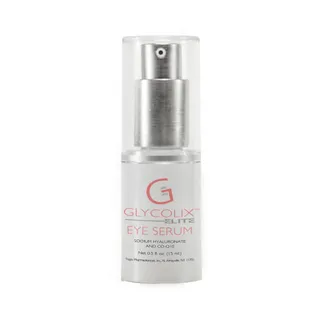
Works for
Anti-agingHyaluronic acid, Ubiquinone + 3 moreMay help
“The gentle eye cream uses Hyaluronic Acid for visible anti-aging benefits, smoothing out fine lines and wrinkles and restoring moisture to dry skin.”
This product contains superoxide dismutase, ubiquinone. These ingredients help neutralize free radicals in skin. By doing so, they might be able to prevent early signs of aging (like fine lines and wrinkles), at least to some extent. These ingredients will not be able to "reverse" signs of aging.
MoisturizingCyclomethicone, Dimethiconol + 5 moreWorks
“The cream can be used on cuticles for nourishing and moisturizing benefits.”
This product can help improve hydration of the skin with the two types of ingredients.
The first type is called “humectants”:
these ingredients help attract water.
When humectants are on the surface of the skin, they “pull in” the moisture from the outside environment, or from
within deeper layers of the skin. The following ingredients in this product do the job:
cyclomethicone, hyaluronic acid.
This product also contains ingredients called “occlusives”. They help reduce the speed with which our skin loses moisture to the outside environment. These ingredients also help soften the upper layer of the skin, so it feels less tight and nicer to the touch. The following ingredients in this product do the job: dimethiconol, cyclomethicone.
Anti-oxidationSide benefit · Camellia sinensis extract, Ubiquinone + 4 moreWorks well
This product contains antioxidants (superoxide dismutase, ubiquinone) that can help neutralize free radicals in skin. By doing so, they can lessen the damage the skin gets from the UV light (sun).
The following ingredients - camellia sinensis extract also can have an antioxidant effect, but there is less evidence to confirm their effectiveness in skin.
Can it cause trouble?
Irritancy1 strong irritant: Retinyl palmitateMedium risk
ComedogenicClean of flagged comedogenic ingredientsNone flagged
User reviews
Be the first — your take helps the next person decide.
Ingredients
Filter by role to see what each ingredient is doing.
Glyceryl polymethacrylate~22–33%
- Irritation risk
- Low
Used to create a nice product texture
More about Glyceryl polymethacrylateCyclomethicone~5–7.5%
- Irritation risk
- Low
A type of silicone that leaves a nice silky finish on the skin and can help soften its upper layer
More about CyclomethiconeDimethiconol~4.5–6.7%
- Irritation risk
- Low
A silicone that makes products more spreadable and keeps skin smooth. Helps to add gloss to skin and may visually fill in fine lines/wrinkles for short time
More about DimethiconolWater~3.3–5%
Phospholipids~2.3–3.5%
- Irritation risk
- Low
Emollients that are naturaly present in skin. In addition, they help water and oil mix together in the product
More about PhospholipidsHyaluronic acid~1.6–2.3%
- Irritation risk
- Low
One of the best moisturizing ingredients. Attracts water into the upper layer of the skin. Naturally present in skin. Typically has large molecule size unless advertised otherwise on the product label. Helps support skin's barrier function and may help to reduce inflammation
More about Hyaluronic acidPeg-40 sorbitan diisostearate~1.2–1.8%
Camellia sinensis extract~1–1.5%
- Irritation risk
- Low
Tea extract. Might be helpful in neutralizing free radicals in skin
More about Camellia sinensis extractAscorbyl palmitate~0.5–1.2%
- Irritation risk
- Medium
Being a lipid soluble form of vitamin C, it is more stable and can penetrate the skin better than L-Ascorbic acid. It is effective in protecting the skin from free radicals, as well as evening the skin tone, but is less effective in stimulating collagen production compared to L-Ascorbic acid.
More about Ascorbyl palmitateUbiquinone~0.45–1.1%
- Irritation risk
- Low
Coenzyme Q10. It helps neutralize free radicals in skin, improves skin hydration and might be helpful agains fine lines and wrinkles. It can be an allergen
More about UbiquinoneChitosan ascorbate~0.45–1.1%
- Irritation risk
- Low
Superoxide dismutase~0.3–0.7%
- Irritation risk
- Low
An antioxidant enzyme that is naturally present in skin. It can help support skin barrier function and reduce inflammation in skin. It is used in topical medications for inflammatory skin conditions including atopic dermatitis (eczema) and psoriasis. There are three types of natural Superoxide Dismutase in human skin. The compound used in topical treatments and cosmetics are mimics of typically one of these natural variants
More about Superoxide dismutaseAscorbic acid~0.15–0.5%
- Irritation risk
- High
The most well-researched antioxidant that works in skin. Helps neutralize free radicals supporting collagen production, helping to even out the skin tone and preventing early signs of aging
More about Ascorbic acidTocopheryl acetate~0.1–0.45%
- Irritation risk
- Medium
A more stable but less bio-available form of vitamin E compared to Tocopherol. Might help moisturize and protect the skin from free radicals, but mostly used in low concentrations to stabilize other ingredients.
More about Tocopheryl acetateRetinyl palmitate~0.01–0.1%
- Irritation risk
- High
Three steps removed from the active form of vitamin A - retinoic acid. To have an effect in the skin, it first needs to be converted twice to become the retinoic acid. This means it is less potent than retinol, but could also be less irritating. Once converted to the retinoic acid in the skin, it helps against all signs of aging, improves skin cell turnover and helps fight blemishes and clogged pores. However, in many cosmetic formulations, it is used in a concentration that is too low to have the full effect
More about Retinyl palmitatePeg-15 cocamine~0.05–0.15%
Laureth-9~0.05–0.1%
Ingredient list view
Glyceryl polymethacrylate, Cyclomethicone, Dimethiconol, Water, Phospholipids, Hyaluronic acid, Peg-40 sorbitan diisostearate, Camellia sinensis extract, Ascorbyl palmitate, Ubiquinone, Chitosan ascorbate, Superoxide dismutase, Ascorbic acid, Tocopheryl acetate, Retinyl palmitate, Peg-15 cocamine, Laureth-9
Compare prices
Retailers ranked by price — lowest first.
Affiliate links · As an Amazon Associate, WIMJ earns from qualifying purchases.
Worth comparing, line by line.
Match % combines shared ingredients, the first five ingredients, shared actives and hero ingredients, irritancy (lower counts in the alternative's favour), texture and body area. Only products in the same routine step are compared.
| GlycolixElite Eye SerumYOUR PRODUCT | All BotanicalEye gel serum | The OrdinaryCaffeine Solution 5% + EGCG | Perricone MDHigh Potency Triple Retinol Renewal Eye Serum | |
|---|---|---|---|---|
| Match | — | 31% | 30% | 29% |
| Price | — | $27.98 | $5.74 | $57.74 |
| Shared key ingredients | — | 3 of 6 | 1 of 6 | 2 of 6 |
| Key difference | — | Ferulic Acid | Caffeine | Niacinamide |
| Irritancy | Medium | Medium | Low | Medium |
| Drying alcohol | — | — | — | — |
| View product | Shop | Shop | Shop |


More alternatives: innisfree Green Tea Caffeine Bright-Eye SerumEsmi Skin Minerals Hydrating Eye Serum
Product summary
"Glycolix - Elite Eye Serum" is effective for: Anti-inflammatory and Anti-oxidation
This product could be helpful for: Anti-aging and Moisturizing, but its actives are not the most effective or are not well-studied.
Ingredient callouts
- This product also contains Vitamin C (Ascorbic Acid). It can be an effective active for anti-aging and evening out the skin tone, but in this product it is used for stabilizing other ingredients in the formulation. In this concentration (0.15% - 0.50%) it cannot have a noticeable benefit for the skin.
- This product includes a form of Retinoids (vitamin A) - retinyl palmitate 0.01% - 0.10%, but this type of vitamin A is not very effective. It could in theory help with fine lines and wrinkles, but the effect is most likely minimal.
- Humectants (hyaluronic acid 1.60% - 2.30% and cyclomethicone 5.00% - 7.50%). These ingredients help attract water to the upper layer of the skin and improve the skin hydration.
Price
The product retails for 112.06A$ in Australia and for 37.31$ in the United States.
For a detailed price comparison: click here.
Sources cited in this review
Every concentration estimate and effectiveness label is anchored to one of these 9 studies and safety reviews.
- 1Efficacy of a New Topical Nano-hyaluronic Acid in Humansncbi.nlm.nih.gov
- 2Physiochemical properties and application of hyaluronic acid: a systematic reviewonlinelibrary.wiley.com
- 3
- 4
- 5
- 6

Affiliate links · As an Amazon Associate, WIMJ earns from qualifying purchases.