Works for
2 of 3 advertised claims delivered
Moisturizing20 ingredients credited for this claimStrong support
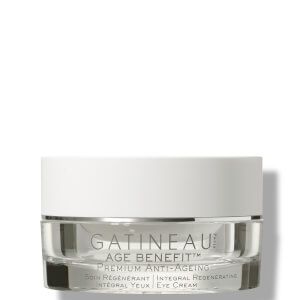
“A rejuvenating, replenishing, and intensely hydrating eye treatment, Gatineau Age Benefit Eye Cream minimises fine lines and wrinkles, reduces dark circles and puffiness, strengthens the skin barrier, improves skin tone, and enhances luminosity.”
This product can help improve hydration of the skin with the two types of ingredients.
The first type is called “humectants”:
these ingredients help attract water.
When humectants are on the surface of the skin, they “pull in” the moisture from the outside environment, or from
within deeper layers of the skin. The following ingredients in this product do the job:
artemia extract, glycerin.
This product also contains ingredients called “occlusives”. They help reduce the speed with which our skin loses moisture to the outside environment. These ingredients also help soften the upper layer of the skin, so it feels less tight and nicer to the touch. The following ingredients in this product do the job: cera microcristallina, dimethicone.
The following ingredients in this product are especially good for supporting the skin barrier and helping with the hydration level: tripeptide-1
Anti-aging3 ingredients credited for this claimModerate support
“Age Benefit Eye Cream”
This product contains tripeptide-1. This ingredient might be able to help reduce and prevent fine lines and wrinkles, improve skin elasticity and firmness, but there is not enough evidence that it actually works.
Evens skin tone2 ingredients credited for this claimWeak support
“Caviar extract Nourishes and improves skin tone.”
Effective ingredients missing or their concentration is too low
Can it cause trouble?
Irritancy2 strong irritants: Pelargonium graveolens flower oil, Diazolidinyl ureaMedium risk
Comedogenic4 ingredients rated 2 or more on the 0–5 pore-clogging scale4 flagged
User reviews
Be the first — your take helps the next person decide.
Ingredients
Filter by role to see what each ingredient is doing.
Water~45–55%
Butylene glycol~5.8–7.1%
- Irritation risk
- Low
Used to create a nice product texture and help delivery of other ingredients. Might be somewhat helpful in attracting water to the upper layer of the skin
More about Butylene glycolOctyldodecyl neopentanoate~4.3–5.3%
- Irritation risk
- Low
An emollient that helps soften the skin. Often used to stabilize other ingredients, for example, sunscreen
More about Octyldodecyl neopentanoateGlycerin~3–3.6%
- Irritation risk
- Low
One of the best moisturizing ingredients. Naturally present in skin. It attracts water to the upper layer of the skin working as a humectant
More about GlycerinSteareth-21~2.3–2.8%
Butylene glycol dicaprylate/dicaprate~1.8–2.2%
- Irritation risk
- Low
Helps soften the upper layer of the skin
More about Butylene glycol dicaprylate/dicapratePropylene glycol stearate~1.5–1.8%
Steareth-2~1.3–1.6%
Cetearyl alcohol~1.1–1.4%
- Irritation risk
- Low
- Comedogenicity
- 2/5
A non-drying alcohol. Works as an emollient. Helps water and oil mix together and creates a nice product texture
More about Cetearyl alcoholGlyceryl polymethacrylate~0.75–1.15%
- Irritation risk
- Low
Used to create a nice product texture
More about Glyceryl polymethacrylateArtemia extract~0.55–0.8%
- Irritation risk
- Low
Zooplankton extract that can attract water to the upper level of the skin and might have some anti-oxidant effect
More about Artemia extractSaccharide isomerate~0.45–0.7%
- Irritation risk
- Low
Helps attract water to the upper layer of the skin
More about Saccharide isomerateNylon-12~0.55–0.8%
Dimethicone~0.45–0.65%
- Irritation risk
- Low
A silicone that helps to reduce water loss from the surface of the skin. Can temporarily "fill in" lines and wrinkles, absorb oil, and create a nice product finish
More about DimethiconeProcollagen~0.35–0.6%
- Irritation risk
- Low
Tripeptide-1~0.35–0.6%
- Irritation risk
- Low
A type of peptide. Peptides are excellent moisturizers and might be able support collagen production reducing fine lines and wrinkles
More about Tripeptide-1Hydrolyzed actin~0.3–0.55%
- Irritation risk
- Low
Saccharomyces cerevisiae extract~0.25–0.45%
- Irritation risk
- Medium
A moisturizing ingredient that works as a humectant to attract water to the upper layer of the skin.
More about Saccharomyces cerevisiae extractHydrolyzed soy protein~0.25–0.45%
- Irritation risk
- Low
Helps attract water to the upper layer of the skin. Might have some anti-aging, anti-oxidant, and skin lightening properties, but solid evidence is missing
More about Hydrolyzed soy proteinGossypium hirsutum extract~0.2–0.4%
- Irritation risk
- Low
Hydrolyzed wheat protein~0.2–0.35%
- Irritation risk
- Medium
Can help attract water to the upper layer of the skin. Avoid if sensitive to gluten
More about Hydrolyzed wheat proteinDna~0.2–0.35%
- Irritation risk
- Low
Hydrolyzed caviar extract~0.15–0.3%
- Irritation risk
- Low
Hydrolyzed roe~0.15–0.3%
- Irritation risk
- Low
Sodium hyaluronate~0.2–0.35%
- Irritation risk
- Low
One of the best moisturizing ingredients. Attracts water into the upper layer of the skin
More about Sodium hyaluronateBrassica napus extract~0.2–0.35%
- Irritation risk
- Low
Fucus vesiculosus extract~0.2–0.35%
- Irritation risk
- Low
- Comedogenicity
- 3/5
Pelargonium graveolens flower oil~0.2–0.4%
- Irritation risk
- High
An essential oil. Can be irritating. Can become an allergen with oxidation
More about Pelargonium graveolens flower oilTocopherol~0.2–0.4%
- Irritation risk
- Low
Pure form of vitamin E. Can help moisturise and protect the skin from free radicals. Often used to help stabilise other ingredients or the formula itself
More about TocopherolTocopheryl acetate~0.25–0.45%
- Irritation risk
- Medium
A more stable but less bio-available form of vitamin E compared to Tocopherol. Might help moisturize and protect the skin from free radicals, but mostly used in low concentrations to stabilize other ingredients.
More about Tocopheryl acetateCera microcristallina~0.3–0.5%
- Irritation risk
- Low
Helps to soften the upper layer of the skin, reduce water loss from its surface and create a thicker product consistency
More about Cera microcristallinaMicrocrystalline wax~0.25–0.5%
Cera microcristallina~0.3–0.55%
- Irritation risk
- Low
Helps to soften the upper layer of the skin, reduce water loss from its surface and create a thicker product consistency
More about Cera microcristallinaPetrolatum~0.25–0.5%
- Irritation risk
- Low
One of the most effective and the most studied occlusive ingredients that creates a protective layer on top of the skin preventing moisture loss
More about PetrolatumPpg-2 myristyl ether propionate~0.15–0.3%
- Irritation risk
- Low
Ascorbyl glucoside~0.25–0.45%
- Irritation risk
- Medium
A vitamin C derivative that is more stable but less potent than pure form of vitamin C. Has a potential to boost collagen production, nutralise free radicals and reduce hyperpigmentation, but the required concentration is likely to be much higher than for the pure form of vitamin C, limiting the ingredient's effectiveness in products
More about Ascorbyl glucosidePolyacrylamide~0.25–0.5%
- Irritation risk
- Medium
Used to improve product texture and help oil and water mix together
More about PolyacrylamideTromethamine~0.25–0.45%
Sodium citrate~0.25–0.45%
- Irritation risk
- Medium
Helps to control the skin's pH level. Maintains the skin's natural film of amino-lactic acids and oils. Helps to preserve products
More about Sodium citrateLaureth-7~0.25–0.45%
C13-14 isoparaffin~0.25–0.5%
- Irritation risk
- Low
Helps soften the upper layer of the skin, dissolve other ingredients and create a thicker product consistency
More about C13-14 isoparaffinAcrylates/c10-30 alkyl acrylate crosspolymer~0.25–0.45%
- Irritation risk
- Medium
Maintains the texture of skincare products. Allows the product to spread evenly. Helps oil and water mix together
More about Acrylates/c10-30 alkyl acrylate crosspolymerPolyethylene~0.35–0.6%
Ethylene/propylene copolymer~0.3–0.6%
- Irritation risk
- Low
Silica~0.35–0.6%
Propylene glycol~0.2–0.4%
- Irritation risk
- High
Helps oil and water mix together and can enhance the penetration of other ingredients into the skin. It can be irritating
More about Propylene glycolXanthan gum~0.25–0.45%
- Irritation risk
- Low
Used to create a thicker product consistency
More about Xanthan gumHydroxyethylcellulose~0.25–0.45%
- Irritation risk
- Low
Used to thicken product formulations and create gel-like textures
More about HydroxyethylcelluloseCarbomer~0.25–0.4%
- Irritation risk
- Low
Helps create a thicker or gel-like product texture. It is not a surfactant but can be used in gentle cleansing formulations
More about CarbomerCitric acid~0.2–0.4%
- Irritation risk
- Medium
Can work as an exfoliant but is typically used to adjust the product pH
More about Citric acidDipropylene glycol~0.2–0.35%
- Irritation risk
- Low
Helps to dissolve other ingredients in a formulation. Slows down the rate of product drying
More about Dipropylene glycolDisodium edta~0.2–0.35%
Diazolidinyl urea~0.15–0.25%
- Irritation risk
- High
A preservative. Works by releasing formaldehyde. Can be irritating
More about Diazolidinyl ureaCaprylyl glycol~0.2–0.35%
- Irritation risk
- Medium
Helps preserve products and creates a nice product texture
More about Caprylyl glycol1,2-hexanediol~0.15–0.3%
Ci 19140~0.15–0.25%
Ci 16035~0.1–0.15%
Ingredient list view
Water, Butylene glycol, Octyldodecyl neopentanoate, Glycerin, Steareth-21, Butylene glycol dicaprylate/dicaprate, Propylene glycol stearate, Steareth-2, Cetearyl alcohol, Glyceryl polymethacrylate, Artemia extract, Saccharide isomerate, Nylon-12, Dimethicone, Procollagen, Tripeptide-1, Hydrolyzed actin, Saccharomyces cerevisiae extract, Hydrolyzed soy protein, Gossypium hirsutum extract, Hydrolyzed wheat protein, Dna, Hydrolyzed caviar extract, Hydrolyzed roe, Sodium hyaluronate, Brassica napus extract, Fucus vesiculosus extract, Pelargonium graveolens flower oil, Tocopherol, Tocopheryl acetate, Cera microcristallina, Microcrystalline wax, Cera microcristallina, Petrolatum, Ppg-2 myristyl ether propionate, Ascorbyl glucoside, Polyacrylamide, Tromethamine, Sodium citrate, Laureth-7, C13-14 isoparaffin, Acrylates/c10-30 alkyl acrylate crosspolymer, Polyethylene, Ethylene/propylene copolymer, Silica, Propylene glycol, Xanthan gum, Hydroxyethylcellulose, Carbomer, Citric acid, Dipropylene glycol, Disodium edta, Diazolidinyl urea, Caprylyl glycol, 1,2-hexanediol, Ci 19140, Ci 16035
Compare prices
Retailers ranked by price — lowest first.


Product summary
Judging from the ingredient list, "Gatineau - Age Benefit Eye Cream" works well for improving skin hydration To work well, any moisturizer needs to include a combination of water-binding and emollient ingredients. Gatineau - Age Benefit Eye Cream ticks this box. Humectants in this product (artemia extract, glycerin, saccharide isomerate, saccharomyces cerevisiae extract and sodium hyaluronate) help to increase the water content in the upper layer of the skin. (These ingredients do so by "capturing" water molecules from the outside air or from within the deeper layers of the skin). Tripeptide-1, octyldodecyl neopentanoate, cera microcristallina, dimethicone and butylene glycol dicaprylate/dicaprate in this product help decrease the water evoporation from the skin, so that it stays hydrated for longer. These ingredients also soften the skin and take away the feeling of tightness and dryness.
Ingredient callouts
- This moisturizer also contains Peptides (tripeptide-1 0.35% - 0.60%). Peptides are a very big group of ingredients. They all consist of a different combination of aminoacids. Our skin produces Peptides naturally. Some of them work as natural antibiotics, promote wound-healing and production of collagen. The scientists are still studying how effective the topical application of Peptides is, but it is very likely that they are helpful. Peptides might be able to support skin barrier restoration and even have an anti-aging benefit. At the very least, they certainly help attract water to the skin and support the hydration in this way.
Irritation risk
This moisturizer contains a bunch of common irritants, including ingredients that do not provide any known benefit for the skin. It might not be the best choice if your skin is sensitive. We assess the overall irritancy of this moisturizer to be medium. For a detailed overview of all potential irritants: click here
You can see the detailed formula review with the breakdown of all actives in the product and the full ingredient list with estimated concentrations in the tables below.
Price
The product retails from 36.00£ up to 77.00£ in the United Kingdom and for 119.00CA$ in Canada.
For a detailed price comparison: click here.
Sources cited in this review
Every concentration estimate and effectiveness label is anchored to one of these 24 studies and safety reviews.
- 1
- 2
- 3
- 4
- 5
- 6Final Report on the Safety Assessment of Dimethicone Copolyoljournals.sagepub.com

Affiliate links · As an Amazon Associate, WIMJ earns from qualifying purchases.