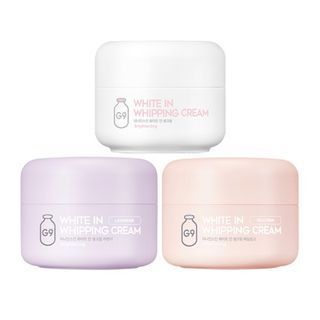
G9SKIN White In Whipping Cream - 3 Colors
Works for
1 of 1 advertised claim delivered
Moisturizing18 ingredients credited for this claimStrong support
“Enriched with milk protein extract to whiten and nourish skin.”
This product can help improve hydration of the skin with the two types of ingredients.
The first type is called “humectants”:
these ingredients help attract water.
When humectants are on the surface of the skin, they “pull in” the moisture from the outside environment, or from
within deeper layers of the skin. The following ingredients in this product do the job:
betaine, glycerin.
This product also contains ingredients called “occlusives”. They help reduce the speed with which our skin loses moisture to the outside environment. These ingredients also help soften the upper layer of the skin, so it feels less tight and nicer to the touch. The following ingredients in this product do the job: dimethicone, peg-10 dimethicone.
The following ingredients in this product are especially good for supporting the skin barrier and helping with the hydration level: niacinamide
Anti-agingNot advertised by the brand · 7 ingredients credited for this claimStrong support
This product can help reduce and prevent fine lines and wrinkles, improve skin elasticity and firmness because it contains adenosine, niacinamide.
These ingredients in the product can also be helpful, even though there is less evidence for their effectiveness: resveratrol.
Keep in mind that it typically takes at least 6 weeks to notice any results because the changes that are needed to improve fine lines and elasticity happen in the deeper layers of the skin. No topical anti-aging product can “erase” wrinkles or fully reverse signs of aging.
Anti-oxidationNot advertised by the brand · 21 ingredients credited for this claimStrong support
This product contains antioxidants (glutathione, resveratrol) that can help neutralize free radicals in skin. By doing so, they can lessen the damage the skin gets from the UV light (sun).
The following ingredients - camellia japonica flower extract, pyridoxine also can have an antioxidant effect, but there is less evidence to confirm their effectiveness in skin.
Evens skin toneNot advertised by the brand · 7 ingredients credited for this claimStrong support
This product can help reduce hypepigmentation and even out the skin tone because it contains the following effective ingredients: glutathione, niacinamide
The following ingredient (ingredients) in this product might be helpful, but there is no evidence to confirm that it actually can help even out the skin tone: glycyrrhiza glabra root extract, resveratrol.
Keep in mind that you would need to apply any topical skincare targetted at hypigmentation consistently for a couple of months to get a result. No topical skincare product can help get rid of hyperpigmentation (including post-acne marks and age spots) instantly.
Anti-blemishNot advertised by the brand · 5 ingredients credited for this claimStrong support
This product can help reduce breakouts and clogged pores because it contains the following ingredient: niacinamide. This ingredient is used for treating acne and can have a noticeable effect.
Can it cause trouble?
Irritancy13 strong irritants: Oenothera biennis flower extract, Hamamelis virginiana leaf extract + 11 more — patch-test recommendedHigh risk
ComedogenicClean of flagged comedogenic ingredientsNone flagged


User reviews
Be the first — your take helps the next person decide.
Ingredients
Filter by role to see what each ingredient is doing.
Water~45–55%
Methylpropanediol~5.7–6.9%
Glycerin~4–4.9%
- Irritation risk
- Low
One of the best moisturizing ingredients. Naturally present in skin. It attracts water to the upper layer of the skin working as a humectant
More about GlycerinCyclopentasiloxane~3.1–3.8%
- Irritation risk
- Low
A silicone that helps improve the product texture and spreadability. Can absorb oil creating a short-term mattifying effect on the skin
More about CyclopentasiloxaneNiacinamide~2.3–2.8%
- Irritation risk
- Low
Is proven to be effective in reducing blemishes, evening out skin tone and helping to improve lines and wrinkles. It helps the skin to repair sun damage, calm down inflammation and keep maintain good levels of moisture. The concentration of about 2% is effective for supporting the skin barrier and evening out the skin tone. Concentration of 4-6% is better for helping with acne and balancing the sebum production
More about NiacinamideDimethicone/peg-10/15 crosspolymer~1.8–2.2%
Dimethicone~1.7–2.1%
- Irritation risk
- Low
A silicone that helps to reduce water loss from the surface of the skin. Can temporarily "fill in" lines and wrinkles, absorb oil, and create a nice product finish
More about DimethiconeSodium chloride~1.5–1.8%
- Irritation risk
- Low
Used to stabilize mixtures of oil and water, and create thicker, gel-like product textures
More about Sodium chlorideMilk protein extract~1.2–1.4%
- Irritation risk
- Low
Fructan~0.95–1.15%
- Irritation risk
- Low
Phenoxyethanol~0.65–1%
- Irritation risk
- Low
A preservative. It helps prevent bacterial growth in cosmetic products
More about PhenoxyethanolCetyl peg/ppg-10/1 dimethicone~0.6–0.9%
- Irritation risk
- Low
A type of silicone that helps water and oil mix together. Can help to soften upper layer of the skin
More about Cetyl peg/ppg-10/1 dimethiconeChlorphenesin~0.16–0.32%
Peg-10 dimethicone~0.55–0.85%
- Irritation risk
- Low
A silicone that works to soften the upper layer of the skin and reduce its water loss
More about Peg-10 dimethiconeSodium citrate~0.45–0.7%
- Irritation risk
- Medium
Helps to control the skin's pH level. Maintains the skin's natural film of amino-lactic acids and oils. Helps to preserve products
More about Sodium citrateTrehalose~0.45–0.7%
- Irritation risk
- Low
A sugar that attracts water to the upper layer of the skin
More about TrehaloseDimethicone/vinyl dimethicone crosspolymer~0.45–0.7%
- Irritation risk
- Low
Used to stabilize product formulations and create a nice product texture
More about Dimethicone/vinyl dimethicone crosspolymerOenothera biennis flower extract~0.4–0.65%
Camellia japonica flower extract~0.4–0.6%
- Irritation risk
- High
A plant extract that might help neutralize free radicals in skin
More about Camellia japonica flower extractResveratrol~0.35–0.6%
- Irritation risk
- Medium
Helps neutralize free radicals in skin and might help reduce fine lines and wrinkles, as well as even out the skin tone
More about ResveratrolHamamelis virginiana leaf extract~0.3–0.55%
- Irritation risk
- High
A plant extract that can help calm down inflammation in skin. Can, however, itself be irritating
More about Hamamelis virginiana leaf extractBetaine~0.3–0.55%
- Irritation risk
- Low
Helps attract water to the upper layer of the skin and improves the product texture
More about BetaineCentella asiatica extract~0.35–0.6%
- Irritation risk
- Medium
A plant extract that has been shown to be able to reduce inflammation in skin, support restoration of skin barrier function, as well as support collagen production. Contains active compounds called centelloids: asiaticoside, madecasosside, asiatic acid and madecassic acid. Might be helpful in preventing stretch marks. It can be itself be irritating though.
More about Centella asiatica extractRubus fruticosus fruit extract~0.25–0.5%
- Irritation risk
- Medium
A plant extract that might help neutralize free radicals in skin
More about Rubus fruticosus fruit extractSambucus nigra fruit extract~0.3–0.5%
- Irritation risk
- High
A plant extract that may contain a small amount of essential oils. Might be helpful in neutralizing free radicals in skin
More about Sambucus nigra fruit extractAnthemis nobilis flower extract~0.25–0.45%
- Irritation risk
- High
A plant extract that one one hand, can contain compounds that can help calm down skin irritation, but, on the other hand, its other compounds (especially fragrant ones) can themselves be irritating
More about Anthemis nobilis flower extractVaccinium macrocarpon fruit extract~0.3–0.5%
- Irritation risk
- High
A berry extract. Might have some anti-oxidant properties
More about Vaccinium macrocarpon fruit extractParfum~0.25–0.5%
- Irritation risk
- High
An aromatic blend of unspecified and possibly irritating ingredients
More about ParfumAdenosine~0.3–0.55%
- Irritation risk
- Low
Might help improve cell turnover and reduce inflammation in skin. One study shows that the ingredients might be able to help reduce dynamic wrinkles (for example, in the corners of the eyes or on the forehead)
More about AdenosineMaltodextrin~0.3–0.6%
- Irritation risk
- Low
Used to stabilize the product formulation and can help absorb oil
More about MaltodextrinCalcium pantothenate~0.3–0.6%
- Irritation risk
- Low
Helps support skin barrier function improving skin hydration and reducing sensitivity
More about Calcium pantothenateSodium starch octenylsuccinate~0.3–0.6%
- Irritation risk
- Low
Camellia sinensis leaf extract~0.35–0.6%
- Irritation risk
- Low
Can contain potent anti-oxidant compounds (abbreviated ECG, GCG, EGC, and EGCG) that might help protect the skin from free radicals. Can help calm down inflammation and has some anti-bacterial properties. Unfortunately, these antioxidants are unstable and lose their effectiveness very quickly in products. The concentration of the antioxidant compounds in the extract also tends to be low to be effective in topical formulation
More about Camellia sinensis leaf extractSalvia hispanica seed extract~0.35–0.6%
- Irritation risk
- Medium
A plant extract that typically contains linolenic and linoleic acids that help soften the upper layer of the skin and can support skin barrier function
More about Salvia hispanica seed extractHedera helix leaf extract~0.3–0.55%
- Irritation risk
- Low
Linum usitatissimum seed extract~0.3–0.5%
- Irritation risk
- Low
Nelumbo nucifera flower water~0.3–0.55%
- Irritation risk
- Low
Origanum vulgare leaf extract~0.3–0.55%
- Irritation risk
- High
A plant extract. Can have an anti-oxidant effect, but can also contain irritants
More about Origanum vulgare leaf extractEucalyptus globulus leaf extract~0.3–0.5%
- Irritation risk
- High
Used as a fragrance. Can be irritating
More about Eucalyptus globulus leaf extractPinus sylvestris leaf extract~0.3–0.55%
- Irritation risk
- Low
Sodium ascorbyl phosphate~0.3–0.6%
- Irritation risk
- Medium
A stable derivative of vitamin C. It is oil-soluble which means it is more likely to penetrate the skin compared to the pure form of vitamin C (which is water-soluble), but it is less bio-available and is way less effective in stimulating collagen and reducing wrinkles compared to the pure form of vitamin C (L-ascorbic acid) and its other derivatives (for example, magnesium ascorbyl phosphate). At the same time, this vitamin C derivative has been shown in studies to be effective in reducing acne, blemishes and clogged pores. It is less irritating then the pure form of vitamin C
More about Sodium ascorbyl phosphateHydroxypropyl cyclodextrin~0.35–0.65%
- Irritation risk
- Medium
Used to stabilize product formulations and help soften the upper layer of the skin
More about Hydroxypropyl cyclodextrinTocopheryl acetate~0.35–0.6%
- Irritation risk
- Medium
A more stable but less bio-available form of vitamin E compared to Tocopherol. Might help moisturize and protect the skin from free radicals, but mostly used in low concentrations to stabilize other ingredients.
More about Tocopheryl acetateEthylhexylglycerin~0.3–0.6%
Glutathione~0.3–0.6%
- Irritation risk
- Medium
A peptide that can help neutralize free radicals in skin and reduce melanin production resulting in skin lightening effect and reduction in hyperpigmentation. It can also help attract moisture to the upper layer of the skin
More about GlutathioneDisodium edta~0.3–0.6%
Silica~0.5–0.75%
Taraxacum officinale leaf extract~0.3–0.55%
- Irritation risk
- Low
Lavandula angustifolia water~0.3–0.6%
Titanium dioxide~0.45–0.7%
- Irritation risk
- Low
Works as a UV filter when used in high concentrations. It is photostable and is effective mostly against the UVB light, with some protection in the UVA range. In small concentrations, used for its ability to improve the color of cosmetic products. Is usually well tolerated by the skin
More about Titanium dioxideCi 77891~0.3–0.55%
- Irritation risk
- Low
Galactomyces ferment filtrate~0.3–0.6%
- Irritation risk
- Low
A yeast ferment filtrate (also known as Pitera - a trademarked name for the filtrate reserved by the SK-II brand). It helps attract water to the upper layer of the skin, can help neutralize antioxidants and can be helpful in evening out the skin tone. It might be somewhat helpful in preventing premature skin aging but solid evidence is lacking. A small manufacturer study also shows that, when used in high concentrations, it can help reduce sebum production and help against blocked pores
More about Galactomyces ferment filtratePyridoxine hcl~0.3–0.55%
- Irritation risk
- Medium
Might help neutralize free radicals in skin
More about Pyridoxine hclHibiscus sabdariffa flower extract~0.3–0.55%
- Irritation risk
- High
A plant extract that can be irritating. It might contain a compound anthocyanin that could be helpful in neutralizing free radicals
More about Hibiscus sabdariffa flower extractUsnea barbata extract~0.3–0.6%
- Irritation risk
- Low
Scutellaria baicalensis root extract~0.3–0.55%
- Irritation risk
- High
A plant extract that might contain a compound baicalin that could be helpful in neutralizing free radicals and reducing inflammation in skin. The baicalin concentration in skincare products is often too low for an effective action. Can be used for its fragrant properties
More about Scutellaria baicalensis root extractOlea europaea leaf extract~0.3–0.5%
- Irritation risk
- Medium
A plant extract that might have some anti-oxidant and anti-inflammatory properties but evidence for effectiveness in skin is missing
More about Olea europaea leaf extractPulsatilla koreana extract~0.3–0.55%
- Irritation risk
- Low
Citronellol~0.3–0.55%
Linalool~0.3–0.55%
Limonene~0.3–0.55%
- Irritation risk
- High
A common frangrance that can easily irritate skin, especially if exposed to air, light or heat
More about LimoneneAcorus calamus root extract~0.3–0.5%
- Irritation risk
- Low
Triethoxycaprylylsilane~0.3–0.6%
- Irritation risk
- Low
A type of silicone that helps oil and water mix well together. Helps to disperse other ingredients, e.g. pigments, evenly in a formulation
More about TriethoxycaprylylsilaneCi 77007~0.3–0.6%
Rhodiola rosea root extract~0.35–0.6%
- Irritation risk
- Low
Lavandula angustifolia extract~0.3–0.55%
- Irritation risk
- High
Used for fragrance and contains volatile compounds that can irritate the skin
More about Lavandula angustifolia extractAspergillus ferment~0.3–0.55%
- Irritation risk
- Low
An extract from fungus (mold) that typically appears on rice. It can help attract water to the upper layer of the skin, might help neutralize free radicals and possibly somewhat reduce hyperpigmentation
More about Aspergillus fermentGlycyrrhiza glabra root extract~0.25–0.5%
- Irritation risk
- Medium
A plant extract that can help lighten the skin and calm down inflammation. Might be helpful in neutralizing free radicals
More about Glycyrrhiza glabra root extractRosa damascena flower extract~0.25–0.5%
Zanthoxylum piperitum fruit extract~0.25–0.5%
- Irritation risk
- High
Plant extract that has some anti-oxidant properties. It can be irritating. Can be used to improve the product's smell
More about Zanthoxylum piperitum fruit extractCi 77491~0.25–0.45%
- Irritation risk
- Low
A red colorant made of iron oxide. Typically is not irritating
More about Ci 77491Pyridoxine~0.25–0.4%
- Irritation risk
- High
Might help neutralize free radicals in skin, but evidence of effectiveness in skin is lacking. It might be irritating
More about PyridoxineTitanium dioxide~0.25–0.5%
- Irritation risk
- Low
Works as a UV filter when used in high concentrations. It is photostable and is effective mostly against the UVB light, with some protection in the UVA range. In small concentrations, used for its ability to improve the color of cosmetic products. Is usually well tolerated by the skin
More about Titanium dioxide1,2-hexanediol~0.1–0.2%
Taraxacum officinale leaf extract~0.15–0.3%
- Irritation risk
- Low
Benzyl benzoate~0.15–0.25%
- Irritation risk
- High
Fragrance with sweet balsamic smell. Help to preserve products and dissolve other ingredients. Could trigger allergic reactions and be irritating
More about Benzyl benzoateAspergillus ferment~0.1–0.2%
- Irritation risk
- Low
An extract from fungus (mold) that typically appears on rice. It can help attract water to the upper layer of the skin, might help neutralize free radicals and possibly somewhat reduce hyperpigmentation
More about Aspergillus fermentHibiscus sabdariffa flower extract~0.1–0.2%
- Irritation risk
- High
A plant extract that can be irritating. It might contain a compound anthocyanin that could be helpful in neutralizing free radicals
More about Hibiscus sabdariffa flower extractIngredient list view
Water, Methylpropanediol, Glycerin, Cyclopentasiloxane, Niacinamide, Dimethicone/peg-10/15 crosspolymer, Dimethicone, Sodium chloride, Milk protein extract, Fructan, Phenoxyethanol, Cetyl peg/ppg-10/1 dimethicone, Chlorphenesin, Peg-10 dimethicone, Sodium citrate, Trehalose, Dimethicone/vinyl dimethicone crosspolymer, Oenothera biennis flower extract, Camellia japonica flower extract, Resveratrol, Hamamelis virginiana leaf extract, Betaine, Centella asiatica extract, Rubus fruticosus fruit extract, Sambucus nigra fruit extract, Anthemis nobilis flower extract, Vaccinium macrocarpon fruit extract, Parfum, Adenosine, Maltodextrin, Calcium pantothenate, Sodium starch octenylsuccinate, Camellia sinensis leaf extract, Salvia hispanica seed extract, Hedera helix leaf extract, Linum usitatissimum seed extract, Nelumbo nucifera flower water, Origanum vulgare leaf extract, Eucalyptus globulus leaf extract, Pinus sylvestris leaf extract, Sodium ascorbyl phosphate, Hydroxypropyl cyclodextrin, Tocopheryl acetate, Ethylhexylglycerin, Glutathione, Disodium edta, Silica, Taraxacum officinale leaf extract, Lavandula angustifolia water, Titanium dioxide, Ci 77891, Galactomyces ferment filtrate, Pyridoxine hcl, Hibiscus sabdariffa flower extract, Usnea barbata extract, Scutellaria baicalensis root extract, Olea europaea leaf extract, Pulsatilla koreana extract, Citronellol, Linalool, Limonene, Acorus calamus root extract, Triethoxycaprylylsilane, Ci 77007, Rhodiola rosea root extract, Lavandula angustifolia extract, Aspergillus ferment, Glycyrrhiza glabra root extract, Rosa damascena flower extract, Zanthoxylum piperitum fruit extract, Ci 77491, Pyridoxine, Unknown, Titanium dioxide, 1,2-hexanediol, Taraxacum officinale leaf extract, Benzyl benzoate, Aspergillus ferment, Hibiscus sabdariffa flower extract
Compare prices
Retailers ranked by price — lowest first.

Affiliate links · prices updated regularly
Worth comparing, line by line.
Match % combines shared ingredients, the first five ingredients, shared actives and hero ingredients, irritancy (lower counts in the alternative's favour), texture and body area. Only products in the same routine step are compared.
| G9SKINWhite In Whipping Cream - 3 ColorsYOUR PRODUCT | Secret KeyHyaluron Aqua Soft Cream | BYROESALMON CREAM DUO | Holika HolikaMechnikov's Probiotics Formula Radiance Cream | |
|---|---|---|---|---|
| Match | — | 75% | 73% | 72% |
| Price | $16.00 | $11.40−$4.60 | $126.40+$110.40 | $49.02+$33.02 |
| Shared key ingredients | — | 6 of 18 | 7 of 18 | 8 of 18 |
| Key difference | — | Glycolic Acid | Panthenol | Caprylic/Capric Triglyceride |
| Irritancy | High | Medium | Medium | Medium |
| Drying alcohol | — | — | — | — |
| View product | Shop | Shop | Shop |


Product summary
"G9SKIN - White In Whipping Cream - 3 Colors" has a good moisturizing formula. This moisturizer uses a good combo of humectants and emollients. These both types of ingredients are essentials for improving the skin hydration and keeping the skin barrier healthy. Humectants in this product (betaine, glycerin, trehalose and scutellaria baicalensis root extract) help to increase the water content in the upper layer of the skin. (These ingredients do so by "capturing" water molecules from the outside air or from within the deeper layers of the skin). Salvia hispanica seed extract, dimethicone, peg-10 dimethicone, cyclopentasiloxane and hydroxypropyl cyclodextrin in this product help decrease the water evoporation from the skin, so that it stays hydrated for longer. These ingredients also soften the skin and take away the feeling of tightness and dryness.
Ingredient callouts
- We particularly like that there is a good concentration of Niacinamide (2.30% - 2.80%) in this moisturizer. Niacinamide is a well-studied multi-tasking active. It is a great ingredient to have in a moisturizer. It is stable, and can work well in almost any hydrating formulation. There is solid evidence that Niacinamide can help support skin barrier, regulate oil production and reduce acne and clogged pores. It also helps to fight photodamage and help improve the skin tone, reducing pigmentation marks.
- Adenosine 0.30% - 0.55%. It is a compound that in involved in many biological processes inside the skin cells. According one high-quality clinical trial, topical Adenosine in low concentrations can somewhat help improve "deep wrinkles" - the wrinkles that appear with age in places where our faces are most dynamic (for example, on the forehead or in the corners of the eyes).
Irritation risk
This moisturizer contains a bunch of common irritants, including ingredients that do not provide any known benefit for the skin. It might not be the best choice if your skin is sensitive. We assess the overall irritancy of this moisturizer to be high. For a detailed overview of all potential irritants: click here
You can see the detailed formula review with the breakdown of all actives in the product and the full ingredient list with estimated concentrations in the tables below.
Price
The product retails for 16.00$ in the United States.
For a detailed price comparison: click here.
Sources cited in this review
Every concentration estimate and effectiveness label is anchored to one of these 52 studies and safety reviews.
- 1
- 2
- 3
- 4
- 5Final Report on the Safety Assessment of Dimethicone Copolyoljournals.sagepub.com
- 6

Affiliate links · As an Amazon Associate, WIMJ earns from qualifying purchases.