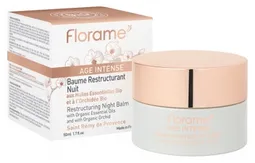
Florame Âge Intense Restructuring Night Balm Organic

Florame Âge Intense Restructuring Night Balm Organic

Efficacy50/100IrritancyHigh

Works for

Anti-aging
Tocopherol, Gluconolactone + 1 more
Not delivered
What the product description says
“Each morning, the complexion is more luminous, the face lines are relaxed and wrinkles smoothed.”
Source: Cocoon Center

This product does not contain ingredients that are able to reduce fine lines and wrinkles or help with skin elasticity, but it can improve the look of the skin temporarily through moisturization. Well-moisturized skin might also be able to repair the sun damage better.

This ingredient squalene might be able to help neutralize free radicals in skin and help it fight off some of the sun damage.

TocopherolEffect: Low, below effective dosePure form of vitamin E. Can help moisturise and protect the skin from free radicals. Often used to help stabilise other ingredients or the formula itself~0.2–0.75%
GluconolactoneUnder-dosedA polyhydroxy acid (PHA) that helps shed the dead cells from the skin surface revealing smoother skin. Is believed to be genter than AHAs. It helps attract water to the upper layer of the skin and can stimulate production of skin's own hyaluronic acid resulting in improved hydration levels. It has been shown to be helpful against acne and clogged pores if used consistently (e.g over a period of 12 weeks) in high enough concentration. It can help reduce fine lines and wrinkles and improve skin tone with long-term application. Can help neutralize free radicals~0.2–0.75%
Ascorbic acidUnder-dosedThe most well-researched antioxidant that works in skin. Helps neutralize free radicals supporting collagen production, helping to even out the skin tone and preventing early signs of aging~0.2–0.7%
Anti-oxidation
Side benefit · Squalene, Rosa damascena flower water + 4 more
May help

This product contains antioxidants (squalene) that might be able to help neutralize free radicals in skin to lessen the damage it gets from the UV light (sun). There is not enough evidence to confirm their effectiveness in skin though.

SqualeneKey activeEffect: MediumAn oil that is naturally part of skin sebum that helps to soften its upper layer, reduce water loss and neutralize free radicals. It might be comedogenic. Avoid applying large concentrations (or pure oil) before sun exposure as oxidized squalene can clog pores and lead to skin irritation. Today squalene is mostly derived from vegetable oils or synthetized by yeast~0.35–0.85%
Rosa damascena flower waterEffect: LowUsed to add a nice rose smell to the product. Might help attract water to the upper layer of the skin and have some anti-oxidant effect. Can be irritating~24–37%
Anthemis nobilis flower oilEffect: Low, below effective doseAn essential oil that is used as a fragrance and can be irritating. It might have some anti-oxidant effect in skin~0.2–0.7%
TocopherolUnder-dosedPure form of vitamin E. Can help moisturise and protect the skin from free radicals. Often used to help stabilise other ingredients or the formula itself~0.2–0.75%
Ascorbic acidUnder-dosedThe most well-researched antioxidant that works in skin. Helps neutralize free radicals supporting collagen production, helping to even out the skin tone and preventing early signs of aging~0.2–0.7%
GluconolactoneUnder-dosedA polyhydroxy acid (PHA) that helps shed the dead cells from the skin surface revealing smoother skin. Is believed to be genter than AHAs. It helps attract water to the upper layer of the skin and can stimulate production of skin's own hyaluronic acid resulting in improved hydration levels. It has been shown to be helpful against acne and clogged pores if used consistently (e.g over a period of 12 weeks) in high enough concentration. It can help reduce fine lines and wrinkles and improve skin tone with long-term application. Can help neutralize free radicals~0.2–0.75%
Moisturizing
Side benefit · C10-18 triglycerides, Cocos nucifera oil + 18 more
Works

This product can help improve hydration of the skin with the two types of ingredients.

The first type is called “humectants”:
these ingredients help attract water. When humectants are on the surface of the skin, they “pull in” the moisture from the outside environment, or from within deeper layers of the skin. The following ingredients in this product do the job: biosaccharide gum-1, glycerin.

This product also contains ingredients called “occlusives”. They help reduce the speed with which our skin loses moisture to the outside environment. These ingredients also help soften the upper layer of the skin, so it feels less tight and nicer to the touch. The following ingredients in this product do the job: cocos nucifera oil, helianthus annuus seed oil.

C10-18 triglyceridesKey active· EmollientEffect: MediumHelps soften the skin and attract water to its upper layer. Helps create nice product texture~4.8–7.1%
Cocos nucifera oilKey active· Emollient, OcclusiveEffect: HighAn emollient. Found to be as effective as a moisturizer for dry skin as mineral oil. Could be comedogenic~3.8–5.7%
GlycerinKey active· HumectantEffect: HighOne of the best moisturizing ingredients. Naturally present in skin. It attracts water to the upper layer of the skin working as a humectant~2.1–3.1%
Myristyl myristateKey active· Emollient, OcclusiveEffect: HighAn emollient. Is not recommended for acne-prone skin as it can be comedogenic~1.6–2.3%
Opuntia ficus-indica seed oilKey active· EmollientEffect: HighA plant oil that helps soften the upper layer of the skin and can support skin's barrier function due to its high content of linoleic acid. It also has anti-microbial properties~0.45–1.05%
Helianthus annuus seed oilKey active· Emollient, OcclusiveEffect: HighA great emollient due to its high linoleic acid content. One of the most effective plant oils in helping skin hydration and repairing skin barrier function~0.4–0.9%
Beta-sitosterolKey active· EmollientEffect: HighA phytosterol that can support skin's barrier function and help the skin stay hydrated~0.35–0.8%
SqualeneKey active· Emollient, OcclusiveEffect: HighAn oil that is naturally part of skin sebum that helps to soften its upper layer, reduce water loss and neutralize free radicals. It might be comedogenic. Avoid applying large concentrations (or pure oil) before sun exposure as oxidized squalene can clog pores and lead to skin irritation. Today squalene is mostly derived from vegetable oils or synthetized by yeast~0.35–0.85%
GlycogenKey active· HumectantEffect: HighHelps attract water to the upper layer of the skin~0.35–0.8%
Biosaccharide gum-1Key active· HumectantEffect: HighHelps attract water to the upper layer of the skin and is claimed to provide a longer-lasting hydration because of its ability to create a water-binding film on the surface of the skin~0.2–0.8%
Rosa damascena flower water· HumectantEffect: LowUsed to add a nice rose smell to the product. Might help attract water to the upper layer of the skin and have some anti-oxidant effect. Can be irritating~24–37%
Behenyl alcohol· Emollient, OcclusiveEffect: LowNon-drying alcohol that helps water and oil mix together. Also serves as an emollient~5–7.5%
Lauryl laurateEffect: LowHelps soften the upper layer of the skin~2.6–3.9%
Glyceryl stearate· EmollientEffect: LowAn emollient that softens the skin and forms a protective layer on its surface. Helps water and oil mix together~1.1–1.7%
Glyceryl stearate citrate· EmollientEffect: LowHelps oil and water mix together while softening the upper layer of the skin~0.95–1.4%
Glyceryl caprylate· EmollientEffect: LowAn emollient that can also help water and oil mix together, as well as prevent bacteria growth in products~0.35–0.85%
Calcium gluconate· HumectantEffect: LowHelps attract water to the upper layer of the skin and helps to improve appearance of the product~0.3–0.7%
TocopherolEffect: Low, below effective dosePure form of vitamin E. Can help moisturise and protect the skin from free radicals. Often used to help stabilise other ingredients or the formula itself~0.2–0.75%
Simmondsia chinensis seed oilUnder-dosedSoftens the upper layer of skin and helps restore the healthy skin barrier. Has shown to help calm down inflammation in skin. It is a stable oil, meaning that it retains its properties even when exposed to air.~0.45–1.05%
GluconolactoneUnder-dosedA polyhydroxy acid (PHA) that helps shed the dead cells from the skin surface revealing smoother skin. Is believed to be genter than AHAs. It helps attract water to the upper layer of the skin and can stimulate production of skin's own hyaluronic acid resulting in improved hydration levels. It has been shown to be helpful against acne and clogged pores if used consistently (e.g over a period of 12 weeks) in high enough concentration. It can help reduce fine lines and wrinkles and improve skin tone with long-term application. Can help neutralize free radicals~0.2–0.75%

Can it cause trouble?

Irritancy
8 strong irritants: Rosa damascena flower water, Sodium anisate + 6 more — patch-test recommended
High risk
We flagged 23 ingredients with irritancy potential. Severity depends on your sensitivity threshold; the table lists the worst offenders first.
IngredientFunctionIrritationEst. amount
Rosa damascena flower waterUsed to add a nice rose smell to the product. Might help attract water to the upper layer of the skin and have some anti-oxidant effect. Can be irritatingHigh~24–37%est.
Orchid extractA plant extract that can be used as fragranceHigh~0.3–0.7%est.
Ascorbic acidThe most well-researched antioxidant that works in skin. Helps neutralize free radicals supporting collagen production, helping to even out the skin tone and preventing early signs of agingHigh~0.2–0.7%est.
Sodium anisateUsed as a fragranceHigh~0.2–0.75%est.
Anthemis nobilis flower oilAn essential oil that is used as a fragrance and can be irritating. It might have some anti-oxidant effect in skinHigh~0.2–0.7%est.
ParfumAn aromatic blend of unspecified and possibly irritating ingredientsHigh~0.15–0.7%est.
Benzyl alcoholA preservative. Can be used to mask unpleasant smell. Can be irritatingHigh~0.1–0.35%est.
LimoneneA common frangrance that can easily irritate skin, especially if exposed to air, light or heatHigh~0.1–0.35%est.
CitronellolA fragrance. Can be irritatingHigh~0.1–0.4%est.
LinaloolA fragrance. Can be irritatingHigh~0.1–0.35%est.
GeraniolA fragrance. Can be irritatingHigh~0.05–0.25%est.
CitralA fragrance with a lemon scent. A likely irritantHigh~0.05–0.25%est.
Lauryl laurateHelps soften the upper layer of the skinMedium~2.6–3.9%est.
Myristyl myristateAn emollient. Is not recommended for acne-prone skin as it can be comedogenicMedium~1.6–2.3%est.
Sodium stearoyl glutamateHelps oil and water mix togetherMedium~0.55–1.3%est.
Opuntia ficus-indica seed oilA plant oil that helps soften the upper layer of the skin and can support skin's barrier function due to its high content of linoleic acid. It also has anti-microbial propertiesMedium~0.45–1.05%est.
Simmondsia chinensis seed oilSoftens the upper layer of skin and helps restore the healthy skin barrier. Has shown to help calm down inflammation in skin. It is a stable oil, meaning that it retains its properties even when exposed to air.Medium~0.45–1.05%est.
Sodium levulinateA preservativeMedium~0.2–0.75%est.
GluconolactoneA polyhydroxy acid (PHA) that helps shed the dead cells from the skin surface revealing smoother skin. Is believed to be genter than AHAs. It helps attract water to the upper layer of the skin and can stimulate production of skin's own hyaluronic acid resulting in improved hydration levels. It has been shown to be helpful against acne and clogged pores if used consistently (e.g over a period of 12 weeks) in high enough concentration. It can help reduce fine lines and wrinkles and improve skin tone with long-term application. Can help neutralize free radicalsMedium~0.2–0.75%est.
Leuconostoc/radish root ferment filtrateA preservative that comes from radishes fermented by a bacteria. New research suggests that the preservation properties in the ingredient come from an ammonium salt that is not present naturally in radish root but used in its cultivation. Is problematic because the exact amount of the preservative agents is difficult to determineMedium~0.2–0.8%est.
Potassium sorbateA preservativeMedium~0.3–0.6%est.
Dehydroacetic acidA preservativeMedium~0.3–0.6%est.
Citric acidCan work as an exfoliant but is typically used to adjust the product pHMedium~0.15–0.6%est.
Comedogenic
3 ingredients rated 2 or more on the 0–5 pore-clogging scale
3 flagged
These ingredients have a comedogenic rating of 2 or more on a 0–5 scale; the table shows each one's rating. In leave-on products they can clog pores in acne-prone skin.
IngredientFunctionRatingEst. amount
Cocos nucifera oilAn emollient. Found to be as effective as a moisturizer for dry skin as mineral oil. Could be comedogenic3/5~3.8–5.7%est.
Myristyl myristateAn emollient. Is not recommended for acne-prone skin as it can be comedogenic3/5~1.6–2.3%est.
SqualeneAn oil that is naturally part of skin sebum that helps to soften its upper layer, reduce water loss and neutralize free radicals. It might be comedogenic. Avoid applying large concentrations (or pure oil) before sun exposure as oxidized squalene can clog pores and lead to skin irritation. Today squalene is mostly derived from vegetable oils or synthetized by yeast2/5~0.35–0.85%est.

User reviews

Would you recommend?
No community reviews yet.

Be the first — your take helps the next person decide.

Ingredients

Filter by role to see what each ingredient is doing.

Rosa damascena flower water~24–37%
Irritant · high
Irritation risk
High
Works for
MoisturizingAnti-oxidation

Used to add a nice rose smell to the product. Might help attract water to the upper layer of the skin and have some anti-oxidant effect. Can be irritating

More about Rosa damascena flower water
Behenyl alcohol~5–7.5%
Formula
Irritation risk
Low
Works for
Moisturizing

Non-drying alcohol that helps water and oil mix together. Also serves as an emollient

More about Behenyl alcohol
C10-18 triglycerides~4.8–7.1%
Key active
Irritation risk
Low
Works for
Moisturizing

Helps soften the skin and attract water to its upper layer. Helps create nice product texture

More about C10-18 triglycerides
Cocos nucifera oil~3.8–5.7%
Key activeComedogenic 3/5
Irritation risk
Low
Comedogenicity
3/5
Works for
Moisturizing

An emollient. Found to be as effective as a moisturizer for dry skin as mineral oil. Could be comedogenic

More about Cocos nucifera oil
Lauryl laurate~2.6–3.9%
Irritant · medium
Irritation risk
Medium
Works for
Moisturizing

Helps soften the upper layer of the skin

More about Lauryl laurate
Glycerin~2.1–3.1%
Key active
Irritation risk
Low
Works for
Moisturizing

One of the best moisturizing ingredients. Naturally present in skin. It attracts water to the upper layer of the skin working as a humectant

More about Glycerin
Water~1.5–2.3%
Formula
Irritation risk
Low

Plain old water

More about Water
Myristyl myristate~1.6–2.3%
Key activeComedogenic 3/5Irritant · medium
Irritation risk
Medium
Comedogenicity
3/5
Works for
Moisturizing

An emollient. Is not recommended for acne-prone skin as it can be comedogenic

More about Myristyl myristate
Glyceryl stearate~1.1–1.7%
Formula
Irritation risk
Low
Works for
CleansingMoisturizing

An emollient that softens the skin and forms a protective layer on its surface. Helps water and oil mix together

More about Glyceryl stearate
Glyceryl stearate citrate~0.95–1.4%
Formula
Irritation risk
Low
Works for
CleansingMoisturizing

Helps oil and water mix together while softening the upper layer of the skin

More about Glyceryl stearate citrate
Sodium stearoyl glutamate~0.55–1.3%
Irritant · medium
Irritation risk
Medium
Works for
Cleansing

Helps oil and water mix together

More about Sodium stearoyl glutamate
Propanediol~0.45–1.1%
Formula
Irritation risk
Low

Acts as a solvent for other ingredients. Speeds up the absorption of other ingredients into the skin

More about Propanediol
Hibiscus sabdariffa seed oil~0.45–1.1%
Formula
Opuntia ficus-indica seed oil~0.45–1.05%
Key activeIrritant · medium
Irritation risk
Medium
Works for
Moisturizing

A plant oil that helps soften the upper layer of the skin and can support skin's barrier function due to its high content of linoleic acid. It also has anti-microbial properties

More about Opuntia ficus-indica seed oil
Simmondsia chinensis seed oil~0.45–1.05%
Under-dosedIrritant · medium
Irritation risk
Medium
Works for
Moisturizing

Softens the upper layer of skin and helps restore the healthy skin barrier. Has shown to help calm down inflammation in skin. It is a stable oil, meaning that it retains its properties even when exposed to air.

More about Simmondsia chinensis seed oil
Calanthe discolor extract~0.35–0.85%
Formula
Glycogen~0.35–0.8%
Key active
Irritation risk
Low
Works for
Moisturizing

Helps attract water to the upper layer of the skin

More about Glycogen
Xanthan gum~0.35–0.8%
Formula
Irritation risk
Low
Works for
Cleansing

Used to create a thicker product consistency

More about Xanthan gum
Helianthus annuus seed oil~0.4–0.9%
Key active
Irritation risk
Low
Works for
Moisturizing

A great emollient due to its high linoleic acid content. One of the most effective plant oils in helping skin hydration and repairing skin barrier function

More about Helianthus annuus seed oil
Myrothamnus flabellifolia leaf/stem extract~0.3–0.7%
Formula
Orchid extract~0.3–0.7%
Irritant · high
Irritation risk
High

A plant extract that can be used as fragrance

More about Orchid extract
Biosaccharide gum-1~0.2–0.8%
Key active
Irritation risk
Low
Works for
Moisturizing

Helps attract water to the upper layer of the skin and is claimed to provide a longer-lasting hydration because of its ability to create a water-binding film on the surface of the skin

More about Biosaccharide gum-1
Ascorbic acid~0.2–0.7%
Under-dosedIrritant · high
Irritation risk
High
Works for
Anti-oxidationEvens skin toneAnti-aging

The most well-researched antioxidant that works in skin. Helps neutralize free radicals supporting collagen production, helping to even out the skin tone and preventing early signs of aging

More about Ascorbic acid
Sodium levulinate~0.2–0.75%
Irritant · medium
Irritation risk
Medium

A preservative

More about Sodium levulinate
Gluconolactone~0.2–0.75%
Under-dosedIrritant · medium
Irritation risk
Medium
Works for
Anti-agingExfoliationEvens skin toneMoisturizingAnti-blemishAnti-oxidation

A polyhydroxy acid (PHA) that helps shed the dead cells from the skin surface revealing smoother skin. Is believed to be genter than AHAs. It helps attract water to the upper layer of the skin and can stimulate production of skin's own hyaluronic acid resulting in improved hydration levels. It has been shown to be helpful against acne and clogged pores if used consistently (e.g over a period of 12 weeks) in high enough concentration. It can help reduce fine lines and wrinkles and improve skin tone with long-term application. Can help neutralize free radicals

More about Gluconolactone
Glyceryl caprylate~0.35–0.85%
Formula
Irritation risk
Low
Works for
CleansingMoisturizing

An emollient that can also help water and oil mix together, as well as prevent bacteria growth in products

More about Glyceryl caprylate
Beta-sitosterol~0.35–0.8%
Key active
Irritation risk
Low
Works for
Moisturizing

A phytosterol that can support skin's barrier function and help the skin stay hydrated

More about Beta-sitosterol
Sodium anisate~0.2–0.75%
Irritant · high
Irritation risk
High

Used as a fragrance

More about Sodium anisate
Squalene~0.35–0.85%
Key activeComedogenic 2/5
Irritation risk
Low
Comedogenicity
2/5
Works for
MoisturizingAnti-oxidation

An oil that is naturally part of skin sebum that helps to soften its upper layer, reduce water loss and neutralize free radicals. It might be comedogenic. Avoid applying large concentrations (or pure oil) before sun exposure as oxidized squalene can clog pores and lead to skin irritation. Today squalene is mostly derived from vegetable oils or synthetized by yeast

More about Squalene
Alkanna tinctoria root extract~0.2–0.75%
Formula
Anthemis nobilis flower oil~0.2–0.7%
Irritant · high
Irritation risk
High
Works for
Anti-oxidationAnti-inflammatory

An essential oil that is used as a fragrance and can be irritating. It might have some anti-oxidant effect in skin

More about Anthemis nobilis flower oil
Helichrysum italicum flower oil~0.2–0.7%
Formula
Calcium gluconate~0.3–0.7%
Formula
Irritation risk
Low
Works for
Moisturizing

Helps attract water to the upper layer of the skin and helps to improve appearance of the product

More about Calcium gluconate
Tocopherol~0.2–0.75%
Under-dosed
Irritation risk
Low
Works for
Anti-oxidationMoisturizingAnti-inflammatoryAnti-aging

Pure form of vitamin E. Can help moisturise and protect the skin from free radicals. Often used to help stabilise other ingredients or the formula itself

More about Tocopherol
Parfum~0.15–0.7%
Irritant · high
Irritation risk
High

An aromatic blend of unspecified and possibly irritating ingredients

More about Parfum
Leuconostoc/radish root ferment filtrate~0.2–0.8%
Irritant · medium
Irritation risk
Medium

A preservative that comes from radishes fermented by a bacteria. New research suggests that the preservation properties in the ingredient come from an ammonium salt that is not present naturally in radish root but used in its cultivation. Is problematic because the exact amount of the preservative agents is difficult to determine

More about Leuconostoc/radish root ferment filtrate
Sodium benzoate~0.25–0.5%
Formula
Irritation risk
Low

A preservative

More about Sodium benzoate
Potassium sorbate~0.3–0.6%
Irritant · medium
Irritation risk
Medium

A preservative

More about Potassium sorbate
Dehydroacetic acid~0.3–0.6%
Irritant · medium
Irritation risk
Medium

A preservative

More about Dehydroacetic acid
Citric acid~0.15–0.6%
Irritant · medium
Irritation risk
Medium

Can work as an exfoliant but is typically used to adjust the product pH

More about Citric acid
Sodium hydroxide~0.15–0.6%
Formula
Irritation risk
Low

Used to adjust the product's pH

More about Sodium hydroxide
Benzyl alcohol~0.1–0.35%
Irritant · high
Irritation risk
High

A preservative. Can be used to mask unpleasant smell. Can be irritating

More about Benzyl alcohol
Limonene~0.1–0.35%
Irritant · high
Irritation risk
High

A common frangrance that can easily irritate skin, especially if exposed to air, light or heat

More about Limonene
Citronellol~0.1–0.4%
Irritant · high
Irritation risk
High

A fragrance. Can be irritating

More about Citronellol
Linalool~0.1–0.35%
Irritant · high
Irritation risk
High

A fragrance. Can be irritating

More about Linalool
Geraniol~0.05–0.25%
Irritant · high
Irritation risk
High

A fragrance. Can be irritating

More about Geraniol
Citral~0.05–0.25%
Irritant · high
Irritation risk
High

A fragrance with a lemon scent. A likely irritant

More about Citral
Ingredient list view

Rosa damascena flower water, Behenyl alcohol, C10-18 triglycerides, Cocos nucifera oil, Lauryl laurate, Glycerin, Water, Myristyl myristate, Glyceryl stearate, Glyceryl stearate citrate, Sodium stearoyl glutamate, Propanediol, Hibiscus sabdariffa seed oil, Opuntia ficus-indica seed oil, Simmondsia chinensis seed oil, Calanthe discolor extract, Glycogen, Xanthan gum, Helianthus annuus seed oil, Myrothamnus flabellifolia leaf/stem extract, Orchid extract, Biosaccharide gum-1, Ascorbic acid, Sodium levulinate, Gluconolactone, Glyceryl caprylate, Beta-sitosterol, Sodium anisate, Squalene, Alkanna tinctoria root extract, Anthemis nobilis flower oil, Helichrysum italicum flower oil, Calcium gluconate, Tocopherol, Parfum, Leuconostoc/radish root ferment filtrate, Sodium benzoate, Potassium sorbate, Dehydroacetic acid, Citric acid, Sodium hydroxide, Benzyl alcohol, Limonene, Citronellol, Linalool, Geraniol, Citral

Compare prices

Retailers ranked by price — lowest first.

🇬🇧 Amazon UK (UK)Price as of 11/7 00:00 GMT
≈ $40.50
Buy
🇫🇷 Cocoon Center (FR)50 ml
≈ $44.72
Buy

Affiliate links · As an Amazon Associate, WIMJ earns from qualifying purchases.

Worth comparing, line by line.

Match % combines shared ingredients, the first five ingredients, shared actives and hero ingredients, irritancy (lower counts in the alternative's favour), texture and body area. Only products in the same routine step are compared.

Side-by-side comparison of this product against its closest alternatives
FlorameÂge Intense Restructuring Night Balm OrganicYOUR PRODUCTTeñzorCyanolift Organic Anti-Ageing Eye Contour FluidBielendaBeauty Molecules, B5, Molecular synbiotic ultra-moisturizing creamSeed PhytonutrientsUltra Rich Facial Cream
Match—43%41%39%
Price—$32.12——
Shared key ingredients—6 of 126 of 124 of 12
Key difference—Persea Gratissima OilCeramide EopCamelina Sativa Seed Oil
Irritancy High Medium Medium Medium
Drying alcohol————
View product Shop Shop Shop

More alternatives: Grahams Natural Skin Rosacea CreamNeutrogena Naturals Multi-Vitamin Moisturizer

Cheaper alternatives? See how this stacks up against similar formulas.
We compare ingredient profiles across our catalog — pick the closest match for your budget.
Open dupe finder

Sources cited in this review

Every concentration estimate and effectiveness label is anchored to one of these 28 studies and safety reviews.

  1. 1
  2. 2
  3. 3
  4. 4
  5. 5
  6. 6
Florame Âge Intense Restructuring Night Balm Organic
FlorameÂge Intense Restructuring Night Balm Organic

Affiliate links · As an Amazon Associate, WIMJ earns from qualifying purchases.

As an Amazon Associate, WIMJ earns from qualifying purchases.