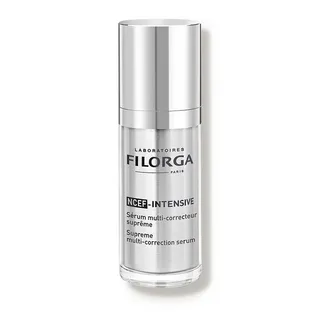
Filorga NCEF-Intensive Supreme Regenerating Serum

Filorga NCEF-Intensive Supreme Regenerating Serum

Efficacy100/100IrritancyHigh

Works for

Anti-aging
Retinol, Ascorbyl glucoside + 15 more
Works well
What the product description says
“Formulated with a potent blend of retinol and vitamin C, this lightweight serum evens your skin tone and plump fine lines.”
Source: Dermstore

This product can help reduce and prevent fine lines and wrinkles, improve skin elasticity and firmness because it contains retinol.

These ingredients in the product can also be helpful, even though there is less evidence for their effectiveness: ascorbyl glucoside, aspartic acid, dipeptide diaminobutyroyl benzylamide diacetate, folic acid, palmitoyl tetrapeptide-7, palmitoyl tripeptide-1, retinyl acetate, serine, threonine.

Keep in mind that it typically takes at least 6 weeks to notice any results because the changes that are needed to improve fine lines and elasticity happen in the deeper layers of the skin. No topical anti-aging product can “erase” wrinkles or fully reverse signs of aging.

RetinolHeroEffect: HighTwo steps removed from the active form of vitamin A - retinoic acid. Once converted to the retinoic acid in the skin, retinol is proven to be effective against all signs of aging. It improves skin cell turnover, helps fight blemishes and clogged pores, can regulate excess oil production and even skin tone. It can, however, be quite irritating~0.15–0.3%
Ascorbyl glucosideKey activeEffect: MediumA vitamin C derivative that is more stable but less potent than pure form of vitamin C. Has a potential to boost collagen production, nutralise free radicals and reduce hyperpigmentation, but the required concentration is likely to be much higher than for the pure form of vitamin C, limiting the ingredient's effectiveness in products~2.3–2.8%
Palmitoyl tetrapeptide-7Key activeEffect: MediumA type of peptide. Peptides are excellent moisturizers and might be able support collagen production reducing fine lines and wrinkles~0.25–0.45%
Palmitoyl tripeptide-1Key activeEffect: MediumA type of peptide. Peptides are excellent moisturizers and might be able support collagen production reducing fine lines and wrinkles~0.25–0.5%
SerineKey activeEffect: MediumAn amino-acid that helps to attract water to the upper layer of the skin. In combination with other amino-acids, might help to reduce fine lines and wrinkles~0.2–0.4%
ThreonineKey activeEffect: MediumAn amino-acid that helps to attract water to the upper layer of the skin. In combination with other amino-acids, might help to reduce fine lines and wrinkles~0.2–0.4%
Aspartic acidKey activeEffect: MediumAn amino-acid that helps increase skin hydration and might help to slightly improve skin firmness, potentially reducing lines and wrinkles~0.2–0.4%
Retinyl acetateKey activeEffect: Medium~0.2–0.35%
Folic acidKey activeEffect: MediumCan help stimulate collagen production in skin. While available studies are promising, more research is needed to confirm the efficacy in skin~0.15–0.25%
Dipeptide diaminobutyroyl benzylamide diacetateKey activeEffect: MediumA type of peptide. Peptides are excellent moisturizers and might be able support collagen production reducing fine lines and wrinkles~0.15–0.3%
Aminobutyric acidEffect: LowHas been shown to support wound healing and skin barrier function when used topically in rats. Is likely to be effective in supporting skin's hydration and barrier function, but research for human skin is missing. Might have some anti-aging properties but the research is missing~0.25–0.45%
HydroxyprolineEffect: LowIs helpful in restoring skin barrier function supporting its moisture levels. Is claimed to stimulte collagen production in skin but evidence is lacking~0.2–0.4%
Prunus amygdalus dulcis oilEffect: LowAn emollient that softens the skin~0.2–0.4%
TocopherolEffect: Low, below effective dosePure form of vitamin E. Can help moisturise and protect the skin from free radicals. Often used to help stabilise other ingredients or the formula itself~0.25–0.45%
Ascorbic acidUnder-dosedThe most well-researched antioxidant that works in skin. Helps neutralize free radicals supporting collagen production, helping to even out the skin tone and preventing early signs of aging~0.2–0.4%
NiacinamideUnder-dosedIs proven to be effective in reducing blemishes, evening out skin tone and helping to improve lines and wrinkles. It helps the skin to repair sun damage, calm down inflammation and keep maintain good levels of moisture. The concentration of about 2% is effective for supporting the skin barrier and evening out the skin tone. Concentration of 4-6% is better for helping with acne and balancing the sebum production~0.15–0.3%
NiacinUnder-dosedA form of vitamin B3. It is similar in action to niacinamide, but is more likely to cause red flashes in skin as the side effect~0.15–0.3%
Evens skin tone
Retinol, Ascorbyl glucoside + 6 more
Works well
What the product description says
“Formulated with a potent blend of retinol and vitamin C, this lightweight serum evens your skin tone and plump fine lines.”
Source: Dermstore

This product can help reduce hypepigmentation and even out the skin tone because it contains the following effective ingredients: retinol.

In addition, this product contains glutathione. This ingredient (ingredients) might help reduce hyperpigmentation, but the effect, if any, is likely to be small.

The following ingredient (ingredients) in this product might be helpful, but there is no evidence to confirm that it actually can help even out the skin tone: alanine, ascorbyl glucoside.

Keep in mind that you would need to apply any topical skincare targetted at hypigmentation consistently for a couple of months to get a result. No topical skincare product can help get rid of hyperpigmentation (including post-acne marks and age spots) instantly.

RetinolHeroEffect: HighTwo steps removed from the active form of vitamin A - retinoic acid. Once converted to the retinoic acid in the skin, retinol is proven to be effective against all signs of aging. It improves skin cell turnover, helps fight blemishes and clogged pores, can regulate excess oil production and even skin tone. It can, however, be quite irritating~0.15–0.3%
Ascorbyl glucosideKey activeEffect: MediumA vitamin C derivative that is more stable but less potent than pure form of vitamin C. Has a potential to boost collagen production, nutralise free radicals and reduce hyperpigmentation, but the required concentration is likely to be much higher than for the pure form of vitamin C, limiting the ingredient's effectiveness in products~2.3–2.8%
GlutathioneKey activeEffect: HighA peptide that can help neutralize free radicals in skin and reduce melanin production resulting in skin lightening effect and reduction in hyperpigmentation. It can also help attract moisture to the upper layer of the skin~0.25–0.45%
TaurineEffect: LowCould be helpful in reducing inflammation in skin, evening out the skin tone and neutralizing free radicals, but more research is needed to confirm its effectiveness~0.25–0.45%
AlanineEffect: LowAn amino-acid that helps to attract water to the upper layer of the skin and might help to lighten the skin, but solid evidence is lacking~0.2–0.35%
Ascorbic acidUnder-dosedThe most well-researched antioxidant that works in skin. Helps neutralize free radicals supporting collagen production, helping to even out the skin tone and preventing early signs of aging~0.2–0.4%
NiacinamideUnder-dosedIs proven to be effective in reducing blemishes, evening out skin tone and helping to improve lines and wrinkles. It helps the skin to repair sun damage, calm down inflammation and keep maintain good levels of moisture. The concentration of about 2% is effective for supporting the skin barrier and evening out the skin tone. Concentration of 4-6% is better for helping with acne and balancing the sebum production~0.15–0.3%
NiacinUnder-dosedA form of vitamin B3. It is similar in action to niacinamide, but is more likely to cause red flashes in skin as the side effect~0.15–0.3%
Moisturizing
Side benefit · Palmitoyl tripeptide-1, Palmitoyl tetrapeptide-7 + 38 more
Works well

This product can help improve hydration of the skin with the two types of ingredients.

The first type is called “humectants”:
these ingredients help attract water. When humectants are on the surface of the skin, they “pull in” the moisture from the outside environment, or from within deeper layers of the skin. The following ingredients in this product do the job: alanine, aminobutyric acid.

This product also contains ingredients called “occlusives”. They help reduce the speed with which our skin loses moisture to the outside environment. These ingredients also help soften the upper layer of the skin, so it feels less tight and nicer to the touch. The following ingredients in this product do the job: arginine, phenyl trimethicone.

The following ingredients in this product are especially good for supporting the skin barrier and helping with the hydration level: dipeptide diaminobutyroyl benzylamide diacetate, palmitoyl tetrapeptide-7, palmitoyl tripeptide-1

Palmitoyl tripeptide-1Hero· EmollientEffect: HighA type of peptide. Peptides are excellent moisturizers and might be able support collagen production reducing fine lines and wrinkles~0.25–0.5%
Palmitoyl tetrapeptide-7Hero· EmollientEffect: HighA type of peptide. Peptides are excellent moisturizers and might be able support collagen production reducing fine lines and wrinkles~0.25–0.45%
Dipeptide diaminobutyroyl benzylamide diacetateHeroEffect: HighA type of peptide. Peptides are excellent moisturizers and might be able support collagen production reducing fine lines and wrinkles~0.15–0.3%
Phenyl trimethiconeKey active· OcclusiveEffect: HighA type of silicone that can decrease loss of moisture from the skin surface. It helps create a nice product texture~3.9–4.8%
GlycerinKey active· HumectantEffect: HighOne of the best moisturizing ingredients. Naturally present in skin. It attracts water to the upper layer of the skin working as a humectant~2.8–3.5%
Glutamic acidKey active· HumectantEffect: HighAn amino-acid that helps attract water to the upper layer of the skin~0.25–0.45%
GlutathioneKey activeEffect: HighA peptide that can help neutralize free radicals in skin and reduce melanin production resulting in skin lightening effect and reduction in hyperpigmentation. It can also help attract moisture to the upper layer of the skin~0.25–0.45%
Aminobutyric acidKey active· HumectantEffect: HighHas been shown to support wound healing and skin barrier function when used topically in rats. Is likely to be effective in supporting skin's hydration and barrier function, but research for human skin is missing. Might have some anti-aging properties but the research is missing~0.25–0.45%
GlucoseKey active· HumectantEffect: MediumHelps attract water to the upper layer of the skin. Could be helpful in restoring the skin barrier function~0.25–0.45%
ProlineKey activeEffect: Medium~0.25–0.45%
GlycineKey active· HumectantEffect: HighHelps to attract water to the upper layer of the skin and can help restore the skin barrier function~0.2–0.35%
Glycine soja oilKey active· EmollientEffect: HighA good emollient that helps soften the skin and helps repair its barrier function. It can clog pores if used in high concentrations.~0.2–0.4%
HistidineKey active· HumectantEffect: High~0.2–0.35%
AlanineKey active· HumectantEffect: HighAn amino-acid that helps to attract water to the upper layer of the skin and might help to lighten the skin, but solid evidence is lacking~0.2–0.35%
InositolKey active· HumectantEffect: High~0.2–0.35%
IsoleucineKey activeEffect: HighAn amino acid that can help attract water to the upper layer of the skin and support skin's barrier function~0.2–0.35%
Lysine hclKey activeEffect: High~0.2–0.35%
OrnithineKey activeEffect: HighAn amino-acid. Helps attract water to the upper layer of the skin~0.2–0.4%
SerineKey activeEffect: HighAn amino-acid that helps to attract water to the upper layer of the skin. In combination with other amino-acids, might help to reduce fine lines and wrinkles~0.2–0.4%
Soluble collagenKey active· HumectantEffect: HighA typically plant-derived compound that is supposed mimic human collagen. Cannot penetrate the skin barrier so is not particularly useful in skincare products beyond attracting water to the upper layer of the skin~0.2–0.35%
ThreonineKey activeEffect: HighAn amino-acid that helps to attract water to the upper layer of the skin. In combination with other amino-acids, might help to reduce fine lines and wrinkles~0.2–0.4%
TyrosineKey activeEffect: High~0.2–0.35%
HydroxyprolineKey activeEffect: HighIs helpful in restoring skin barrier function supporting its moisture levels. Is claimed to stimulte collagen production in skin but evidence is lacking~0.2–0.4%
ArginineKey active· Humectant, OcclusiveEffect: HighAn amino acid that is naturally present in skin and helps keep it hydrated. When used together with AHAs, it can reduce their irritating effect on the skin~0.2–0.35%
Aspartic acidKey active· HumectantEffect: HighAn amino-acid that helps increase skin hydration and might help to slightly improve skin firmness, potentially reducing lines and wrinkles~0.2–0.4%
CyanocobalaminKey activeEffect: HighCan support skin barrier function and reduce inflammation in skin~0.2–0.4%
Prunus amygdalus dulcis oilKey active· EmollientEffect: MediumAn emollient that softens the skin~0.2–0.4%
Sodium hyaluronateKey active· HumectantEffect: HighOne of the best moisturizing ingredients. Attracts water into the upper layer of the skin~0.15–0.3%
Sodium lactateKey active· HumectantEffect: HighHelps attract water to the upper layer of the skin. Is often used to adjust the pH level of the product~0.15–0.3%
Calcium pantothenateKey activeEffect: HighHelps support skin barrier function improving skin hydration and reducing sensitivity~0.15–0.25%
Dicaprylyl carbonate· EmollientEffect: LowHelps products spread more easily and works as an emollient to soften skin~1.9–2.3%
Butylene glycol· HumectantEffect: LowUsed to create a nice product texture and help delivery of other ingredients. Might be somewhat helpful in attracting water to the upper layer of the skin~0.75–1.15%
Pentylene glycol· EmollientEffect: LowUsed to preserve products, dissolve other ingredients and create a nice product texture~0.3–0.55%
Coenzyme aEffect: LowHelps soften the upper layer of the skin and dissolve other ingredients in a product~0.2–0.4%
BiotinEffect: LowMight have some moisturising properties. Is not effective when applied topically beyond some moisturizing effect~0.15–0.25%
LecithinEffect: Low, below effective doseUsed mostly for creating emulsions - helping oil and water mix together. Helps soften the upper layer of the skin~0.3–0.6%
TocopherolEffect: Low, below effective dosePure form of vitamin E. Can help moisturise and protect the skin from free radicals. Often used to help stabilise other ingredients or the formula itself~0.25–0.45%
Triticum vulgare germ extractUnder-dosedPlant extract that might have moisturizing properties. Avoid if you suffer from wheat or gluten intolerance~0.2–0.35%
NiacinUnder-dosedA form of vitamin B3. It is similar in action to niacinamide, but is more likely to cause red flashes in skin as the side effect~0.15–0.3%
NiacinamideUnder-dosedIs proven to be effective in reducing blemishes, evening out skin tone and helping to improve lines and wrinkles. It helps the skin to repair sun damage, calm down inflammation and keep maintain good levels of moisture. The concentration of about 2% is effective for supporting the skin barrier and evening out the skin tone. Concentration of 4-6% is better for helping with acne and balancing the sebum production~0.15–0.3%
Anti-oxidation
Side benefit · Ascorbyl glucoside, Glutathione + 7 more
Works well

This product contains antioxidants (glutathione, retinol) that can help neutralize free radicals in skin. By doing so, they can lessen the damage the skin gets from the UV light (sun).

The following ingredients - ascorbyl glucoside also can have an antioxidant effect, but there is less evidence to confirm their effectiveness in skin.

Ascorbyl glucosideKey activeEffect: MediumA vitamin C derivative that is more stable but less potent than pure form of vitamin C. Has a potential to boost collagen production, nutralise free radicals and reduce hyperpigmentation, but the required concentration is likely to be much higher than for the pure form of vitamin C, limiting the ingredient's effectiveness in products~2.3–2.8%
GlutathioneKey activeEffect: HighA peptide that can help neutralize free radicals in skin and reduce melanin production resulting in skin lightening effect and reduction in hyperpigmentation. It can also help attract moisture to the upper layer of the skin~0.25–0.45%
RetinolKey activeEffect: HighTwo steps removed from the active form of vitamin A - retinoic acid. Once converted to the retinoic acid in the skin, retinol is proven to be effective against all signs of aging. It improves skin cell turnover, helps fight blemishes and clogged pores, can regulate excess oil production and even skin tone. It can, however, be quite irritating~0.15–0.3%
TaurineEffect: LowCould be helpful in reducing inflammation in skin, evening out the skin tone and neutralizing free radicals, but more research is needed to confirm its effectiveness~0.25–0.45%
Prunus amygdalus dulcis oilEffect: LowAn emollient that softens the skin~0.2–0.4%
Pyridoxine hclEffect: LowMight help neutralize free radicals in skin~0.15–0.25%
Triticum vulgare germ extractEffect: Low, below effective dosePlant extract that might have moisturizing properties. Avoid if you suffer from wheat or gluten intolerance~0.2–0.35%
TocopherolUnder-dosedPure form of vitamin E. Can help moisturise and protect the skin from free radicals. Often used to help stabilise other ingredients or the formula itself~0.25–0.45%
Ascorbic acidUnder-dosedThe most well-researched antioxidant that works in skin. Helps neutralize free radicals supporting collagen production, helping to even out the skin tone and preventing early signs of aging~0.2–0.4%
Exfoliation
Side benefit · Retinol
Works well

This product can help exfoliate the skin. In other words, it helps break down the bonds between dead cells on the surface of the skin and speed up the skin turnover. Skin often appears softer and brighter after exfoliation, but overdoing it can result in disrupted skin barrier. The following ingredient is doing the exfoliating job in this product: retinol.

RetinolKey activeEffect: HighTwo steps removed from the active form of vitamin A - retinoic acid. Once converted to the retinoic acid in the skin, retinol is proven to be effective against all signs of aging. It improves skin cell turnover, helps fight blemishes and clogged pores, can regulate excess oil production and even skin tone. It can, however, be quite irritating~0.15–0.3%
Anti-blemish
Side benefit · Retinol, Taurine + 2 more
Works well

This product can help reduce breakouts and clogged pores because it contains the following ingredient: retinol. This ingredient is used for treating acne and can have a noticeable effect.

RetinolHeroEffect: HighTwo steps removed from the active form of vitamin A - retinoic acid. Once converted to the retinoic acid in the skin, retinol is proven to be effective against all signs of aging. It improves skin cell turnover, helps fight blemishes and clogged pores, can regulate excess oil production and even skin tone. It can, however, be quite irritating~0.15–0.3%
TaurineEffect: LowCould be helpful in reducing inflammation in skin, evening out the skin tone and neutralizing free radicals, but more research is needed to confirm its effectiveness~0.25–0.45%
NiacinamideUnder-dosedIs proven to be effective in reducing blemishes, evening out skin tone and helping to improve lines and wrinkles. It helps the skin to repair sun damage, calm down inflammation and keep maintain good levels of moisture. The concentration of about 2% is effective for supporting the skin barrier and evening out the skin tone. Concentration of 4-6% is better for helping with acne and balancing the sebum production~0.15–0.3%
NiacinUnder-dosedA form of vitamin B3. It is similar in action to niacinamide, but is more likely to cause red flashes in skin as the side effect~0.15–0.3%

Can it cause trouble?

Irritancy
5 strong irritants: Parfum, Alcohol + 3 more — patch-test recommended
High risk
We flagged 29 ingredients with irritancy potential. Severity depends on your sensitivity threshold; the table lists the worst offenders first.
IngredientFunctionIrritationEst. amount
ParfumAn aromatic blend of unspecified and possibly irritating ingredientsHigh~0.45–0.65%est.
AlcoholCan be drying and contribute to skin irritation. Used in formulars to dissolve other ingredients, create a thinner product consistency or for its antibacterial propertiesHigh~0.2–0.35%est.
RetinolTwo steps removed from the active form of vitamin A - retinoic acid. Once converted to the retinoic acid in the skin, retinol is proven to be effective against all signs of aging. It improves skin cell turnover, helps fight blemishes and clogged pores, can regulate excess oil production and even skin tone. It can, however, be quite irritatingHigh~0.15–0.3%est.
Benzophenone-4Sulisobenzone. A UV filter. Is typically used to improve the product stability under exposure to UV light. It is effective against both UVA and UVB rays. It can be used is larger concentrations as a sun protection ingredient for the skin, but can be irritatingHigh~0.35–0.6%est.
Ascorbic acidThe most well-researched antioxidant that works in skin. Helps neutralize free radicals supporting collagen production, helping to even out the skin tone and preventing early signs of agingHigh~0.2–0.4%est.
Retinyl acetate—High~0.2–0.35%est.
NiacinA form of vitamin B3. It is similar in action to niacinamide, but is more likely to cause red flashes in skin as the side effectHigh~0.15–0.3%est.
Ascorbyl glucosideA vitamin C derivative that is more stable but less potent than pure form of vitamin C. Has a potential to boost collagen production, nutralise free radicals and reduce hyperpigmentation, but the required concentration is likely to be much higher than for the pure form of vitamin C, limiting the ingredient's effectiveness in productsMedium~2.3–2.8%est.
Acrylates/c10-30 alkyl acrylate crosspolymerMaintains the texture of skincare products. Allows the product to spread evenly. Helps oil and water mix togetherMedium~0.35–0.65%est.
ChlorphenesinA preservativeMedium~0.16–0.32%est.
Pentylene glycolUsed to preserve products, dissolve other ingredients and create a nice product textureMedium~0.3–0.55%est.
Disodium edtaStabilizes the product formulationMedium~0.2–0.4%est.
Glyceryl linoleateHelps oil and water mix togetherMedium~0.25–0.45%est.
Butyl methoxydibenzoylmethaneAvobenzone. An organic, or so-called "chemical" UV filter. Protects against both UVA and UVB rays. Needs to be combined with other filters in a formulation to be stable.Medium~0.35–0.6%est.
Triticum vulgare germ extractPlant extract that might have moisturizing properties. Avoid if you suffer from wheat or gluten intoleranceMedium~0.2–0.35%est.
Diethylhexyl syringylidenemalonateUsed to stabilize the product formulationMedium~0.2–0.35%est.
Citric acidCan work as an exfoliant but is typically used to adjust the product pHMedium~0.15–0.3%est.
Sodium lactateHelps attract water to the upper layer of the skin. Is often used to adjust the pH level of the productMedium~0.15–0.3%est.
Calcium chlorideHelps create a thicker product consistency. Might be irritatingMedium~0.2–0.35%est.
Sodium citrateHelps to control the skin's pH level. Maintains the skin's natural film of amino-lactic acids and oils. Helps to preserve productsMedium~0.15–0.3%est.
T-butyl alcoholUsed to dissolve other ingredients and to improve smell of products. It could be irritatingMedium~0.15–0.3%est.
Sodium benzotriazolyl butylphenol sulfonateHelps protect the ingredients in the formulation against UV lightMedium~0.2–0.35%est.
Potassium sorbateA preservativeMedium~0.2–0.4%est.
GlutathioneA peptide that can help neutralize free radicals in skin and reduce melanin production resulting in skin lightening effect and reduction in hyperpigmentation. It can also help attract moisture to the upper layer of the skinMedium~0.25–0.45%est.
Tributyl citrateHelps improve the product textureMedium~0.25–0.45%est.
TaurineCould be helpful in reducing inflammation in skin, evening out the skin tone and neutralizing free radicals, but more research is needed to confirm its effectivenessMedium~0.25–0.45%est.
Glycine soja oilA good emollient that helps soften the skin and helps repair its barrier function. It can clog pores if used in high concentrations.Medium~0.2–0.4%est.
Ci 17200A red colorantMedium~0.2–0.35%est.
Pyridoxine hclMight help neutralize free radicals in skinMedium~0.15–0.25%est.
Comedogenic
2 ingredients rated 2 or more on the 0–5 pore-clogging scale
2 flagged
These ingredients have a comedogenic rating of 2 or more on a 0–5 scale; the table shows each one's rating. In leave-on products they can clog pores in acne-prone skin.
IngredientFunctionRatingEst. amount
Triticum vulgare germ extractPlant extract that might have moisturizing properties. Avoid if you suffer from wheat or gluten intolerance3/5~0.2–0.35%est.
Glycine soja oilA good emollient that helps soften the skin and helps repair its barrier function. It can clog pores if used in high concentrations.2/5~0.2–0.4%est.

User reviews

Would you recommend?
No community reviews yet.

Be the first — your take helps the next person decide.

Ingredients

Filter by role to see what each ingredient is doing.

Water~45–55%
Formula
Irritation risk
Low

Plain old water

More about Water
Propanediol~4.3–5.3%
Formula
Irritation risk
Low

Acts as a solvent for other ingredients. Speeds up the absorption of other ingredients into the skin

More about Propanediol
Phenyl trimethicone~3.9–4.8%
Key active
Irritation risk
Low
Works for
Moisturizing

A type of silicone that can decrease loss of moisture from the skin surface. It helps create a nice product texture

More about Phenyl trimethicone
Glycerin~2.8–3.5%
Key active
Irritation risk
Low
Works for
Moisturizing

One of the best moisturizing ingredients. Naturally present in skin. It attracts water to the upper layer of the skin working as a humectant

More about Glycerin
Ascorbyl glucoside~2.3–2.8%
Key activeIrritant · medium
Irritation risk
Medium
Works for
Anti-oxidationEvens skin toneAnti-aging

A vitamin C derivative that is more stable but less potent than pure form of vitamin C. Has a potential to boost collagen production, nutralise free radicals and reduce hyperpigmentation, but the required concentration is likely to be much higher than for the pure form of vitamin C, limiting the ingredient's effectiveness in products

More about Ascorbyl glucoside
Dicaprylyl carbonate~1.9–2.3%
Formula
Irritation risk
Low
Works for
Moisturizing

Helps products spread more easily and works as an emollient to soften skin

More about Dicaprylyl carbonate
Sodium chloride~1.6–2%
Formula
Irritation risk
Low

Used to stabilize mixtures of oil and water, and create thicker, gel-like product textures

More about Sodium chloride
Phenoxyethanol~0.5–1%
Formula
Irritation risk
Low

A preservative. It helps prevent bacterial growth in cosmetic products

More about Phenoxyethanol
Polyacrylate crosspolymer-6~1.1–1.4%
Formula
Butylene glycol~0.75–1.15%
Formula
Irritation risk
Low
Works for
Moisturizing

Used to create a nice product texture and help delivery of other ingredients. Might be somewhat helpful in attracting water to the upper layer of the skin

More about Butylene glycol
Carbomer~0.6–0.95%
Formula
Irritation risk
Low
Works for
Cleansing

Helps create a thicker or gel-like product texture. It is not a surfactant but can be used in gentle cleansing formulations

More about Carbomer
Sodium hydroxide~0.5–0.75%
Formula
Irritation risk
Low

Used to adjust the product's pH

More about Sodium hydroxide
Parfum~0.45–0.65%
Irritant · high
Irritation risk
High

An aromatic blend of unspecified and possibly irritating ingredients

More about Parfum
Sucrose palmitate~0.45–0.65%
Formula
Irritation risk
Low
Works for
Cleansing
More about Sucrose palmitate
Acrylates/c10-30 alkyl acrylate crosspolymer~0.35–0.65%
Irritant · medium
Irritation risk
Medium

Maintains the texture of skincare products. Allows the product to spread evenly. Helps oil and water mix together

More about Acrylates/c10-30 alkyl acrylate crosspolymer
Ethylhexyl salicylate~0.55–0.8%
Formula
Irritation risk
Low
Works for
Sun protection

Octisalate. A UV filter. It offers some protection against the sun rays that cause sunburn (UVB), but does not protect against the most aging sun rays (UVA). It loses its effectiveness quickly when exposed to sunlight. It is an organic, or so called "chemical" sunscreen

More about Ethylhexyl salicylate
Chlorphenesin~0.16–0.32%
Irritant · medium
Irritation risk
Medium

A preservative

More about Chlorphenesin
Lecithin~0.3–0.6%
Formula
Irritation risk
Low
Works for
CleansingMoisturizing

Used mostly for creating emulsions - helping oil and water mix together. Helps soften the upper layer of the skin

More about Lecithin
Pentylene glycol~0.3–0.55%
Irritant · medium
Irritation risk
Medium
Works for
Moisturizing

Used to preserve products, dissolve other ingredients and create a nice product texture

More about Pentylene glycol
Glucose~0.25–0.45%
Key active
Irritation risk
Low
Works for
Moisturizing

Helps attract water to the upper layer of the skin. Could be helpful in restoring the skin barrier function

More about Glucose
Disodium edta~0.2–0.4%
Irritant · medium
Irritation risk
Medium

Stabilizes the product formulation

More about Disodium edta
Glyceryl linoleate~0.25–0.45%
Irritant · medium
Irritation risk
Medium
Works for
Cleansing

Helps oil and water mix together

More about Glyceryl linoleate
Prunus amygdalus dulcis oil~0.2–0.4%
Key active
Irritation risk
Low
Works for
MoisturizingAnti-oxidationAnti-aging

An emollient that softens the skin

More about Prunus amygdalus dulcis oil
Butyl methoxydibenzoylmethane~0.35–0.6%
Irritant · medium
Irritation risk
Medium
Works for
Sun protection

Avobenzone. An organic, or so-called "chemical" UV filter. Protects against both UVA and UVB rays. Needs to be combined with other filters in a formulation to be stable.

More about Butyl methoxydibenzoylmethane
Dna~0.15–0.3%
Formula
Irritation risk
Low
More about Dna
Triticum vulgare germ extract~0.2–0.35%
Under-dosedComedogenic 3/5Irritant · medium
Irritation risk
Medium
Comedogenicity
3/5
Works for
MoisturizingAnti-oxidation

Plant extract that might have moisturizing properties. Avoid if you suffer from wheat or gluten intolerance

More about Triticum vulgare germ extract
Polysorbate 20~0.2–0.4%
Formula
Irritation risk
Low
Works for
Cleansing

Helps oil and water mix together

More about Polysorbate 20
Potassium chloride~0.2–0.35%
Formula
Diethylhexyl syringylidenemalonate~0.2–0.35%
Irritant · medium
Irritation risk
Medium

Used to stabilize the product formulation

More about Diethylhexyl syringylidenemalonate
Citric acid~0.15–0.3%
Irritant · medium
Irritation risk
Medium

Can work as an exfoliant but is typically used to adjust the product pH

More about Citric acid
Alcohol~0.2–0.35%
Irritant · high
Irritation risk
High
Works for
Antibacterial

Can be drying and contribute to skin irritation. Used in formulars to dissolve other ingredients, create a thinner product consistency or for its antibacterial properties

More about Alcohol
Retinol~0.15–0.3%
Hero · Anti-aging, Evens skin tone, Anti-blemishIrritant · high
Irritation risk
High
Works for
MattifyingAnti-oxidationExfoliationAnti-agingAnti-blemishEvens skin tone

Two steps removed from the active form of vitamin A - retinoic acid. Once converted to the retinoic acid in the skin, retinol is proven to be effective against all signs of aging. It improves skin cell turnover, helps fight blemishes and clogged pores, can regulate excess oil production and even skin tone. It can, however, be quite irritating

More about Retinol
Sodium lactate~0.15–0.3%
Key activeIrritant · medium
Irritation risk
Medium
Works for
Moisturizing

Helps attract water to the upper layer of the skin. Is often used to adjust the pH level of the product

More about Sodium lactate
Triticum vulgare germ protein~0.2–0.35%
Formula
Calcium chloride~0.2–0.35%
Irritant · medium
Irritation risk
Medium

Helps create a thicker product consistency. Might be irritating

More about Calcium chloride
Benzophenone-4~0.35–0.6%
Irritant · high
Irritation risk
High
Works for
Sun protection

Sulisobenzone. A UV filter. Is typically used to improve the product stability under exposure to UV light. It is effective against both UVA and UVB rays. It can be used is larger concentrations as a sun protection ingredient for the skin, but can be irritating

More about Benzophenone-4
Pentaerythrityl tetra-di-t-butyl hydroxyhydrocinnamate~0.2–0.35%
Formula
Irritation risk
Low

Used to increase stability of product formulations

More about Pentaerythrityl tetra-di-t-butyl hydroxyhydrocinnamate
Sodium citrate~0.15–0.3%
Irritant · medium
Irritation risk
Medium

Helps to control the skin's pH level. Maintains the skin's natural film of amino-lactic acids and oils. Helps to preserve products

More about Sodium citrate
Soluble collagen~0.2–0.35%
Key active
Irritation risk
Low
Works for
Moisturizing

A typically plant-derived compound that is supposed mimic human collagen. Cannot penetrate the skin barrier so is not particularly useful in skincare products beyond attracting water to the upper layer of the skin

More about Soluble collagen
Magnesium sulfate~0.2–0.4%
Formula
Irritation risk
Low

Used to create a thicker product consistency

More about Magnesium sulfate
Glutamine~0.15–0.3%
Formula
Irritation risk
Low
More about Glutamine
T-butyl alcohol~0.15–0.3%
Irritant · medium
Irritation risk
Medium

Used to dissolve other ingredients and to improve smell of products. It could be irritating

More about T-butyl alcohol
Buteth-3~0.2–0.35%
Formula
Irritation risk
Low
More about Buteth-3
Sodium phosphate~0.2–0.35%
Formula
Irritation risk
Low

Helps stabilize the product formulation

More about Sodium phosphate
Dipeptide diaminobutyroyl benzylamide diacetate~0.15–0.3%
Hero · Moisturizing
Irritation risk
Low
Works for
MoisturizingAnti-aging

A type of peptide. Peptides are excellent moisturizers and might be able support collagen production reducing fine lines and wrinkles

More about Dipeptide diaminobutyroyl benzylamide diacetate
Sodium hyaluronate~0.15–0.3%
Key active
Irritation risk
Low
Works for
Moisturizing

One of the best moisturizing ingredients. Attracts water into the upper layer of the skin

More about Sodium hyaluronate
Sodium benzoate~0.2–0.35%
Formula
Irritation risk
Low

A preservative

More about Sodium benzoate
Sodium benzotriazolyl butylphenol sulfonate~0.2–0.35%
Irritant · medium
Irritation risk
Medium

Helps protect the ingredients in the formulation against UV light

More about Sodium benzotriazolyl butylphenol sulfonate
Potassium phosphate~0.2–0.4%
Formula
Irritation risk
Low

Helps regulate the pH of the formulation

More about Potassium phosphate
Ascorbic acid~0.2–0.4%
Under-dosedIrritant · high
Irritation risk
High
Works for
Anti-oxidationAnti-agingEvens skin tone

The most well-researched antioxidant that works in skin. Helps neutralize free radicals supporting collagen production, helping to even out the skin tone and preventing early signs of aging

More about Ascorbic acid
Sodium acetate~0.2–0.4%
Formula
Irritation risk
Low
More about Sodium acetate
Lysine hcl~0.2–0.35%
Key active
Irritation risk
Low
Works for
Moisturizing
More about Lysine hcl
Arginine~0.2–0.35%
Key active
Irritation risk
Low
Works for
Moisturizing

An amino acid that is naturally present in skin and helps keep it hydrated. When used together with AHAs, it can reduce their irritating effect on the skin

More about Arginine
Alanine~0.2–0.35%
Key active
Irritation risk
Low
Works for
MoisturizingEvens skin tone

An amino-acid that helps to attract water to the upper layer of the skin and might help to lighten the skin, but solid evidence is lacking

More about Alanine
Histidine~0.2–0.35%
Key active
Irritation risk
Low
Works for
Moisturizing
More about Histidine
Valine~0.2–0.35%
Formula
Irritation risk
Low
More about Valine
Potassium sorbate~0.2–0.4%
Irritant · medium
Irritation risk
Medium

A preservative

More about Potassium sorbate
Leucine~0.2–0.35%
Formula
Irritation risk
Low
More about Leucine
Threonine~0.2–0.4%
Key active
Irritation risk
Low
Works for
MoisturizingAnti-aging

An amino-acid that helps to attract water to the upper layer of the skin. In combination with other amino-acids, might help to reduce fine lines and wrinkles

More about Threonine
Isoleucine~0.2–0.35%
Key active
Irritation risk
Low
Works for
Moisturizing

An amino acid that can help attract water to the upper layer of the skin and support skin's barrier function

More about Isoleucine
Tryptophan~0.2–0.4%
Formula
Irritation risk
Low
More about Tryptophan
Phenylalanine~0.2–0.4%
Formula
Irritation risk
Low
More about Phenylalanine
Tyrosine~0.2–0.35%
Key active
Irritation risk
Low
Works for
Moisturizing
More about Tyrosine
Glycine~0.2–0.35%
Key active
Irritation risk
Low
Works for
Moisturizing

Helps to attract water to the upper layer of the skin and can help restore the skin barrier function

More about Glycine
Polysorbate 80~0.25–0.45%
Formula
Irritation risk
Low
Works for
Cleansing

Helps water and oil mix together

More about Polysorbate 80
Serine~0.2–0.4%
Key active
Irritation risk
Low
Works for
MoisturizingAnti-aging

An amino-acid that helps to attract water to the upper layer of the skin. In combination with other amino-acids, might help to reduce fine lines and wrinkles

More about Serine
Cystine~0.2–0.4%
Formula
Irritation risk
Low
More about Cystine
Cyanocobalamin~0.2–0.4%
Key active
Irritation risk
Low
Works for
Anti-inflammatoryMoisturizing

Can support skin barrier function and reduce inflammation in skin

More about Cyanocobalamin
Glutathione~0.25–0.45%
Key activeIrritant · medium
Irritation risk
Medium
Works for
Anti-oxidationMoisturizingEvens skin tone

A peptide that can help neutralize free radicals in skin and reduce melanin production resulting in skin lightening effect and reduction in hyperpigmentation. It can also help attract moisture to the upper layer of the skin

More about Glutathione
Asparagine~0.2–0.4%
Formula
Irritation risk
Low
More about Asparagine
Aspartic acid~0.2–0.4%
Key active
Irritation risk
Low
Works for
MoisturizingAnti-aging

An amino-acid that helps increase skin hydration and might help to slightly improve skin firmness, potentially reducing lines and wrinkles

More about Aspartic acid
Tris(tetramethylhydroxypiperidinol) citrate~0.25–0.45%
Formula
Ornithine~0.2–0.4%
Key active
Irritation risk
Low
Works for
Moisturizing

An amino-acid. Helps attract water to the upper layer of the skin

More about Ornithine
Glutamic acid~0.25–0.45%
Key active
Irritation risk
Low
Works for
Moisturizing

An amino-acid that helps attract water to the upper layer of the skin

More about Glutamic acid
Nicotinamide adenine dinucleotide~0.2–0.4%
Formula
Tocopherol~0.25–0.45%
Under-dosed
Irritation risk
Low
Works for
Anti-oxidationAnti-inflammatoryMoisturizingAnti-aging

Pure form of vitamin E. Can help moisturise and protect the skin from free radicals. Often used to help stabilise other ingredients or the formula itself

More about Tocopherol
Proline~0.25–0.45%
Key active
Irritation risk
Low
Works for
Moisturizing
More about Proline
Tributyl citrate~0.25–0.45%
Irritant · medium
Irritation risk
Medium

Helps improve the product texture

More about Tributyl citrate
Aminobutyric acid~0.25–0.45%
Key active
Irritation risk
Low
Works for
MoisturizingAnti-inflammatoryAnti-aging

Has been shown to support wound healing and skin barrier function when used topically in rats. Is likely to be effective in supporting skin's hydration and barrier function, but research for human skin is missing. Might have some anti-aging properties but the research is missing

More about Aminobutyric acid
Methionine~0.2–0.4%
Formula
Irritation risk
Low
More about Methionine
Taurine~0.25–0.45%
Irritant · medium
Irritation risk
Medium
Works for
Anti-oxidationAnti-blemishAnti-inflammatoryEvens skin tone

Could be helpful in reducing inflammation in skin, evening out the skin tone and neutralizing free radicals, but more research is needed to confirm its effectiveness

More about Taurine
Hydroxyproline~0.2–0.4%
Key active
Irritation risk
Low
Works for
CleansingMoisturizingAnti-aging

Is helpful in restoring skin barrier function supporting its moisture levels. Is claimed to stimulte collagen production in skin but evidence is lacking

More about Hydroxyproline
Glucosamine~0.25–0.45%
Formula
Irritation risk
Low
More about Glucosamine
Palmitoyl tripeptide-1~0.25–0.5%
Hero · Moisturizing
Irritation risk
Low
Works for
MoisturizingAnti-aging

A type of peptide. Peptides are excellent moisturizers and might be able support collagen production reducing fine lines and wrinkles

More about Palmitoyl tripeptide-1
Coenzyme a~0.2–0.4%
Formula
Irritation risk
Low
Works for
Moisturizing

Helps soften the upper layer of the skin and dissolve other ingredients in a product

More about Coenzyme a
Palmitoyl tetrapeptide-7~0.25–0.45%
Hero · Moisturizing
Irritation risk
Low
Works for
MoisturizingAnti-aging

A type of peptide. Peptides are excellent moisturizers and might be able support collagen production reducing fine lines and wrinkles

More about Palmitoyl tetrapeptide-7
Thiamine diphosphate~0.2–0.35%
Formula
Glycine soja oil~0.2–0.4%
Key activeComedogenic 2/5Irritant · medium
Irritation risk
Medium
Comedogenicity
2/5
Works for
Moisturizing

A good emollient that helps soften the skin and helps repair its barrier function. It can clog pores if used in high concentrations.

More about Glycine soja oil
Ci 17200~0.2–0.35%
Irritant · medium
Irritation risk
Medium

A red colorant

More about Ci 17200
Retinyl acetate~0.2–0.35%
Key activeIrritant · high
Irritation risk
High
Works for
Anti-aging
More about Retinyl acetate
Inositol~0.2–0.35%
Key active
Irritation risk
Low
Works for
Moisturizing
More about Inositol
Niacin~0.15–0.3%
Under-dosedIrritant · high
Irritation risk
High
Works for
MoisturizingEvens skin toneAnti-agingAnti-blemish

A form of vitamin B3. It is similar in action to niacinamide, but is more likely to cause red flashes in skin as the side effect

More about Niacin
Niacinamide~0.15–0.3%
Under-dosed
Irritation risk
Low
Works for
Evens skin toneAnti-agingMoisturizingAnti-blemishReduces irritationAnti-inflammatoryAntibacterialReduces redness

Is proven to be effective in reducing blemishes, evening out skin tone and helping to improve lines and wrinkles. It helps the skin to repair sun damage, calm down inflammation and keep maintain good levels of moisture. The concentration of about 2% is effective for supporting the skin barrier and evening out the skin tone. Concentration of 4-6% is better for helping with acne and balancing the sebum production

More about Niacinamide
Pyridoxine hcl~0.15–0.25%
Irritant · medium
Irritation risk
Medium
Works for
Anti-oxidation

Might help neutralize free radicals in skin

More about Pyridoxine hcl
Biotin~0.15–0.25%
Formula
Irritation risk
Low
Works for
Moisturizing

Might have some moisturising properties. Is not effective when applied topically beyond some moisturizing effect

More about Biotin
Calcium pantothenate~0.15–0.25%
Key active
Irritation risk
Low
Works for
Reduces irritationMoisturizing

Helps support skin barrier function improving skin hydration and reducing sensitivity

More about Calcium pantothenate
Folic acid~0.15–0.25%
Key active
Irritation risk
Low
Works for
Anti-aging

Can help stimulate collagen production in skin. While available studies are promising, more research is needed to confirm the efficacy in skin

More about Folic acid
Riboflavin~0.1–0.15%
Formula
Irritation risk
Low
More about Riboflavin
Tocopheryl phosphate~0.15–0.3%
Formula
Irritation risk
Low
Works for
Cleansing
More about Tocopheryl phosphate
Ingredient list view

Water, Propanediol, Phenyl trimethicone, Glycerin, Ascorbyl glucoside, Dicaprylyl carbonate, Sodium chloride, Phenoxyethanol, Polyacrylate crosspolymer-6, Butylene glycol, Carbomer, Sodium hydroxide, Parfum, Sucrose palmitate, Acrylates/c10-30 alkyl acrylate crosspolymer, Ethylhexyl salicylate, Chlorphenesin, Lecithin, Pentylene glycol, Glucose, Disodium edta, Glyceryl linoleate, Prunus amygdalus dulcis oil, Butyl methoxydibenzoylmethane, Dna, Triticum vulgare germ extract, Polysorbate 20, Potassium chloride, Diethylhexyl syringylidenemalonate, Citric acid, Alcohol, Retinol, Sodium lactate, Triticum vulgare germ protein, Calcium chloride, Benzophenone-4, Pentaerythrityl tetra-di-t-butyl hydroxyhydrocinnamate, Sodium citrate, Soluble collagen, Magnesium sulfate, Glutamine, T-butyl alcohol, Buteth-3, Sodium phosphate, Dipeptide diaminobutyroyl benzylamide diacetate, Sodium hyaluronate, Sodium benzoate, Sodium benzotriazolyl butylphenol sulfonate, Potassium phosphate, Ascorbic acid, Sodium acetate, Lysine hcl, Arginine, Alanine, Histidine, Valine, Potassium sorbate, Leucine, Threonine, Isoleucine, Tryptophan, Phenylalanine, Tyrosine, Glycine, Polysorbate 80, Serine, Cystine, Cyanocobalamin, Glutathione, Asparagine, Aspartic acid, Tris(tetramethylhydroxypiperidinol) citrate, Ornithine, Glutamic acid, Nicotinamide adenine dinucleotide, Tocopherol, Proline, Tributyl citrate, Aminobutyric acid, Methionine, Taurine, Hydroxyproline, Glucosamine, Palmitoyl tripeptide-1, Coenzyme a, Palmitoyl tetrapeptide-7, Thiamine diphosphate, Glycine soja oil, Ci 17200, Retinyl acetate, Inositol, Niacin, Niacinamide, Pyridoxine hcl, Biotin, Calcium pantothenate, Folic acid, Riboflavin, Tocopheryl phosphate

Compare prices

Retailers ranked by price — lowest first.

No pricing data available yet for this product.

Worth comparing, line by line.

Match % combines shared ingredients, the first five ingredients, shared actives and hero ingredients, irritancy (lower counts in the alternative's favour), texture and body area. Only products in the same routine step are compared.

Side-by-side comparison of this product against its closest alternatives
FilorgaNCEF-Intensive Supreme Regenerating SerumYOUR PRODUCTSKIN&LABVitamin C Brightening SerumREMEDY SCIENCEREMEDY for healthy agingSkin NutritionsDouble Strength Retinol Night Repair Serum
Match—83%81%81%
Price—$13.89$35.00$28.95
Shared key ingredients—9 of 357 of 357 of 35
Key difference—3-O-Ethyl Ascorbic AcidRetinalRetinyl Palmitate
Irritancy High Medium Medium Medium
Drying alcohol Contains drying alcohol ———
View product Shop Shop Shop

More alternatives: Chemist Confessions Double Play Retinol Face & Eye TreatmentISNTREE Hyper Retinol EX 1.0 Serum

Cheaper alternatives? Browse formulas in the same category.
We compare ingredient profiles across our catalog — pick the closest match for your budget.
Open dupe finder

Sources cited in this review

Every concentration estimate and effectiveness label is anchored to one of these 43 studies and safety reviews.

  1. 1
  2. 2
  3. 3
  4. 4
  5. 5
  6. 6
Filorga NCEF-Intensive Supreme Regenerating Serum
FilorgaNCEF-Intensive Supreme Regenerating Serum

Affiliate links · As an Amazon Associate, WIMJ earns from qualifying purchases.

As an Amazon Associate, WIMJ earns from qualifying purchases.