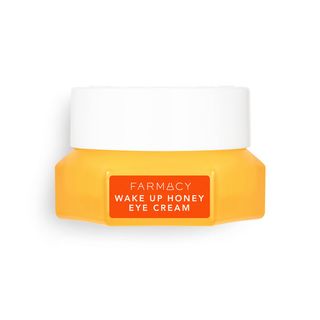
Farmacy Beauty Wake Up Honey Eye Cream
Works for
2 of 2 advertised claims delivered
Moisturizing21 ingredients credited for this claimStrong support
“Encapsulated caffeine + upcycled cranberry peptide penetrate the skin to immediately combat dark circles + fine lines and depuff. Replenishes hydration.”
This product can help improve hydration of the skin with the two types of ingredients.
The first type is called “humectants”:
these ingredients help attract water.
When humectants are on the surface of the skin, they “pull in” the moisture from the outside environment, or from
within deeper layers of the skin. The following ingredients in this product do the job:
betaine, glycerin.
This product also contains ingredients called “occlusives”. They help reduce the speed with which our skin loses moisture to the outside environment. These ingredients also help soften the upper layer of the skin, so it feels less tight and nicer to the touch. The following ingredients in this product do the job: butyrospermum parkii butter, helianthus annuus seed oil unsaponifiables.
The following ingredients in this product are especially good for supporting the skin barrier and helping with the hydration level: ceramide np
Anti-aging8 ingredients credited for this claimModerate support
“Encapsulated caffeine + upcycled cranberry peptide penetrate the skin to immediately combat dark circles + fine lines and depuff. Replenishes hydration.”
This product contains astaxanthin. This ingredient might be able to help reduce and prevent fine lines and wrinkles, improve skin elasticity and firmness, but there is not enough evidence that it actually works.
Anti-oxidationNot advertised by the brand · 13 ingredients credited for this claimStrong support
This product contains antioxidants (astaxanthin, ubiquinone) that can help neutralize free radicals in skin. By doing so, they can lessen the damage the skin gets from the UV light (sun).
The following ingredients - haematococcus pluvialis extract also can have an antioxidant effect, but there is less evidence to confirm their effectiveness in skin.
Can it cause trouble?
Irritancy3 strong irritants: Citrus aurantium amara fruit extract, Citrus aurantium sinensis peel extract + 1 more — patch-test recommendedHigh risk
Comedogenic2 ingredients rated 2 or more on the 0–5 pore-clogging scale2 flagged

User reviews
Be the first — your take helps the next person decide.
Ingredients
Filter by role to see what each ingredient is doing.
Water~45–55%
Glycerin~4.4–5.4%
- Irritation risk
- Low
One of the best moisturizing ingredients. Naturally present in skin. It attracts water to the upper layer of the skin working as a humectant
More about GlycerinCoco-caprylate/caprate~4.1–5%
- Irritation risk
- Low
Helps to soften the upper layer of the skin without creating a greasy texture
More about Coco-caprylate/capratePentaerythrityl tetraisostearate~2.7–3.4%
- Irritation risk
- Medium
Used to create a thicker product consistency
More about Pentaerythrityl tetraisostearateDiisostearyl malate~2.3–2.8%
- Irritation risk
- Medium
Helps to soften the upper layer of the skin
More about Diisostearyl malateButyrospermum parkii butter~1.9–2.4%
- Irritation risk
- Low
- Comedogenicity
- 3/5
A great moisturising ingredient that softens the skin and reduces water loss from its upper layer. It also can be helpful in protecting skin from free radicals
More about Butyrospermum parkii butterCetearyl alcohol~1.6–1.9%
- Irritation risk
- Low
- Comedogenicity
- 2/5
A non-drying alcohol. Works as an emollient. Helps water and oil mix together and creates a nice product texture
More about Cetearyl alcoholTetrahexyldecyl ascorbate~1.3–1.6%
- Irritation risk
- Medium
Being a lipid soluble form of vitamin C, it is more stable than ascorbic acid, but still degrades quickly and needs to be stabilized in a formulation with another ingredient. It is claimed to penetrate skin better than pure vitamin C and have the the similar benefits, but solid studies of its effectiveness are lacking. Is likely to require a higher concentration in a product than pure vitamin C to be effective. It might be able to help reduce pore clogging.
More about Tetrahexyldecyl ascorbateCetearyl olivate~1.1–1.4%
Pentylene glycol~0.95–1.15%
- Irritation risk
- Medium
Used to preserve products, dissolve other ingredients and create a nice product texture
More about Pentylene glycolHelianthus annuus seed oil unsaponifiables~0.7–1%
- Irritation risk
- Low
A great emollient due to its high linoleic acid content. One of the most effective plant oils in helping skin hydration and repairing skin barrier function
More about Helianthus annuus seed oil unsaponifiablesSorbitan olivate~0.55–0.8%
Boron nitride~0.5–0.8%
- Irritation risk
- Low
Helps to absord oil and evenly disperse other ingredients (for example, pigment) in product formulation
More about Boron nitrideCaffeine~0.4–0.65%
- Irritation risk
- Medium
Might be helpful in neutralizing free radicals. Can have a dehydration effect that might somewhat decrease the look of puffy eyes
More about CaffeineHyaluronic acid~0.35–0.65%
- Irritation risk
- Low
One of the best moisturizing ingredients. Attracts water into the upper layer of the skin. Naturally present in skin. Typically has large molecule size unless advertised otherwise on the product label. Helps support skin's barrier function and may help to reduce inflammation
More about Hyaluronic acidCeramide np~0.45–0.65%
- Irritation risk
- Low
A type of lipid similar to ceramides naturally present in skin. Helps to soften the upper layer of the skin and supports the skin barrier function to keep it hydrated. Can help to prevent inflammation in skin
More about Ceramide npVaccinium macrocarpon fruit extract~0.35–0.6%
- Irritation risk
- High
A berry extract. Might have some anti-oxidant properties
More about Vaccinium macrocarpon fruit extractCoffea arabica seed extract~0.3–0.55%
- Irritation risk
- Low
Might be helpful in neutralizing free radicals in skin
More about Coffea arabica seed extractHoney extract~0.25–0.5%
- Irritation risk
- Medium
Helps attract water to the upper layer of the skin
More about Honey extractPropolis extract~0.25–0.5%
- Irritation risk
- High
A complex substance produced by honey bees. Can have anti-bacterial and some anti-oxidant effect. Is an allergen and can be irritating
More about Propolis extractRoyal jelly extract~0.25–0.45%
- Irritation risk
- Medium
A compound secreted by bees. Might be able to attract water to the top layer of the skin. Avoid if sensitive to honey and bee products
More about Royal jelly extractCitrus aurantium amara fruit extract~0.2–0.4%
- Irritation risk
- High
Citrus aurantium sinensis peel extract~0.2–0.4%
- Irritation risk
- High
Citrus reticulata fruit extract~0.2–0.4%
- Irritation risk
- High
Ascorbic acid~0.2–0.4%
- Irritation risk
- High
The most well-researched antioxidant that works in skin. Helps neutralize free radicals supporting collagen production, helping to even out the skin tone and preventing early signs of aging
More about Ascorbic acidTridecapeptide-1~0.2–0.4%
- Irritation risk
- Low
Betaine~0.2–0.4%
- Irritation risk
- Low
Helps attract water to the upper layer of the skin and improves the product texture
More about BetaineTriolein~0.2–0.4%
Hydroxyacetophenone~0.2–0.4%
Tocopheryl acetate~0.25–0.45%
- Irritation risk
- Medium
A more stable but less bio-available form of vitamin E compared to Tocopherol. Might help moisturize and protect the skin from free radicals, but mostly used in low concentrations to stabilize other ingredients.
More about Tocopheryl acetateAstaxanthin~0.2–0.4%
- Irritation risk
- Medium
Helps neutralize free radicals in skin and might help to calm down inflammation
More about AstaxanthinAllantoin~0.2–0.4%
- Irritation risk
- Low
Helps calm down inflammation in skin and can help reduce itching. Helps to repair the skin barrier and keep skin hydrated
More about AllantoinHippophae rhamnoides oil~0.25–0.45%
- Irritation risk
- High
A good emollient. Contains various ingredients including vitamins and fatty acids that could work in the skin to neutralize free radicals and minimize moisture loss - if enough of these compounds is able to penetrate the skin in an active form.
More about Hippophae rhamnoides oilTocopherol~0.2–0.4%
- Irritation risk
- Low
Pure form of vitamin E. Can help moisturise and protect the skin from free radicals. Often used to help stabilise other ingredients or the formula itself
More about TocopherolUbiquinone~0.2–0.4%
- Irritation risk
- Low
Coenzyme Q10. It helps neutralize free radicals in skin, improves skin hydration and might be helpful agains fine lines and wrinkles. It can be an allergen
More about UbiquinoneLecithin~0.25–0.5%
- Irritation risk
- Low
Used mostly for creating emulsions - helping oil and water mix together. Helps soften the upper layer of the skin
More about LecithinHaematococcus pluvialis extract~0.2–0.35%
- Irritation risk
- Medium
Green algae extract that might contain antioxidant astaxanthin
More about Haematococcus pluvialis extractGlyceryl dioleate~0.25–0.45%
- Irritation risk
- Low
Sclerotium gum~0.2–0.35%
- Irritation risk
- Low
Used to create gel-like formulas and stabilize emulsions
More about Sclerotium gumHexamidine diisethionate~0.05–0.1%
- Irritation risk
- Low
Sodium phytate~0.15–0.3%
Citric acid~0.15–0.25%
- Irritation risk
- Medium
Can work as an exfoliant but is typically used to adjust the product pH
More about Citric acidLactic acid~0.15–0.25%
- Irritation risk
- Medium
An exfoliating and moisturizing alpha-hydroxy acid (AHA). Typically causes less irritation than other AHAs, for example, glycolic acid. At high concentrations (about 15%), lactic acid can help reduce lines and wrinkles. Recent studies show that lactic acid can support the "good" bacteria living on skin's surface (healthy skin microbiome)
More about Lactic acidMalic acid~0.15–0.25%
1,2-hexanediol~0.1–0.2%
Caprylyl glycol~0.1–0.25%
- Irritation risk
- Medium
Helps preserve products and creates a nice product texture
More about Caprylyl glycolIngredient list view
Water, Glycerin, Coco-caprylate/caprate, Pentaerythrityl tetraisostearate, Diisostearyl malate, Butyrospermum parkii butter, Cetearyl alcohol, Tetrahexyldecyl ascorbate, Cetearyl olivate, Pentylene glycol, Helianthus annuus seed oil unsaponifiables, Sorbitan olivate, Boron nitride, Caffeine, Hyaluronic acid, Ceramide np, Vaccinium macrocarpon fruit extract, Coffea arabica seed extract, Honey extract, Propolis extract, Royal jelly extract, Citrus aurantium amara fruit extract, Citrus aurantium sinensis peel extract, Citrus reticulata fruit extract, Ascorbic acid, Tridecapeptide-1, Betaine, Triolein, Hydroxyacetophenone, Tocopheryl acetate, Astaxanthin, Allantoin, Hippophae rhamnoides oil, Tocopherol, Ubiquinone, Lecithin, Haematococcus pluvialis extract, Glyceryl dioleate, Sclerotium gum, Hexamidine diisethionate, Sodium phytate, Citric acid, Lactic acid, Malic acid, 1,2-hexanediol, Caprylyl glycol
Compare prices
Retailers ranked by price — lowest first.


Worth comparing, line by line.
Match % combines shared ingredients, the first five ingredients, shared actives and hero ingredients, irritancy (lower counts in the alternative's favour), texture and body area. Only products in the same routine step are compared.
| Farmacy BeautyWake Up Honey Eye CreamYOUR PRODUCT | Youth To The PeopleSuperberry Dream Eye Cream | |
|---|---|---|
| Match | — | 57% |
| Price | $22.00 | $16.00−$6.00 |
| Shared key ingredients | — | 4 of 15 |
| Key difference | — | Prickly Pear Seed Oil |
| Irritancy | High | Medium |
| Drying alcohol | — | — |
| View product | Shop |

Product summary
Based on the ingredient list, "Farmacy Beauty - Wake Up Honey Eye Cream" can work well for skin moisturization. To work well, any moisturizer needs to include a combination of water-binding and emollient ingredients. Farmacy Beauty - Wake Up Honey Eye Cream ticks this box. Betaine, glycerin, hyaluronic acid, honey extract and royal jelly extract in this product (humectants) attract water molecules to the upper layer of the skin (the water comes from the outside air or from the deeper layers of the skin if the air is dry). Emollients in this formulation (ceramide np, helianthus annuus seed oil unsaponifiables, hippophae rhamnoides oil, butyrospermum parkii butter and cetearyl alcohol) help to reduce the moisture loss from the skin. They also soften the skin surface and relieve the feeling of dryness and tightness.
Ingredient callouts
- This product also contains Vitamin C (Ascorbic Acid). It can be an effective active for anti-aging and evening out the skin tone, but in this moisturizer it is used for stabilizing other ingredients in the formulation. In this concentration (0.20% - 0.40%) it cannot have a noticeable benefit for the skin.
- As a plus, this moisturizer also contains Ceramides (ceramide np 0.45% - 0.65%). Ceramides are a type of lipids that our skin produces itself. They are a building block of the skin's barrier. Ceramides used in skincare are synthetic or extracted from plants. They work well for softening the skin surface and "patch holes" in the skin's barrier.
Irritation risk
We assess the overall irritancy of this moisturizer to be high. For a detailed overview of all potential irritants: click here
You can see the detailed formula review with the breakdown of all actives in the product and the full ingredient list with estimated concentrations in the tables below.
About the brand
According to Cruelty-Free Kitty "Farmacy Beauty" is cruelty free, but its parent company is not.
Price
The product retails from 22.00$ up to 45.00$ in the United States and from 41.00£ up to 65.50£ in the United Kingdom.
For a detailed price comparison: click here.
Sources cited in this review
Every concentration estimate and effectiveness label is anchored to one of these 24 studies and safety reviews.
- 1
- 2Safety Assessment of Alkyl Esters as Used in Cosmeticscir-safety.org
- 3
- 4
- 5
- 6Safety Assessment of Boron Nitride as Used in Cosmetics cir-safety.org

Affiliate links · As an Amazon Associate, WIMJ earns from qualifying purchases.