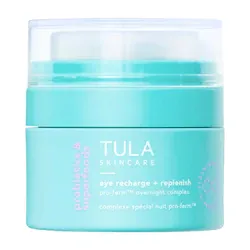
Tula Eye Recharge + Replenish Pro-Ferm™ Overnight Eye Cream with Bakuchiol and Peptides

Tula Eye Recharge + Replenish Pro-Ferm™ Overnight Eye Cream with Bakuchiol and Peptides

Efficacy100/100IrritancyMedium
Edit

Works for

2 of 2 advertised claims delivered

Anti-aging
7 ingredients credited for this claim
Strong support
What the product description says
“A luxuriously rich overnight eye cream that helps protect and hydrate the eye area and minimizes the look of fine lines and wrinkles.”
Source: Sephora CA

This product can help reduce and prevent fine lines and wrinkles, improve skin elasticity and firmness because it contains bakuchiol.

These ingredients in the product can also be helpful, even though there is less evidence for their effectiveness: palmitoyl tetrapeptide-7.

Keep in mind that it typically takes at least 6 weeks to notice any results because the changes that are needed to improve fine lines and elasticity happen in the deeper layers of the skin. No topical anti-aging product can “erase” wrinkles or fully reverse signs of aging.

BakuchiolKey activeEffect: HighA plant extract that is, though different in chemical structure, acts similar to retinoids. First studies show that it can help reduce fine lines and wrinkles, improve skin tone, reduce clogged pores and blemishes, and reduce inflammation. There is no conclusive evidence that bakuchiol is as effective as retinol however. The study that directly compared retinol with bakuchiol used bakuchiol applied twice daily compared to once per day for the retinol. According to this study, bakuchiol is less irritating than retinol. Bakuchiol is extracted from seeds of Babchi plant. Other parts of the plant contain coumarins that could cause allergic and irritant reactions. These compounds should be removed in the extraction process when bakuchiol is produced, but it is a good idea to be cautious and stay away from products that include the Babchi plant extracts other than purified bakuchiol to avoid irritation~0.4–0.6%
Palmitoyl tetrapeptide-7Key activeEffect: MediumA type of peptide. Peptides are excellent moisturizers and might be able support collagen production reducing fine lines and wrinkles~0.25–0.5%
Butyrospermum parkii butterEffect: LowA great moisturising ingredient that softens the skin and reduces water loss from its upper layer. It also can be helpful in protecting skin from free radicals~5.7–6.9%
ChrysinEffect: LowMight be helpful in reducing fine lines and wrinkles, as well as lightening the skin, but solid evidence is missing. Could somewhat help in reducing the darkness of the under-eye area. Helps to neutralise free radicals in skin~0.25–0.45%
Lactococcus ferment lysateEffect: LowConsists of remains of dead bacteria cells. Is likely helpful in attracting water to the upper layer of the skin. Might be helpful in reducing inflammation and neutralizing free radicals in skin~0.75–1.15%
Lactic acidUnder-dosedEffect: MediumAn exfoliating and moisturizing alpha-hydroxy acid (AHA). Typically causes less irritation than other AHAs, for example, glycolic acid. At high concentrations (about 15%), lactic acid can help reduce lines and wrinkles. Recent studies show that lactic acid can support the "good" bacteria living on skin's surface (healthy skin microbiome)~0.2–0.4%
TocopherolEffect: Low, below effective dosePure form of vitamin E. Can help moisturise and protect the skin from free radicals. Often used to help stabilise other ingredients or the formula itself~0.15–0.25%
Moisturizing
28 ingredients credited for this claim
Strong support
What the product description says
“A luxuriously rich overnight eye cream that helps protect and hydrate the eye area and minimizes the look of fine lines and wrinkles.”
Source: Sephora CA

This product can help improve hydration of the skin with the two types of ingredients.

The first type is called “humectants”:
these ingredients help attract water. When humectants are on the surface of the skin, they “pull in” the moisture from the outside environment, or from within deeper layers of the skin. The following ingredients in this product do the job: glycerin, lactobacillus ferment.

This product also contains ingredients called “occlusives”. They help reduce the speed with which our skin loses moisture to the outside environment. These ingredients also help soften the upper layer of the skin, so it feels less tight and nicer to the touch. The following ingredients in this product do the job: butyrospermum parkii butter, myristyl myristate.

The following ingredients in this product are especially good for supporting the skin barrier and helping with the hydration level: ceramide ap, ceramide as, ceramide eop, ceramide np, ceramide ns, palmitoyl tetrapeptide-7

Ceramide asHeroEffect: HighA type of lipid similar to ceramides naturally present in skin. Helps to soften the upper layer of the skin and supports the skin barrier function to keep it hydrated. Can help to prevent inflammation in skin~0.2–0.4%
GlycerinKey active· HumectantEffect: HighOne of the best moisturizing ingredients. Naturally present in skin. It attracts water to the upper layer of the skin working as a humectant~4.2–5.1%
SqualeneKey active· Emollient, OcclusiveEffect: HighAn oil that is naturally part of skin sebum that helps to soften its upper layer, reduce water loss and neutralize free radicals. It might be comedogenic. Avoid applying large concentrations (or pure oil) before sun exposure as oxidized squalene can clog pores and lead to skin irritation. Today squalene is mostly derived from vegetable oils or synthetized by yeast~0.25–0.5%
Ceramide eopHero· EmollientEffect: HighA type of lipid similar to ceramides naturally present in skin. Helps to soften the upper layer of the skin and supports the skin barrier function to keep it hydrated. Can help to prevent inflammation in skin~0.25–0.45%
Ceramide npHero· EmollientEffect: HighA type of lipid similar to ceramides naturally present in skin. Helps to soften the upper layer of the skin and supports the skin barrier function to keep it hydrated. Can help to prevent inflammation in skin~0.25–0.5%
CholesterolKey active· EmollientEffect: HighAn emollient that is naturally found in skin~0.3–0.5%
Alpha-glucan oligosaccharideKey activeEffect: HighHelps attract water to the upper layer of the skin~0.3–0.5%
Beta-sitosterolKey active· EmollientEffect: HighA phytosterol that can support skin's barrier function and help the skin stay hydrated~0.1–0.25%
Butyrospermum parkii butterKey active· Emollient, OcclusiveEffect: HighA great moisturising ingredient that softens the skin and reduces water loss from its upper layer. It also can be helpful in protecting skin from free radicals~5.7–6.9%
Ceramide apHeroEffect: HighA type of lipid similar to ceramides naturally present in skin. Helps to soften the upper layer of the skin and supports the skin barrier function to keep it hydrated. Can help to prevent inflammation in skin~0.2–0.4%
Ceramide nsHero· EmollientEffect: HighA type of lipid similar to ceramides naturally present in skin. Helps to soften the upper layer of the skin and supports the skin barrier function to keep it hydrated. Can help to prevent inflammation in skin~0.25–0.45%
InulinKey activeEffect: HighHelps attract water to the upper layer of the skin. Is claimed to support the growth of "good" bacteria in skin (as a "prebiotic"), but the research is lacking~0.2–0.4%
LactobacillusKey activeEffect: HighA non-living ingredient made by fermentation with the bacteria Lactobacillus. It can help attract water to the upper layer of the skin and might help reduce inflammation~0.3–0.6%
Lactobacillus fermentKey active· HumectantEffect: HighA fermentation product created by bacteria Lactobacillus. The fermented product has anti-bacterial properties and might be helpful in calming down inflammation, but studies are lacking. Helps attract water to the upper layer of the skin. Can be used as a preservative~0.3–0.55%
Lactococcus ferment lysateKey activeEffect: HighConsists of remains of dead bacteria cells. Is likely helpful in attracting water to the upper layer of the skin. Might be helpful in reducing inflammation and neutralizing free radicals in skin~0.75–1.15%
Myristyl myristateKey active· Emollient, OcclusiveEffect: HighAn emollient. Is not recommended for acne-prone skin as it can be comedogenic~2–2.5%
Oenothera biennis oilKey active· EmollientEffect: HighHelps soften the upper layer of the skin and can support skin barrier function~0.45–0.7%
Palmitoyl tetrapeptide-7Hero· EmollientEffect: HighA type of peptide. Peptides are excellent moisturizers and might be able support collagen production reducing fine lines and wrinkles~0.25–0.5%
SqualaneKey active· Emollient, OcclusiveEffect: HighAn oil naturally present in skin. Works as an emollient to soften the skin and form a protective layer on its surface without a greasy feeling.~3.3–4%
Glyceryl stearate· EmollientEffect: LowAn emollient that softens the skin and forms a protective layer on its surface. Helps water and oil mix together~0.5–0.75%
Butylene glycol· HumectantEffect: LowUsed to create a nice product texture and help delivery of other ingredients. Might be somewhat helpful in attracting water to the upper layer of the skin~1.6–2%
Polymnia sonchifolia root juiceEffect: LowA plant extract that helps attract water to the upper layer of the skin and might have some anti-oxidant properties~0.25–0.45%
Arachidyl alcohol· EmollientEffect: LowUsed to soften the upper layer of the skin and create a thicker product consistency~0.65–0.95%
Behenyl alcohol· Emollient, OcclusiveEffect: LowNon-drying alcohol that helps water and oil mix together. Also serves as an emollient~0.3–0.5%
Pentylene glycol· EmollientEffect: LowUsed to preserve products, dissolve other ingredients and create a nice product texture~0.25–0.5%
Lactic acidUnder-dosedEffect: HighAn exfoliating and moisturizing alpha-hydroxy acid (AHA). Typically causes less irritation than other AHAs, for example, glycolic acid. At high concentrations (about 15%), lactic acid can help reduce lines and wrinkles. Recent studies show that lactic acid can support the "good" bacteria living on skin's surface (healthy skin microbiome)~0.2–0.4%
TocopherolEffect: Low, below effective dosePure form of vitamin E. Can help moisturise and protect the skin from free radicals. Often used to help stabilise other ingredients or the formula itself~0.15–0.25%
LecithinEffect: Low, below effective doseUsed mostly for creating emulsions - helping oil and water mix together. Helps soften the upper layer of the skin~0.3–0.5%
Anti-oxidation
Not advertised by the brand · 11 ingredients credited for this claim
Strong support

This product contains antioxidants (bakuchiol) that can help neutralize free radicals in skin. By doing so, they can lessen the damage the skin gets from the UV light (sun).

The following ingredients - chrysin, haematococcus pluvialis extract, squalene also can have an antioxidant effect, but there is less evidence to confirm their effectiveness in skin.

BakuchiolKey activeEffect: HighA plant extract that is, though different in chemical structure, acts similar to retinoids. First studies show that it can help reduce fine lines and wrinkles, improve skin tone, reduce clogged pores and blemishes, and reduce inflammation. There is no conclusive evidence that bakuchiol is as effective as retinol however. The study that directly compared retinol with bakuchiol used bakuchiol applied twice daily compared to once per day for the retinol. According to this study, bakuchiol is less irritating than retinol. Bakuchiol is extracted from seeds of Babchi plant. Other parts of the plant contain coumarins that could cause allergic and irritant reactions. These compounds should be removed in the extraction process when bakuchiol is produced, but it is a good idea to be cautious and stay away from products that include the Babchi plant extracts other than purified bakuchiol to avoid irritation~0.4–0.6%
SqualeneKey activeEffect: MediumAn oil that is naturally part of skin sebum that helps to soften its upper layer, reduce water loss and neutralize free radicals. It might be comedogenic. Avoid applying large concentrations (or pure oil) before sun exposure as oxidized squalene can clog pores and lead to skin irritation. Today squalene is mostly derived from vegetable oils or synthetized by yeast~0.25–0.5%
ChrysinKey activeEffect: MediumMight be helpful in reducing fine lines and wrinkles, as well as lightening the skin, but solid evidence is missing. Could somewhat help in reducing the darkness of the under-eye area. Helps to neutralise free radicals in skin~0.25–0.45%
Haematococcus pluvialis extractKey activeEffect: MediumGreen algae extract that might contain antioxidant astaxanthin~0.25–0.5%
Oenothera biennis oilEffect: LowHelps soften the upper layer of the skin and can support skin barrier function~0.45–0.7%
Lactobacillus fermentEffect: LowA fermentation product created by bacteria Lactobacillus. The fermented product has anti-bacterial properties and might be helpful in calming down inflammation, but studies are lacking. Helps attract water to the upper layer of the skin. Can be used as a preservative~0.3–0.55%
Butyrospermum parkii butterEffect: LowA great moisturising ingredient that softens the skin and reduces water loss from its upper layer. It also can be helpful in protecting skin from free radicals~5.7–6.9%
Lactococcus ferment lysateEffect: LowConsists of remains of dead bacteria cells. Is likely helpful in attracting water to the upper layer of the skin. Might be helpful in reducing inflammation and neutralizing free radicals in skin~0.75–1.15%
TocopherolUnder-dosedEffect: HighPure form of vitamin E. Can help moisturise and protect the skin from free radicals. Often used to help stabilise other ingredients or the formula itself~0.15–0.25%
Rosmarinus officinalis leaf extractEffect: Low, below effective doseCan be helpful in reducing inflammation in skin, including inflamed acne. It can be irritating~0.2–0.4%
Beta vulgaris root extractEffect: Low, below effective doseA plant extract that might have some antioxidant properties, but mostly used in cosmetics for its color~0.25–0.45%
Evens skin tone
Not advertised by the brand · 3 ingredients credited for this claim
Strong support

This product can help reduce hypepigmentation and even out the skin tone because it contains the following effective ingredients: bakuchiol

The following ingredient (ingredients) in this product might be helpful, but there is no evidence to confirm that it actually can help even out the skin tone: chrysin.

Keep in mind that you would need to apply any topical skincare targetted at hypigmentation consistently for a couple of months to get a result. No topical skincare product can help get rid of hyperpigmentation (including post-acne marks and age spots) instantly.

BakuchiolKey activeEffect: HighA plant extract that is, though different in chemical structure, acts similar to retinoids. First studies show that it can help reduce fine lines and wrinkles, improve skin tone, reduce clogged pores and blemishes, and reduce inflammation. There is no conclusive evidence that bakuchiol is as effective as retinol however. The study that directly compared retinol with bakuchiol used bakuchiol applied twice daily compared to once per day for the retinol. According to this study, bakuchiol is less irritating than retinol. Bakuchiol is extracted from seeds of Babchi plant. Other parts of the plant contain coumarins that could cause allergic and irritant reactions. These compounds should be removed in the extraction process when bakuchiol is produced, but it is a good idea to be cautious and stay away from products that include the Babchi plant extracts other than purified bakuchiol to avoid irritation~0.4–0.6%
ChrysinKey activeEffect: MediumMight be helpful in reducing fine lines and wrinkles, as well as lightening the skin, but solid evidence is missing. Could somewhat help in reducing the darkness of the under-eye area. Helps to neutralise free radicals in skin~0.25–0.45%
Lactic acidUnder-dosedEffect: HighAn exfoliating and moisturizing alpha-hydroxy acid (AHA). Typically causes less irritation than other AHAs, for example, glycolic acid. At high concentrations (about 15%), lactic acid can help reduce lines and wrinkles. Recent studies show that lactic acid can support the "good" bacteria living on skin's surface (healthy skin microbiome)~0.2–0.4%

Can it cause trouble?

Irritancy
1 strong irritant: Rosmarinus officinalis leaf extract
Medium risk
We flagged 18 ingredients with irritancy potential. Severity depends on your sensitivity threshold; the table lists the worst offenders first.
IngredientFunctionIrritationEst. amount
Curcuma longa root extractA plant extract that can contain an active compound curcumin, that may have some anti-inflammatory properties when applied to the skin, but solid research is lacking and the typical concentration used in skincare products is too low. Can be an irritantHigh~0.2–0.4%est.
Rosmarinus officinalis leaf extractCan be helpful in reducing inflammation in skin, including inflamed acne. It can be irritatingHigh~0.2–0.4%est.
Chamomilla recutita flower extractPlant extract that can have healing and anti-inflammatory properties. It is a potential allergen and can be irritatingHigh~0.2–0.4%est.
Polymnia sonchifolia root juiceA plant extract that helps attract water to the upper layer of the skin and might have some anti-oxidant propertiesHigh~0.25–0.45%est.
Myristyl myristateAn emollient. Is not recommended for acne-prone skin as it can be comedogenicMedium~2–2.5%est.
1,2-hexanediolA preservativeMedium~0.65–0.95%est.
Pentaerythrityl tetraisostearateUsed to create a thicker product consistencyMedium~1.2–1.4%est.
Oenothera biennis oilHelps soften the upper layer of the skin and can support skin barrier functionMedium~0.45–0.7%est.
BakuchiolA plant extract that is, though different in chemical structure, acts similar to retinoids. First studies show that it can help reduce fine lines and wrinkles, improve skin tone, reduce clogged pores and blemishes, and reduce inflammation. There is no conclusive evidence that bakuchiol is as effective as retinol however. The study that directly compared retinol with bakuchiol used bakuchiol applied twice daily compared to once per day for the retinol. According to this study, bakuchiol is less irritating than retinol. Bakuchiol is extracted from seeds of Babchi plant. Other parts of the plant contain coumarins that could cause allergic and irritant reactions. These compounds should be removed in the extraction process when bakuchiol is produced, but it is a good idea to be cautious and stay away from products that include the Babchi plant extracts other than purified bakuchiol to avoid irritationMedium~0.4–0.6%est.
Haematococcus pluvialis extractGreen algae extract that might contain antioxidant astaxanthinMedium~0.25–0.5%est.
Beta vulgaris root extractA plant extract that might have some antioxidant properties, but mostly used in cosmetics for its colorMedium~0.25–0.45%est.
Lactic acidAn exfoliating and moisturizing alpha-hydroxy acid (AHA). Typically causes less irritation than other AHAs, for example, glycolic acid. At high concentrations (about 15%), lactic acid can help reduce lines and wrinkles. Recent studies show that lactic acid can support the "good" bacteria living on skin's surface (healthy skin microbiome)Medium~0.2–0.4%est.
ChrysinMight be helpful in reducing fine lines and wrinkles, as well as lightening the skin, but solid evidence is missing. Could somewhat help in reducing the darkness of the under-eye area. Helps to neutralise free radicals in skinMedium~0.25–0.45%est.
Sodium polyacryloyldimethyl taurateHelps oil and water mix togetherMedium~0.2–0.4%est.
Pentylene glycolUsed to preserve products, dissolve other ingredients and create a nice product textureMedium~0.25–0.5%est.
Citric acidCan work as an exfoliant but is typically used to adjust the product pHMedium~0.15–0.3%est.
Phytic acidAn alpha-hydroxy acid (AHA), but is mostly used to stabilize product formulations in cosmeticsMedium~0.15–0.3%est.
Potassium sorbateA preservativeMedium~0.15–0.25%est.
Comedogenic
3 ingredients rated 2 or more on the 0–5 pore-clogging scale
3 flagged
These ingredients have a comedogenic rating of 2 or more on a 0–5 scale; the table shows each one's rating. In leave-on products they can clog pores in acne-prone skin.
IngredientFunctionRatingEst. amount
Butyrospermum parkii butterA great moisturising ingredient that softens the skin and reduces water loss from its upper layer. It also can be helpful in protecting skin from free radicals3/5~5.7–6.9%est.
Myristyl myristateAn emollient. Is not recommended for acne-prone skin as it can be comedogenic3/5~2–2.5%est.
SqualeneAn oil that is naturally part of skin sebum that helps to soften its upper layer, reduce water loss and neutralize free radicals. It might be comedogenic. Avoid applying large concentrations (or pure oil) before sun exposure as oxidized squalene can clog pores and lead to skin irritation. Today squalene is mostly derived from vegetable oils or synthetized by yeast2/5~0.25–0.5%est.
Edit

User reviews

Would you recommend?
No community reviews yet.

Be the first — your take helps the next person decide.

Write a review · ~30s

Ingredients

Filter by role to see what each ingredient is doing.

Water~45–55%
Formula
Irritation risk
Low

Plain old water

More about Water
Butyrospermum parkii butter~5.7–6.9%
Key activeComedogenic 3/5
Irritation risk
Low
Comedogenicity
3/5
Works for
MoisturizingAnti-agingAnti-oxidation

A great moisturising ingredient that softens the skin and reduces water loss from its upper layer. It also can be helpful in protecting skin from free radicals

More about Butyrospermum parkii butter
Glycerin~4.2–5.1%
Key active
Irritation risk
Low
Works for
Moisturizing

One of the best moisturizing ingredients. Naturally present in skin. It attracts water to the upper layer of the skin working as a humectant

More about Glycerin
Squalane~3.3–4%
Key active
Irritation risk
Low
Works for
Moisturizing

An oil naturally present in skin. Works as an emollient to soften the skin and form a protective layer on its surface without a greasy feeling.

More about Squalane
Isopentyldiol~2.3–2.9%
Formula
Irritation risk
Low

Helps dissolve other ingredients in a formulation

More about Isopentyldiol
Myristyl myristate~2–2.5%
Key activeComedogenic 3/5Irritant · medium
Irritation risk
Medium
Comedogenicity
3/5
Works for
Moisturizing

An emollient. Is not recommended for acne-prone skin as it can be comedogenic

More about Myristyl myristate
Butylene glycol~1.6–2%
Formula
Irritation risk
Low
Works for
Moisturizing

Used to create a nice product texture and help delivery of other ingredients. Might be somewhat helpful in attracting water to the upper layer of the skin

More about Butylene glycol
1,2-hexanediol~0.65–0.95%
Irritant · medium
Irritation risk
Medium

A preservative

More about 1,2-hexanediol
Pentaerythrityl tetraisostearate~1.2–1.4%
Irritant · medium
Irritation risk
Medium
Works for
Cleansing

Used to create a thicker product consistency

More about Pentaerythrityl tetraisostearate
Lactococcus ferment lysate~0.75–1.15%
Key active
Irritation risk
Low
Works for
MoisturizingAnti-oxidationAnti-agingAnti-inflammatory

Consists of remains of dead bacteria cells. Is likely helpful in attracting water to the upper layer of the skin. Might be helpful in reducing inflammation and neutralizing free radicals in skin

More about Lactococcus ferment lysate
Arachidyl alcohol~0.65–0.95%
Formula
Irritation risk
Low
Works for
Moisturizing

Used to soften the upper layer of the skin and create a thicker product consistency

More about Arachidyl alcohol
Cetearyl olivate~0.55–0.8%
Formula
Irritation risk
Low
Works for
Cleansing

Helps oil and water mix together

More about Cetearyl olivate
Glyceryl stearate~0.5–0.75%
Formula
Irritation risk
Low
Works for
CleansingMoisturizing

An emollient that softens the skin and forms a protective layer on its surface. Helps water and oil mix together

More about Glyceryl stearate
Oenothera biennis oil~0.45–0.7%
Key activeIrritant · medium
Irritation risk
Medium
Works for
MoisturizingAnti-inflammatoryAnti-oxidationAnti-blemish

Helps soften the upper layer of the skin and can support skin barrier function

More about Oenothera biennis oil
Pseudozyma epicola/camellia sinensis seed oil ferment extract filtrate~0.3–0.6%
Formula
Bakuchiol~0.4–0.6%
Key activeIrritant · medium
Irritation risk
Medium
Works for
Anti-blemishAnti-inflammatoryEvens skin toneAnti-oxidationAnti-aging

A plant extract that is, though different in chemical structure, acts similar to retinoids. First studies show that it can help reduce fine lines and wrinkles, improve skin tone, reduce clogged pores and blemishes, and reduce inflammation. There is no conclusive evidence that bakuchiol is as effective as retinol however. The study that directly compared retinol with bakuchiol used bakuchiol applied twice daily compared to once per day for the retinol. According to this study, bakuchiol is less irritating than retinol. Bakuchiol is extracted from seeds of Babchi plant. Other parts of the plant contain coumarins that could cause allergic and irritant reactions. These compounds should be removed in the extraction process when bakuchiol is produced, but it is a good idea to be cautious and stay away from products that include the Babchi plant extracts other than purified bakuchiol to avoid irritation

More about Bakuchiol
Lactobacillus~0.3–0.6%
Key active
Irritation risk
Low
Works for
Moisturizing

A non-living ingredient made by fermentation with the bacteria Lactobacillus. It can help attract water to the upper layer of the skin and might help reduce inflammation

More about Lactobacillus
Lactobacillus ferment~0.3–0.55%
Key active
Irritation risk
Low
Works for
MoisturizingAnti-inflammatoryAnti-oxidationReduces irritation

A fermentation product created by bacteria Lactobacillus. The fermented product has anti-bacterial properties and might be helpful in calming down inflammation, but studies are lacking. Helps attract water to the upper layer of the skin. Can be used as a preservative

More about Lactobacillus ferment
Haematococcus pluvialis extract~0.25–0.5%
Key activeIrritant · medium
Irritation risk
Medium
Works for
Anti-oxidation

Green algae extract that might contain antioxidant astaxanthin

More about Haematococcus pluvialis extract
Beta vulgaris root extract~0.25–0.45%
Irritant · medium
Irritation risk
Medium
Works for
Anti-oxidation

A plant extract that might have some antioxidant properties, but mostly used in cosmetics for its color

More about Beta vulgaris root extract
Curcuma longa root extract~0.2–0.4%
Irritant · high
Irritation risk
High
Works for
Anti-inflammatory

A plant extract that can contain an active compound curcumin, that may have some anti-inflammatory properties when applied to the skin, but solid research is lacking and the typical concentration used in skincare products is too low. Can be an irritant

More about Curcuma longa root extract
Rosmarinus officinalis leaf extract~0.2–0.4%
Irritant · high
Irritation risk
High
Works for
Anti-blemishAntibacterialAnti-oxidation

Can be helpful in reducing inflammation in skin, including inflamed acne. It can be irritating

More about Rosmarinus officinalis leaf extract
Palmitoyl tetrapeptide-7~0.25–0.5%
Hero · Moisturizing
Irritation risk
Low
Works for
MoisturizingAnti-aging

A type of peptide. Peptides are excellent moisturizers and might be able support collagen production reducing fine lines and wrinkles

More about Palmitoyl tetrapeptide-7
Inulin~0.2–0.4%
Key active
Irritation risk
Low
Works for
MoisturizingAnti-blemish

Helps attract water to the upper layer of the skin. Is claimed to support the growth of "good" bacteria in skin (as a "prebiotic"), but the research is lacking

More about Inulin
Alpha-glucan oligosaccharide~0.3–0.5%
Key active
Irritation risk
Low
Works for
Moisturizing

Helps attract water to the upper layer of the skin

More about Alpha-glucan oligosaccharide
Ceramide np~0.25–0.5%
Hero · Moisturizing
Irritation risk
Low
Works for
MoisturizingReduces irritationAnti-inflammatory

A type of lipid similar to ceramides naturally present in skin. Helps to soften the upper layer of the skin and supports the skin barrier function to keep it hydrated. Can help to prevent inflammation in skin

More about Ceramide np
Lactic acid~0.2–0.4%
Under-dosedIrritant · medium
Irritation risk
Medium
Works for
ExfoliationMoisturizingEvens skin toneAnti-aging

An exfoliating and moisturizing alpha-hydroxy acid (AHA). Typically causes less irritation than other AHAs, for example, glycolic acid. At high concentrations (about 15%), lactic acid can help reduce lines and wrinkles. Recent studies show that lactic acid can support the "good" bacteria living on skin's surface (healthy skin microbiome)

More about Lactic acid
Ceramide ap~0.2–0.4%
Hero · Moisturizing
Irritation risk
Low
Works for
Reduces irritationMoisturizingAnti-inflammatory

A type of lipid similar to ceramides naturally present in skin. Helps to soften the upper layer of the skin and supports the skin barrier function to keep it hydrated. Can help to prevent inflammation in skin

More about Ceramide ap
Ceramide as~0.2–0.4%
Hero · Moisturizing
Irritation risk
Low
Works for
Reduces irritationMoisturizingAnti-inflammatory

A type of lipid similar to ceramides naturally present in skin. Helps to soften the upper layer of the skin and supports the skin barrier function to keep it hydrated. Can help to prevent inflammation in skin

More about Ceramide as
Ceramide ns~0.25–0.45%
Hero · Moisturizing
Irritation risk
Low
Works for
MoisturizingAnti-inflammatory

A type of lipid similar to ceramides naturally present in skin. Helps to soften the upper layer of the skin and supports the skin barrier function to keep it hydrated. Can help to prevent inflammation in skin

More about Ceramide ns
Chrysin~0.25–0.45%
Key activeIrritant · medium
Irritation risk
Medium
Works for
Anti-oxidationEvens skin toneAnti-aging

Might be helpful in reducing fine lines and wrinkles, as well as lightening the skin, but solid evidence is missing. Could somewhat help in reducing the darkness of the under-eye area. Helps to neutralise free radicals in skin

More about Chrysin
Ceramide eop~0.25–0.45%
Hero · Moisturizing
Irritation risk
Low
Works for
Reduces irritationMoisturizingAnti-inflammatory

A type of lipid similar to ceramides naturally present in skin. Helps to soften the upper layer of the skin and supports the skin barrier function to keep it hydrated. Can help to prevent inflammation in skin

More about Ceramide eop
Chamomilla recutita flower extract~0.2–0.4%
Irritant · high
Irritation risk
High
Works for
Anti-inflammatory

Plant extract that can have healing and anti-inflammatory properties. It is a potential allergen and can be irritating

More about Chamomilla recutita flower extract
Cholesterol~0.3–0.5%
Key active
Irritation risk
Low
Works for
MoisturizingCleansing

An emollient that is naturally found in skin

More about Cholesterol
Squalene~0.25–0.5%
Key activeComedogenic 2/5
Irritation risk
Low
Comedogenicity
2/5
Works for
MoisturizingAnti-oxidation

An oil that is naturally part of skin sebum that helps to soften its upper layer, reduce water loss and neutralize free radicals. It might be comedogenic. Avoid applying large concentrations (or pure oil) before sun exposure as oxidized squalene can clog pores and lead to skin irritation. Today squalene is mostly derived from vegetable oils or synthetized by yeast

More about Squalene
Behenyl alcohol~0.3–0.5%
Formula
Irritation risk
Low
Works for
Moisturizing

Non-drying alcohol that helps water and oil mix together. Also serves as an emollient

More about Behenyl alcohol
Sorbitan olivate~0.25–0.45%
Formula
Irritation risk
Low
Works for
Cleansing

Helps oil and water mix together

More about Sorbitan olivate
Sodium polyacryloyldimethyl taurate~0.2–0.4%
Irritant · medium
Irritation risk
Medium

Helps oil and water mix together

More about Sodium polyacryloyldimethyl taurate
Arachidyl glucoside~0.25–0.45%
Formula
Irritation risk
Low
Works for
Cleansing

Helps oil and water mix together

More about Arachidyl glucoside
Sodium polyacrylate starch~0.25–0.45%
Formula
Irritation risk
Low

Used to create a thicker product consistency

More about Sodium polyacrylate starch
Sodium polyglutamate~0.2–0.4%
Formula
Lecithin~0.3–0.5%
Formula
Irritation risk
Low
Works for
CleansingMoisturizing

Used mostly for creating emulsions - helping oil and water mix together. Helps soften the upper layer of the skin

More about Lecithin
Pentylene glycol~0.25–0.5%
Irritant · medium
Irritation risk
Medium
Works for
Moisturizing

Used to preserve products, dissolve other ingredients and create a nice product texture

More about Pentylene glycol
Sodium dilauramidoglutamide lysine~0.25–0.45%
Formula
2,3-butanediol~0.25–0.4%
Formula
Irritation risk
Low
More about 2,3-butanediol
Polymnia sonchifolia root juice~0.25–0.45%
Irritant · high
Irritation risk
High
Works for
Moisturizing

A plant extract that helps attract water to the upper layer of the skin and might have some anti-oxidant properties

More about Polymnia sonchifolia root juice
Hydrogenated lecithin~0.25–0.45%
Formula
Irritation risk
Low
Works for
Cleansing

Helps to retain moisture by creating a protective barrier on the skin. Rich in fatty acids. Improves product texture and helps with the penetration of other ingredients.

More about Hydrogenated lecithin
Maltodextrin~0.2–0.4%
Formula
Irritation risk
Low
Works for
Mattifying

Used to stabilize the product formulation and can help absorb oil

More about Maltodextrin
Sodium benzoate~0.15–0.3%
Formula
Irritation risk
Low

A preservative

More about Sodium benzoate
Citric acid~0.15–0.3%
Irritant · medium
Irritation risk
Medium

Can work as an exfoliant but is typically used to adjust the product pH

More about Citric acid
Tocopherol~0.15–0.25%
Under-dosed
Irritation risk
Low
Works for
Anti-oxidationMoisturizingAnti-inflammatoryAnti-aging

Pure form of vitamin E. Can help moisturise and protect the skin from free radicals. Often used to help stabilise other ingredients or the formula itself

More about Tocopherol
Phytic acid~0.15–0.3%
Irritant · medium
Irritation risk
Medium

An alpha-hydroxy acid (AHA), but is mostly used to stabilize product formulations in cosmetics

More about Phytic acid
Potassium sorbate~0.15–0.25%
Irritant · medium
Irritation risk
Medium

A preservative

More about Potassium sorbate
Sodium chloride~0.1–0.15%
Formula
Irritation risk
Low

Used to stabilize mixtures of oil and water, and create thicker, gel-like product textures

More about Sodium chloride
Beta-sitosterol~0.1–0.25%
Key active
Irritation risk
Low
Works for
Moisturizing

A phytosterol that can support skin's barrier function and help the skin stay hydrated

More about Beta-sitosterol
Ingredient list view

Water, Butyrospermum parkii butter, Glycerin, Squalane, Isopentyldiol, Myristyl myristate, Butylene glycol, 1,2-hexanediol, Pentaerythrityl tetraisostearate, Lactococcus ferment lysate, Arachidyl alcohol, Cetearyl olivate, Glyceryl stearate, Oenothera biennis oil, Pseudozyma epicola/camellia sinensis seed oil ferment extract filtrate, Bakuchiol, Lactobacillus, Lactobacillus ferment, Haematococcus pluvialis extract, Beta vulgaris root extract, Curcuma longa root extract, Rosmarinus officinalis leaf extract, Palmitoyl tetrapeptide-7, Inulin, Alpha-glucan oligosaccharide, Ceramide np, Lactic acid, Ceramide ap, Ceramide as, Ceramide ns, Chrysin, Ceramide eop, Chamomilla recutita flower extract, Cholesterol, Squalene, Behenyl alcohol, Sorbitan olivate, Sodium polyacryloyldimethyl taurate, Arachidyl glucoside, Sodium polyacrylate starch, Sodium polyglutamate, Lecithin, Pentylene glycol, Sodium dilauramidoglutamide lysine, 2,3-butanediol, Polymnia sonchifolia root juice, Hydrogenated lecithin, Maltodextrin, Sodium benzoate, Citric acid, Tocopherol, Phytic acid, Potassium sorbate, Sodium chloride, Beta-sitosterol

Compare prices

Retailers ranked by price — lowest first.

Sephora CA
≈ $51.31
Buy

Affiliate links · prices updated regularly

Worth comparing, line by line.

Match % combines shared ingredients, the first five ingredients, shared actives and hero ingredients, irritancy (lower counts in the alternative's favour), texture and body area. Only products in the same routine step are compared.

Side-by-side comparison of this product against its closest alternatives
TulaEye Recharge + Replenish Pro-Ferm™ Overnight Eye Cream with Bakuchiol and PeptidesYOUR PRODUCTAllies of SkinPeptides & Omegas Firming Eye CreamBYBIEye Plump Bakuchiol Eye CreamKey SoulcareSKIN TRANSFORMATION CREAM FRAGRANCE FREE
Match—69%69%67%
Price$96.51$54.00−$42.51$23.80−$72.71$34.00−$62.51
Shared key ingredients—6 of 234 of 237 of 23
Key difference—N-Prolyl Palmitoyl Tripeptide-56 AcetateLactic AcidNiacinamide
Irritancy Medium Medium Low Low
Drying alcohol————
View product Shop Shop Shop
Cheaper alternatives? See how this stacks up against similar formulas.
We compare ingredient profiles across our catalog — pick the closest match for your budget.
Open dupe finder

Product summary

Judging from the ingredient list, "Tula - Eye Recharge + Replenish Pro-Ferm™ Overnight Eye Cream with Bakuchiol and Peptides" works well for improving skin hydration This moisturizer uses a good combo of humectants and emollients. These both types of ingredients are essentials for improving the skin hydration and keeping the skin barrier healthy. Glycerin, lactobacillus ferment and butylene glycol in this product (humectants) attract water molecules to the upper layer of the skin (the water comes from the outside air or from the deeper layers of the skin if the air is dry). Emollients in this formulation (ceramide eop, ceramide np, ceramide ns, palmitoyl tetrapeptide-7 and beta-sitosterol) help to reduce the moisture loss from the skin. They also soften the skin surface and relieve the feeling of dryness and tightness.

Ingredient callouts

  • As a plus, this moisturizer also contains ceramides (ceramide ns 0.25% - 0.45%, ceramide np 0.25% - 0.50%, ceramide eop 0.25% - 0.45%, ceramide as 0.20% - 0.40% and ceramide ap 0.20% - 0.40%). Ceramides are a type of lipids that our skin produces itself. They are a building block of the skin's barrier. Ceramides used in skincare are synthetic or extracted from plants. They work well for softening the skin surface and "patch holes" in the skin's barrier.
  • This moistruizer also contains peptides (palmitoyl tetrapeptide-7 0.25% - 0.50%). Peptides is a very big group of ingredients. They all consist of a different combination of amino-acids. Our skin produces peptides naturally. Some of them work as natural anti-biotics, promote wound-healing and production of collagen. The scientists are still studying how effective the topical application of peptides is, but it is very likely that peptides in skincare are helpful. They might be able to support skin barrier restoration and even have an anti-aging benefit. At the very least, they certainly help attract water to the skin and support the hydration in this way.
  • This moisturizer contains Bakuchiol (0.40% - 0.60%). It is a plant extract that is has a similar effect to that of retinoids but with less irritation. Bakuchiol can help reduce fine lines and wrinkles, improve skin tone, reduce clogged pores and blemishes, and reduce inflammation.

Irritation risk

This moisturizer contains some common irritants, including those without a benefit for the skin. We assess the overall irritancy of this moisturizer to be medium. For a detailed overview of all potential irritants: click here

You can see the detailed formula review with the breakdown of all actives in the product and the full ingredient list with estimated concentrations in the tables below.

About the brand

According to Cruelty-Free Kitty "Tula" is cruelty free and so is its parent company.

Price

The product retails for 73.00CA$ in Canada.

For a detailed price comparison: click here.

Sources cited in this review

Every concentration estimate and effectiveness label is anchored to one of these 34 studies and safety reviews.

  1. 1
  2. 2
  3. 3
  4. 4
  5. 5
  6. 6
Tula Eye Recharge + Replenish Pro-Ferm™ Overnight Eye Cream with Bakuchiol and Peptides
TulaEye Recharge + Replenish Pro-Ferm™ Overnight Eye Cream with Bakuchiol and Peptides

Affiliate links · As an Amazon Associate, WIMJ earns from qualifying purchases.

As an Amazon Associate, WIMJ earns from qualifying purchases.