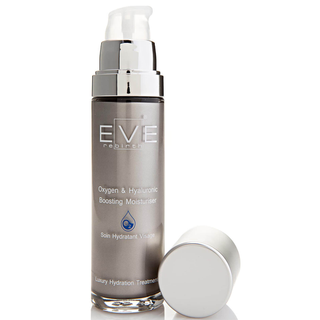
Eve Rebirth Oxygen & Hyaluronic Boosting Moisturizer
Works for
1 of 3 advertised claims delivered
Moisturizing18 ingredients credited for this claimGood support
“Oxygen & Hyaluronic Boosting Moisturizer”
This product can help improve hydration of the skin with the two types of ingredients.
The first type is called “humectants”:
these ingredients help attract water.
When humectants are on the surface of the skin, they “pull in” the moisture from the outside environment, or from
within deeper layers of the skin. The following ingredients in this product do the job:
glycerin, glycogen.
This product also contains ingredients called “occlusives”. They help reduce the speed with which our skin loses moisture to the outside environment. These ingredients also help soften the upper layer of the skin, so it feels less tight and nicer to the touch. The following ingredients in this product do the job: caprylic/capric triglyceride, dimethicone.
Anti-aging3 ingredients credited for this claimWeak support
“Specially formulated for those with active or intense lifestyles, the cream works to moisturise and firm the appearance of skin; its dose of Hyaluronic Acid attracts and preserves moisture whilst plumping out the appearance of wrinkles, and a cocktail of organic extracts improve tone and protect the complexion.”
Effective ingredients missing or their concentration is too low.
Evens skin tone1 ingredient credited for this claimWeak support
“The moisturiser contributes to boosted oxygen consumption, and may help to prevent the formation of pigmentation.”
Effective ingredients missing or their concentration is too low
Can it cause trouble?
Irritancy3 strong irritants: Achillea millefolium extract, Calendula officinalis flower extract + 1 more — patch-test recommendedHigh risk
ComedogenicClean of flagged comedogenic ingredientsNone flagged
User reviews
Be the first — your take helps the next person decide.
Ingredients
Filter by role to see what each ingredient is doing.
Water~45–55%
Propanediol~4.8–5.9%
- Irritation risk
- Low
Acts as a solvent for other ingredients. Speeds up the absorption of other ingredients into the skin
More about PropanediolCetyl palmitate~4.1–5%
- Irritation risk
- Low
An emollient that helps soften the skin and is used to improve product texture and stability
More about Cetyl palmitatePolyglyceryl-6 distearate~2.7–3.3%
- Irritation risk
- Medium
Helps oil and water mix together while softening the upper layer of the skin
More about Polyglyceryl-6 distearateCoco-caprylate~2.4–2.9%
- Irritation risk
- Medium
An emollient that softens skin and creates a nice product texture
More about Coco-caprylateCaprylic/capric triglyceride~2–2.4%
- Irritation risk
- Medium
A good mix of fatty acids that forms a protective layer on the skin. Improves the shelf life of products. Derived from coconut and glycerin
More about Caprylic/capric triglycerideGlycerin~1.7–2.1%
- Irritation risk
- Low
One of the best moisturizing ingredients. Naturally present in skin. It attracts water to the upper layer of the skin working as a humectant
More about GlycerinDimethicone~1.5–1.8%
- Irritation risk
- Low
A silicone that helps to reduce water loss from the surface of the skin. Can temporarily "fill in" lines and wrinkles, absorb oil, and create a nice product finish
More about DimethiconeCyclopentasiloxane~1.2–1.4%
- Irritation risk
- Low
A silicone that helps improve the product texture and spreadability. Can absorb oil creating a short-term mattifying effect on the skin
More about CyclopentasiloxanePolymethylsilsesquioxane~1–1.2%
- Irritation risk
- Low
A silicone that improves product texture and helps dissolve other ingredients. Can form a non-greasy film on the skin to prevent moisture loss
More about PolymethylsilsesquioxaneSodium hyaluronate~0.65–1%
- Irritation risk
- Low
One of the best moisturizing ingredients. Attracts water into the upper layer of the skin
More about Sodium hyaluronateGlycogen~0.55–0.85%
- Irritation risk
- Low
Helps attract water to the upper layer of the skin
More about GlycogenAchillea millefolium extract~0.6–0.9%
- Irritation risk
- High
Plant extract that can help neutralize free radicals in skin. Can be used as a fragrance. Can be irritating
More about Achillea millefolium extractEchinacea pallida extract~0.45–0.7%
- Irritation risk
- Low
Calendula officinalis flower extract~0.4–0.65%
- Irritation risk
- High
A plant extract that has some anti-oxidant and anti-bacterial properties. Can be irritating
More about Calendula officinalis flower extractMagnesium ascorbyl phosphate~0.45–0.65%
- Irritation risk
- Medium
A derivative of vitamin C that is more stable, but less bioavailable than the pure form of vitamin C. It does not penetrate the skin well, but has been shown to convert to pure vitamin C once in skin. It can be helpful in stimulating collagen production and lightening the skin tone, but the required concentration is likely to be very high
More about Magnesium ascorbyl phosphateSodium ascorbyl phosphate~0.45–0.65%
- Irritation risk
- Medium
A stable derivative of vitamin C. It is oil-soluble which means it is more likely to penetrate the skin compared to the pure form of vitamin C (which is water-soluble), but it is less bio-available and is way less effective in stimulating collagen and reducing wrinkles compared to the pure form of vitamin C (L-ascorbic acid) and its other derivatives (for example, magnesium ascorbyl phosphate). At the same time, this vitamin C derivative has been shown in studies to be effective in reducing acne, blemishes and clogged pores. It is less irritating then the pure form of vitamin C
More about Sodium ascorbyl phosphateTocopheryl acetate~0.4–0.65%
- Irritation risk
- Medium
A more stable but less bio-available form of vitamin E compared to Tocopherol. Might help moisturize and protect the skin from free radicals, but mostly used in low concentrations to stabilize other ingredients.
More about Tocopheryl acetateTocopherol~0.35–0.65%
- Irritation risk
- Low
Pure form of vitamin E. Can help moisturise and protect the skin from free radicals. Often used to help stabilise other ingredients or the formula itself
More about TocopherolYeast ferment extract~0.3–0.55%
- Irritation risk
- Low
Mannitol~0.3–0.55%
- Irritation risk
- Low
Helps to attract water to the upper layer of the skin
More about MannitolSorbitan olivate~0.3–0.55%
Jojoba esters~0.3–0.55%
- Irritation risk
- Medium
An emollient made of jojoba oil. Helps soften the skin and support its barrier function
More about Jojoba estersCetyl alcohol~0.3–0.6%
- Irritation risk
- Low
A non-drying alcohol that works to soften the skin and stabilize product formulations helping oil and water mix together
More about Cetyl alcoholPolyglyceryl-3 beeswax~0.3–0.55%
- Irritation risk
- Medium
Helps water and oil mix together. Could be an allergen (beeswax)
More about Polyglyceryl-3 beeswaxSorbitan palmitate~0.3–0.5%
- Irritation risk
- Medium
Helps water and oil mix together and stabilize the product formulation
More about Sorbitan palmitateHelianthus annuus seed oil~0.3–0.5%
- Irritation risk
- Low
A great emollient due to its high linoleic acid content. One of the most effective plant oils in helping skin hydration and repairing skin barrier function
More about Helianthus annuus seed oilSorbitol~0.25–0.45%
- Irritation risk
- Low
Helps attract water to the upper layer of the skin and improves the product texture
More about SorbitolXanthan gum~0.25–0.5%
- Irritation risk
- Low
Used to create a thicker product consistency
More about Xanthan gumSodium stearoyl glutamate~0.3–0.55%
- Irritation risk
- Medium
Helps oil and water mix together
More about Sodium stearoyl glutamateTetrasodium glutamate diacetate~0.2–0.4%
- Irritation risk
- Low
Helps stabilize the product formulation
More about Tetrasodium glutamate diacetateCitric acid~0.2–0.35%
- Irritation risk
- Medium
Can work as an exfoliant but is typically used to adjust the product pH
More about Citric acidSodium polyacrylate~0.25–0.45%
- Irritation risk
- Low
Used to create a gel-like product texture, as well as to stabilize emulsions
More about Sodium polyacrylateLecithin~0.2–0.4%
- Irritation risk
- Low
Used mostly for creating emulsions - helping oil and water mix together. Helps soften the upper layer of the skin
More about LecithinParfum~0.1–0.2%
- Irritation risk
- High
An aromatic blend of unspecified and possibly irritating ingredients
More about ParfumPolysilicone-11~0.15–0.25%
- Irritation risk
- Low
A silicone that forms a light film on the skin surface helping to bind water and temporarily absorb oils creating a matt and powdery feel
More about Polysilicone-11Hdi/trimethylol hexyllactone crosspolymer~0.1–0.2%
- Irritation risk
- Low
Used to create a silky product texture and add volume to products
More about Hdi/trimethylol hexyllactone crosspolymerPhenoxyethanol~0.1–0.2%
- Irritation risk
- Low
A preservative. It helps prevent bacterial growth in cosmetic products
More about PhenoxyethanolEthylhexylglycerin~0.05–0.1%
Ingredient list view
Water, Propanediol, Cetyl palmitate, Polyglyceryl-6 distearate, Coco-caprylate, Caprylic/capric triglyceride, Glycerin, Dimethicone, Cyclopentasiloxane, Polymethylsilsesquioxane, Sodium hyaluronate, Glycogen, Achillea millefolium extract, Echinacea pallida extract, Calendula officinalis flower extract, Magnesium ascorbyl phosphate, Sodium ascorbyl phosphate, Tocopheryl acetate, Tocopherol, Yeast ferment extract, Mannitol, Sorbitan olivate, Jojoba esters, Cetyl alcohol, Polyglyceryl-3 beeswax, Sorbitan palmitate, Helianthus annuus seed oil, Sorbitol, Xanthan gum, Sodium stearoyl glutamate, Tetrasodium glutamate diacetate, Citric acid, Sodium polyacrylate, Lecithin, Parfum, Polysilicone-11, Hdi/trimethylol hexyllactone crosspolymer, Phenoxyethanol, Ethylhexylglycerin
Compare prices
Retailers ranked by price — lowest first.

Affiliate links · prices updated regularly
Sources cited in this review
Every concentration estimate and effectiveness label is anchored to one of these 26 studies and safety reviews.
- 1
- 2
- 3Final Report on the Safety Assessment of Dimethicone Copolyoljournals.sagepub.com
- 4Hyaluronic acid: A key molecule in skin agingncbi.nlm.nih.gov
- 5
- 6

Affiliate links · As an Amazon Associate, WIMJ earns from qualifying purchases.