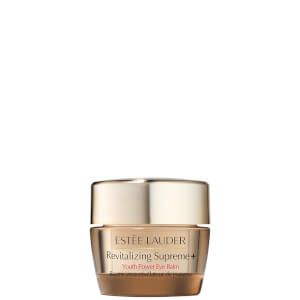
Estée Lauder Revitalizing Supreme+ Youth Power Eye Balm
Works for
2 of 2 advertised claims delivered
MoisturizingAcetyl glucosamine, Acetyl hexapeptide-8 + 27 moreStrong evidence
“What it is: A supremely nourishing eye balm, infused with moringa, that visibly firms, supports, and gives eyes a more lifted look.”
This product can help improve hydration of the skin with the two types of ingredients.
The first type is called “humectants”:
these ingredients help attract water.
When humectants are on the surface of the skin, they “pull in” the moisture from the outside environment, or from
within deeper layers of the skin. The following ingredients in this product do the job:
algae extract, artemia extract.
This product also contains ingredients called “occlusives”. They help reduce the speed with which our skin loses moisture to the outside environment. These ingredients also help soften the upper layer of the skin, so it feels less tight and nicer to the touch. The following ingredients in this product do the job: dimethicone, methicone.
The following ingredients in this product are especially good for supporting the skin barrier and helping with the hydration level: acetyl glucosamine, acetyl hexapeptide-8
Anti-agingAcetyl glucosamine, Acetyl hexapeptide-8 + 3 moreStrong evidence
“It reduces the look of lines and dark circles and leaves the eye area looking radiant and more youthful.”
This product can help reduce and prevent fine lines and wrinkles, improve skin elasticity and firmness because it contains acetyl glucosamine.
These ingredients in the product can also be helpful, even though there is less evidence for their effectiveness: acetyl hexapeptide-8.
Keep in mind that it typically takes at least 6 weeks to notice any results because the changes that are needed to improve fine lines and elasticity happen in the deeper layers of the skin. No topical anti-aging product can “erase” wrinkles or fully reverse signs of aging.
Evens skin toneNot advertised by the brand · Acetyl glucosamine, Hydrolyzed rice extract + 2 moreStrong evidence
This product can help reduce hypepigmentation and even out the skin tone because it contains the following effective ingredients: acetyl glucosamine
Keep in mind that you would need to apply any topical skincare targetted at hypigmentation consistently for a couple of months to get a result. No topical skincare product can help get rid of hyperpigmentation (including post-acne marks and age spots) instantly.
Can it cause trouble?
Irritancy1 strong irritant: Limonium vulgare flower/leaf/stem extractMedium risk
Comedogenic3 ingredients rated 2 or more on the 0–5 pore-clogging scale3 flagged
User reviews
Be the first — your take helps the next person decide.
Ingredients
Filter by role to see what each ingredient is doing.
Water~45–55%
Methyl trimethicone~5.1–6.2%
- Irritation risk
- Low
A type of silicone that helps create a silky product finish and dissolve other ingredients
More about Methyl trimethiconePropanediol~4–4.8%
- Irritation risk
- Low
Acts as a solvent for other ingredients. Speeds up the absorption of other ingredients into the skin
More about PropanediolIsododecane~3.1–3.7%
- Irritation risk
- Low
An emollient that helps soften the skin and can decrease moisture loss. Helps create a nice product texture
More about IsododecanePolyethylene~2.4–3%
Dimethicone~1.9–2.4%
- Irritation risk
- Low
A silicone that helps to reduce water loss from the surface of the skin. Can temporarily "fill in" lines and wrinkles, absorb oil, and create a nice product finish
More about DimethiconeButylene glycol~1.6–1.9%
- Irritation risk
- Low
Used to create a nice product texture and help delivery of other ingredients. Might be somewhat helpful in attracting water to the upper layer of the skin
More about Butylene glycolHydrogenated polyisobutene~1.4–1.8%
- Irritation risk
- Low
Used to improve the product consistency and soften the upper layer of the skin
More about Hydrogenated polyisobuteneDimethicone/vinyl dimethicone crosspolymer~1.1–1.4%
- Irritation risk
- Low
Used to stabilize product formulations and create a nice product texture
More about Dimethicone/vinyl dimethicone crosspolymerCetyl peg/ppg-10/1 dimethicone~0.9–1.1%
- Irritation risk
- Low
A type of silicone that helps water and oil mix together. Can help to soften upper layer of the skin
More about Cetyl peg/ppg-10/1 dimethiconeStearyl dimethicone~0.7–1.1%
- Irritation risk
- Low
Helps soften the upper layer of the skin
More about Stearyl dimethiconeNylon-12~0.75–1.1%
Isononyl isononanoate~0.6–0.85%
- Irritation risk
- Low
Forms a protective film on the surface of the skin to prevent moisture loss. Gives a velvety feel to products while reducing tackiness
More about Isononyl isononanoateMoringa oleifera seed extract~0.5–0.75%
- Irritation risk
- Medium
Helps soften the upper layer of the skin and might have some antioxidant effect
More about Moringa oleifera seed extractHibiscus sinensis flower extract~0.55–0.8%
- Irritation risk
- Low
Sodium hyaluronate~0.5–0.7%
- Irritation risk
- Low
One of the best moisturizing ingredients. Attracts water into the upper layer of the skin
More about Sodium hyaluronateAcetyl hexapeptide-8~0.45–0.7%
- Irritation risk
- Low
A type of peptide. Peptides are excellent moisturizers and might be able support collagen production reducing fine lines and wrinkles
More about Acetyl hexapeptide-8Laminaria digitata extract~0.45–0.65%
- Irritation risk
- Low
- Comedogenicity
- 3/5
Seaweed extract that helps the skin to attract water and make it more smooth for touch. Also shows promise of anti-aging properties, but good research is lacking at the moment
More about Laminaria digitata extractWhey protein~0.45–0.65%
- Irritation risk
- Low
A protein derived from milk. In skincare products, might help to soften the upper layer of the skin
More about Whey proteinOpuntia tuna fruit extract~0.35–0.6%
- Irritation risk
- Low
Acetyl glucosamine~0.3–0.6%
- Irritation risk
- Low
An effective moisturizing ingredient that also has been shown to be effective in evening out the skin tone and reducing hyperpigmentation. It can help somewhat reduce wrinkles in skin
More about Acetyl glucosamineTocopheryl acetate~0.3–0.6%
- Irritation risk
- Medium
A more stable but less bio-available form of vitamin E compared to Tocopherol. Might help moisturize and protect the skin from free radicals, but mostly used in low concentrations to stabilize other ingredients.
More about Tocopheryl acetateNarcissus tazetta bulb extract~0.3–0.55%
- Irritation risk
- Medium
Might contain compounds called dormins that in theory could help lighten skin and reduce hyperpigmentation, but solid research is lacking
More about Narcissus tazetta bulb extractSqualane~0.35–0.65%
- Irritation risk
- Low
An oil naturally present in skin. Works as an emollient to soften the skin and form a protective layer on its surface without a greasy feeling.
More about SqualaneHydrolyzed rice extract~0.3–0.55%
- Irritation risk
- Low
A plant extract that is claimed to be helpful in moisturizing and lightening the skin, but evidence is missing
More about Hydrolyzed rice extractAlgae extract~0.4–0.6%
- Irritation risk
- Low
- Comedogenicity
- 3/5
Plant extract that helps the skin to attract water and make it more smooth for touch. Also shows promise of anti-aging properties, but research is not extensive yet
More about Algae extractLimonium vulgare flower/leaf/stem extract~0.3–0.55%
- Irritation risk
- High
An essential oil that can be irritating
More about Limonium vulgare flower/leaf/stem extractCucumis sativus fruit extract~0.3–0.55%
- Irritation risk
- Medium
Might be somewhat helpful in reducing hyperpigmentation and neutralizing free radicals but its typical concentration in a product is too low for having an effect
More about Cucumis sativus fruit extractSilybum marianum extract~0.3–0.55%
- Irritation risk
- High
Might be able to help neutralize free radical, calm down inflammation in skin, and even skin tone
More about Silybum marianum extractMimosa tenuiflora bark extract~0.3–0.5%
- Irritation risk
- Low
Helianthus annuus seed extract~0.3–0.55%
- Irritation risk
- Low
Hypericum perforatum extract~0.3–0.55%
- Irritation risk
- Low
Caffeine~0.3–0.55%
- Irritation risk
- Medium
Might be helpful in neutralizing free radicals. Can have a dehydration effect that might somewhat decrease the look of puffy eyes
More about CaffeineHordeum vulgare extract~0.3–0.6%
- Irritation risk
- Medium
A plant extract that might have some anti-oxidant properties. Avoid if you are sensitive to gluten
More about Hordeum vulgare extractTriticum vulgare germ extract~0.3–0.6%
- Irritation risk
- Medium
- Comedogenicity
- 3/5
Plant extract that might have moisturizing properties. Avoid if you suffer from wheat or gluten intolerance
More about Triticum vulgare germ extractPropylene glycol dicaprate~0.35–0.6%
- Irritation risk
- Low
An emollient that helps soften the upper layer of the skin
More about Propylene glycol dicaprateGlucose~0.3–0.55%
- Irritation risk
- Low
Helps attract water to the upper layer of the skin. Could be helpful in restoring the skin barrier function
More about GlucoseMagnesium sulfate~0.35–0.6%
Sucrose~0.3–0.5%
- Irritation risk
- Low
Can help attract water to the upper layer of the skin. In crystal form, it can work as a gentle exfoliant, gentler than the salt scrub. Helps stabilize the emulsion
More about SucroseGlycerin~0.35–0.6%
- Irritation risk
- Low
One of the best moisturizing ingredients. Naturally present in skin. It attracts water to the upper layer of the skin working as a humectant
More about GlycerinPinanediol~0.3–0.55%
- Irritation risk
- Low
Camphanediol~0.3–0.55%
- Irritation risk
- Low
Hexylene glycol~0.3–0.55%
- Irritation risk
- Medium
Helps create a more spreadable product texture
More about Hexylene glycolCaprylyl glycol~0.3–0.6%
- Irritation risk
- Medium
Helps preserve products and creates a nice product texture
More about Caprylyl glycolBoron nitride~0.3–0.55%
- Irritation risk
- Low
Helps to absord oil and evenly disperse other ingredients (for example, pigment) in product formulation
More about Boron nitrideMaltodextrin~0.3–0.55%
- Irritation risk
- Low
Used to stabilize the product formulation and can help absorb oil
More about MaltodextrinAminopropyl ascorbyl phosphate~0.3–0.55%
- Irritation risk
- Medium
A more stable but less potent derivative of vitamin C. It can help neautralize free radicals and even out the skin tone if used in high enough concentration (required levels are likely to be much higher than for pure vitamin C, and solid studies are lacking at the moment)
More about Aminopropyl ascorbyl phosphateMethicone~0.3–0.6%
- Irritation risk
- Low
A type of silicone that helps soften the upper layer of the skin and reduces the water loss from the skin surface
More about MethiconeArtemia extract~0.3–0.55%
- Irritation risk
- Low
Zooplankton extract that can attract water to the upper level of the skin and might have some anti-oxidant effect
More about Artemia extractPolysilicone-11~0.35–0.6%
- Irritation risk
- Low
A silicone that forms a light film on the skin surface helping to bind water and temporarily absorb oils creating a matt and powdery feel
More about Polysilicone-11Isoceteth-20~0.3–0.6%
Disteardimonium hectorite~0.3–0.55%
- Irritation risk
- Low
A type of clay that is used to thicken the product consistency
More about Disteardimonium hectoritePeg-10 dimethicone~0.35–0.65%
- Irritation risk
- Low
A silicone that works to soften the upper layer of the skin and reduce its water loss
More about Peg-10 dimethiconeLauryl peg-9 polydimethylsiloxyethyl dimethicone~0.3–0.55%
- Irritation risk
- Low
A type of silicone that helps to soften upper layer of the skin and create a nice product texture
More about Lauryl peg-9 polydimethylsiloxyethyl dimethiconeCitric acid~0.3–0.55%
- Irritation risk
- Medium
Can work as an exfoliant but is typically used to adjust the product pH
More about Citric acidOctadecene~0.3–0.55%
- Irritation risk
- Low
Triethoxycaprylylsilane~0.3–0.55%
- Irritation risk
- Low
A type of silicone that helps oil and water mix well together. Helps to disperse other ingredients, e.g. pigments, evenly in a formulation
More about TriethoxycaprylylsilaneDisodium edta~0.3–0.55%
Bht~0.3–0.55%
Potassium sorbate~0.3–0.55%
Chlorphenesin~0.16–0.32%
Phenoxyethanol~0.3–0.6%
- Irritation risk
- Low
A preservative. It helps prevent bacterial growth in cosmetic products
More about PhenoxyethanolTitanium dioxide~0.45–0.65%
- Irritation risk
- Low
Works as a UV filter when used in high concentrations. It is photostable and is effective mostly against the UVB light, with some protection in the UVA range. In small concentrations, used for its ability to improve the color of cosmetic products. Is usually well tolerated by the skin
More about Titanium dioxideIron oxides~0.25–0.5%
- Irritation risk
- Low
An umbrella term for the following three colorants: CI 77491, CI 77492, CI 77499. They might be able to offer some protection against visible light, but the degree of the protection is not clear
More about Iron oxidesIron oxides~0.25–0.5%
- Irritation risk
- Low
An umbrella term for the following three colorants: CI 77491, CI 77492, CI 77499. They might be able to offer some protection against visible light, but the degree of the protection is not clear
More about Iron oxidesIron oxides~0.25–0.5%
- Irritation risk
- Low
An umbrella term for the following three colorants: CI 77491, CI 77492, CI 77499. They might be able to offer some protection against visible light, but the degree of the protection is not clear
More about Iron oxidesIron oxides~0.25–0.5%
- Irritation risk
- Low
An umbrella term for the following three colorants: CI 77491, CI 77492, CI 77499. They might be able to offer some protection against visible light, but the degree of the protection is not clear
More about Iron oxidesIron oxides~0.25–0.5%
- Irritation risk
- Low
An umbrella term for the following three colorants: CI 77491, CI 77492, CI 77499. They might be able to offer some protection against visible light, but the degree of the protection is not clear
More about Iron oxidesIron oxides~0.25–0.5%
- Irritation risk
- Low
An umbrella term for the following three colorants: CI 77491, CI 77492, CI 77499. They might be able to offer some protection against visible light, but the degree of the protection is not clear
More about Iron oxidesIron oxides~0.25–0.5%
- Irritation risk
- Low
An umbrella term for the following three colorants: CI 77491, CI 77492, CI 77499. They might be able to offer some protection against visible light, but the degree of the protection is not clear
More about Iron oxidesIron oxides~0.25–0.5%
- Irritation risk
- Low
An umbrella term for the following three colorants: CI 77491, CI 77492, CI 77499. They might be able to offer some protection against visible light, but the degree of the protection is not clear
More about Iron oxidesIron oxides~0.25–0.5%
- Irritation risk
- Low
An umbrella term for the following three colorants: CI 77491, CI 77492, CI 77499. They might be able to offer some protection against visible light, but the degree of the protection is not clear
More about Iron oxidesIron oxides~0.25–0.5%
- Irritation risk
- Low
An umbrella term for the following three colorants: CI 77491, CI 77492, CI 77499. They might be able to offer some protection against visible light, but the degree of the protection is not clear
More about Iron oxidesIron oxides~0.25–0.5%
- Irritation risk
- Low
An umbrella term for the following three colorants: CI 77491, CI 77492, CI 77499. They might be able to offer some protection against visible light, but the degree of the protection is not clear
More about Iron oxidesIron oxides~0.25–0.5%
- Irritation risk
- Low
An umbrella term for the following three colorants: CI 77491, CI 77492, CI 77499. They might be able to offer some protection against visible light, but the degree of the protection is not clear
More about Iron oxidesIron oxides~0.25–0.5%
- Irritation risk
- Low
An umbrella term for the following three colorants: CI 77491, CI 77492, CI 77499. They might be able to offer some protection against visible light, but the degree of the protection is not clear
More about Iron oxidesIron oxides~0.25–0.5%
- Irritation risk
- Low
An umbrella term for the following three colorants: CI 77491, CI 77492, CI 77499. They might be able to offer some protection against visible light, but the degree of the protection is not clear
More about Iron oxidesIron oxides~0.25–0.5%
- Irritation risk
- Low
An umbrella term for the following three colorants: CI 77491, CI 77492, CI 77499. They might be able to offer some protection against visible light, but the degree of the protection is not clear
More about Iron oxidesIron oxides~0.25–0.45%
- Irritation risk
- Low
An umbrella term for the following three colorants: CI 77491, CI 77492, CI 77499. They might be able to offer some protection against visible light, but the degree of the protection is not clear
More about Iron oxidesIron oxides~0.25–0.45%
- Irritation risk
- Low
An umbrella term for the following three colorants: CI 77491, CI 77492, CI 77499. They might be able to offer some protection against visible light, but the degree of the protection is not clear
More about Iron oxidesIron oxides~0.2–0.4%
- Irritation risk
- Low
An umbrella term for the following three colorants: CI 77491, CI 77492, CI 77499. They might be able to offer some protection against visible light, but the degree of the protection is not clear
More about Iron oxidesIron oxides~0.2–0.35%
- Irritation risk
- Low
An umbrella term for the following three colorants: CI 77491, CI 77492, CI 77499. They might be able to offer some protection against visible light, but the degree of the protection is not clear
More about Iron oxidesIron oxides~0.2–0.35%
- Irritation risk
- Low
An umbrella term for the following three colorants: CI 77491, CI 77492, CI 77499. They might be able to offer some protection against visible light, but the degree of the protection is not clear
More about Iron oxidesIron oxides~0.15–0.3%
- Irritation risk
- Low
An umbrella term for the following three colorants: CI 77491, CI 77492, CI 77499. They might be able to offer some protection against visible light, but the degree of the protection is not clear
More about Iron oxidesIron oxides~0.15–0.25%
- Irritation risk
- Low
An umbrella term for the following three colorants: CI 77491, CI 77492, CI 77499. They might be able to offer some protection against visible light, but the degree of the protection is not clear
More about Iron oxidesIron oxides~0.1–0.2%
- Irritation risk
- Low
An umbrella term for the following three colorants: CI 77491, CI 77492, CI 77499. They might be able to offer some protection against visible light, but the degree of the protection is not clear
More about Iron oxidesIron oxides~0.1–0.2%
- Irritation risk
- Low
An umbrella term for the following three colorants: CI 77491, CI 77492, CI 77499. They might be able to offer some protection against visible light, but the degree of the protection is not clear
More about Iron oxidesIron oxides~0.1–0.2%
- Irritation risk
- Low
An umbrella term for the following three colorants: CI 77491, CI 77492, CI 77499. They might be able to offer some protection against visible light, but the degree of the protection is not clear
More about Iron oxidesIron oxides~0.05–0.1%
- Irritation risk
- Low
An umbrella term for the following three colorants: CI 77491, CI 77492, CI 77499. They might be able to offer some protection against visible light, but the degree of the protection is not clear
More about Iron oxidesIron oxides~0.05–0.1%
- Irritation risk
- Low
An umbrella term for the following three colorants: CI 77491, CI 77492, CI 77499. They might be able to offer some protection against visible light, but the degree of the protection is not clear
More about Iron oxidesIngredient list view
Water, Methyl trimethicone, Propanediol, Isododecane, Polyethylene, Dimethicone, Butylene glycol, Hydrogenated polyisobutene, Dimethicone/vinyl dimethicone crosspolymer, Cetyl peg/ppg-10/1 dimethicone, Stearyl dimethicone, Nylon-12, Isononyl isononanoate, Moringa oleifera seed extract, Hibiscus sinensis flower extract, Sodium hyaluronate, Acetyl hexapeptide-8, Laminaria digitata extract, Whey protein, Opuntia tuna fruit extract, Acetyl glucosamine, Tocopheryl acetate, Narcissus tazetta bulb extract, Squalane, Hydrolyzed rice extract, Algae extract, Limonium vulgare flower/leaf/stem extract, Cucumis sativus fruit extract, Silybum marianum extract, Mimosa tenuiflora bark extract, Helianthus annuus seed extract, Hypericum perforatum extract, Caffeine, Hordeum vulgare extract, Triticum vulgare germ extract, Propylene glycol dicaprate, Glucose, Magnesium sulfate, Sucrose, Glycerin, Pinanediol, Camphanediol, Hexylene glycol, Caprylyl glycol, Boron nitride, Maltodextrin, Aminopropyl ascorbyl phosphate, Methicone, Artemia extract, Polysilicone-11, Unknown, Isoceteth-20, Disteardimonium hectorite, Peg-10 dimethicone, Lauryl peg-9 polydimethylsiloxyethyl dimethicone, Citric acid, Octadecene, Triethoxycaprylylsilane, Disodium edta, Bht, Potassium sorbate, Chlorphenesin, Phenoxyethanol, Titanium dioxide, Iron oxides, Iron oxides, Iron oxides, Iron oxides, Iron oxides, Iron oxides, Iron oxides, Iron oxides, Iron oxides, Iron oxides, Iron oxides, Iron oxides, Iron oxides, Iron oxides, Iron oxides, Iron oxides, Iron oxides, Iron oxides, Iron oxides, Iron oxides, Iron oxides, Iron oxides, Iron oxides, Iron oxides, Iron oxides, Iron oxides, Iron oxides
Compare prices
Retailers ranked by price — lowest first.

Product summary
Judging from the ingredient list, "Estée Lauder - Revitalizing Supreme+ Youth Power Eye Balm" works well for improving skin hydration As we expect from a proper moisturizer, the formula includes a combo of effective humectants and emollients. These are the two different types of ingredients that are essential for improving the skin hydration and supporting a healthy skin barrier. Humectants in this product (acetyl glucosamine, acetyl hexapeptide-8, algae extract, artemia extract and glycerin) help to increase the water content in the upper layer of the skin. (These ingredients do so by "capturing" water molecules from the outside air or from within the deeper layers of the skin). Algae extract, stearyl dimethicone, dimethicone, methicone and peg-10 dimethicone in this product help decrease the water evoporation from the skin, so that it stays hydrated for longer. These ingredients also soften the skin and take away the feeling of tightness and dryness.
Ingredient callouts
- We like that this moisturizer contains peptides (acetyl hexapeptide-8 0.45% - 0.70%). There are many different kind of Peptides and they are naturally present in our skin. They all are a combination of aminoacids. Some of them work as natural antibiotics, promote wound-healing and production of collagen. The science is still not settled on how effective Peptides are in skincare, but it is very likely that they have a benefit. Peptides might help restore the skin barrier and fight the signs of aging. At the very least, Peptides work as humectants: they attract water to the upper layer of the skin and improve its hydration.
Irritation risk
This formulation includes some common irritants, including ingredients that do not provide a benefit for the skin. We assess the overall irritancy of this moisturizer to be medium. For a detailed overview of all potential irritants: click here
You can see the detailed formula review with the breakdown of all actives in the product and the full ingredient list with estimated concentrations in the tables below.
Price
The product retails from 75.00$ up to 76.00$ in the United States, from 47.35£ up to 1311.00£ in the United Kingdom, from 98.43A$ up to 108.00A$ in Australia, for 96.00CA$ in Canada, for 595.00HK$ in Hong Kong and for 133.00NZ$ in New Zealand.
For a detailed price comparison: click here.
Sources cited in this review
Every concentration estimate and effectiveness label is anchored to one of these 22 studies and safety reviews.
- 1
- 2Final Report on the Safety Assessment of Dimethicone Copolyoljournals.sagepub.com
- 3
- 4
- 5Hyaluronic acid: A key molecule in skin agingncbi.nlm.nih.gov
- 6

Affiliate links · As an Amazon Associate, WIMJ earns from qualifying purchases.