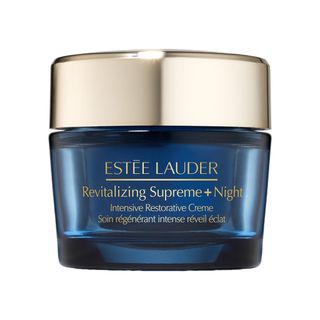
Estée Lauder Revitalizing Supreme+ Night Restorative Creme Moisturizer
Works for
2 of 3 advertised claims delivered
Anti-aging8 ingredients credited for this claimStrong support
“Reduces the look of lines.”
This product can help reduce and prevent fine lines and wrinkles, improve skin elasticity and firmness because it contains acetyl glucosamine.
These ingredients in the product can also be helpful, even though there is less evidence for their effectiveness: acetyl hexapeptide-8.
Keep in mind that it typically takes at least 6 weeks to notice any results because the changes that are needed to improve fine lines and elasticity happen in the deeper layers of the skin. No topical anti-aging product can “erase” wrinkles or fully reverse signs of aging.
Moisturizing41 ingredients credited for this claimStrong support
“Revitalizing Supreme+ Night Restorative Creme Moisturizer”
This product can help improve hydration of the skin with the two types of ingredients.
The first type is called “humectants”:
these ingredients help attract water.
When humectants are on the surface of the skin, they “pull in” the moisture from the outside environment, or from
within deeper layers of the skin. The following ingredients in this product do the job:
algae extract, glycerin.
This product also contains ingredients called “occlusives”. They help reduce the speed with which our skin loses moisture to the outside environment. These ingredients also help soften the upper layer of the skin, so it feels less tight and nicer to the touch. The following ingredients in this product do the job: cocos nucifera oil, dimethicone.
The following ingredients in this product are especially good for supporting the skin barrier and helping with the hydration level: acetyl glucosamine, acetyl hexapeptide-8
Anti-blemish1 ingredient credited for this claimWeak support
“Dermatologist-tested Won't cause breakouts, won't clog pores (non-acnegenic) Suitable for neck area”
Effective ingredients missing or their concentration is too low.
ExfoliationNot advertised by the brand · 2 ingredients credited for this claimStrong support
This product can help exfoliate the skin. In other words, it helps break down the bonds between dead cells on the surface of the skin and speed up the skin turnover. Skin often appears softer and brighter after exfoliation, but overdoing it can result in disrupted skin barrier. The following ingredient is doing the exfoliating job in this product: hydroxyethyl urea.
Evens skin toneNot advertised by the brand · 4 ingredients credited for this claimStrong support
This product can help reduce hypepigmentation and even out the skin tone because it contains the following effective ingredients: acetyl glucosamine, hydroxyethyl urea
Keep in mind that you would need to apply any topical skincare targetted at hypigmentation consistently for a couple of months to get a result. No topical skincare product can help get rid of hyperpigmentation (including post-acne marks and age spots) instantly.
Can it cause trouble?
Irritancy3 strong irritants: Limonium vulgare flower/leaf/stem extract, Silybum marianum seed oil + 1 more — patch-test recommendedHigh risk
Comedogenic5 ingredients rated 2 or more on the 0–5 pore-clogging scale5 flagged


User reviews
Be the first — your take helps the next person decide.
Ingredients
Filter by role to see what each ingredient is doing.
Water~45–55%
Glycine soja oil~4.6–5.6%
- Irritation risk
- Medium
- Comedogenicity
- 2/5
A good emollient that helps soften the skin and helps repair its barrier function. It can clog pores if used in high concentrations.
More about Glycine soja oilCaprylic/capric/myristic/stearic triglyceride~4.2–5.1%
- Irritation risk
- Low
Helps to soften the upper layer of the skin
More about Caprylic/capric/myristic/stearic triglycerideGlycerin~3–3.6%
- Irritation risk
- Low
One of the best moisturizing ingredients. Naturally present in skin. It attracts water to the upper layer of the skin working as a humectant
More about GlycerinPrunus amygdalus dulcis seed~2.2–2.7%
- Irritation risk
- Low
Helps soften the upper layer of the skin
More about Prunus amygdalus dulcis seedDimethicone~1.9–2.4%
- Irritation risk
- Low
A silicone that helps to reduce water loss from the surface of the skin. Can temporarily "fill in" lines and wrinkles, absorb oil, and create a nice product finish
More about DimethiconeStearyl alcohol~1.6–2%
- Irritation risk
- Low
An emollient that helps soften the skin
More about Stearyl alcoholButylene glycol~1.4–1.7%
- Irritation risk
- Low
Used to create a nice product texture and help delivery of other ingredients. Might be somewhat helpful in attracting water to the upper layer of the skin
More about Butylene glycolSteareth-2~1.1–1.4%
Cocos nucifera oil~0.9–1.1%
- Irritation risk
- Low
- Comedogenicity
- 3/5
An emollient. Found to be as effective as a moisturizer for dry skin as mineral oil. Could be comedogenic
More about Cocos nucifera oilVitis vinifera seed oil~0.65–1%
- Irritation risk
- Medium
A great emollient that can also have anti-oxidant properties
More about Vitis vinifera seed oilGlyceryl stearate~0.55–0.85%
- Irritation risk
- Low
An emollient that softens the skin and forms a protective layer on its surface. Helps water and oil mix together
More about Glyceryl stearateNiacinamide~0.45–0.7%
- Irritation risk
- Low
Is proven to be effective in reducing blemishes, evening out skin tone and helping to improve lines and wrinkles. It helps the skin to repair sun damage, calm down inflammation and keep maintain good levels of moisture. The concentration of about 2% is effective for supporting the skin barrier and evening out the skin tone. Concentration of 4-6% is better for helping with acne and balancing the sebum production
More about NiacinamidePropanediol~0.45–0.65%
- Irritation risk
- Low
Acts as a solvent for other ingredients. Speeds up the absorption of other ingredients into the skin
More about PropanediolSteareth-21~0.45–0.7%
Moringa oleifera seed extract~0.3–0.6%
- Irritation risk
- Medium
Helps soften the upper layer of the skin and might have some antioxidant effect
More about Moringa oleifera seed extractLimonium vulgare flower/leaf/stem extract~0.3–0.55%
- Irritation risk
- High
An essential oil that can be irritating
More about Limonium vulgare flower/leaf/stem extractSodium hyaluronate~0.3–0.55%
- Irritation risk
- Low
One of the best moisturizing ingredients. Attracts water into the upper layer of the skin
More about Sodium hyaluronateAcetyl hexapeptide-8~0.25–0.45%
- Irritation risk
- Low
A type of peptide. Peptides are excellent moisturizers and might be able support collagen production reducing fine lines and wrinkles
More about Acetyl hexapeptide-8Laminaria digitata extract~0.25–0.45%
- Irritation risk
- Low
- Comedogenicity
- 3/5
Seaweed extract that helps the skin to attract water and make it more smooth for touch. Also shows promise of anti-aging properties, but good research is lacking at the moment
More about Laminaria digitata extractWhey protein~0.25–0.45%
- Irritation risk
- Low
A protein derived from milk. In skincare products, might help to soften the upper layer of the skin
More about Whey proteinAcetyl glucosamine~0.2–0.4%
- Irritation risk
- Low
An effective moisturizing ingredient that also has been shown to be effective in evening out the skin tone and reducing hyperpigmentation. It can help somewhat reduce wrinkles in skin
More about Acetyl glucosamineTuna extract~0.2–0.35%
- Irritation risk
- Low
Tocopheryl acetate~0.2–0.4%
- Irritation risk
- Medium
A more stable but less bio-available form of vitamin E compared to Tocopherol. Might help moisturize and protect the skin from free radicals, but mostly used in low concentrations to stabilize other ingredients.
More about Tocopheryl acetateCitrullus lanatus fruit extract~0.2–0.35%
- Irritation risk
- Medium
A plant extract that can contain an antioxidant compound
More about Citrullus lanatus fruit extractPersea gratissima oil~0.3–0.5%
- Irritation risk
- Medium
An emollient that helps soften the skin and could be helpful in repairing its barrier function
More about Persea gratissima oilMangifera indica seed oil~0.25–0.5%
- Irritation risk
- Low
Aminopropyl ascorbyl phosphate~0.2–0.4%
- Irritation risk
- Medium
A more stable but less potent derivative of vitamin C. It can help neautralize free radicals and even out the skin tone if used in high enough concentration (required levels are likely to be much higher than for pure vitamin C, and solid studies are lacking at the moment)
More about Aminopropyl ascorbyl phosphateAlgae extract~0.3–0.55%
- Irritation risk
- Low
- Comedogenicity
- 3/5
Plant extract that helps the skin to attract water and make it more smooth for touch. Also shows promise of anti-aging properties, but research is not extensive yet
More about Algae extractCaffeine~0.25–0.4%
- Irritation risk
- Medium
Might be helpful in neutralizing free radicals. Can have a dehydration effect that might somewhat decrease the look of puffy eyes
More about CaffeineCucumis sativus fruit extract~0.25–0.45%
- Irritation risk
- Medium
Might be somewhat helpful in reducing hyperpigmentation and neutralizing free radicals but its typical concentration in a product is too low for having an effect
More about Cucumis sativus fruit extractPyrus malus fruit extract~0.2–0.4%
- Irritation risk
- Medium
Can have some moisturizing properties due to its sugar content
More about Pyrus malus fruit extractNarcissus tazetta bulb extract~0.2–0.4%
- Irritation risk
- Medium
Might contain compounds called dormins that in theory could help lighten skin and reduce hyperpigmentation, but solid research is lacking
More about Narcissus tazetta bulb extractSigesbeckia orientalis extract~0.2–0.4%
- Irritation risk
- Medium
A plant extract that can contain an anti-inflammatory compound
More about Sigesbeckia orientalis extractButyrospermum parkii butter~0.3–0.5%
- Irritation risk
- Low
- Comedogenicity
- 3/5
A great moisturising ingredient that softens the skin and reduces water loss from its upper layer. It also can be helpful in protecting skin from free radicals
More about Butyrospermum parkii butterLens esculenta fruit extract~0.2–0.4%
- Irritation risk
- Medium
A plant extract containing sugars that might help attract water to the upper layer of the skin. Is claimed by the manufacturer to help reduce pore size but evidence is lacking
More about Lens esculenta fruit extractSilybum marianum seed oil~0.2–0.4%
- Irritation risk
- High
A plant oil that contains essential oils that can be irritating. Can help soften the upper layer of the skin. Might have some anti-oxidant activity but evidence is lacking
More about Silybum marianum seed oilLimnanthes alba seed oil~0.25–0.5%
- Irritation risk
- Low
This oil's cmposition is closest to rapeseed oil. It is a very stable oil and serves as an emoillient
More about Limnanthes alba seed oilHordeum vulgare extract~0.25–0.5%
- Irritation risk
- Medium
A plant extract that might have some anti-oxidant properties. Avoid if you are sensitive to gluten
More about Hordeum vulgare extractSimmondsia chinensis seed oil~0.3–0.55%
- Irritation risk
- Medium
Softens the upper layer of skin and helps restore the healthy skin barrier. Has shown to help calm down inflammation in skin. It is a stable oil, meaning that it retains its properties even when exposed to air.
More about Simmondsia chinensis seed oilMacadamia integrifolia seed oil~0.25–0.5%
- Irritation risk
- Low
A plant oil that helps soften the upper layer of the skin
More about Macadamia integrifolia seed oilOlea europaea fruit oil~0.25–0.45%
- Irritation risk
- Medium
An emollient that helps soften the skin but is not effective for restoring its barrier function. Might be helpful to calm down inflammation
More about Olea europaea fruit oilDextrin palmitate~0.25–0.45%
- Irritation risk
- Medium
Helps water and oil mix together
More about Dextrin palmitateSodium hydroxide~0.25–0.45%
Carbomer~0.25–0.45%
- Irritation risk
- Low
Helps create a thicker or gel-like product texture. It is not a surfactant but can be used in gentle cleansing formulations
More about CarbomerBehenyl alcohol~0.3–0.55%
- Irritation risk
- Low
Non-drying alcohol that helps water and oil mix together. Also serves as an emollient
More about Behenyl alcoholCaprylyl glycol~0.25–0.5%
- Irritation risk
- Medium
Helps preserve products and creates a nice product texture
More about Caprylyl glycolHydroxyethyl urea~0.25–0.45%
- Irritation risk
- Low
A derivative of urea, a compound that is naturally present in skin. Attracts water to the upper layer of the skin. Can enhance penetration of other ingredients
More about Hydroxyethyl ureaPropylene glycol dicaprate~0.25–0.5%
- Irritation risk
- Low
An emollient that helps soften the upper layer of the skin
More about Propylene glycol dicaprateCholesterol~0.3–0.5%
- Irritation risk
- Low
An emollient that is naturally found in skin
More about CholesterolIsoceteth-20~0.25–0.45%
Lactoperoxidase~0.25–0.45%
- Irritation risk
- Low
Helps attract water to the upper layer of the skin. In theory, could support healthy skin's microbiome, but evidence of effectiveness in skin is lacking
More about LactoperoxidaseHelianthus annuus seedcake~0.35–0.6%
Sodium polyaspartate~0.25–0.45%
- Irritation risk
- Medium
Helps attract water to the upper layer of the skin and can help stabilize the product formulation
More about Sodium polyaspartateSorbitol~0.25–0.45%
- Irritation risk
- Low
Helps attract water to the upper layer of the skin and improves the product texture
More about SorbitolGlucose~0.25–0.45%
- Irritation risk
- Low
Helps attract water to the upper layer of the skin. Could be helpful in restoring the skin barrier function
More about GlucoseCetyl alcohol~0.3–0.5%
- Irritation risk
- Low
A non-drying alcohol that works to soften the skin and stabilize product formulations helping oil and water mix together
More about Cetyl alcoholMyristyl alcohol~0.25–0.5%
- Irritation risk
- High
Helps to stabilize the product formulation while softening the upper layer of the skin. Can be irritating
More about Myristyl alcoholSodium lactate~0.25–0.45%
- Irritation risk
- Medium
Helps attract water to the upper layer of the skin. Is often used to adjust the pH level of the product
More about Sodium lactateCitric acid~0.25–0.4%
- Irritation risk
- Medium
Can work as an exfoliant but is typically used to adjust the product pH
More about Citric acidSodium pca~0.25–0.4%
- Irritation risk
- Low
Naturally present in skin and helps to attract water to its upper layer
More about Sodium pcaGlucose oxidase~0.25–0.45%
- Irritation risk
- Low
Helps attract water to the upper layer of the skin
More about Glucose oxidasePotassium phosphate~0.25–0.45%
Sodium chloride~0.25–0.45%
- Irritation risk
- Low
Used to stabilize mixtures of oil and water, and create thicker, gel-like product textures
More about Sodium chlorideParfum~0.2–0.35%
- Irritation risk
- High
An aromatic blend of unspecified and possibly irritating ingredients
More about ParfumDisodium edta~0.2–0.4%
Bht~0.2–0.35%
Potassium sorbate~0.2–0.35%
Sodium benzoate~0.15–0.3%
Phenoxyethanol~0.15–0.3%
- Irritation risk
- Low
A preservative. It helps prevent bacterial growth in cosmetic products
More about PhenoxyethanolCi 19140~0.15–0.25%
Ci 14700~0.15–0.25%
Iron oxides~0.1–0.25%
- Irritation risk
- Low
An umbrella term for the following three colorants: CI 77491, CI 77492, CI 77499. They might be able to offer some protection against visible light, but the degree of the protection is not clear
More about Iron oxidesCi 77491~0.15–0.25%
- Irritation risk
- Low
A red colorant made of iron oxide. Typically is not irritating
More about Ci 77491Iron oxides~0.05–0.15%
- Irritation risk
- Low
An umbrella term for the following three colorants: CI 77491, CI 77492, CI 77499. They might be able to offer some protection against visible light, but the degree of the protection is not clear
More about Iron oxidesCi 77492~0.05–0.15%
Ingredient list view
Water, Glycine soja oil, Caprylic/capric/myristic/stearic triglyceride, Glycerin, Prunus amygdalus dulcis seed, Dimethicone, Stearyl alcohol, Butylene glycol, Steareth-2, Cocos nucifera oil, Vitis vinifera seed oil, Glyceryl stearate, Niacinamide, Propanediol, Steareth-21, Moringa oleifera seed extract, Limonium vulgare flower/leaf/stem extract, Sodium hyaluronate, Acetyl hexapeptide-8, Laminaria digitata extract, Whey protein, Acetyl glucosamine, Unknown, Tuna extract, Tocopheryl acetate, Citrullus lanatus fruit extract, Persea gratissima oil, Mangifera indica seed oil, Aminopropyl ascorbyl phosphate, Algae extract, Caffeine, Cucumis sativus fruit extract, Pyrus malus fruit extract, Narcissus tazetta bulb extract, Sigesbeckia orientalis extract, Butyrospermum parkii butter, Lens esculenta fruit extract, Silybum marianum seed oil, Limnanthes alba seed oil, Hordeum vulgare extract, Simmondsia chinensis seed oil, Macadamia integrifolia seed oil, Olea europaea fruit oil, Dextrin palmitate, Sodium hydroxide, Carbomer, Behenyl alcohol, Caprylyl glycol, Hydroxyethyl urea, Propylene glycol dicaprate, Cholesterol, Isoceteth-20, Lactoperoxidase, Helianthus annuus seedcake, Sodium polyaspartate, Sorbitol, Glucose, Cetyl alcohol, Myristyl alcohol, Sodium lactate, Citric acid, Sodium pca, Glucose oxidase, Potassium phosphate, Sodium chloride, Parfum, Disodium edta, Bht, Potassium sorbate, Sodium benzoate, Phenoxyethanol, Ci 19140, Ci 14700, Iron oxides, Ci 77491, Iron oxides, Ci 77492
Compare prices
Retailers ranked by price — lowest first.

Worth comparing, line by line.
Match % combines shared ingredients, the first five ingredients, shared actives and hero ingredients, irritancy (lower counts in the alternative's favour), texture and body area. Only products in the same routine step are compared.
| Estée LauderRevitalizing Supreme+ Night Restorative Creme MoisturizerYOUR PRODUCT | Lab Series Skincare for MenDaily Rescue Energising Face Lotion | Lab Series For MenAge Rescue Face Lotion | It'S SKINPrestige Creme Ginseng D'escargot | |
|---|---|---|---|---|
| Match | — | 82% | 82% | 79% |
| Price | $102.00 | $65.44−$36.56 | $55.00−$47.00 | $57.50−$44.50 |
| Shared key ingredients | — | 8 of 22 | 8 of 22 | 7 of 22 |
| Key difference | — | Ascorbyl Glucoside | Ascorbyl Glucoside | Adenosine |
| Irritancy | High | Medium | Medium | Medium |
| Drying alcohol | — | — | — | — |
| View product | Shop | Shop | Shop |


Product summary
"Estée Lauder - Revitalizing Supreme+ Night Restorative Creme Moisturizer" is a well-rounded moisturizing product. As we expect from a proper moisturizer, the formula includes a combo of effective humectants and emollients. These are the two different types of ingredients that are essential for improving the skin hydration and supporting a healthy skin barrier. Humectants in this product (acetyl glucosamine, acetyl hexapeptide-8, algae extract, glycerin and hydroxyethyl urea) help to increase the water content in the upper layer of the skin. (These ingredients do so by "capturing" water molecules from the outside air or from within the deeper layers of the skin). Algae extract, cholesterol, glycine soja oil, limnanthes alba seed oil and vitis vinifera seed oil in this product help decrease the water evoporation from the skin, so that it stays hydrated for longer. These ingredients also soften the skin and take away the feeling of tightness and dryness.
Ingredient callouts
- This moistruizer also contains peptides (acetyl hexapeptide-8 0.25% - 0.45%). Peptides is a very big group of ingredients. They all consist of a different combination of amino-acids. Our skin produces peptides naturally. Some of them work as natural anti-biotics, promote wound-healing and production of collagen. The scientists are still studying how effective the topical application of peptides is, but it is very likely that peptides in skincare are helpful. They might be able to support skin barrier restoration and even have an anti-aging benefit. At the very least, they certainly help attract water to the skin and support the hydration in this way.
Irritation risk
There are quite a few common irritants in this product, including ingredients without particular skin benefits. We would not recommend it for sensitive skin. We assess the overall irritancy of this moisturizer to be high. For a detailed overview of all potential irritants: click here
You can see the detailed formula review with the breakdown of all actives in the product and the full ingredient list with estimated concentrations in the tables below.
Price
The product retails for 102.00$ in the United States.
For a detailed price comparison: click here.
Sources cited in this review
Every concentration estimate and effectiveness label is anchored to one of these 35 studies and safety reviews.
- 1
- 2
- 3
- 4Final Report on the Safety Assessment of Dimethicone Copolyoljournals.sagepub.com
- 5
- 6

Affiliate links · As an Amazon Associate, WIMJ earns from qualifying purchases.