Works for:
based on ingredients and %- Moisturizing
- Anti-aging
- Anti-oxidation
- Evens skin tone
Doesn't work for:
based on ingredients and %- Anti-blemish
Can it cause trouble?
- Irritation risk: high
- Comedogenic risk ingredients: 5
Key actives

Product Summary
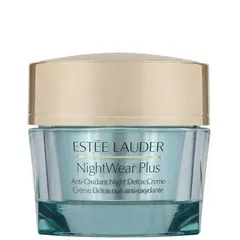
Judging from the ingredient list, "Estée Lauder - Moisturiser Nightwear Plus Anti-Oxidant Night Detox Creme" works well for improving skin hydration To work well, any moisturizer needs to include a combination of water-binding and emollient ingredients. Estée Lauder - Moisturiser Nightwear Plus Anti-Oxidant Night Detox Creme ticks this box. Humectants in this product (urea, algae extract, artemia extract, glycerin and saccharomyces lysate extract) help to increase the water content in the upper layer of the skin. (These ingredients do so by "capturing" water molecules from the outside air or from within the deeper layers of the skin). Emollients in this formulation (algae extract, cholesterol, butyrospermum parkii butter, dimethicone and dimethiconol) help to reduce the moisture loss from the skin. They also soften the skin surface and relieve the feeling of dryness and tightness.
This product contains ingredients that could be beneficial, but their concentrations are too low in this formulation: tetrahexyldecyl ascorbate, caprylic/capric triglyceride, stearic acid, dipentaerythrityl hexacaprylate/hexacaprate, ergothioneine, lecithin, linoleic acid and laminaria saccharina extractIrritation risk
This moisturizer contains a bunch of common irritants, including ingredients that do not provide any known benefit for the skin. It might not be the best choice if your skin is sensitive. We assess the overall irritancy of this moisturizer to be high. For a detailed overview of all potential irritants: click here
You can see the detailed formula review with the breakdown of all actives in the product and the full ingredient list with estimated concentrations in the tables below.
Price
The product retails for 113.33CA$ in Canada, for 34.59A$ in Australia, from 49.82$ up to 63.00$ in the United States and for 70.00£ in the United Kingdom.
For a detailed price comparison: click here.
Anti-oxidation
This product contains antioxidants (ethylbisiminomethylguaiacol manganese chloride, glycyrrhetinic acid, vitis vinifera seed extract) that can help neutralize free radicals in skin. By doing so, they can lessen the damage the skin gets from the UV light (sun).
Active compound of licorice root. Works to calm down inflammation, as an anti-oxidant, and might be helpful in lightening the skin and reducing hyperpigmentation
A plant extract that contains resveratrol and other anti-oxidant compounds that can help neutralize free radicals, reduce inflammation in skin and even out its tone. Can be also used to stabilize the product formulation
A potent anti-oxidant that can help neutralize free radicals in skin and protect from harmful effects of sun exposure, even though more studies are needed to confirm its effectiveness in topical applications
Zooplankton extract that can attract water to the upper level of the skin and might have some anti-oxidant effect
A great moisturising ingredient that softens the skin and reduces water loss from its upper layer. It also can be helpful in protecting skin from free radicals
Might be helpful in neutralizing free radicals. Can have a dehydration effect that might somewhat decrease the look of puffy eyes
Might be helpful in neutralizing free radicals in skin
Might be helpful in neutralising free radicals in skin and have some hydration properties
A fruit extract that might have some anti-oxidant effect
A likely irritant. Might have some anti-oxidant activity, but is mostly used as a fragrance in cosmetic products
Can help neutralize free radicals in skin. Preliminary studies show that it can be more effective than coenzyme Q10 but studies on effective concentration for topical applications are lacking
Being a lipid soluble form of vitamin C, it is more stable than ascorbic acid, but still degrades quickly and needs to be stabilized in a formulation with another ingredient. It is claimed to penetrate skin better than pure vitamin C and have the the similar benefits, but solid studies of its effectiveness are lacking. Is likely to require a higher concentration in a product than pure vitamin C to be effective. It might be able to help reduce pore clogging.
A plant extract that can contain resveratrol, an antioxidant that can help neutralize free radicals in skin. The effectiveness depends on the extract quality and concentration in the product
A more stable but less bio-available form of vitamin E compared to Tocopherol. Might help moisturize and protect the skin from free radicals, but mostly used in low concentrations to stabilize other ingredients.
A plant extract that might have some anti-oxidant properties. Avoid if you are sensitive to gluten
Plant extract that might have moisturizing properties. Avoid if you suffer from wheat or gluten intolerance
Moisturizing
What does the product description say?
Moisturiser Nightwear Plus Anti-Oxidant Night Detox Creme
Source: From product name
This product can help improve hydration of the skin with the two types of ingredients.
The first type is called “humectants”:
these ingredients help attract water.
When humectants are on the surface of the skin, they “pull in” the moisture from the outside environment, or from
within deeper layers of the skin. The following ingredients in this product do the job:
algae extract, artemia extract.
This product also contains ingredients called “occlusives”. They help reduce the speed with which our skin loses moisture to the outside environment. These ingredients also help soften the upper layer of the skin, so it feels less tight and nicer to the touch. The following ingredients in this product do the job: butyrospermum parkii butter, dimethicone.
The following ingredients in this product are especially good for supporting the skin barrier and helping with the hydration level: urea
Plant extract that helps the skin to attract water and make it more smooth for touch. Also shows promise of anti-aging properties, but research is not extensive yet
An oil naturally present in skin. Works as an emollient to soften the skin and form a protective layer on its surface without a greasy feeling.
Helps attract water to the upper layer of the skin
A great moisturising ingredient that softens the skin and reduces water loss from its upper layer. It also can be helpful in protecting skin from free radicals
Can help attract water to the upper layer of the skin. In crystal form, it can work as a gentle exfoliant, gentler than the salt scrub. Helps stabilize the emulsion
A silicone that makes products more spreadable and keeps skin smooth. Helps to add gloss to skin and may visually fill in fine lines/wrinkles for short time
Zooplankton extract that can attract water to the upper level of the skin and might have some anti-oxidant effect
An emollient that is naturally found in skin
A silicone that helps to reduce water loss from the surface of the skin. Can temporarily "fill in" lines and wrinkles, absorb oil, and create a nice product finish
Might be helpful in neutralising free radicals in skin and have some hydration properties
A sugar that attracts water to the upper layer of the skin
One of the best moisturizing ingredients. Naturally present in skin. It attracts water to the upper layer of the skin working as a humectant
Helps attract water to the upper layer of the skin. Can have some anti-inflammatory effect
Naturally present in skin and helps to attract water to its upper layer
Naturally present in skin (urea makes up about 7% of natural moisturizing factors in skin). Attracts water to the upper layer of the skin. Also has a positive effect on the skin barrier beyond the humectant action. Can enhance penetration of other ingredients. Is an exfoliating ingredient when used in high concentrations
One of the best moisturizing ingredients. Attracts water into the upper layer of the skin
A non-drying alcohol that works to soften the skin and stabilize product formulations helping oil and water mix together
An emollient that helps soften the skin and is used to improve product texture and stability
Helps to soften the upper layer of the skin and create a nice product texture
An emollient that softens the skin and forms a protective layer on its surface. Helps water and oil mix together
An emollient that helps create a nice silky finish on the skin
Used to create a thicker product consistency and soften the upper layer of the skin
Used to create a thicker product consistency and soften the upper layer of the skin
Improves the texture of the product and helps soften the skin. Helps oil and water mix together and can be used as a cleansing agent
Non-drying alcohol that helps water and oil mix together. Also serves as an emollient
Used to create a nice product texture and help delivery of other ingredients. Might be somewhat helpful in attracting water to the upper layer of the skin
An emollient that is naturally present in skin and helps soften it
Helps to stabilize the product formulation while softening the upper layer of the skin. Can be irritating
A plant extract that is claimed to be helpful in moisturizing and lightening the skin, but evidence is missing
An excellent emollient. Helps soften the skin, restore its barrier function, and can help to calm down inflammation. It can be helpful to prevent blemishes and clogged pores
An effective moisturizing ingredient that also has been shown to be effective in evening out the skin tone and reducing hyperpigmentation. It can help somewhat reduce wrinkles in skin
A good mix of fatty acids that forms a protective layer on the skin. Improves the shelf life of products. Derived from coconut and glycerin
A seaweed extract that contains sugars and can be helpful in attracting water to the upper layers of the skin if used in high enough concentrations
Plant extract that might have moisturizing properties. Avoid if you suffer from wheat or gluten intolerance
Helps oil and water mix together and works as an emollient
Used mostly for creating emulsions - helping oil and water mix together. Helps soften the upper layer of the skin
A plant extract that can help strengthen the skin barrier function and improve skin moisture levels
Anti-aging
What does the product description say?
Estée Lauder, Moisturiser A light and refreshing night cream enriched with super anti-oxidant complex to help the skin detox and defend against signs of premature ageing by purifying and shrinking pores, diminishing the appearance of wrinkles, and hydrating the skin.
Source: Allbeauty
This product contains vitis vinifera seed extract. This ingredient might be able to help reduce and prevent fine lines and wrinkles, improve skin elasticity and firmness, but there is not enough evidence that it actually works.
A plant extract that contains resveratrol and other anti-oxidant compounds that can help neutralize free radicals, reduce inflammation in skin and even out its tone. Can be also used to stabilize the product formulation
A great moisturising ingredient that softens the skin and reduces water loss from its upper layer. It also can be helpful in protecting skin from free radicals
Might be helpful in neutralising free radicals in skin and have some hydration properties
Plant extract that helps the skin to attract water and make it more smooth for touch. Also shows promise of anti-aging properties, but research is not extensive yet
An effective moisturizing ingredient that also has been shown to be effective in evening out the skin tone and reducing hyperpigmentation. It can help somewhat reduce wrinkles in skin
Being a lipid soluble form of vitamin C, it is more stable than ascorbic acid, but still degrades quickly and needs to be stabilized in a formulation with another ingredient. It is claimed to penetrate skin better than pure vitamin C and have the the similar benefits, but solid studies of its effectiveness are lacking. Is likely to require a higher concentration in a product than pure vitamin C to be effective. It might be able to help reduce pore clogging.
A seaweed extract that contains sugars and can be helpful in attracting water to the upper layers of the skin if used in high enough concentrations
Evens skin tone
The following ingredient (ingredients) in this product might be helpful, but there is no evidence to confirm that it actually works: glycyrrhetinic acid.
Active compound of licorice root. Works to calm down inflammation, as an anti-oxidant, and might be helpful in lightening the skin and reducing hyperpigmentation
A plant extract that might contain an active compound orthosilicic acid that could be helpful to regulate the level of pigment in skin, but solid research is lacking
A plant extract that is claimed to be helpful in moisturizing and lightening the skin, but evidence is missing
An effective moisturizing ingredient that also has been shown to be effective in evening out the skin tone and reducing hyperpigmentation. It can help somewhat reduce wrinkles in skin
Being a lipid soluble form of vitamin C, it is more stable than ascorbic acid, but still degrades quickly and needs to be stabilized in a formulation with another ingredient. It is claimed to penetrate skin better than pure vitamin C and have the the similar benefits, but solid studies of its effectiveness are lacking. Is likely to require a higher concentration in a product than pure vitamin C to be effective. It might be able to help reduce pore clogging.
Anti-blemish
What does the product description say?
What it is A night cream that purifies, refinishes skin's surface, and visibly reduces pores.
Source: Sephora
Effective ingredients missing or their concentration is too low.
An excellent emollient. Helps soften the skin, restore its barrier function, and can help to calm down inflammation. It can be helpful to prevent blemishes and clogged pores
How honest is this product?
| Promise | Can it deliver? |
|---|---|
| Moisturizing | |
| Anti-aging | |
| Anti-blemish |
Total Promises Fulfilled score: 58/100.
We receive a small commission for purchases made through these links at no cost for you. Thank you for your support! Learn more
Potential irritants
Comedogenic ingredients
User reviews (0)
Averages from community submissions.
No reviews yet for this product.
Be the first to share your experience!
Tried this product?
Help capture what the ingredient list can't—texture, finish, pilling, scent, and more. Answer what you can, skip the rest.
Takes ~30 seconds.
Reviews are shown in aggregate. No personal details.
| Product | Similarity | Price | Irritancy |
|---|---|---|---|
 Estée Lauder Moisturiser Nightwear Plus Anti-Oxidant Night Detox Creme | Current | $44.20 | |
 Darphin Ideal Resource Anti-Age & Radiance Eye Contour Radiance Repair Cream | 57% | - | |
 Lab Series Skincare for Men Lab Series Age Rescue+ Water Charged Gel Cream | 51% | $47.00 | |
 Lab Series For Men Age Rescue Water-Charged Gel Cream | 51% | - | |
 Ultraceuticals LIMITED EDITION SIZE Ultra Moisturiser Cream | 51% | - | |
 SENTÉ Dermal Repair Ultra‐Nourish | 50% | $179.00 |
Key Actives
A plant extract that contains resveratrol and other anti-oxidant compounds that can help neutralize free radicals, reduce inflammation in skin and even out its tone. Can be also used to stabilize the product formulation
An effective moisturizing ingredient that also has been shown to be effective in evening out the skin tone and reducing hyperpigmentation. It can help somewhat reduce wrinkles in skin
A great moisturising ingredient that softens the skin and reduces water loss from its upper layer. It also can be helpful in protecting skin from free radicals
Might be helpful in neutralising free radicals in skin and have some hydration properties
An excellent emollient. Helps soften the skin, restore its barrier function, and can help to calm down inflammation. It can be helpful to prevent blemishes and clogged pores
Active compound of licorice root. Works to calm down inflammation, as an anti-oxidant, and might be helpful in lightening the skin and reducing hyperpigmentation
A silicone that helps to reduce water loss from the surface of the skin. Can temporarily "fill in" lines and wrinkles, absorb oil, and create a nice product finish
A seaweed extract that contains sugars and can be helpful in attracting water to the upper layers of the skin if used in high enough concentrations
Zooplankton extract that can attract water to the upper level of the skin and might have some anti-oxidant effect
An emollient that is naturally found in skin
Plant extract that helps the skin to attract water and make it more smooth for touch. Also shows promise of anti-aging properties, but research is not extensive yet
Might be helpful in neutralizing free radicals. Can have a dehydration effect that might somewhat decrease the look of puffy eyes
Naturally present in skin (urea makes up about 7% of natural moisturizing factors in skin). Attracts water to the upper layer of the skin. Also has a positive effect on the skin barrier beyond the humectant action. Can enhance penetration of other ingredients. Is an exfoliating ingredient when used in high concentrations
One of the best moisturizing ingredients. Naturally present in skin. It attracts water to the upper layer of the skin working as a humectant
An oil naturally present in skin. Works as an emollient to soften the skin and form a protective layer on its surface without a greasy feeling.
Helps attract water to the upper layer of the skin
Helps attract water to the upper layer of the skin. Can have some anti-inflammatory effect
A potent anti-oxidant that can help neutralize free radicals in skin and protect from harmful effects of sun exposure, even though more studies are needed to confirm its effectiveness in topical applications
A silicone that makes products more spreadable and keeps skin smooth. Helps to add gloss to skin and may visually fill in fine lines/wrinkles for short time
One of the best moisturizing ingredients. Attracts water into the upper layer of the skin
A sugar that attracts water to the upper layer of the skin
Can help attract water to the upper layer of the skin. In crystal form, it can work as a gentle exfoliant, gentler than the salt scrub. Helps stabilize the emulsion
Naturally present in skin and helps to attract water to its upper layer
A good mix of fatty acids that forms a protective layer on the skin. Improves the shelf life of products. Derived from coconut and glycerin
Potential irritants
A likely irritant. Might have some anti-oxidant activity, but is mostly used as a fragrance in cosmetic products
A fruit extract that might have some anti-oxidant effect
Used as a fragrance. Can be irritating and cause photosensitivity
An essential oil that can be irritating
Helps to stabilize the product formulation while softening the upper layer of the skin. Can be irritating
An aromatic blend of unspecified and possibly irritating ingredients
A fragrance. Can trigger allergic reactions and be irritating
A fragrance. Can be irritating
Used to create a thicker product consistency and soften the upper layer of the skin
A plant extract that can help strengthen the skin barrier function and improve skin moisture levels
Plant extract that might have moisturizing properties. Avoid if you suffer from wheat or gluten intolerance
A plant extract that might have some anti-oxidant properties. Avoid if you are sensitive to gluten
A plant extract that can contain resveratrol, an antioxidant that can help neutralize free radicals in skin. The effectiveness depends on the extract quality and concentration in the product
Might be helpful in neutralising free radicals in skin and have some hydration properties
A potent anti-oxidant that can help neutralize free radicals in skin and protect from harmful effects of sun exposure, even though more studies are needed to confirm its effectiveness in topical applications
Used to create a thicker product consistency and soften the upper layer of the skin
Active compound of licorice root. Works to calm down inflammation, as an anti-oxidant, and might be helpful in lightening the skin and reducing hyperpigmentation
Maintains the texture of skincare products. Allows the product to spread evenly. Helps oil and water mix together
Might be helpful in neutralizing free radicals. Can have a dehydration effect that might somewhat decrease the look of puffy eyes
A good mix of fatty acids that forms a protective layer on the skin. Improves the shelf life of products. Derived from coconut and glycerin
A more stable but less bio-available form of vitamin E compared to Tocopherol. Might help moisturize and protect the skin from free radicals, but mostly used in low concentrations to stabilize other ingredients.
Being a lipid soluble form of vitamin C, it is more stable than ascorbic acid, but still degrades quickly and needs to be stabilized in a formulation with another ingredient. It is claimed to penetrate skin better than pure vitamin C and have the the similar benefits, but solid studies of its effectiveness are lacking. Is likely to require a higher concentration in a product than pure vitamin C to be effective. It might be able to help reduce pore clogging.
Can work as an exfoliant but is typically used to adjust the product pH
Comedogenic ingredients
A great moisturising ingredient that softens the skin and reduces water loss from its upper layer. It also can be helpful in protecting skin from free radicals
A seaweed extract that contains sugars and can be helpful in attracting water to the upper layers of the skin if used in high enough concentrations
Helps attract water to the upper layer of the skin
Plant extract that might have moisturizing properties. Avoid if you suffer from wheat or gluten intolerance
Plant extract that helps the skin to attract water and make it more smooth for touch. Also shows promise of anti-aging properties, but research is not extensive yet
All ingredients
A silicone that helps to reduce water loss from the surface of the skin. Can temporarily "fill in" lines and wrinkles, absorb oil, and create a nice product finish
One of the best moisturizing ingredients. Naturally present in skin. It attracts water to the upper layer of the skin working as a humectant
A great moisturising ingredient that softens the skin and reduces water loss from its upper layer. It also can be helpful in protecting skin from free radicals
Helps to soften the upper layer of the skin and create a nice product texture
Acts as a solvent for other ingredients. Speeds up the absorption of other ingredients into the skin
An oil naturally present in skin. Works as an emollient to soften the skin and form a protective layer on its surface without a greasy feeling.
An emollient that helps soften the skin and is used to improve product texture and stability
Used to create a thicker product consistency and soften the upper layer of the skin
A seaweed extract that contains sugars and can be helpful in attracting water to the upper layers of the skin if used in high enough concentrations
Helps attract water to the upper layer of the skin
A plant extract that can help strengthen the skin barrier function and improve skin moisture levels
A plant extract that might contain an active compound orthosilicic acid that could be helpful to regulate the level of pigment in skin, but solid research is lacking
A likely irritant. Might have some anti-oxidant activity, but is mostly used as a fragrance in cosmetic products
A fruit extract that might have some anti-oxidant effect
A plant extract that is claimed to be helpful in moisturizing and lightening the skin, but evidence is missing
Used as a fragrance. Can be irritating and cause photosensitivity
Plant extract that might have moisturizing properties. Avoid if you suffer from wheat or gluten intolerance
A plant extract that might have some anti-oxidant properties. Avoid if you are sensitive to gluten
A plant extract that can contain resveratrol, an antioxidant that can help neutralize free radicals in skin. The effectiveness depends on the extract quality and concentration in the product
Might be helpful in neutralising free radicals in skin and have some hydration properties
Might be helpful in neutralizing free radicals in skin
A plant extract that contains resveratrol and other anti-oxidant compounds that can help neutralize free radicals, reduce inflammation in skin and even out its tone. Can be also used to stabilize the product formulation
Helps attract water to the upper layer of the skin. Can have some anti-inflammatory effect
An essential oil that can be irritating
A potent anti-oxidant that can help neutralize free radicals in skin and protect from harmful effects of sun exposure, even though more studies are needed to confirm its effectiveness in topical applications
Zooplankton extract that can attract water to the upper level of the skin and might have some anti-oxidant effect
Plant extract that helps the skin to attract water and make it more smooth for touch. Also shows promise of anti-aging properties, but research is not extensive yet
An excellent emollient. Helps soften the skin, restore its barrier function, and can help to calm down inflammation. It can be helpful to prevent blemishes and clogged pores
A silicone that makes products more spreadable and keeps skin smooth. Helps to add gloss to skin and may visually fill in fine lines/wrinkles for short time
Improves the texture of the product and helps soften the skin. Helps oil and water mix together and can be used as a cleansing agent
One of the best moisturizing ingredients. Attracts water into the upper layer of the skin
Used mostly for creating emulsions - helping oil and water mix together. Helps soften the upper layer of the skin
Used to create a thicker product consistency and soften the upper layer of the skin
Active compound of licorice root. Works to calm down inflammation, as an anti-oxidant, and might be helpful in lightening the skin and reducing hyperpigmentation
Can help attract water to the upper layer of the skin. In crystal form, it can work as a gentle exfoliant, gentler than the salt scrub. Helps stabilize the emulsion
Can help neutralize free radicals in skin. Preliminary studies show that it can be more effective than coenzyme Q10 but studies on effective concentration for topical applications are lacking
Maintains the texture of skincare products. Allows the product to spread evenly. Helps oil and water mix together
An effective moisturizing ingredient that also has been shown to be effective in evening out the skin tone and reducing hyperpigmentation. It can help somewhat reduce wrinkles in skin
Used to create a nice product texture and help delivery of other ingredients. Might be somewhat helpful in attracting water to the upper layer of the skin
An emollient that softens the skin and forms a protective layer on its surface. Helps water and oil mix together
Non-drying alcohol that helps water and oil mix together. Also serves as an emollient
Might be helpful in neutralizing free radicals. Can have a dehydration effect that might somewhat decrease the look of puffy eyes
An emollient that is naturally present in skin and helps soften it
Naturally present in skin and helps to attract water to its upper layer
Naturally present in skin (urea makes up about 7% of natural moisturizing factors in skin). Attracts water to the upper layer of the skin. Also has a positive effect on the skin barrier beyond the humectant action. Can enhance penetration of other ingredients. Is an exfoliating ingredient when used in high concentrations
A good mix of fatty acids that forms a protective layer on the skin. Improves the shelf life of products. Derived from coconut and glycerin
Helps water and oil mix together and create gel-like textures
A more stable but less bio-available form of vitamin E compared to Tocopherol. Might help moisturize and protect the skin from free radicals, but mostly used in low concentrations to stabilize other ingredients.
Being a lipid soluble form of vitamin C, it is more stable than ascorbic acid, but still degrades quickly and needs to be stabilized in a formulation with another ingredient. It is claimed to penetrate skin better than pure vitamin C and have the the similar benefits, but solid studies of its effectiveness are lacking. Is likely to require a higher concentration in a product than pure vitamin C to be effective. It might be able to help reduce pore clogging.
A non-drying alcohol that works to soften the skin and stabilize product formulations helping oil and water mix together
Helps to stabilize the product formulation while softening the upper layer of the skin. Can be irritating
An emollient that helps create a nice silky finish on the skin
Can work as an exfoliant but is typically used to adjust the product pH
A type of sugar that is used to support delivery of active ingredients and can enhance their penetration into the skin without disrupting the skin's barrier
An aromatic blend of unspecified and possibly irritating ingredients
A preservative. It helps prevent bacterial growth in cosmetic products
A fragrance. Can trigger allergic reactions and be irritating
A fragrance. Can be irritating
Ingredient list view
Water, Dimethicone, Glycerin, Polysorbate 60, Butyrospermum parkii butter, Hydrogenated polydecene, Propanediol, Squalane, Sorbitan stearate, Cetyl palmitate, Tridecyl stearate, Laminaria saccharina extract, Laminaria ochroleuca extract, Gentiana lutea root extract, Hydrolyzed rice bran extract, Citrus reticulata peel extract, Psidium guajava fruit extract, Hydrolyzed rice extract, Citrus limon fruit extract, Fumaria officinalis flower/leaf/stem extract, Triticum vulgare germ extract, Hordeum vulgare extract, Polygonum cuspidatum root extract, Thermus thermophillus ferment, Coffea arabica seed extract, Vitis vinifera seed extract, Saccharomyces lysate extract, Limonium vulgare flower/leaf/stem extract, Ethylbisiminomethylguaiacol manganese chloride, Palmitoyl hydroxypropyltrimonium amylopectin/glycerin crosspolymer, Artemia extract, Cholesterol, Algae extract, Linoleic acid, Dimethiconol, Isohexadecane, Sodium hyaluronate, Lecithin, Tridecyl trimellitate, Lauryl alcohol, Glycyrrhetinic acid, Trehalose, Sucrose, Ergothioneine, Acrylates/c10-30 alkyl acrylate crosspolymer, Dipentaerythrityl hexacaprylate/hexacaprate, Acetyl glucosamine, Ethylhexylglycerin, Butylene glycol, Glyceryl stearate, Behenyl alcohol, Caffeine, Palmitic acid, Sodium pca, Stearic acid, Urea, Caprylic/capric triglyceride, Acrylamide/sodium acryloyldimethyltaurate copolymer, Tocopheryl acetate, Tetrahexyldecyl ascorbate, Cetyl alcohol, Myristyl alcohol, Polyquaternium-51, Citric acid, Sodium hydroxide, Polysorbate 80, Sodium benzoate, Fumaric acid, Cyclodextrin, Parfum, Disodium edta, Bht, Phenoxyethanol, Chlorphenesin, Linalool, Butylphenyl methylpropional, Hydroxyisohexyl 3-cyclohexene carboxaldehyde, Benzyl salicylate, Ci 42090, Ci 19140
- Dimethicone as a protective ingredient in topical medications
- Final Report on the Safety Assessment of Dimethicone Copolyol
- Glycerol and the skin: holistic approach to its origin and functions
- Safety Assessment of Polyene Group as Used in Cosmetics
- Amended Safety Assessment of Alkyl Esters as Used in Cosmetics
- Safety Assessment of Brown Algae-Derived Ingredients as Used in Cosmetics
- The effect of laminaria saccharina extract on suppressing pigmentation in in-vitro system
- The Herbal Bitter Drug Gentiana lutea Modulates Lipid Synthesis in Human Keratinocytes In Vitro and In Vivo
- Pigmentation Effect of Rice Bran Extracted Minerals Comprising Soluble Silicic Acids
- Transdermal Absorption Enhancement of Rice Bran Bioactive Compounds Entrapped in Niosomes
- Guava: phytochemical composition of a potential source of antioxidants for cosmetic and/or dermatological applications
- Safety Assessment of Citrus-Derived Peel Oils as Used in Cosmetics
- Wheat in skin care
- Celiac Disease & Skin Care Products
- Preventive and Therapeutic Role of Functional Ingredients of Barley Grass for Chronic Diseases in Human Beings
- Nuclear Factor Kappa B Inhibition as a Therapeutic Target of Nutraceuticals in Arthritis, Osteoarthritis, and Related Inflammation
- Resveratrol as an active ingredient for cosmetic and dermatological applications: a review
- Effect of green Coffea arabica L. seed oil on extracellular matrix components and water-channel expression in in vitro and ex vivo human skin models
- Safety Assessment of Vitis Vinifera (Grape)-Derived Ingredients as Used in Cosmetics
- The Topical Effect of Grape Seed Extract 2% Cream on Surgery Wound Healing
- Review of the Pharmacological Effects of Vitis vinifera (Grape) and its Bioactive Constituents: An Update
- Use of Probiotics for Dermal Applications
- A Synthetic Superoxide Dismutase/Catalase Mimetic (EUK-134) Inhibits Membrane-Damage-Induced Activation of Mitogen-Activated Protein Kinase Pathways and Reduces p53 Accumulation in Ultraviolet B-Exposed Primary Human Keratinocytes
- Use of the synthetic superoxide dismutase/catalase mimetic EUK-134 to compensate for seasonal antioxidant deficiency by reducing pre-existing lipid peroxides at the human skin surface
- A synthetic superoxide dismutase/catalase mimetic EUK-207 mitigates radiation dermatitis and promotes wound healing in irradiated rat skin
- The Effects of Purified Artemia Extract Proteins on Proliferation, Differentiation and Apoptosis of Human Leukemic HL-60 Cells
- The Permeability Barrier in Essential Fatty Acid Deficiency: Evidence for a Direct Role for Linoleic Acid in Barrier Function
- Digital image analysis of the effect of topically applied linoleic acid on acne microcomedones.
- Hyaluronic acid: A key molecule in skin aging
- Hyaluronan (Hyaluronic Acid): a natural moisturizer for skin care
- Glycyrrhetinic acid, the active principle of licorice, can reduce the thickness of subcutaneous thigh fat through topical application
- Effects of topical application of B‐Resorcinol and Glycyrrhetinic acid monotherapy and in combination with fractional CO2 laser treatment for benign hand hyperpigmentation treatment
- 18β-Glycyrrhetinic Acid and Glabridin Prevent Oxidative DNA Fragmentation in UVB-irradiated Human Keratinocyte Cultures
- A comparison of the relative antioxidant potency of L‐ergothioneine and idebenone
- l-Ergothioneine Protects Skin Cells against UV-Induced Damage—A Preliminary Study
- The effect of N-acetyl-glucosamine on stratum corneum desquamation and water content in human skin
- Glucosamine: an ingredient with skin and other benefits
- Genomic expression changes induced by topical N-acetyl glucosamine in skin equivalent cultures in vitro
- Incorporation of D-(^H)glucosamine into normal and psoriatic epidermal glycoconjugates
- Reduction in the appearance of facial hyperpigmentation by topical N-acetyl glucosamine
- Topical urea in skincare: A review
- Double-blind, half-face study comparing topical vitamin C and vehicle for rejuvenation of photodamage
- Application of tetra-isopalmitoyl ascorbic acid in cosmetic formulations: Stability studies and in vivo efficacy
- Cosmetic allergy from myristyl alcohol
- Contact Sensitization to Emulsifying Agents: An Underrated Issue?
- Patch testing with myristyl alcohol
- Cyclodextrins: new drug delivery systems in dermatology
- Analysis of Dyes in Cosmetics: Challenges and Recent Developments