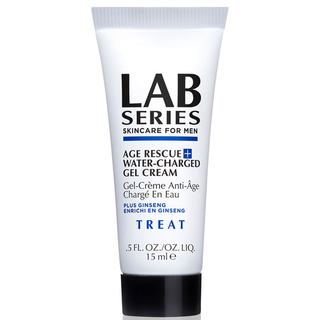
Lab Series Skincare for Men Lab Series Age Rescue+ Water Charged Gel Cream
Works for
2 of 2 advertised claims delivered
Anti-agingAcetyl glucosamine, Acetyl hexapeptide-8 + 7 moreStrong evidence
“The formula boosts collagen for firmer skin, smoothing out fine lines and wrinkles while also targeted signs of fatigue.”
This product can help reduce and prevent fine lines and wrinkles, improve skin elasticity and firmness because it contains acetyl glucosamine.
These ingredients in the product can also be helpful, even though there is less evidence for their effectiveness: acetyl hexapeptide-8, creatine, palmitoyl oligopeptide, vitis vinifera seed extract.
Keep in mind that it typically takes at least 6 weeks to notice any results because the changes that are needed to improve fine lines and elasticity happen in the deeper layers of the skin. No topical anti-aging product can “erase” wrinkles or fully reverse signs of aging.
MoisturizingUrea, Palmitoyl oligopeptide + 26 moreStrong evidence
“Helping to fight the signs of ageing whilst replacing lost moisture, the Age Rescue+ Water Charged Gel Cream (50ml) deeply hydrates and reveals youthful looking skin.”
This product can help improve hydration of the skin with the two types of ingredients.
The first type is called “humectants”:
these ingredients help attract water.
When humectants are on the surface of the skin, they “pull in” the moisture from the outside environment, or from
within deeper layers of the skin. The following ingredients in this product do the job:
algae extract, artemia extract.
This product also contains ingredients called “occlusives”. They help reduce the speed with which our skin loses moisture to the outside environment. These ingredients also help soften the upper layer of the skin, so it feels less tight and nicer to the touch. The following ingredients in this product do the job: dimethicone, dimethiconol.
The following ingredients in this product are especially good for supporting the skin barrier and helping with the hydration level: acetyl glucosamine, acetyl hexapeptide-8, palmitoyl oligopeptide, phytosphingosine, urea
Anti-oxidationNot advertised by the brand · Vitis vinifera seed extract, Glycyrrhetinic acid + 18 moreStrong evidence
This product contains antioxidants (glycyrrhetinic acid, vitis vinifera seed extract) that can help neutralize free radicals in skin. By doing so, they can lessen the damage the skin gets from the UV light (sun).
The following ingredients - camellia sinensis leaf extract, creatine also can have an antioxidant effect, but there is less evidence to confirm their effectiveness in skin.
Evens skin toneNot advertised by the brand · Acetyl glucosamine, Glycyrrhetinic acid + 3 moreStrong evidence
This product can help reduce hypepigmentation and even out the skin tone because it contains the following effective ingredients: acetyl glucosamine
The following ingredient (ingredients) in this product might be helpful, but there is no evidence to confirm that it actually can help even out the skin tone: glycyrrhetinic acid.
Keep in mind that you would need to apply any topical skincare targetted at hypigmentation consistently for a couple of months to get a result. No topical skincare product can help get rid of hyperpigmentation (including post-acne marks and age spots) instantly.
Can it cause trouble?
Irritancy2 strong irritants: Salvia sclarea extract, ParfumMedium risk
Comedogenic3 ingredients rated 2 or more on the 0–5 pore-clogging scale3 flagged

User reviews
Be the first — your take helps the next person decide.
Ingredients
Filter by role to see what each ingredient is doing.
Water~45–55%
Dimethicone~6–7.4%
- Irritation risk
- Low
A silicone that helps to reduce water loss from the surface of the skin. Can temporarily "fill in" lines and wrinkles, absorb oil, and create a nice product finish
More about DimethiconeGlycerin~4.1–5%
- Irritation risk
- Low
One of the best moisturizing ingredients. Naturally present in skin. It attracts water to the upper layer of the skin working as a humectant
More about GlycerinButylene glycol~3–3.7%
- Irritation risk
- Low
Used to create a nice product texture and help delivery of other ingredients. Might be somewhat helpful in attracting water to the upper layer of the skin
More about Butylene glycolStearoxymethicone/dimethicone copolymer~2.3–2.8%
- Irritation risk
- Low
Panax ginseng root extract~1.8–2.2%
- Irritation risk
- High
A plant extract that might have some anti-inflammatory properties, but solid evidence is lacking. It can be irritating
More about Panax ginseng root extractCamellia sinensis leaf extract~1.5–1.9%
- Irritation risk
- Low
Can contain potent anti-oxidant compounds (abbreviated ECG, GCG, EGC, and EGCG) that might help protect the skin from free radicals. Can help calm down inflammation and has some anti-bacterial properties. Unfortunately, these antioxidants are unstable and lose their effectiveness very quickly in products. The concentration of the antioxidant compounds in the extract also tends to be low to be effective in topical formulation
More about Camellia sinensis leaf extractHypnea musciformis extract~1.3–1.6%
- Irritation risk
- Low
- Comedogenicity
- 3/5
Might help to attract water to the upper layer of the skin
More about Hypnea musciformis extractAlgae extract~1.2–1.5%
- Irritation risk
- Low
- Comedogenicity
- 3/5
Plant extract that helps the skin to attract water and make it more smooth for touch. Also shows promise of anti-aging properties, but research is not extensive yet
More about Algae extractSalvia sclarea extract~0.6–0.9%
- Irritation risk
- High
Used as a fragrance. Can be irritating
More about Salvia sclarea extractWhey protein~0.6–0.95%
- Irritation risk
- Low
A protein derived from milk. In skincare products, might help to soften the upper layer of the skin
More about Whey proteinCoffea arabica seed extract~0.45–0.7%
- Irritation risk
- Low
Might be helpful in neutralizing free radicals in skin
More about Coffea arabica seed extractPolygonum cuspidatum root extract~0.45–0.65%
- Irritation risk
- Medium
A plant extract that can contain resveratrol, an antioxidant that can help neutralize free radicals in skin. The effectiveness depends on the extract quality and concentration in the product
More about Polygonum cuspidatum root extractColeus forskohlii root extract~0.45–0.65%
- Irritation risk
- Low
Vitis vinifera seed extract~0.35–0.6%
- Irritation risk
- Low
A plant extract that contains resveratrol and other anti-oxidant compounds that can help neutralize free radicals, reduce inflammation in skin and even out its tone. Can be also used to stabilize the product formulation
More about Vitis vinifera seed extractLycium chinense fruit extract~0.3–0.55%
- Irritation risk
- Low
Vaccinium macrocarpon fruit extract~0.3–0.55%
- Irritation risk
- High
A berry extract. Might have some anti-oxidant properties
More about Vaccinium macrocarpon fruit extractVaccinium angustifolium fruit extract~0.25–0.45%
- Irritation risk
- Medium
A plant extract tha can have anti-oxidant properties, but evidence of effectiveness in skin is lacking
More about Vaccinium angustifolium fruit extractSaccharomyces lysate extract~0.25–0.45%
- Irritation risk
- Low
Helps attract water to the upper layer of the skin. Can have some anti-inflammatory effect
More about Saccharomyces lysate extractAcetyl hexapeptide-8~0.2–0.4%
- Irritation risk
- Low
A type of peptide. Peptides are excellent moisturizers and might be able support collagen production reducing fine lines and wrinkles
More about Acetyl hexapeptide-8Betula alba bark extract~0.2–0.35%
- Irritation risk
- High
Has astringent properties. Creates a tightening and drying effect on the skin. Can be irritating
More about Betula alba bark extractLaminaria digitata extract~0.2–0.35%
- Irritation risk
- Low
- Comedogenicity
- 3/5
Seaweed extract that helps the skin to attract water and make it more smooth for touch. Also shows promise of anti-aging properties, but good research is lacking at the moment
More about Laminaria digitata extractSea salt~0.2–0.35%
- Irritation risk
- Medium
Used to thicken the product formulation and might help to add minerals to the surface of the skin. It is used in scrubs as a physical exfoliant. Can increase sensitivity to other ingredients if left on the skin or used in high concentration
More about Sea saltMaris sal~0.2–0.35%
- Irritation risk
- Medium
Used to thicken the product formulation and might help to add minerals to the surface of the skin. It is used in scrubs as a physical exfoliant. Can increase sensitivity to other ingredients if left on the skin or used in high concentration
More about Maris salMethyl trimethicone~0.2–0.35%
- Irritation risk
- Low
A type of silicone that helps create a silky product finish and dissolve other ingredients
More about Methyl trimethiconeSigesbeckia orientalis extract~0.2–0.35%
- Irritation risk
- Medium
A plant extract that can contain an anti-inflammatory compound
More about Sigesbeckia orientalis extractTrisiloxane~0.2–0.4%
Ergothioneine~0.2–0.4%
- Irritation risk
- Low
Can help neutralize free radicals in skin. Preliminary studies show that it can be more effective than coenzyme Q10 but studies on effective concentration for topical applications are lacking
More about ErgothioneinePalmitoyl oligopeptide~0.3–0.55%
- Irritation risk
- Low
A type of peptide. Peptides are excellent moisturizers and might be able support collagen production reducing fine lines and wrinkles
More about Palmitoyl oligopeptidePunica granatum fruit juice~0.2–0.4%
- Irritation risk
- Medium
A fruit juice. Might have some anti-oxidant properties but is unlikely to have any benefit when used in skincare
More about Punica granatum fruit juiceSea whip extract~0.2–0.4%
- Irritation risk
- Low
Might help neutrlize free radicals, calm down inflammation, and attract water to the upper layer of the skin
More about Sea whip extractCreatine~0.2–0.4%
- Irritation risk
- Low
Can support skin's ability to neutralize free radicals and produce collagen, though further research is needed to confirm effectiveness
More about CreatineArtemia extract~0.2–0.4%
- Irritation risk
- Low
Zooplankton extract that can attract water to the upper level of the skin and might have some anti-oxidant effect
More about Artemia extractPhytosphingosine~0.25–0.5%
- Irritation risk
- Low
A type of lipid that is naturally present in skin. It might help in repairing skin barrier function and has anti-bacterial effect
More about PhytosphingosineTrehalose~0.2–0.4%
- Irritation risk
- Low
A sugar that attracts water to the upper layer of the skin
More about TrehaloseLauryl peg-9 polydimethylsiloxyethyl dimethicone~0.25–0.4%
- Irritation risk
- Low
A type of silicone that helps to soften upper layer of the skin and create a nice product texture
More about Lauryl peg-9 polydimethylsiloxyethyl dimethiconeSodium pca~0.2–0.4%
- Irritation risk
- Low
Naturally present in skin and helps to attract water to its upper layer
More about Sodium pcaAminopropyl ascorbyl phosphate~0.2–0.4%
- Irritation risk
- Medium
A more stable but less potent derivative of vitamin C. It can help neautralize free radicals and even out the skin tone if used in high enough concentration (required levels are likely to be much higher than for pure vitamin C, and solid studies are lacking at the moment)
More about Aminopropyl ascorbyl phosphateAcetyl glucosamine~0.2–0.4%
- Irritation risk
- Low
An effective moisturizing ingredient that also has been shown to be effective in evening out the skin tone and reducing hyperpigmentation. It can help somewhat reduce wrinkles in skin
More about Acetyl glucosamineSorbitol~0.2–0.4%
- Irritation risk
- Low
Helps attract water to the upper layer of the skin and improves the product texture
More about SorbitolGlycyrrhetinic acid~0.2–0.4%
- Irritation risk
- Medium
Active compound of licorice root. Works to calm down inflammation, as an anti-oxidant, and might be helpful in lightening the skin and reducing hyperpigmentation
More about Glycyrrhetinic acidDimethiconol~0.25–0.5%
- Irritation risk
- Low
A silicone that makes products more spreadable and keeps skin smooth. Helps to add gloss to skin and may visually fill in fine lines/wrinkles for short time
More about DimethiconolCaffeine~0.2–0.4%
- Irritation risk
- Medium
Might be helpful in neutralizing free radicals. Can have a dehydration effect that might somewhat decrease the look of puffy eyes
More about CaffeineEthylhexylglycerin~0.25–0.4%
Urea~0.2–0.4%
- Irritation risk
- Low
Naturally present in skin (urea makes up about 7% of natural moisturizing factors in skin). Attracts water to the upper layer of the skin. Also has a positive effect on the skin barrier beyond the humectant action. Can enhance penetration of other ingredients. Is an exfoliating ingredient when used in high concentrations
More about UreaTocopheryl acetate~0.25–0.45%
- Irritation risk
- Medium
A more stable but less bio-available form of vitamin E compared to Tocopherol. Might help moisturize and protect the skin from free radicals, but mostly used in low concentrations to stabilize other ingredients.
More about Tocopheryl acetateDimethicone/peg-10/15 crosspolymer~0.2–0.4%
Peg-8~0.25–0.45%
- Irritation risk
- Medium
Used to create a nice product consistency
More about Peg-8Sodium hyaluronate~0.2–0.4%
- Irritation risk
- Low
One of the best moisturizing ingredients. Attracts water into the upper layer of the skin
More about Sodium hyaluronateDipropylene glycol~0.2–0.35%
- Irritation risk
- Low
Helps to dissolve other ingredients in a formulation. Slows down the rate of product drying
More about Dipropylene glycolYeast extract~0.2–0.4%
- Irritation risk
- Low
Helps attract water to the upper layer of the skin and might have some anti-oxidant and skin lightening properties. It can help calm down inflammation in skin
More about Yeast extractFaex~0.2–0.4%
- Irritation risk
- Low
Yeast extract. Helps to attract water to the upper layer of the skin
More about FaexYeast extract~0.2–0.4%
- Irritation risk
- Low
Helps attract water to the upper layer of the skin and might have some anti-oxidant and skin lightening properties. It can help calm down inflammation in skin
More about Yeast extractPolyquaternium-51~0.25–0.45%
- Irritation risk
- Low
An emollient that helps create a nice silky finish on the skin
More about Polyquaternium-51Lauryl methacrylate/glycol dimethacrylate crosspolymer~0.25–0.45%
- Irritation risk
- Low
Glyceryl polymethacrylate~0.25–0.45%
- Irritation risk
- Low
Used to create a nice product texture
More about Glyceryl polymethacrylateCitric acid~0.2–0.4%
- Irritation risk
- Medium
Can work as an exfoliant but is typically used to adjust the product pH
More about Citric acidTriethoxycaprylylsilane~0.25–0.45%
- Irritation risk
- Low
A type of silicone that helps oil and water mix well together. Helps to disperse other ingredients, e.g. pigments, evenly in a formulation
More about TriethoxycaprylylsilaneAscorbyl tocopheryl maleate~0.25–0.5%
- Irritation risk
- Low
Nordihydroguaiaretic acid~0.25–0.45%
- Irritation risk
- Medium
Used to stabilize the formula of product formulation. Might be helpful in neutralizing free radicals in skin
More about Nordihydroguaiaretic acidMaltodextrin~0.25–0.45%
- Irritation risk
- Low
Used to stabilize the product formulation and can help absorb oil
More about MaltodextrinParfum~0.2–0.35%
- Irritation risk
- High
An aromatic blend of unspecified and possibly irritating ingredients
More about ParfumDisodium edta~0.2–0.4%
Bht~0.2–0.35%
Phenoxyethanol~0.2–0.35%
- Irritation risk
- Low
A preservative. It helps prevent bacterial growth in cosmetic products
More about PhenoxyethanolMica~0.25–0.45%
- Irritation risk
- Low
Creates an illusion of smoother and more radiant skin tone. Adds shimmer to the skin by reflecting light
More about MicaCi 60730~0.15–0.25%
- Irritation risk
- Low
Titanium dioxide~0.25–0.45%
- Irritation risk
- Low
Works as a UV filter when used in high concentrations. It is photostable and is effective mostly against the UVB light, with some protection in the UVA range. In small concentrations, used for its ability to improve the color of cosmetic products. Is usually well tolerated by the skin
More about Titanium dioxideCi 77891~0.15–0.25%
- Irritation risk
- Low
Ci 17200~0.1–0.15%
Ci 42090~0.1–0.15%
Ingredient list view
Water, Dimethicone, Glycerin, Butylene glycol, Stearoxymethicone/dimethicone copolymer, Panax ginseng root extract, Camellia sinensis leaf extract, Hypnea musciformis extract, Algae extract, Salvia sclarea extract, Whey protein, Coffea arabica seed extract, Polygonum cuspidatum root extract, Coleus forskohlii root extract, Vitis vinifera seed extract, Lycium chinense fruit extract, Vaccinium macrocarpon fruit extract, Vaccinium angustifolium fruit extract, Saccharomyces lysate extract, Acetyl hexapeptide-8, Betula alba bark extract, Laminaria digitata extract, Sea salt, Maris sal, Methyl trimethicone, Sigesbeckia orientalis extract, Trisiloxane, Ergothioneine, Palmitoyl oligopeptide, Punica granatum fruit juice, Sea whip extract, Creatine, Artemia extract, Phytosphingosine, Trehalose, Lauryl peg-9 polydimethylsiloxyethyl dimethicone, Sodium pca, Aminopropyl ascorbyl phosphate, Acetyl glucosamine, Sorbitol, Glycyrrhetinic acid, Dimethiconol, Caffeine, Ethylhexylglycerin, Urea, Tocopheryl acetate, Dimethicone/peg-10/15 crosspolymer, Peg-8, Sodium hyaluronate, Dipropylene glycol, Yeast extract, Faex, Yeast extract, Polyquaternium-51, Lauryl methacrylate/glycol dimethacrylate crosspolymer, Glyceryl polymethacrylate, Citric acid, Triethoxycaprylylsilane, Ascorbyl tocopheryl maleate, Nordihydroguaiaretic acid, Maltodextrin, Parfum, Disodium edta, Bht, Phenoxyethanol, Mica, Unknown, Ci 60730, Titanium dioxide, Ci 77891, Ci 17200, Ci 42090
Compare prices
Retailers ranked by price — lowest first.
Affiliate links · prices updated regularly · As an Amazon Associate, WIMJ earns from qualifying purchases.
Worth comparing, line by line.
Match % combines shared ingredients, the first five ingredients, shared actives and hero ingredients, irritancy (lower counts in the alternative's favour), texture and body area. Only products in the same routine step are compared.
| Lab Series Skincare for MenLab Series Age Rescue+ Water Charged Gel CreamYOUR PRODUCT | Lab Series For MenAge Rescue Water-Charged Gel Cream | |
|---|---|---|
| Match | — | 74% |
| Price | $19.00 | $55.00+$36.00 |
| Shared key ingredients | — | 23 of 23 |
| Key difference | — | — |
| Irritancy | Medium | Medium |
| Drying alcohol | — | — |
| View product | Shop |

Product summary
Based on the ingredients included, "Lab Series Skincare for Men - Lab Series Age Rescue+ Water Charged Gel Cream" works well for moisturizing the skin. As we expect from a proper moisturizer, the formula includes a combo of effective humectants and emollients. These are the two different types of ingredients that are essential for improving the skin hydration and supporting a healthy skin barrier. Humectants in this product (acetyl glucosamine, acetyl hexapeptide-8, urea, algae extract and artemia extract) help to increase the water content in the upper layer of the skin. (These ingredients do so by "capturing" water molecules from the outside air or from within the deeper layers of the skin). Emollients in this formulation (phytosphingosine, algae extract, dimethicone, dimethiconol and whey protein) help to reduce the moisture loss from the skin. They also soften the skin surface and relieve the feeling of dryness and tightness.
Ingredient callouts
- As a plus, this moisturizer also contains Ceramides (phytosphingosine 0.25% - 0.50%). Ceramides are a type of lipids that our skin produces itself. They are a building block of the skin's barrier. Ceramides used in skincare are synthetic or extracted from plants. They work well for softening the skin surface and "patch holes" in the skin's barrier.
- We like that this moisturizer contains peptides (palmitoyl oligopeptide 0.30% - 0.55% and acetyl hexapeptide-8 0.20% - 0.40%). There are many different kind of Peptides and they are naturally present in our skin. They all are a combination of aminoacids. Some of them work as natural antibiotics, promote wound-healing and production of collagen. The science is still not settled on how effective Peptides are in skincare, but it is very likely that they have a benefit. Peptides might help restore the skin barrier and fight the signs of aging. At the very least, Peptides work as humectants: they attract water to the upper layer of the skin and improve its hydration.
Irritation risk
There are some common irritants in this product, including ingredients that do not have benefits for the skin. We assess the overall irritancy of this moisturizer to be medium. For a detailed overview of all potential irritants: click here
You can see the detailed formula review with the breakdown of all actives in the product and the full ingredient list with estimated concentrations in the tables below.
Price
The product retails for 47.00£ in the United Kingdom.
For a detailed price comparison: click here.
Sources cited in this review
Every concentration estimate and effectiveness label is anchored to one of these 40 studies and safety reviews.
- 1
- 2Final Report on the Safety Assessment of Dimethicone Copolyoljournals.sagepub.com
- 3
- 4Ginseng in Dermatology: A Reviewncbi.nlm.nih.gov
- 5
- 6TOPICAL COMPOSITIONS CONTAINING WHEY PROTEINS patentimages.storage.googleapis.com

Affiliate links · As an Amazon Associate, WIMJ earns from qualifying purchases.