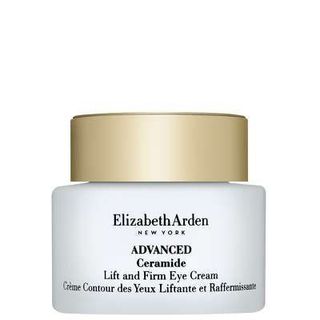
Elizabeth Arden Eye Care Advanced Ceramide Lift and Firm Eye Cream
Works for
2 of 2 advertised claims delivered
Moisturizing31 ingredients credited for this claimStrong support
“Elizabeth Arden, Eye Care This rich and luxurious cream provides a boost to the delicate eye area, maintaining hydration and visibly improving brightness.”
This product can help improve hydration of the skin with the two types of ingredients.
The first type is called “humectants”:
these ingredients help attract water.
When humectants are on the surface of the skin, they “pull in” the moisture from the outside environment, or from
within deeper layers of the skin. The following ingredients in this product do the job:
glycerin, butylene glycol.
This product also contains ingredients called “occlusives”. They help reduce the speed with which our skin loses moisture to the outside environment. These ingredients also help soften the upper layer of the skin, so it feels less tight and nicer to the touch. The following ingredients in this product do the job: beeswax, cera alba.
The following ingredients in this product are especially good for supporting the skin barrier and helping with the hydration level: acetyl octapeptide-3, ceramide 1, ceramide 3, ceramide 6 ii, dipeptide-2, phytosphingosine
Anti-aging6 ingredients credited for this claimModerate support
“Eye Care Advanced Ceramide Lift and Firm Eye Cream”
This product contains acetyl octapeptide-3, ascorbyl glucoside, dipeptide-2. These ingredients might be able to help reduce and prevent fine lines and wrinkles, improve skin elasticity and firmness, but there is not enough evidence that it actually works.
Evens skin toneNot advertised by the brand · 3 ingredients credited for this claimModerate support
The following ingredient (ingredients) in this product might be helpful, but there is no evidence to confirm that it actually works: ascorbyl glucoside, glycine soja seed extract.
Anti-oxidationNot advertised by the brand · 8 ingredients credited for this claimModerate support
This product contains antioxidants (ascorbyl glucoside) that might be able to help neutralize free radicals in skin to lessen the damage it gets from the UV light (sun). There is not enough evidence to confirm their effectiveness in skin though.
Can it cause trouble?
Irritancy2 strong irritants: Benzophenone-3, Diazolidinyl ureaMedium risk
Comedogenic3 ingredients rated 2 or more on the 0–5 pore-clogging scale3 flagged
User reviews
Be the first — your take helps the next person decide.
Ingredients
Filter by role to see what each ingredient is doing.
Ceramide 1~22–33%
- Irritation risk
- Low
A type of lipid similar to ceramides naturally present in skin. Helps to soften the upper layer of the skin and supports the skin barrier function to keep it hydrated. Can help to prevent inflammation in skin
More about Ceramide 1Acetyl octapeptide-3~4.6–6.8%
- Irritation risk
- Low
A type of peptide. Peptides are excellent moisturizers and might be able support collagen production reducing fine lines and wrinkles
More about Acetyl octapeptide-3Hibiscus abelmoschus seed extract~4.4–6.6%
- Irritation risk
- Low
Cholesterol~3.2–4.8%
- Irritation risk
- Low
An emollient that is naturally found in skin
More about CholesterolMalus domestica fruit extract~2.5–3.7%
- Irritation risk
- Medium
Helps attract water to the upper layer of the skin
More about Malus domestica fruit extractGlycine soja seed extract~2–3%
- Irritation risk
- Medium
An emollient that helps soften the skin. Might be somewhat helpful in evening the skin tone.
More about Glycine soja seed extractAscorbyl glucoside~1.5–2.3%
- Irritation risk
- Medium
A vitamin C derivative that is more stable but less potent than pure form of vitamin C. Has a potential to boost collagen production, nutralise free radicals and reduce hyperpigmentation, but the required concentration is likely to be much higher than for the pure form of vitamin C, limiting the ingredient's effectiveness in products
More about Ascorbyl glucosideBenzophenone-31.4%
- Irritation risk
- High
Same as oxybenzone. Protects in the UVB and short UVA range. In small concentrations, used to stabilize product formulation. Can be irritating. Is shown to be harmful to coral reefs - consider avoiding bathing in coral reef areas when wearing a product with this ingredient. It can penetrate the skin and get absorbed into bloodstream faster than other popular filters available in the US. The study that produced this finding did not address any potential health effects of the absorption
More about Benzophenone-3Ethylhexyl methoxycinnamate4.09%
- Irritation risk
- High
Octinoxate. When used in higher concentrations, works as a sunscreen protecting the skin from UVB rays. When used in lower concentration, helps to preserve the product formulation. Is shown to be harmful to coral reefs - consider avoiding bathing in coral reef areas when wearing a product with this ingredient. It can be irritating
More about Ethylhexyl methoxycinnamateWater~1.2–1.7%
Dimethicone~1.2–1.7%
- Irritation risk
- Low
A silicone that helps to reduce water loss from the surface of the skin. Can temporarily "fill in" lines and wrinkles, absorb oil, and create a nice product finish
More about DimethiconeCetyl ricinoleate~0.85–1.25%
- Irritation risk
- Low
An emollient that helps soften the upper layer of the skin
More about Cetyl ricinoleateCetearyl alcohol~0.55–1.3%
- Irritation risk
- Low
- Comedogenicity
- 2/5
A non-drying alcohol. Works as an emollient. Helps water and oil mix together and creates a nice product texture
More about Cetearyl alcoholGlycerin~0.4–0.95%
- Irritation risk
- Low
One of the best moisturizing ingredients. Naturally present in skin. It attracts water to the upper layer of the skin working as a humectant
More about GlycerinSynthetic beeswax~0.35–0.75%
- Irritation risk
- Low
Helps soften the upper layer of the skin
More about Synthetic beeswaxButylene glycol~0.2–0.8%
- Irritation risk
- Low
Used to create a nice product texture and help delivery of other ingredients. Might be somewhat helpful in attracting water to the upper layer of the skin
More about Butylene glycolCetearyl dimethicone crosspolymer~0.2–0.75%
- Irritation risk
- Low
Helps create a nice product texture and soften the upper layer of the skin
More about Cetearyl dimethicone crosspolymerHydrogenated polyisobutene~0.3–0.75%
- Irritation risk
- Low
Used to improve the product consistency and soften the upper layer of the skin
More about Hydrogenated polyisobutenePentylene glycol~0.3–0.75%
- Irritation risk
- Medium
Used to preserve products, dissolve other ingredients and create a nice product texture
More about Pentylene glycolStearyl heptanoate~0.2–0.75%
Myristyl myristate~0.2–0.7%
- Irritation risk
- Medium
- Comedogenicity
- 3/5
An emollient. Is not recommended for acne-prone skin as it can be comedogenic
More about Myristyl myristateIsononyl isononanoate~0.2–0.75%
- Irritation risk
- Low
Forms a protective film on the surface of the skin to prevent moisture loss. Gives a velvety feel to products while reducing tackiness
More about Isononyl isononanoateAmmonium acryloyldimethyltaurate/vp copolymer~0.15–0.55%
- Irritation risk
- Low
Increases thickness of a product. Texture enhancer for oil-in-water emulsions
More about Ammonium acryloyldimethyltaurate/vp copolymerCopernicia cerifera wax~0.2–0.8%
- Irritation risk
- Low
Helps to soften the upper layer of the skin and create a nice product consistency
More about Copernicia cerifera waxCopernicia cerifera cera~0.35–0.75%
- Irritation risk
- Low
Brazilian palm wax. Helps soften the upper layer of the skin
More about Copernicia cerifera ceraCopernicia cerifera wax~0.2–0.75%
- Irritation risk
- Low
Helps to soften the upper layer of the skin and create a nice product consistency
More about Copernicia cerifera waxPpg-2 isoceteth-20 acetate~0.15–0.55%
- Irritation risk
- Medium
Helps water and oil mix together
More about Ppg-2 isoceteth-20 acetateAscorbyl glucoside~0.1–0.5%
- Irritation risk
- Medium
A vitamin C derivative that is more stable but less potent than pure form of vitamin C. Has a potential to boost collagen production, nutralise free radicals and reduce hyperpigmentation, but the required concentration is likely to be much higher than for the pure form of vitamin C, limiting the ingredient's effectiveness in products
More about Ascorbyl glucosideCeramide 1~0.15–0.7%
- Irritation risk
- Low
A type of lipid similar to ceramides naturally present in skin. Helps to soften the upper layer of the skin and supports the skin barrier function to keep it hydrated. Can help to prevent inflammation in skin
More about Ceramide 1Ceramide 3~0.15–0.7%
- Irritation risk
- Low
A type of lipid similar to ceramides naturally present in skin. Helps to soften the upper layer of the skin and supports the skin barrier function to keep it hydrated. Can help to prevent inflammation in skin
More about Ceramide 3Ceramide 6 ii~0.15–0.7%
- Irritation risk
- Low
A type of lipid similar to ceramides naturally present in skin. Helps to soften the upper layer of the skin and supports the skin barrier function to keep it hydrated. Can help to prevent inflammation in skin
More about Ceramide 6 iiBeeswax~0.2–0.7%
- Irritation risk
- Low
Forms a protective barrier that holds water and keeps dry skin hydrated. Keeps an emulsion from separating into its oil and liquid components, and increases the thickness of a product. Can be an allergen
More about BeeswaxCera alba~0.4–0.9%
- Irritation risk
- Medium
Forms a protective barrier that holds water and keeps dry skin hydrated. Keeps an emulsion from separating into its oil and liquid components, and increases the thickness of a product. Can be an allergen
More about Cera albaBeeswax~0.2–0.7%
- Irritation risk
- Low
Forms a protective barrier that holds water and keeps dry skin hydrated. Keeps an emulsion from separating into its oil and liquid components, and increases the thickness of a product. Can be an allergen
More about BeeswaxCamellia sinensis leaf extract~0.15–0.55%
- Irritation risk
- Low
Can contain potent anti-oxidant compounds (abbreviated ECG, GCG, EGC, and EGCG) that might help protect the skin from free radicals. Can help calm down inflammation and has some anti-bacterial properties. Unfortunately, these antioxidants are unstable and lose their effectiveness very quickly in products. The concentration of the antioxidant compounds in the extract also tends to be low to be effective in topical formulation
More about Camellia sinensis leaf extractGlycine soja seed extract~0.15–0.7%
- Irritation risk
- Medium
An emollient that helps soften the skin. Might be somewhat helpful in evening the skin tone.
More about Glycine soja seed extractHibiscus abelmoschus seed extract~0.1–0.45%
- Irritation risk
- Low
Pyrus malus fruit extract~0.15–0.5%
- Irritation risk
- Medium
Can have some moisturizing properties due to its sugar content
More about Pyrus malus fruit extractAscorbyl palmitate~0.15–0.55%
- Irritation risk
- Medium
Being a lipid soluble form of vitamin C, it is more stable and can penetrate the skin better than L-Ascorbic acid. It is effective in protecting the skin from free radicals, as well as evening the skin tone, but is less effective in stimulating collagen production compared to L-Ascorbic acid.
More about Ascorbyl palmitateTocopheryl acetate~0.15–0.6%
- Irritation risk
- Medium
A more stable but less bio-available form of vitamin E compared to Tocopherol. Might help moisturize and protect the skin from free radicals, but mostly used in low concentrations to stabilize other ingredients.
More about Tocopheryl acetateBis-peg-12 dimethicone~0.2–0.7%
- Irritation risk
- Low
A type of silicone. Helps soften the upper layer of the skin
More about Bis-peg-12 dimethiconeAcetyl octapeptide-3~0.15–0.55%
- Irritation risk
- Low
A type of peptide. Peptides are excellent moisturizers and might be able support collagen production reducing fine lines and wrinkles
More about Acetyl octapeptide-3Propylene glycol~0.15–0.55%
- Irritation risk
- High
Helps oil and water mix together and can enhance the penetration of other ingredients into the skin. It can be irritating
More about Propylene glycolDipeptide-2~0.15–0.6%
- Irritation risk
- Low
A type of peptide. Peptides are excellent moisturizers and might be able support collagen production reducing fine lines and wrinkles
More about Dipeptide-2Elaeis guineensis extract~0.15–0.6%
- Irritation risk
- Low
Tetrapeptide-3~0.15–0.65%
- Irritation risk
- Low
Phospholipids~0.15–0.65%
- Irritation risk
- Low
Emollients that are naturaly present in skin. In addition, they help water and oil mix together in the product
More about PhospholipidsPhytosphingosine~0.3–0.7%
- Irritation risk
- Low
A type of lipid that is naturally present in skin. It might help in repairing skin barrier function and has anti-bacterial effect
More about PhytosphingosineCeteth-20~0.35–0.8%
Peg-100 stearate~0.3–0.75%
- Irritation risk
- Low
Helps oil and water mix togehter and creates a nice product texture
More about Peg-100 stearatePeg-20~0.15–0.65%
- Irritation risk
- Low
Sodium lauroyl lactylate~0.15–0.65%
- Irritation risk
- Medium
Helps water and oil mix together
More about Sodium lauroyl lactylateSorbitan tristearate~0.15–0.65%
- Irritation risk
- Medium
Helps oil and water mix together
More about Sorbitan tristearateMyristyl laurate~0.15–0.65%
Steareth-100~0.15–0.65%
Steareth-20~0.3–0.7%
Pvp~0.2–0.75%
- Irritation risk
- Medium
Helps evenly disperse other ingredients in a formulation and create an even layer on the surface of the skin
More about PvpVp/eicosene copolymer~0.2–0.8%
- Irritation risk
- Medium
Used to improve the product adherence to the skin, for example, to pro-long the protective effect of sunscreens. Can be irritating to very sensitive skin
More about Vp/eicosene copolymerXanthan gum~0.15–0.65%
- Irritation risk
- Low
Used to create a thicker product consistency
More about Xanthan gumSodium hydroxide~0.15–0.65%
Bht~0.15–0.65%
Hesperidin methyl chalcone~0.15–0.65%
- Irritation risk
- High
Might help neutralize free radicals in skin. Is claimed to be able to improve the appearance of undereye darkness but evidence is missing. Can be an allergen and cause irritation
More about Hesperidin methyl chalconeDisodium edta~0.15–0.6%
Silica~0.35–0.85%
Cyclopentasiloxane~0.2–0.8%
- Irritation risk
- Low
A silicone that helps improve the product texture and spreadability. Can absorb oil creating a short-term mattifying effect on the skin
More about CyclopentasiloxaneDiazolidinyl urea~0.1–0.45%
- Irritation risk
- High
A preservative. Works by releasing formaldehyde. Can be irritating
More about Diazolidinyl ureaMethylparaben~0.15–0.3%
Phenoxyethanol~0.15–0.5%
- Irritation risk
- Low
A preservative. It helps prevent bacterial growth in cosmetic products
More about PhenoxyethanolPotassium sorbate~0.15–0.5%
Propylparaben~0.1–0.4%
Chlorhexidine digluconate~0.15–0.3%
Ingredient list view
Ceramide 1, Acetyl octapeptide-3, Hibiscus abelmoschus seed extract, Cholesterol, Malus domestica fruit extract, Glycine soja seed extract, Ascorbyl glucoside, Benzophenone-3, Ethylhexyl methoxycinnamate, Water, Dimethicone, Cetyl ricinoleate, Cetearyl alcohol, Glycerin, Synthetic beeswax, Butylene glycol, Cetearyl dimethicone crosspolymer, Hydrogenated polyisobutene, Pentylene glycol, Stearyl heptanoate, Myristyl myristate, Isononyl isononanoate, Ammonium acryloyldimethyltaurate/vp copolymer, Copernicia cerifera wax, Copernicia cerifera cera, Copernicia cerifera wax, Ppg-2 isoceteth-20 acetate, Ascorbyl glucoside, Ceramide 1, Ceramide 3, Ceramide 6 ii, Beeswax, Cera alba, Beeswax, Camellia sinensis leaf extract, Glycine soja seed extract, Hibiscus abelmoschus seed extract, Pyrus malus fruit extract, Ascorbyl palmitate, Tocopheryl acetate, Bis-peg-12 dimethicone, Acetyl octapeptide-3, Propylene glycol, Dipeptide-2, Elaeis guineensis extract, Tetrapeptide-3, Phospholipids, Phytosphingosine, Ceteth-20, Peg-100 stearate, Peg-20, Sodium lauroyl lactylate, Sorbitan tristearate, Myristyl laurate, Steareth-100, Steareth-20, Pvp, Vp/eicosene copolymer, Xanthan gum, Sodium hydroxide, Bht, Hesperidin methyl chalcone, Disodium edta, Silica, Cyclopentasiloxane, Diazolidinyl urea, Methylparaben, Phenoxyethanol, Potassium sorbate, Propylparaben, Chlorhexidine digluconate
Compare prices
Retailers ranked by price — lowest first.
Affiliate links · prices updated regularly · As an Amazon Associate, WIMJ earns from qualifying purchases.
Product summary
Judging from the ingredient list, "Elizabeth Arden - Eye Care Advanced Ceramide Lift and Firm Eye Cream" works well for improving skin hydration The formulation is based on a combination of good humectants and emollients. Both are needed to increase the skin hydration level. Acetyl octapeptide-3, glycerin, butylene glycol and propylene glycol in this product (humectants) attract water molecules to the upper layer of the skin (the water comes from the outside air or from the deeper layers of the skin if the air is dry). Ceramide 1, ceramide 3, ceramide 6 ii, phytosphingosine and cholesterol in this product help decrease the water evoporation from the skin, so that it stays hydrated for longer. These ingredients also soften the skin and take away the feeling of tightness and dryness.
Ingredient callouts
- Another benefit is that this moisturizer contain ceramides (phytosphingosine 0.30% - 0.70%, ceramide 6 ii 0.15% - 0.70%, ceramide 3 0.15% - 0.70%, ceramide 1 0.15% - 0.70% and ceramide 1 22.00% - 33.00%). Ceramides are an important part of our natural skin barrier. The Ceramides used in skincare are synthetic or come from plants. They help soften the skin and can help "fill the gaps" in the skin barrier, keeping the skin hydrated and resilient for longer.
- This moisturizer also contains Peptides (dipeptide-2 0.15% - 0.60%, acetyl octapeptide-3 0.15% - 0.55% and acetyl octapeptide-3 4.60% - 6.80%). Peptides are a very big group of ingredients. They all consist of a different combination of aminoacids. Our skin produces Peptides naturally. Some of them work as natural antibiotics, promote wound-healing and production of collagen. The scientists are still studying how effective the topical application of Peptides is, but it is very likely that they are helpful. Peptides might be able to support skin barrier restoration and even have an anti-aging benefit. At the very least, they certainly help attract water to the skin and support the hydration in this way.
Irritation risk
There are some common irritants in this product, including ingredients that do not have benefits for the skin. We assess the overall irritancy of this moisturizer to be medium. For a detailed overview of all potential irritants: click here
You can see the detailed formula review with the breakdown of all actives in the product and the full ingredient list with estimated concentrations in the tables below.
Price
The product retails from 31.65£ up to 876.00£ in the United Kingdom.
For a detailed price comparison: click here.
Sources cited in this review
Every concentration estimate and effectiveness label is anchored to one of these 18 studies and safety reviews.
- 1
- 2The Roles of Vitamin C in Skin Healthncbi.nlm.nih.gov
- 3
- 4
- 5
- 6On Photostability of Oxybenzonecore.ac.uk

Affiliate links · As an Amazon Associate, WIMJ earns from qualifying purchases.