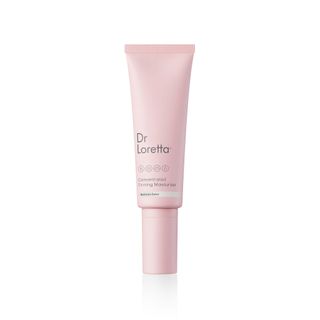
Dr. Loretta Concentrated Firming Moisturizer
Works for
3 of 4 advertised claims delivered
Anti-aging2 ingredients credited for this claimStrong support
“This antioxidant-rich firming cream reduces rough texture and minimizes the appearance of wrinkles, pores, and fine lines.”
This product can help reduce and prevent fine lines and wrinkles, improve skin elasticity and firmness because it contains hydroxypinacolone retinoate.
Keep in mind that it typically takes at least 6 weeks to notice any results because the changes that are needed to improve fine lines and elasticity happen in the deeper layers of the skin. No topical anti-aging product can “erase” wrinkles or fully reverse signs of aging.
Evens skin tone2 ingredients credited for this claimStrong support
“While that works to correct texture, Lipochroman, a supercharged antioxidant bio-inspired by Vitamin E, defends against pollution — a leading cause of fine lines and age spots.”
This product can help reduce hypepigmentation and even out the skin tone because it contains the following effective ingredients: hydroxypinacolone retinoate.
The following ingredient (ingredients) in this product might be helpful, but there is no evidence to confirm that it actually can help even out the skin tone: pinus pinaster bark extract.
Keep in mind that you would need to apply any topical skincare targetted at hypigmentation consistently for a couple of months to get a result. No topical skincare product can help get rid of hyperpigmentation (including post-acne marks and age spots) instantly.
Moisturizing11 ingredients credited for this claimGood support
“Concentrated Firming Moisturizer”
This product can help improve hydration of the skin with the two types of ingredients.
The first type is called “humectants”:
these ingredients help attract water.
When humectants are on the surface of the skin, they “pull in” the moisture from the outside environment, or from
within deeper layers of the skin. The following ingredients in this product do the job:
glycerin, caprylyl glycol.
This product also contains ingredients called “occlusives”. They help reduce the speed with which our skin loses moisture to the outside environment. These ingredients also help soften the upper layer of the skin, so it feels less tight and nicer to the touch. The following ingredients in this product do the job: caprylic/capric triglyceride, dimethicone.
Exfoliation2 ingredients credited for this claimLimited support
“Retinol supports collagen, protects from free radical damage caused by pollution and exfoliates dead cells from skin surface.”
This product might help exfoliate the skin with hydroxypinacolone retinoate, but This ingredient is not the most effective.
Anti-blemishNot advertised by the brand · 1 ingredient credited for this claimStrong support
This product can help reduce breakouts and clogged pores because it contains the following ingredient: hydroxypinacolone retinoate. This ingredient is used for treating acne and can have a noticeable effect.
Anti-oxidationNot advertised by the brand · 3 ingredients credited for this claimStrong support
This product contains antioxidants (dimethylmethoxy chromanol, ubiquinone) that can help neutralize free radicals in skin. By doing so, they can lessen the damage the skin gets from the UV light (sun).
The following ingredients - pinus pinaster bark extract also can have an antioxidant effect, but there is less evidence to confirm their effectiveness in skin.
Can it cause trouble?
Irritancy6 strong irritants: Citrus aurantium dulcis flower oil, Hydroxypinacolone retinoate + 4 more — patch-test recommendedHigh risk
Comedogenic1 ingredient rated 2 or more on the 0–5 pore-clogging scale1 flagged


User reviews
Be the first — your take helps the next person decide.
Ingredients
Filter by role to see what each ingredient is doing.
Water~45–55%
Caprylic/capric triglyceride~6.4–7.9%
- Irritation risk
- Medium
A good mix of fatty acids that forms a protective layer on the skin. Improves the shelf life of products. Derived from coconut and glycerin
More about Caprylic/capric triglycerideC10-18 triglycerides~4.5–5.5%
- Irritation risk
- Low
Helps soften the skin and attract water to its upper layer. Helps create nice product texture
More about C10-18 triglyceridesGlycerin~3.2–3.9%
- Irritation risk
- Low
One of the best moisturizing ingredients. Naturally present in skin. It attracts water to the upper layer of the skin working as a humectant
More about GlycerinGlyceryl behenate~2.5–3%
- Irritation risk
- Medium
Used to create a thicker product consistency and help soften the upper layer of the skin
More about Glyceryl behenateRicinus communis seed oil~2.2–2.6%
- Irritation risk
- Medium
A plant oil that can help soften the skin. It might be helpful in calming down inflammation, but solid research is lacking. Is often used in lip products to create the needed product consistency
More about Ricinus communis seed oilCetyl alcohol~1.8–2.2%
- Irritation risk
- Low
A non-drying alcohol that works to soften the skin and stabilize product formulations helping oil and water mix together
More about Cetyl alcoholCandelilla/jojoba/rice bran polyglyceryl-3 esters~1.5–1.8%
- Irritation risk
- Medium
Help oil and water mix together
More about Candelilla/jojoba/rice bran polyglyceryl-3 estersGlyceryl stearate~1.3–1.5%
- Irritation risk
- Low
An emollient that softens the skin and forms a protective layer on its surface. Helps water and oil mix together
More about Glyceryl stearateDimethicone~1–1.3%
- Irritation risk
- Low
A silicone that helps to reduce water loss from the surface of the skin. Can temporarily "fill in" lines and wrinkles, absorb oil, and create a nice product finish
More about DimethiconeMicrocrystalline cellulose~0.9–1.1%
Dimethyl isosorbide~0.6–0.9%
- Irritation risk
- Low
Used to dissolve other ingredients in a product and can enhance their ability to penetrate the skin
More about Dimethyl isosorbideCetearyl alcohol~0.6–0.95%
- Irritation risk
- Low
- Comedogenicity
- 2/5
A non-drying alcohol. Works as an emollient. Helps water and oil mix together and creates a nice product texture
More about Cetearyl alcoholSodium stearoyl lactylate~0.5–0.75%
- Irritation risk
- Medium
Helps oil and water mix together
More about Sodium stearoyl lactylateGlyceryl oleate citrate~0.45–0.7%
- Irritation risk
- Medium
Helps oil and water mix together
More about Glyceryl oleate citrateHydroxyacetophenone~0.45–0.65%
Lecithin~0.45–0.7%
- Irritation risk
- Low
Used mostly for creating emulsions - helping oil and water mix together. Helps soften the upper layer of the skin
More about Lecithin1,2-hexanediol~0.35–0.65%
Caprylyl glycol~0.35–0.6%
- Irritation risk
- Medium
Helps preserve products and creates a nice product texture
More about Caprylyl glycolXanthan gum~0.3–0.55%
- Irritation risk
- Low
Used to create a thicker product consistency
More about Xanthan gumCellulose gum~0.3–0.5%
- Irritation risk
- Low
Used to create thicker product consistency and stabilize emulsions
More about Cellulose gumCitrus aurantium dulcis flower oil~0.25–0.45%
- Irritation risk
- High
Hydroxypinacolone retinoate~0.05–0.1%
- Irritation risk
- High
A derivative of the most potent form of vitamin A, retinoic acid. The ingredient can be sold under name Granactive Retinoid. Note that if a skincare brand discloses the concentration of Granactive Retinoid in a product, the concentration refers to a diluted form of Hydroxypinacolone Retinoate: 1% of Granactive Retinoid corresponds to 0.1% of Hydroxypinacolone Retinoate. Hydroxypinacolone Retinoate (HPR) is a unique derivative of retinoic acid because it can directly work in the skin and does not require additional conversion steps. According to studies done by the manufacturer on models of human skin (not real people), this derivative is more effective than other cosmetic versions of retinoids (such as retinol, retinaldehyde, and retinyl palmitate), and, at the same time, causes less irritation. It has been also demonstrated to be more stable than retinol which makes formulating with easier and increases the chances that a product with it will maintain its effectiveness after opening. The packaging should still ideally be air-tight. HPR is available over the counter in the EU, UK, Asia, Australia and New Zealand, but is only with a prescription in Canada.
More about Hydroxypinacolone retinoateDimethylmethoxy chromanol~0.2–0.4%
- Irritation risk
- Low
Can help neutralize free radicals in skin
More about Dimethylmethoxy chromanolCitric acid~0.2–0.35%
- Irritation risk
- Medium
Can work as an exfoliant but is typically used to adjust the product pH
More about Citric acidUbiquinone~0.2–0.35%
- Irritation risk
- Low
Coenzyme Q10. It helps neutralize free radicals in skin, improves skin hydration and might be helpful agains fine lines and wrinkles. It can be an allergen
More about UbiquinonePinus pinaster bark extract~0.2–0.35%
- Irritation risk
- Medium
A plant extract that might help neutralize free radicals and reduce hyperpigmentation, but evidence of effectiveness of topical application is lacking. It can be an INCI name for the trademarked ingredient Pycnogenol (but could also be a different type of this plant's bark extract)
More about Pinus pinaster bark extractLinalool~0.15–0.25%
Limonene~0.1–0.2%
- Irritation risk
- High
A common frangrance that can easily irritate skin, especially if exposed to air, light or heat
More about LimoneneGeraniol~0.1–0.15%
Farnesol~0.05–0.1%
Ingredient list view
Water, Caprylic/capric triglyceride, C10-18 triglycerides, Glycerin, Glyceryl behenate, Ricinus communis seed oil, Cetyl alcohol, Candelilla/jojoba/rice bran polyglyceryl-3 esters, Glyceryl stearate, Dimethicone, Microcrystalline cellulose, Dimethyl isosorbide, Cetearyl alcohol, Sodium stearoyl lactylate, Glyceryl oleate citrate, Hydroxyacetophenone, Lecithin, 1,2-hexanediol, Caprylyl glycol, Xanthan gum, Cellulose gum, Citrus aurantium dulcis flower oil, Hydroxypinacolone retinoate, Dimethylmethoxy chromanol, Citric acid, Ubiquinone, Pinus pinaster bark extract, Linalool, Limonene, Geraniol, Farnesol
Compare prices
Retailers ranked by price — lowest first.


Worth comparing, line by line.
Match % combines shared ingredients, the first five ingredients, shared actives and hero ingredients, irritancy (lower counts in the alternative's favour), texture and body area. Only products in the same routine step are compared.
| Dr. LorettaConcentrated Firming MoisturizerYOUR PRODUCT | BiopelleEmepelle Night Cream | MANTLETHE RICH CREAM | Peter Thomas RothGreen Releaf Therapeutic Sleep Cream | |
|---|---|---|---|---|
| Match | — | 89% | 87% | 86% |
| Price | $60.00 | $195.00+$135.00 | $25.11−$34.89 | $37.61−$22.39 |
| Shared key ingredients | — | 2 of 8 | 4 of 8 | 3 of 8 |
| Key difference | — | Niacinamide | Ceramide Np | Gluconolactone |
| Irritancy | High | Low | High | Medium |
| Drying alcohol | — | — | — | — |
| View product | Shop | Shop | Shop |


Sources cited in this review
Every concentration estimate and effectiveness label is anchored to one of these 13 studies and safety reviews.
- 1
- 2
- 3
- 4
- 5
- 6Final Report on the Safety Assessment of Dimethicone Copolyoljournals.sagepub.com

Affiliate links · As an Amazon Associate, WIMJ earns from qualifying purchases.