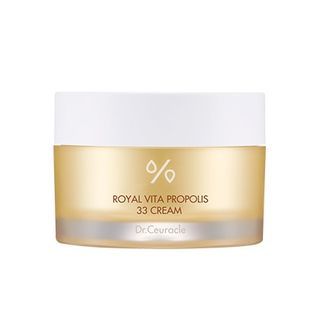
Dr. Ceuracle Royal Vita Propolis 33 Cream
Works for
3 of 3 advertised claims delivered
Moisturizing19 ingredients credited for this claimStrong support
“Dr. Ceuracle Royal Vita Propolis 33 Cream is a nourishing cream that provides antioxidant, anti-inflammatory benefits.”
This product can help improve hydration of the skin with the two types of ingredients.
The first type is called “humectants”:
these ingredients help attract water.
When humectants are on the surface of the skin, they “pull in” the moisture from the outside environment, or from
within deeper layers of the skin. The following ingredients in this product do the job:
fructooligosaccharides, glycerin.
This product also contains ingredients called “occlusives”. They help reduce the speed with which our skin loses moisture to the outside environment. These ingredients also help soften the upper layer of the skin, so it feels less tight and nicer to the touch. The following ingredients in this product do the job: helianthus annuus seed oil, vegetable oil.
The following ingredients in this product are especially good for supporting the skin barrier and helping with the hydration level: ceramide np, niacinamide
Evens skin tone2 ingredients credited for this claimStrong support
“Vitamin Tree Extract and Niacinamide, Panthenol, Ethyl Ascorbyl Ether help brighten up the overall skin tone for clear skin.”
This product can help reduce hypepigmentation and even out the skin tone because it contains the following effective ingredients: niacinamide
The following ingredient (ingredients) in this product might be helpful, but there is no evidence to confirm that it actually can help even out the skin tone: 3-o-ethyl ascorbic acid.
Keep in mind that you would need to apply any topical skincare targetted at hypigmentation consistently for a couple of months to get a result. No topical skincare product can help get rid of hyperpigmentation (including post-acne marks and age spots) instantly.
Anti-aging6 ingredients credited for this claimStrong support
“Brand from South Korea Dr. Ceuracle. Benefits Honey-like antioxidative cream deeply nourishes and protects delicate skin from free radicals for radiant, youthful skin.”
This product can help reduce and prevent fine lines and wrinkles, improve skin elasticity and firmness because it contains adenosine, niacinamide.
Keep in mind that it typically takes at least 6 weeks to notice any results because the changes that are needed to improve fine lines and elasticity happen in the deeper layers of the skin. No topical anti-aging product can “erase” wrinkles or fully reverse signs of aging.
Anti-blemishNot advertised by the brand · 4 ingredients credited for this claimStrong support
This product can help reduce breakouts and clogged pores because it contains the following ingredient: niacinamide. This ingredient is used for treating acne and can have a noticeable effect.
Anti-oxidationNot advertised by the brand · 11 ingredients credited for this claimModerate support
This product contains antioxidants (3-o-ethyl ascorbic acid, ficus carica fruit extract) that might be able to help neutralize free radicals in skin to lessen the damage it gets from the UV light (sun). There is not enough evidence to confirm their effectiveness in skin though.
Can it cause trouble?
Irritancy8 strong irritants: Eclipta prostrata leaf extract, Alcohol + 6 more — patch-test recommendedHigh risk
Comedogenic2 ingredients rated 2 or more on the 0–5 pore-clogging scale2 flagged


User reviews
Be the first — your take helps the next person decide.
Ingredients
Filter by role to see what each ingredient is doing.
Water~45–55%
Butylene glycol~5.7–7%
- Irritation risk
- Low
Used to create a nice product texture and help delivery of other ingredients. Might be somewhat helpful in attracting water to the upper layer of the skin
More about Butylene glycolVegetable oil~4.5–5.5%
- Irritation risk
- Low
An oil from a mixture of different vegetables. Helps soften the upper layer of the skin
More about Vegetable oilPolyglyceryl-3 methylglucose distearate~3.1–3.7%
- Irritation risk
- Medium
Helps water and oil mix together
More about Polyglyceryl-3 methylglucose distearateNiacinamide~2.6–3.1%
- Irritation risk
- Low
Is proven to be effective in reducing blemishes, evening out skin tone and helping to improve lines and wrinkles. It helps the skin to repair sun damage, calm down inflammation and keep maintain good levels of moisture. The concentration of about 2% is effective for supporting the skin barrier and evening out the skin tone. Concentration of 4-6% is better for helping with acne and balancing the sebum production
More about Niacinamide1,2-hexanediol~0.8–1.2%
Ammonium acryloyldimethyltaurate/vp copolymer~1.7–2.1%
- Irritation risk
- Low
Increases thickness of a product. Texture enhancer for oil-in-water emulsions
More about Ammonium acryloyldimethyltaurate/vp copolymerCamellia japonica seed oil~1.4–1.7%
- Irritation risk
- Low
A plant oil that helps to soften the upper layer of the skin and can help restore skin's barrier function. Might have an anti-oxidant effect
More about Camellia japonica seed oil3-o-ethyl ascorbic acid~1.2–1.4%
- Irritation risk
- High
A vitamin C derivative that is more stable but less potent than pure form of vitamin C. Can help neutralize free radicals and help reduce hyperpigmentation, but the required concentration is likely to be much higher than for the pure form of vitamin C, limiting the ingredient's effectiveness in products
More about 3-o-ethyl ascorbic acidGlycerin~1–1.3%
- Irritation risk
- Low
One of the best moisturizing ingredients. Naturally present in skin. It attracts water to the upper layer of the skin working as a humectant
More about GlycerinPropolis extract~0.7–1.05%
- Irritation risk
- High
A complex substance produced by honey bees. Can have anti-bacterial and some anti-oxidant effect. Is an allergen and can be irritating
More about Propolis extractDipropylene glycol~0.65–0.95%
- Irritation risk
- Low
Helps to dissolve other ingredients in a formulation. Slows down the rate of product drying
More about Dipropylene glycolEclipta prostrata leaf extract~0.65–0.95%
- Irritation risk
- High
A plant extract that is mostly used as a fragrance. Might have some anti-oxidant effect
More about Eclipta prostrata leaf extractLaminaria japonica extract~0.6–0.9%
- Irritation risk
- Low
- Comedogenicity
- 3/5
Seaweed extract that might help to attract water to the upper layer of the skin and have some anti-oxidant properties
More about Laminaria japonica extractHydroxyacetophenone~0.6–0.85%
Alcohol~0.55–0.85%
- Irritation risk
- High
Can be drying and contribute to skin irritation. Used in formulars to dissolve other ingredients, create a thinner product consistency or for its antibacterial properties
More about AlcoholCitrus aurantium dulcis oil~0.55–0.8%
- Irritation risk
- High
Used as a fragrance. It can be irritating and cause photosensitivity
More about Citrus aurantium dulcis oilEthylhexylglycerin~0.55–0.8%
Rosa centifolia flower water~0.5–0.7%
- Irritation risk
- High
Propanediol~0.5–0.75%
- Irritation risk
- Low
Acts as a solvent for other ingredients. Speeds up the absorption of other ingredients into the skin
More about PropanediolHippophae rhamnoides fruit extract~0.45–0.65%
- Irritation risk
- Medium
A plant extract that might help neutralize free radicals in skin, but research on its effectiveness is lacking
More about Hippophae rhamnoides fruit extractSodium hyaluronate~0.45–0.65%
- Irritation risk
- Low
One of the best moisturizing ingredients. Attracts water into the upper layer of the skin
More about Sodium hyaluronateAdenosine~0.4–0.6%
- Irritation risk
- Low
Might help improve cell turnover and reduce inflammation in skin. One study shows that the ingredients might be able to help reduce dynamic wrinkles (for example, in the corners of the eyes or on the forehead)
More about AdenosineFructooligosaccharides~0.4–0.6%
- Irritation risk
- Low
Help attract water to the upper layer of the skin
More about FructooligosaccharidesHydrogenated lecithin~0.45–0.65%
- Irritation risk
- Low
Helps to retain moisture by creating a protective barrier on the skin. Rich in fatty acids. Improves product texture and helps with the penetration of other ingredients.
More about Hydrogenated lecithinCitrus nobilis peel oil~0.35–0.6%
- Irritation risk
- High
A plant oil with high content of volatile compounds that, especially when exposed to air, can cause allergic reactions and irritate the skin
More about Citrus nobilis peel oilBeta-glucan~0.35–0.65%
- Irritation risk
- Low
Helps attract water to the upper layer of the skin, calm down inflammation and irritation, restore the barrier function and support wound healing. It can be helpful in reducing fine lines and wrinkles
More about Beta-glucanCentella asiatica extract~0.45–0.7%
- Irritation risk
- Medium
A plant extract that has been shown to be able to reduce inflammation in skin, support restoration of skin barrier function, as well as support collagen production. Contains active compounds called centelloids: asiaticoside, madecasosside, asiatic acid and madecassic acid. Might be helpful in preventing stretch marks. It can be itself be irritating though.
More about Centella asiatica extractSodium stearoyl glutamate~0.45–0.65%
- Irritation risk
- Medium
Helps oil and water mix together
More about Sodium stearoyl glutamateHelianthus annuus seed oil~0.4–0.6%
- Irritation risk
- Low
A great emollient due to its high linoleic acid content. One of the most effective plant oils in helping skin hydration and repairing skin barrier function
More about Helianthus annuus seed oilFicus carica fruit extract~0.25–0.5%
- Irritation risk
- Medium
A plant extract that can help neutralize free radicals. The concentrations typically used in cosmetics are too small to have an effect
More about Ficus carica fruit extractLitsea cubeba fruit oil~0.25–0.45%
- Irritation risk
- High
An essential oil with a lemon-like smell that is extracted from a fruit grown in Asia. Used as a fragrance
More about Litsea cubeba fruit oilAcmella oleracea extract~0.25–0.5%
- Irritation risk
- Low
Hydrolyzed hyaluronic acid~0.25–0.45%
- Irritation risk
- Low
One of the best moisturizing ingredients. Attracts water into the upper layer of the skin. A version of it is naturally present in skin
More about Hydrolyzed hyaluronic acidPhellodendron amurense bark extract~0.25–0.5%
- Irritation risk
- Medium
A plant extract that might have an anti-inflammatory effect
More about Phellodendron amurense bark extractPortulaca oleracea extract~0.25–0.45%
- Irritation risk
- Medium
A plant extract that has some anti-oxidant activity, but solid research is lacking. Can help attract water to the upper layer of the skin
More about Portulaca oleracea extractDextrin~0.25–0.45%
- Irritation risk
- Low
A sugar that is used to stabilize the product formulation. Can help attract water to the upper layer of the skin
More about DextrinTheobroma cacao seed extract~0.2–0.4%
- Irritation risk
- Low
- Comedogenicity
- 3/5
Chamomilla recutita flower extract~0.2–0.35%
- Irritation risk
- High
Plant extract that can have healing and anti-inflammatory properties. It is a potential allergen and can be irritating
More about Chamomilla recutita flower extractRosmarinus officinalis leaf extract~0.15–0.3%
- Irritation risk
- High
Can be helpful in reducing inflammation in skin, including inflamed acne. It can be irritating
More about Rosmarinus officinalis leaf extractCeramide np~0.2–0.35%
- Irritation risk
- Low
A type of lipid similar to ceramides naturally present in skin. Helps to soften the upper layer of the skin and supports the skin barrier function to keep it hydrated. Can help to prevent inflammation in skin
More about Ceramide npRoyal jelly extract~0.15–0.25%
- Irritation risk
- Medium
A compound secreted by bees. Might be able to attract water to the top layer of the skin. Avoid if sensitive to honey and bee products
More about Royal jelly extractHamamelis virginiana extract~0.15–0.25%
- Irritation risk
- High
A plant extract that can help calm down inflammation in skin. Can, however, itself be irritating
More about Hamamelis virginiana extractPhenoxyethanol~0.15–0.25%
- Irritation risk
- Low
A preservative. It helps prevent bacterial growth in cosmetic products
More about PhenoxyethanolLupinus albus seed extract~0.1–0.15%
- Irritation risk
- Medium
A plant extract that helps soften the upper layer of the skin
More about Lupinus albus seed extractTocopherol~0.1–0.15%
- Irritation risk
- Low
Pure form of vitamin E. Can help moisturise and protect the skin from free radicals. Often used to help stabilise other ingredients or the formula itself
More about TocopherolIngredient list view
Water, Butylene glycol, Vegetable oil, Polyglyceryl-3 methylglucose distearate, Niacinamide, 1,2-hexanediol, Ammonium acryloyldimethyltaurate/vp copolymer, Camellia japonica seed oil, 3-o-ethyl ascorbic acid, Glycerin, Propolis extract, Dipropylene glycol, Eclipta prostrata leaf extract, Laminaria japonica extract, Hydroxyacetophenone, Alcohol, Citrus aurantium dulcis oil, Ethylhexylglycerin, Rosa centifolia flower water, Propanediol, Hippophae rhamnoides fruit extract, Sodium hyaluronate, Adenosine, Fructooligosaccharides, Hydrogenated lecithin, Citrus nobilis peel oil, Beta-glucan, Centella asiatica extract, Sodium stearoyl glutamate, Helianthus annuus seed oil, Ficus carica fruit extract, Litsea cubeba fruit oil, Acmella oleracea extract, Hydrolyzed hyaluronic acid, Phellodendron amurense bark extract, Portulaca oleracea extract, Dextrin, Theobroma cacao seed extract, Chamomilla recutita flower extract, Rosmarinus officinalis leaf extract, Ceramide np, Royal jelly extract, Hamamelis virginiana extract, Phenoxyethanol, Lupinus albus seed extract, Tocopherol
Compare prices
Retailers ranked by price — lowest first.

Worth comparing, line by line.
Match % combines shared ingredients, the first five ingredients, shared actives and hero ingredients, irritancy (lower counts in the alternative's favour), texture and body area. Only products in the same routine step are compared.
| Dr. CeuracleRoyal Vita Propolis 33 CreamYOUR PRODUCT | celimaxThe Real Noni Energy Repair Cream | The SaemSnail Essential EX Wrinkle Solution Multi Cream | Rephrintense hydration cream 1.0 | |
|---|---|---|---|---|
| Match | — | 88% | 87% | 87% |
| Price | $16.73 | $13.62−$3.11 | $23.00+$6.27 | — |
| Shared key ingredients | — | 11 of 15 | 8 of 15 | 7 of 15 |
| Key difference | — | Butyrospermum Parkii Butter | Acetyl Dipeptide-1 Cetyl Ester | Ceramide Ng |
| Irritancy | High | Medium | Medium | Medium |
| Drying alcohol | Contains drying alcohol | — | — | — |
| View product | Shop | Shop | Shop |


Product summary
Based on the ingredients included, "Dr. Ceuracle - Royal Vita Propolis 33 Cream" works well for moisturizing the skin. As we expect from a proper moisturizer, the formula includes a combo of effective humectants and emollients. These are the two different types of ingredients that are essential for improving the skin hydration and supporting a healthy skin barrier. Fructooligosaccharides, glycerin, hydrolyzed hyaluronic acid, sodium hyaluronate and royal jelly extract in this product (humectants) attract water molecules to the upper layer of the skin (the water comes from the outside air or from the deeper layers of the skin if the air is dry). Emollients in this formulation (ceramide np, helianthus annuus seed oil and vegetable oil) help to reduce the moisture loss from the skin. They also soften the skin surface and relieve the feeling of dryness and tightness.
Ingredient callouts
- We particularly like that there is a good concentration of Niacinamide (2.60% - 3.10%) in this moisturizer. Niacinamide is a well-studied multi-tasking active. It is a great ingredient to have in a moisturizer. It is stable, and can work well in almost any hydrating formulation. There is solid evidence that Niacinamide can help support skin barrier, regulate oil production and reduce acne and clogged pores. It also helps to fight photodamage and help improve the skin tone, reducing pigmentation marks.
- As a plus, this moisturizer also contains Ceramides (ceramide np 0.20% - 0.35%). Ceramides are a type of lipids that our skin produces itself. They are a building block of the skin's barrier. Ceramides used in skincare are synthetic or extracted from plants. They work well for softening the skin surface and "patch holes" in the skin's barrier.
- Adenosine 0.40% - 0.60%. It is a compound that in involved in many biological processes inside the skin cells. According one high-quality clinical trial, topical Adenosine in low concentrations can somewhat help improve "deep wrinkles" - the wrinkles that appear with age in places where our faces are most dynamic (for example, on the forehead or in the corners of the eyes).
Irritation risk
There are quite a few common irritants in this product, including ingredients without particular skin benefits. We would not recommend it for sensitive skin. We assess the overall irritancy of this moisturizer to be high. For a detailed overview of all potential irritants: click here
You can see the detailed formula review with the breakdown of all actives in the product and the full ingredient list with estimated concentrations in the tables below.
Price
The product retails for 29.95A$ in Australia, for 43.00CA$ in Canada, from 24.99$ up to 38.00$ in the United States and for 35.00£ in the United Kingdom.
For a detailed price comparison: click here.
Sources cited in this review
Every concentration estimate and effectiveness label is anchored to one of these 48 studies and safety reviews.
- 1
- 2
- 3
- 4
- 5
- 6

Affiliate links · As an Amazon Associate, WIMJ earns from qualifying purchases.