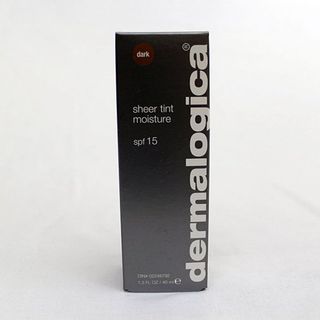
Dermalogica SPF 15 Dark Tone Sheer Tint 1.3-oz Moisture
Works for
1 of 3 advertised claims delivered
Sun protectionSPF 15 · 3 UV filters · Broad spectrumWeak protectionSPF under 30
This product offers broad spectrum sun protection, but it is weak. We recommend to use a broad spectrum sunscreen with at least SPF 30.
Moisturizing16 ingredients credited for this claimStrong support
“3-oz Moisture”
This product can help improve hydration of the skin with the two types of ingredients.
The first type is called “humectants”:
these ingredients help attract water.
When humectants are on the surface of the skin, they “pull in” the moisture from the outside environment, or from
within deeper layers of the skin. The following ingredients in this product do the job:
glycerin, sodium lactate.
This product also contains ingredients called “occlusives”. They help reduce the speed with which our skin loses moisture to the outside environment. These ingredients also help soften the upper layer of the skin, so it feels less tight and nicer to the touch. The following ingredients in this product do the job: caprylic/capric triglyceride, dimethicone.
The following ingredients in this product are especially good for supporting the skin barrier and helping with the hydration level: urea
Evens skin tone1 ingredient credited for this claimLimited support
“SPF 15 Dark Tone Sheer Tint 1.”
This product contains ingredients () that could help reduce hyperpigmentation (for example, post-acne marks or age spots) in theory, but there is not enough evidence that they actually work.
The biggest effect for evening out skin tone in this product comes from sun protection. Sun damage is the main factor causing age spots, darkening of post-acne marks and other discolorations. This is why sun protection is the best strategy for maintaining an even skin tone. We, however, do not recommend using this product as a sunscreen because the protection it offers is not strong enough).
Anti-agingNot advertised by the brand · 3 ingredients credited for this claimModerate support
This product contains serine. This ingredient might be able to help reduce and prevent fine lines and wrinkles, improve skin elasticity and firmness, but there is not enough evidence that it actually works. The biggest anti-aging effect in this product comes from sun protection. Sun damage is the main factor causing early signs of skin aging. We, however, do not recommend using this product as a sunscreen because the protection it offers is not strong enough).
Can it cause trouble?
Irritancy2 strong irritants: Lavandula angustifolia extract, Lavandula hybrida oilMedium risk
Comedogenic1 ingredient rated 2 or more on the 0–5 pore-clogging scale1 flagged
User reviews
Be the first — your take helps the next person decide.
Ingredients
Filter by role to see what each ingredient is doing.
Ethylhexyl methoxycinnamate7.5%
- Irritation risk
- High
Octinoxate. When used in higher concentrations, works as a sunscreen protecting the skin from UVB rays. When used in lower concentration, helps to preserve the product formulation. Is shown to be harmful to coral reefs - consider avoiding bathing in coral reef areas when wearing a product with this ingredient. It can be irritating
More about Ethylhexyl methoxycinnamateZinc oxide5%
- Irritation risk
- Low
A broad spectrum sunblock (protects from both UVA and UVB rays). Is suitable for most sensitive skins. In small concentrations, can be used as a colorant
More about Zinc oxideLavandula angustifolia extract~22–34%
- Irritation risk
- High
Used for fragrance and contains volatile compounds that can irritate the skin
More about Lavandula angustifolia extractCaprylic/capric triglyceride~5.7–8.6%
- Irritation risk
- Medium
A good mix of fatty acids that forms a protective layer on the skin. Improves the shelf life of products. Derived from coconut and glycerin
More about Caprylic/capric triglycerideButylene glycol~5.3–7.9%
- Irritation risk
- Low
Used to create a nice product texture and help delivery of other ingredients. Might be somewhat helpful in attracting water to the upper layer of the skin
More about Butylene glycolMethyl gluceth-20~3.8–5.8%
- Irritation risk
- Low
Helps attract water to the upper layer of the skin and soften it
More about Methyl gluceth-20Dimethicone~3.4–5.1%
- Irritation risk
- Low
A silicone that helps to reduce water loss from the surface of the skin. Can temporarily "fill in" lines and wrinkles, absorb oil, and create a nice product finish
More about DimethiconeLactamide mea~2.4–3.6%
- Irritation risk
- Low
Glyceryl stearate~2.1–3.2%
- Irritation risk
- Low
An emollient that softens the skin and forms a protective layer on its surface. Helps water and oil mix together
More about Glyceryl stearatePeg-100 stearate~1.8–2.6%
- Irritation risk
- Low
Helps oil and water mix togehter and creates a nice product texture
More about Peg-100 stearateStearic acid~1.3–2%
- Irritation risk
- Low
Helps oil and water mix together and works as an emollient
More about Stearic acidCetearyl alcohol~1.1–1.7%
- Irritation risk
- Low
- Comedogenicity
- 2/5
A non-drying alcohol. Works as an emollient. Helps water and oil mix together and creates a nice product texture
More about Cetearyl alcoholJuglans regia seed~0.95–1.4%
- Irritation risk
- Low
Olea europaea fruit extract~0.55–1.25%
- Irritation risk
- Low
An emollient that helps soften the skin but is not effective for restoring its barrier function. Might be helpful to calm down inflammation
More about Olea europaea fruit extractAllantoin panthenol~0.4–1%
- Irritation risk
- Low
Sodium lactate~0.4–0.95%
- Irritation risk
- Medium
Helps attract water to the upper layer of the skin. Is often used to adjust the pH level of the product
More about Sodium lactateLactic acid~0.35–0.85%
- Irritation risk
- Medium
An exfoliating and moisturizing alpha-hydroxy acid (AHA). Typically causes less irritation than other AHAs, for example, glycolic acid. At high concentrations (about 15%), lactic acid can help reduce lines and wrinkles. Recent studies show that lactic acid can support the "good" bacteria living on skin's surface (healthy skin microbiome)
More about Lactic acidSerine~0.35–0.85%
- Irritation risk
- Low
An amino-acid that helps to attract water to the upper layer of the skin. In combination with other amino-acids, might help to reduce fine lines and wrinkles
More about SerineSorbitol~0.35–0.85%
- Irritation risk
- Low
Helps attract water to the upper layer of the skin and improves the product texture
More about SorbitolGlycerin~0.35–0.85%
- Irritation risk
- Low
One of the best moisturizing ingredients. Naturally present in skin. It attracts water to the upper layer of the skin working as a humectant
More about GlycerinLavandula hybrida oil~0.35–0.8%
- Irritation risk
- High
Plant extract that can be irritating and is a known allergen
More about Lavandula hybrida oilPentylene glycol~0.35–0.85%
- Irritation risk
- Medium
Used to preserve products, dissolve other ingredients and create a nice product texture
More about Pentylene glycolCetyl alcohol~0.35–0.8%
- Irritation risk
- Low
A non-drying alcohol that works to soften the skin and stabilize product formulations helping oil and water mix together
More about Cetyl alcoholXanthan gum~0.2–0.75%
- Irritation risk
- Low
Used to create a thicker product consistency
More about Xanthan gumPolysorbate 60~0.2–0.75%
Sodium chloride~0.2–0.75%
- Irritation risk
- Low
Used to stabilize mixtures of oil and water, and create thicker, gel-like product textures
More about Sodium chlorideUrea~0.15–0.65%
- Irritation risk
- Low
Naturally present in skin (urea makes up about 7% of natural moisturizing factors in skin). Attracts water to the upper layer of the skin. Also has a positive effect on the skin barrier beyond the humectant action. Can enhance penetration of other ingredients. Is an exfoliating ingredient when used in high concentrations
More about UreaMagnesium aluminum silicate~0.15–0.7%
- Irritation risk
- Low
Might be helpful in restoring skin barrier function and, when combined with zinc carbonate and malonic acid, reducing fine lines and wrinkles by stimulating elastin production. Also helps stabilize the product formulation
More about Magnesium aluminum silicateDisodium edta~0.15–0.6%
Triethoxycaprylylsilane~0.2–0.75%
- Irritation risk
- Low
A type of silicone that helps oil and water mix well together. Helps to disperse other ingredients, e.g. pigments, evenly in a formulation
More about TriethoxycaprylylsilaneAminomethyl propanol~0.15–0.7%
Phenoxyethanol~0.2–0.75%
- Irritation risk
- Low
A preservative. It helps prevent bacterial growth in cosmetic products
More about PhenoxyethanolSodium benzoate~0.25–0.5%
Methylparaben~0.15–0.3%
Propylparaben~0.2–0.4%
Titanium dioxide~0.3–0.7%
- Irritation risk
- Low
Works as a UV filter when used in high concentrations. It is photostable and is effective mostly against the UVB light, with some protection in the UVA range. In small concentrations, used for its ability to improve the color of cosmetic products. Is usually well tolerated by the skin
More about Titanium dioxideIron oxides~0.1–0.4%
- Irritation risk
- Low
An umbrella term for the following three colorants: CI 77491, CI 77492, CI 77499. They might be able to offer some protection against visible light, but the degree of the protection is not clear
More about Iron oxidesMica~0.1–0.35%
- Irritation risk
- Low
Creates an illusion of smoother and more radiant skin tone. Adds shimmer to the skin by reflecting light
More about MicaIngredient list view
Ethylhexyl methoxycinnamate, Zinc oxide, Lavandula angustifolia extract, Caprylic/capric triglyceride, Butylene glycol, Methyl gluceth-20, Dimethicone, Lactamide mea, Glyceryl stearate, Peg-100 stearate, Stearic acid, Cetearyl alcohol, Juglans regia seed, Olea europaea fruit extract, Allantoin panthenol, Sodium lactate, Lactic acid, Serine, Sorbitol, Glycerin, Lavandula hybrida oil, Pentylene glycol, Cetyl alcohol, Xanthan gum, Polysorbate 60, Sodium chloride, Urea, Magnesium aluminum silicate, Disodium edta, Triethoxycaprylylsilane, Aminomethyl propanol, Phenoxyethanol, Sodium benzoate, Methylparaben, Propylparaben, Titanium dioxide, Iron oxides, Mica
Compare prices
Retailers ranked by price — lowest first.
Product summary
"Dermalogica - SPF 15 Dark Tone Sheer Tint 1.3-oz Moisture" offers broad spectrum protection. It means that it protects from both UVA and UVB rays (you can remember UVB as "burning" sunlight - they cause sunburn. You can remember UVA rays as "aging" - they do not lead to sunburn, but they cause photodamage and contribute to early signs of skin aging and hyperpigmentation). On the negative side, the SPF of this sunscreen is not high enough. We recommend to use a sunscreen with at least SPF 30 daily.
It contains good moisturizing ingredients and can double as a hydrating day cream.
Sunscreen filters
This is a "mixed" sunscreen in the sense that it uses both mineral and organic (so-called "chemical") sun filters. Here are the organic filters this product uses: octinoxate. As for the mineral filters, this sunscreen uses both titanium dioxide and zinc oxide.
Irritation risk
There are some common irritants in this product, including ingredients that do not have benefits for the skin. We assess the overall irritancy of this product to be medium. For a detailed overview of all potential irritants: click here
You can see the detailed formula review with the breakdown of all actives in the product and the full ingredient list with estimated concentrations in the tables below.
About the brand
According to Cruelty-Free Kitty "Dermalogica" is cruelty free, but its parent company is not.
Sources cited in this review
Every concentration estimate and effectiveness label is anchored to one of these 14 studies and safety reviews.
- 1A review of inorganic UV filters zinc oxide and titanium dioxideonlinelibrary.wiley.com
- 2
- 3
- 4
- 5
- 6

Affiliate links · As an Amazon Associate, WIMJ earns from qualifying purchases.