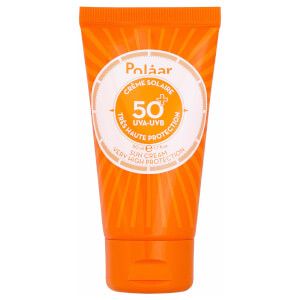
Polaar Very High Protection Sun Cream SPF 50+
Works for
3 of 3 advertised claims delivered
Sun protectionSPF 50 · 6 UV filtersBroad spectrum
This product offers a good level of protection against both UVB and UVA rays.
This sunscreen uses organic (so-called "chemical") sunscreen filters. Organic, or "chemical" filters usually provide reliable sun protection and rarely leave a white cast. Sunscreens with organic filters can sting eyes.
Evens skin tone2 ingredients credited for this claimStrong support
“Skin is offered strong protection against harmful sun damage, while exclusive active ingredients accelerate the natural tanning process by activating melanin synthesis for an even and long-lasting bronzed glow.”
This product offers broad spectrum sun protection. It means that it can prevent hyperpigmentation and help keep the skin tone even (sun damage is the main factor causing age spots, darkening of post-acne marks and other discolorations).
Moisturizing19 ingredients credited for this claimStrong support
“Very High Protection Sun Cream SPF 50+”
This product can help improve hydration of the skin with the two types of ingredients.
The first type is called “humectants”:
these ingredients help attract water.
When humectants are on the surface of the skin, they “pull in” the moisture from the outside environment, or from
within deeper layers of the skin. The following ingredients in this product do the job:
glycerin, glycine.
This product also contains ingredients called “occlusives”. They help reduce the speed with which our skin loses moisture to the outside environment. These ingredients also help soften the upper layer of the skin, so it feels less tight and nicer to the touch. The following ingredients in this product do the job: caprylic/capric triglyceride, methicone.
The following ingredients in this product are especially good for supporting the skin barrier and helping with the hydration level: urea
Anti-agingNot advertised by the brand · 3 ingredients credited for this claimStrong support
This product can help prevent early signs of skin aging because it offers a good level of broad spectrum sun protection. Sun damage is the main cause of premature skin aging, and protecting your skin from the sun is the best anti-aging strategy.
These ingredients in the product might also be helpful for reducing and preventing fine lines, wrinkles, and skin elasticity, even though there is no conclusive evidence for their effectiveness: serine.
Anti-blemishNot advertised by the brand · 2 ingredients credited for this claimGood support
This product might be able to help reduce blemishes and clogged pores because it contains ethyl linoleate.
Can it cause trouble?
Irritancy3 strong irritants: Ethylhexyl dimethyl paba, Rosa centifolia flower extract + 1 more — patch-test recommendedHigh risk
Comedogenic2 ingredients rated 2 or more on the 0–5 pore-clogging scale2 flagged
User reviews
Be the first — your take helps the next person decide.
Ingredients
Filter by role to see what each ingredient is doing.
Water~45–55%
Ethylhexyl methoxycinnamate~5.7–6.9%
- Irritation risk
- High
Octinoxate. When used in higher concentrations, works as a sunscreen protecting the skin from UVB rays. When used in lower concentration, helps to preserve the product formulation. Is shown to be harmful to coral reefs - consider avoiding bathing in coral reef areas when wearing a product with this ingredient. It can be irritating
More about Ethylhexyl methoxycinnamateEthylhexyl dimethyl paba~4.7–5.8%
- Irritation risk
- High
Padimate O. A UV filter. Effective against UVB rays. There are concerns about the safety of this sunscreen ingredient, but conclusive evidence in either direction is missing. Because of the safety concerns, it is rarely used in leave-in skincare
More about Ethylhexyl dimethyl pabaCaprylic/capric triglyceride~3.3–4%
- Irritation risk
- Medium
A good mix of fatty acids that forms a protective layer on the skin. Improves the shelf life of products. Derived from coconut and glycerin
More about Caprylic/capric triglycerideHydrogenated polydecene~2.3–2.9%
- Irritation risk
- Low
Helps to soften the upper layer of the skin and create a nice product texture
More about Hydrogenated polydeceneTitanium dioxide~2.5–3.1%
- Irritation risk
- Low
Works as a UV filter when used in high concentrations. It is photostable and is effective mostly against the UVB light, with some protection in the UVA range. In small concentrations, used for its ability to improve the color of cosmetic products. Is usually well tolerated by the skin
More about Titanium dioxideButyl methoxydibenzoylmethane~2.1–2.6%
- Irritation risk
- Medium
Avobenzone. An organic, or so-called "chemical" UV filter. Protects against both UVA and UVB rays. Needs to be combined with other filters in a formulation to be stable.
More about Butyl methoxydibenzoylmethaneZinc oxide~2.1–2.5%
- Irritation risk
- Low
A broad spectrum sunblock (protects from both UVA and UVB rays). Is suitable for most sensitive skins. In small concentrations, can be used as a colorant
More about Zinc oxideCetearyl alcohol~1.3–1.6%
- Irritation risk
- Low
- Comedogenicity
- 2/5
A non-drying alcohol. Works as an emollient. Helps water and oil mix together and creates a nice product texture
More about Cetearyl alcoholGlycerin~1.1–1.3%
- Irritation risk
- Low
One of the best moisturizing ingredients. Naturally present in skin. It attracts water to the upper layer of the skin working as a humectant
More about GlycerinButyrospermum parkii butter~0.75–1.15%
- Irritation risk
- Low
- Comedogenicity
- 3/5
A great moisturising ingredient that softens the skin and reduces water loss from its upper layer. It also can be helpful in protecting skin from free radicals
More about Butyrospermum parkii butterArachidyl alcohol~0.65–0.95%
- Irritation risk
- Low
Used to soften the upper layer of the skin and create a thicker product consistency
More about Arachidyl alcoholEthylhexyl triazone~0.75–1.15%
- Irritation risk
- Medium
Uvinul T. A UV filter. Effective against UVB rays. It is photostable. Can increase water resistance properties of the sunscreen. Unfortunately, not approved by the FDA (US) yet
More about Ethylhexyl triazoneInulin lauryl carbamate~0.5–0.75%
Methylene bis-benzotriazolyl tetramethylbutylphenol~0.65–0.95%
- Irritation risk
- Medium
Tinosorb M. A UV filter. Is effective against both UVA and UVB rays. It also provides some protection against visible light. It is photostable and can also be used to improve photostability of other sunscreen ingredients. Its physical properties help to create lightweight sunscreen formulations. It can leave a slight white cast. Unfortunately, it is not approved by the FDA (US) yet
More about Methylene bis-benzotriazolyl tetramethylbutylphenolRosa centifolia flower extract~0.4–0.65%
- Irritation risk
- High
Contains essential oil. Can be irritating
More about Rosa centifolia flower extractCetearyl glucoside~0.45–0.7%
- Irritation risk
- Medium
Helps water and oil in the product mix well together and improves product texture
More about Cetearyl glucosideAcetyl tyrosine~0.35–0.65%
- Irritation risk
- Low
Riboflavin~0.3–0.6%
- Irritation risk
- Low
Sodium lactate~0.3–0.55%
- Irritation risk
- Medium
Helps attract water to the upper layer of the skin. Is often used to adjust the pH level of the product
More about Sodium lactateSorbitol~0.3–0.55%
- Irritation risk
- Low
Helps attract water to the upper layer of the skin and improves the product texture
More about SorbitolLactic acid~0.25–0.5%
- Irritation risk
- Medium
An exfoliating and moisturizing alpha-hydroxy acid (AHA). Typically causes less irritation than other AHAs, for example, glycolic acid. At high concentrations (about 15%), lactic acid can help reduce lines and wrinkles. Recent studies show that lactic acid can support the "good" bacteria living on skin's surface (healthy skin microbiome)
More about Lactic acidSerine~0.25–0.5%
- Irritation risk
- Low
An amino-acid that helps to attract water to the upper layer of the skin. In combination with other amino-acids, might help to reduce fine lines and wrinkles
More about SerineUrea~0.25–0.5%
- Irritation risk
- Low
Naturally present in skin (urea makes up about 7% of natural moisturizing factors in skin). Attracts water to the upper layer of the skin. Also has a positive effect on the skin barrier beyond the humectant action. Can enhance penetration of other ingredients. Is an exfoliating ingredient when used in high concentrations
More about UreaGlycine~0.25–0.5%
- Irritation risk
- Low
Helps to attract water to the upper layer of the skin and can help restore the skin barrier function
More about GlycineGlucose~0.25–0.5%
- Irritation risk
- Low
Helps attract water to the upper layer of the skin. Could be helpful in restoring the skin barrier function
More about GlucoseAllantoin~0.25–0.45%
- Irritation risk
- Low
Helps calm down inflammation in skin and can help reduce itching. Helps to repair the skin barrier and keep skin hydrated
More about AllantoinBehenyl alcohol~0.3–0.6%
- Irritation risk
- Low
Non-drying alcohol that helps water and oil mix together. Also serves as an emollient
More about Behenyl alcoholArachidyl glucoside~0.3–0.55%
Hydroxyethyl acrylate/sodium acryloyldimethyl taurate copolymer~0.25–0.5%
- Irritation risk
- Medium
A gelling agent that thickens the product consistency and leaves the skin with a velvety finish
More about Hydroxyethyl acrylate/sodium acryloyldimethyl taurate copolymerIsohexadecane~0.4–0.6%
- Irritation risk
- Low
Improves the texture of the product and helps soften the skin. Helps oil and water mix together and can be used as a cleansing agent
More about IsohexadecanePolysorbate 60~0.3–0.55%
Aluminum hydroxide~0.3–0.55%
- Irritation risk
- Low
Is used to add opaque (non-transparent) appearance to formulations. Can be used to coat other ingredients for even dispersion. This is a different ingredient compared to the ones used in antipersperants (aluminium chloride and aluminium chlorohydrate)
More about Aluminum hydroxideMethicone~0.3–0.5%
- Irritation risk
- Low
A type of silicone that helps soften the upper layer of the skin and reduces the water loss from the skin surface
More about MethiconeXanthan gum~0.25–0.5%
- Irritation risk
- Low
Used to create a thicker product consistency
More about Xanthan gumDecyl glucoside~0.35–0.6%
- Irritation risk
- High
Helps oil and water mix together. Can be irritating
More about Decyl glucosidePropylene glycol~0.25–0.45%
- Irritation risk
- High
Helps oil and water mix together and can enhance the penetration of other ingredients into the skin. It can be irritating
More about Propylene glycolTocopheryl acetate~0.25–0.5%
- Irritation risk
- Medium
A more stable but less bio-available form of vitamin E compared to Tocopherol. Might help moisturize and protect the skin from free radicals, but mostly used in low concentrations to stabilize other ingredients.
More about Tocopheryl acetateDisodium edta~0.25–0.45%
Ethyl linoleate~0.25–0.45%
- Irritation risk
- Medium
Helps reduce acne and blemishes. Helps to soften the upper layer of the skin and reduce inflammation. Might be helpful in reducing hyperpigmentation and evening out the skin tone, but evidence of effectiveness in skin are lacking
More about Ethyl linoleateEthyl oleate~0.25–0.45%
- Irritation risk
- Medium
Ethyl oleate is a long-chain fatty acid ethyl ester resulting from the formal condensation of the carboxy group of oleic acid with the hydroxy group of ethanol. It derives from an oleic acid. In skincare, it is used to soften the upper layer of the skin, improve the product texture and smell
More about Ethyl oleateEthyl palmitate~0.25–0.45%
- Irritation risk
- Low
Ethyl stearate~0.25–0.45%
- Irritation risk
- Low
Ethyl linolenate~0.25–0.45%
- Irritation risk
- Low
Parfum~0.15–0.3%
- Irritation risk
- High
An aromatic blend of unspecified and possibly irritating ingredients
More about ParfumPotassium sorbate~0.15–0.25%
Citric acid~0.15–0.3%
- Irritation risk
- Medium
Can work as an exfoliant but is typically used to adjust the product pH
More about Citric acidBht~0.15–0.25%
Phenoxyethanol~0.15–0.3%
- Irritation risk
- Low
A preservative. It helps prevent bacterial growth in cosmetic products
More about PhenoxyethanolEthylhexylglycerin~0.1–0.2%
Ingredient list view
Water, Ethylhexyl methoxycinnamate, Ethylhexyl dimethyl paba, Caprylic/capric triglyceride, Hydrogenated polydecene, Titanium dioxide, Butyl methoxydibenzoylmethane, Zinc oxide, Cetearyl alcohol, Glycerin, Butyrospermum parkii butter, Arachidyl alcohol, Ethylhexyl triazone, Inulin lauryl carbamate, Methylene bis-benzotriazolyl tetramethylbutylphenol, Rosa centifolia flower extract, Cetearyl glucoside, Acetyl tyrosine, Riboflavin, Sodium lactate, Sorbitol, Lactic acid, Serine, Urea, Glycine, Glucose, Allantoin, Behenyl alcohol, Arachidyl glucoside, Hydroxyethyl acrylate/sodium acryloyldimethyl taurate copolymer, Isohexadecane, Polysorbate 60, Aluminum hydroxide, Methicone, Xanthan gum, Decyl glucoside, Propylene glycol, Tocopheryl acetate, Disodium edta, Ethyl linoleate, Ethyl oleate, Ethyl palmitate, Ethyl stearate, Ethyl linolenate, Parfum, Potassium sorbate, Citric acid, Bht, Phenoxyethanol, Ethylhexylglycerin
Compare prices
Retailers ranked by price — lowest first.

Affiliate links · prices updated regularly
Product summary
We believe that "Polaar - Very High Protection Sun Cream SPF 50+" can provide reliable sun protection based on the ingredients listed. It can protect from both UVA and UVB rays. This is great news because not all sunscreens with SPF ratings give UVA protection. (UVA rays do not cause sunburn, but still damage our skin and lead to early aging).
As a plus, this sunscreen uses some of the new generation UV filters (Tinosorb M). These filters are more stable and more gentle on the skin.
It also works as a moisturizer, so you do not have to use an additional hydrating product. Like all broad-spectrum sunscreens, this product has an anti-aging benefit.
Sunscreen filters
This sunscreen uses a mixture of both mineral and organic (so-called "chemical") UV filters. Here are the organic filters this product uses: avobenzone, octinoxate, uvinul t and tinosorb m. As for the mineral filters, this sunscreen uses both titanium dioxide and zinc oxide.
Irritation risk
There are some common irritants in this product, including ingredients that do not have benefits for the skin. We assess the overall irritancy of this sunscreen to be high. For a detailed overview of all potential irritants: click here
You can see the detailed formula review with the breakdown of all actives in the product and the full ingredient list with estimated concentrations in the tables below.
Price
The product retails for 30.40$ in the United States, from 17.99£ up to 22.00£ in the United Kingdom and for 38.50CA$ in Canada.
For a detailed price comparison: click here.
Sources cited in this review
Every concentration estimate and effectiveness label is anchored to one of these 24 studies and safety reviews.
- 1Risk Assessment of Ethylhexyl Dimethyl PABA in Cosmeticsncbi.nlm.nih.gov
- 2Safety Assessment of Polyene Group as Used in Cosmeticscir-safety.org
- 3A review of inorganic UV filters zinc oxide and titanium dioxideonlinelibrary.wiley.com
- 4
- 5
- 6

Affiliate links · As an Amazon Associate, WIMJ earns from qualifying purchases.