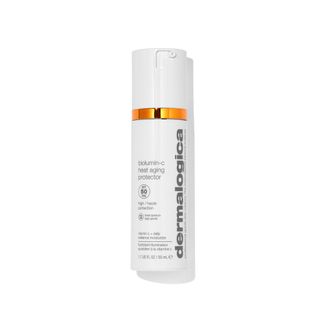
Dermalogica Biolumin-C Heat Aging Protector SPF 50 Soin Hydratant
Works for
0 of 2 advertised claims delivered
Sun protectionSPF 50 · 1 UV filter · Partial spectrumWeak protectionLow filter dose
This product does not offer good protection against UVA rays.
This product can be considered "reef safe" because it does not contain the UV filters (oxybenzone and octinoxate) that can be harmful to coral reefs when present in the water in high concentrations.
Anti-aging3 ingredients credited for this claimLimited support
“Biolumin-C Heat Aging Protector SPF 50 Soin Hydratant”
This product does not contain ingredients that are able to reduce fine lines and wrinkles or help with skin elasticity, but it can improve the look of the skin temporarily through moisturization. Well-moisturized skin might also be able to repair the sun damage better.
The biggest anti-aging effect in this product comes from sun protection. Sun damage is the main factor causing early signs of skin aging. We, however, do not recommend using this product as a sunscreen because the protection it offers is not strong enough).
MoisturizingNot advertised by the brand · 13 ingredients credited for this claimGood support
This product can help improve hydration of the skin with the two types of ingredients.
The first type is called “humectants”:
these ingredients help attract water.
When humectants are on the surface of the skin, they “pull in” the moisture from the outside environment, or from
within deeper layers of the skin. The following ingredients in this product do the job:
glycerin, butylene glycol.
This product also contains ingredients called “occlusives”. They help reduce the speed with which our skin loses moisture to the outside environment. These ingredients also help soften the upper layer of the skin, so it feels less tight and nicer to the touch. The following ingredients in this product do the job: ricinus communis seed oil, glycine soja oil.
Can it cause trouble?
Irritancy7 strong irritants: Physalis pubescens fruit juice, Citrus nobilis peel oil + 5 more — patch-test recommendedHigh risk
Comedogenic1 ingredient rated 2 or more on the 0–5 pore-clogging scale1 flagged


User reviews
Be the first — your take helps the next person decide.
Ingredients
Filter by role to see what each ingredient is doing.
Water~45–55%
Carthamus tinctorius oleosomes~4.9–6%
- Irritation risk
- Low
Helps soften the upper layer of the skin
More about Carthamus tinctorius oleosomesPropanediol~4–4.8%
- Irritation risk
- Low
Acts as a solvent for other ingredients. Speeds up the absorption of other ingredients into the skin
More about PropanediolButyloctyl salicylate~3.2–3.9%
- Irritation risk
- Medium
A synthetic ester of salicylic acid that is used to help disperse pigments and boost effectiveness of sunscreen ingredients. It is able to absorb UV light (working as an organic, or chemical filter), but is not approved as a sunscreen ingredient on its own
More about Butyloctyl salicylateBentonite~2.4–3%
Butylene glycol~1.9–2.3%
- Irritation risk
- Low
Used to create a nice product texture and help delivery of other ingredients. Might be somewhat helpful in attracting water to the upper layer of the skin
More about Butylene glycolDibutyl adipate~1.7–2.1%
- Irritation risk
- Low
Helps soften the upper layer of the skin and create a nice product consistency
More about Dibutyl adipatePolysorbate 80~1.4–1.8%
Physalis pubescens fruit juice~1.2–1.4%
- Irritation risk
- High
C12-15 alkyl benzoate~0.95–1.2%
- Irritation risk
- Low
Enhances the product texture and makes it more spreadable. Helps reduce water loss from the outer layer of skin. Extands the shelf life by preventing bacteria growth
More about C12-15 alkyl benzoateDiethylhexyl 2,6-naphthalate~0.8–1.15%
- Irritation risk
- Low
Vp/eicosene copolymer~0.6–0.9%
- Irritation risk
- Medium
Used to improve the product adherence to the skin, for example, to pro-long the protective effect of sunscreens. Can be irritating to very sensitive skin
More about Vp/eicosene copolymerAminopropyl ascorbyl phosphate~0.45–0.7%
- Irritation risk
- Medium
A more stable but less potent derivative of vitamin C. It can help neautralize free radicals and even out the skin tone if used in high enough concentration (required levels are likely to be much higher than for pure vitamin C, and solid studies are lacking at the moment)
More about Aminopropyl ascorbyl phosphateHydroxyacetophenone~0.4–0.65%
Dipotassium glycyrrhizate~0.35–0.6%
- Irritation risk
- Low
A salt derived from licorice. Works as an emollient to soften the upper layer of the skin and can help calm down inflammation. Might be helpful for skin lightening
More about Dipotassium glycyrrhizateGlycine soja oil~0.4–0.6%
- Irritation risk
- Medium
- Comedogenicity
- 2/5
A good emollient that helps soften the skin and helps repair its barrier function. It can clog pores if used in high concentrations.
More about Glycine soja oilVerbascum thapsus extract~0.35–0.6%
- Irritation risk
- Low
Citrus nobilis peel oil~0.3–0.55%
- Irritation risk
- High
A plant oil with high content of volatile compounds that, especially when exposed to air, can cause allergic reactions and irritate the skin
More about Citrus nobilis peel oilRicinus communis seed oil~0.3–0.6%
- Irritation risk
- Medium
A plant oil that can help soften the skin. It might be helpful in calming down inflammation, but solid research is lacking. Is often used in lip products to create the needed product consistency
More about Ricinus communis seed oilDaucus carota sativa root extract~0.25–0.5%
- Irritation risk
- Low
Carrot extract. Might have anti-oxidant properties and be used to add orange color
More about Daucus carota sativa root extractCitrus aurantium dulcis fruit extract~0.25–0.45%
- Irritation risk
- High
A plant extract that is used as a fragrance. Can be irritating and lead to photosensitivity
More about Citrus aurantium dulcis fruit extractCitrus paradisi fruit extract~0.25–0.4%
- Irritation risk
- High
Glycerin~0.25–0.45%
- Irritation risk
- Low
One of the best moisturizing ingredients. Naturally present in skin. It attracts water to the upper layer of the skin working as a humectant
More about GlycerinCitrus aurantifolia oil~0.2–0.4%
- Irritation risk
- High
Tocopherol~0.2–0.4%
- Irritation risk
- Low
Pure form of vitamin E. Can help moisturise and protect the skin from free radicals. Often used to help stabilise other ingredients or the formula itself
More about TocopherolHydrogenated lecithin~0.25–0.4%
- Irritation risk
- Low
Helps to retain moisture by creating a protective barrier on the skin. Rich in fatty acids. Improves product texture and helps with the penetration of other ingredients.
More about Hydrogenated lecithinAcrylates/c10-30 alkyl acrylate crosspolymer~0.25–0.4%
- Irritation risk
- Medium
Maintains the texture of skincare products. Allows the product to spread evenly. Helps oil and water mix together
More about Acrylates/c10-30 alkyl acrylate crosspolymerAllantoin~0.2–0.35%
- Irritation risk
- Low
Helps calm down inflammation in skin and can help reduce itching. Helps to repair the skin barrier and keep skin hydrated
More about AllantoinAscorbyl methylsilanol pectinate~0.2–0.4%
- Irritation risk
- Medium
A stable derivative of pectin and vitamin C. It might help neutralize free radicals in skin, but evidence of effectiveness is lacking. Helps create a thicker product consistency and stabilize the product formulation
More about Ascorbyl methylsilanol pectinateBeta-carotene~0.2–0.35%
Caprylic/capric triglyceride~0.25–0.5%
- Irritation risk
- Medium
A good mix of fatty acids that forms a protective layer on the skin. Improves the shelf life of products. Derived from coconut and glycerin
More about Caprylic/capric triglycerideBisabolol~0.2–0.35%
- Irritation risk
- Low
An active component of chamomile plant that historically has been used to calm down irritated skin. A recent study shows that bisabolol indeed can have some anti-inflammatory effect on skin, even though conclusive data is lacking. Bisabolol has a sweet floral scent and can be added to products for its aromatic properties
More about BisabololGluconolactone~0.2–0.35%
- Irritation risk
- Medium
A polyhydroxy acid (PHA) that helps shed the dead cells from the skin surface revealing smoother skin. Is believed to be genter than AHAs. It helps attract water to the upper layer of the skin and can stimulate production of skin's own hyaluronic acid resulting in improved hydration levels. It has been shown to be helpful against acne and clogged pores if used consistently (e.g over a period of 12 weeks) in high enough concentration. It can help reduce fine lines and wrinkles and improve skin tone with long-term application. Can help neutralize free radicals
More about GluconolactoneLecithin~0.25–0.45%
- Irritation risk
- Low
Used mostly for creating emulsions - helping oil and water mix together. Helps soften the upper layer of the skin
More about LecithinBoron nitride~0.2–0.35%
- Irritation risk
- Low
Helps to absord oil and evenly disperse other ingredients (for example, pigment) in product formulation
More about Boron nitrideXanthan gum~0.2–0.4%
- Irritation risk
- Low
Used to create a thicker product consistency
More about Xanthan gumMethylpropanediol~0.2–0.35%
Silica~0.3–0.5%
Sodium stearoyl glutamate~0.25–0.45%
- Irritation risk
- Medium
Helps oil and water mix together
More about Sodium stearoyl glutamatePotassium cetyl phosphate~0.2–0.4%
- Irritation risk
- Medium
Helps oil and water mix together
More about Potassium cetyl phosphateTetrahydroxypropyl ethylenediamine~0.15–0.3%
- Irritation risk
- Low
Trisodium ethylenediamine disuccinate~0.15–0.3%
- Irritation risk
- Medium
Used to improve stability of the formulation
More about Trisodium ethylenediamine disuccinateCitric acid~0.15–0.3%
- Irritation risk
- Medium
Can work as an exfoliant but is typically used to adjust the product pH
More about Citric acidSodium hydroxide~0.15–0.3%
Sodium acrylates copolymer~0.15–0.25%
- Irritation risk
- Medium
Used to create a thicker product consistency
More about Sodium acrylates copolymerSodium benzoate~0.15–0.3%
Potassium sorbate~0.15–0.3%
Limonene~0.1–0.15%
- Irritation risk
- High
A common frangrance that can easily irritate skin, especially if exposed to air, light or heat
More about LimoneneCitrus species peel extract~0.1–0.15%
- Irritation risk
- High
Ingredient list view
Water, Carthamus tinctorius oleosomes, Propanediol, Butyloctyl salicylate, Bentonite, Butylene glycol, Dibutyl adipate, Polysorbate 80, Physalis pubescens fruit juice, C12-15 alkyl benzoate, Diethylhexyl 2,6-naphthalate, Vp/eicosene copolymer, Aminopropyl ascorbyl phosphate, Hydroxyacetophenone, Dipotassium glycyrrhizate, Glycine soja oil, Verbascum thapsus extract, Citrus nobilis peel oil, Ricinus communis seed oil, Daucus carota sativa root extract, Citrus aurantium dulcis fruit extract, Citrus paradisi fruit extract, Glycerin, Citrus aurantifolia oil, Tocopherol, Hydrogenated lecithin, Acrylates/c10-30 alkyl acrylate crosspolymer, Allantoin, Ascorbyl methylsilanol pectinate, Beta-carotene, Caprylic/capric triglyceride, Bisabolol, Gluconolactone, Lecithin, Boron nitride, Xanthan gum, Methylpropanediol, Silica, Sodium stearoyl glutamate, Potassium cetyl phosphate, Tetrahydroxypropyl ethylenediamine, Trisodium ethylenediamine disuccinate, Citric acid, Sodium hydroxide, Sodium acrylates copolymer, Sodium benzoate, Potassium sorbate, Limonene, Citrus species peel extract
Compare prices
Retailers ranked by price — lowest first.

Affiliate links · prices updated regularly
Worth comparing, line by line.
Match % combines shared ingredients, the first five ingredients, shared actives and hero ingredients, irritancy (lower counts in the alternative's favour), texture and body area. Only products in the same routine step are compared.
| DermalogicaBiolumin-C Heat Aging Protector SPF 50 Soin HydratantYOUR PRODUCT | AnthonyDay Cream Broad Spectrum Sunscreen SPF 30 | Dr Dennis GrossSkincare All Physical Lightweight Wrinkle Defense SPF30 | DecreeDay Shield SPF 30 | |
|---|---|---|---|---|
| Match | — | 55% | 53% | 53% |
| Price | $95.00 | $34.00−$61.00 | $54.73−$40.27 | $93.00−$2.00 |
| Shared key ingredients | — | 4 of 11 | 5 of 11 | 4 of 11 |
| Key difference | — | Avobenzone | Ferulic Acid | Palmitoyl Tripeptide-1 |
| Irritancy | High | Medium | Low | Medium |
| SPF | SPF 50 | SPF 30 | SPF 30 | SPF 30 |
| Drying alcohol | — | — | — | — |
| View product | Shop | Shop | Shop |


Product summary
"Dermalogica - Biolumin-C Heat Aging Protector SPF 50 Soin Hydratant" does not provide enough UVA protection. UVA rays do not cause sunburn, but still damage the skin, leading to early signs of aging and pigmentation issues.
It also works as a moisturizer, so you do not have to use an additional hydrating product.
Sunscreen filters
This sunscreen uses so-called "chemical", or organic UV filters (organic simply means that their molecules contain atoms of carbon). These filters typically give good sun protection and rarely leave a white cast, but they can be irritating for sensitive skin. The UV filters in this sunscreen are: butyloctyl salicylate 3.20% - 3.90%.
Irritation risk
There are quite a few common irritants in this product, including ingredients without particular skin benefits. We would not recommend it for sensitive skin. We assess the overall irritancy of this product to be high. For a detailed overview of all potential irritants: click here
You can see the detailed formula review with the breakdown of all actives in the product and the full ingredient list with estimated concentrations in the tables below.
About the brand
According to Cruelty-Free Kitty "Dermalogica" is cruelty free, but its parent company is not.
Price
The product retails for 95.00$ in the United States.
For a detailed price comparison: click here.
Sources cited in this review
Every concentration estimate and effectiveness label is anchored to one of these 31 studies and safety reviews.
- 1
- 2
- 3
- 4
- 5
- 6

Affiliate links · As an Amazon Associate, WIMJ earns from qualifying purchases.