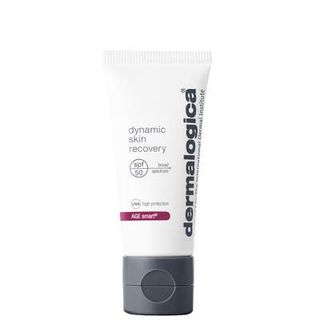
Dermalogica Age Smart Dynamic Skin Recovery SPF50
Works for
4 of 5 advertised claims delivered
Sun protectionSPF 50 · 2 UV filtersBroad spectrum
This product offers a good level of protection against both UVB and UVA rays.
This sunscreen uses organic (so-called "chemical") sunscreen filters. Organic, or "chemical" filters usually provide reliable sun protection and rarely leave a white cast. Sunscreens with organic filters can sting eyes.
Anti-aging6 ingredients credited for this claimStrong support
“Dermalogica AGE SmartTM Dynamic Skin Recovery SPF50 is a medium-weight, daily moisturiser with broad spectrum SPF50 and is Dermalogica's best selling anti-ageing moisturiser.”
This product can help prevent early signs of skin aging because it offers a good level of broad spectrum sun protection. Sun damage is the main cause of premature skin aging, and protecting your skin from the sun is the best anti-aging strategy.
These ingredients in the product might also be helpful for reducing and preventing fine lines, wrinkles, and skin elasticity, even though there is no conclusive evidence for their effectiveness: arginine/lysine polypeptide, palmitoyl tripeptide-5.
Evens skin tone4 ingredients credited for this claimStrong support
“Helps minimise the look of lines, wrinkles and age spots”
This product offers broad spectrum sun protection. It means that it can prevent hyperpigmentation and help keep the skin tone even (sun damage is the main factor causing age spots, darkening of post-acne marks and other discolorations).
Moisturizing24 ingredients credited for this claimStrong support
“Dermalogica AGE SmartTM Dynamic Skin Recovery SPF50 is a medium-weight, daily moisturiser with broad spectrum SPF50 and is Dermalogica's best selling anti-ageing moisturiser.”
This product can help improve hydration of the skin with the two types of ingredients.
The first type is called “humectants”:
these ingredients help attract water.
When humectants are on the surface of the skin, they “pull in” the moisture from the outside environment, or from
within deeper layers of the skin. The following ingredients in this product do the job:
galactoarabinan, glucosamine hcl.
This product also contains ingredients called “occlusives”. They help reduce the speed with which our skin loses moisture to the outside environment. These ingredients also help soften the upper layer of the skin, so it feels less tight and nicer to the touch. The following ingredients in this product do the job: dimethicone, helianthus annuus seed oil.
The following ingredients in this product are especially good for supporting the skin barrier and helping with the hydration level: arginine/lysine polypeptide, palmitoyl tripeptide-5, urea
Anti-blemish1 ingredient credited for this claimWeak support
“AGE Smart Dynamic Skin Recovery SPF 50 by Dermalogica banishes blemishes to give your skin a clearer, smoother appearance.”
Effective ingredients missing or their concentration is too low.
Can it cause trouble?
Irritancy13 strong irritants: Aniba rosaeodora wood extract, Rose flower oil + 11 more — patch-test recommendedHigh risk
Comedogenic3 ingredients rated 2 or more on the 0–5 pore-clogging scale3 flagged
User reviews
Ingredients
Filter by role to see what each ingredient is doing.
Water~45–55%
Ethylhexyl methoxycinnamate~5.6–6.8%
- Irritation risk
- High
Octinoxate. When used in higher concentrations, works as a sunscreen protecting the skin from UVB rays. When used in lower concentration, helps to preserve the product formulation. Is shown to be harmful to coral reefs - consider avoiding bathing in coral reef areas when wearing a product with this ingredient. It can be irritating
More about Ethylhexyl methoxycinnamateButylene glycol~4–4.9%
- Irritation risk
- Low
Used to create a nice product texture and help delivery of other ingredients. Might be somewhat helpful in attracting water to the upper layer of the skin
More about Butylene glycolCarthamus tinctorius oleosomes~3.3–4%
- Irritation risk
- Low
Helps soften the upper layer of the skin
More about Carthamus tinctorius oleosomesC12-15 alkyl benzoate~2.4–3%
- Irritation risk
- Low
Enhances the product texture and makes it more spreadable. Helps reduce water loss from the outer layer of skin. Extands the shelf life by preventing bacteria growth
More about C12-15 alkyl benzoateCyclopentasiloxane~2–2.5%
- Irritation risk
- Low
A silicone that helps improve the product texture and spreadability. Can absorb oil creating a short-term mattifying effect on the skin
More about CyclopentasiloxaneGlycerin~1.8–2.2%
- Irritation risk
- Low
One of the best moisturizing ingredients. Naturally present in skin. It attracts water to the upper layer of the skin working as a humectant
More about GlycerinButyl methoxydibenzoylmethane~2–2.5%
- Irritation risk
- Medium
Avobenzone. An organic, or so-called "chemical" UV filter. Protects against both UVA and UVB rays. Needs to be combined with other filters in a formulation to be stable.
More about Butyl methoxydibenzoylmethaneDimethicone~1.3–1.6%
- Irritation risk
- Low
A silicone that helps to reduce water loss from the surface of the skin. Can temporarily "fill in" lines and wrinkles, absorb oil, and create a nice product finish
More about DimethiconeDimethyl capramide~0.95–1.2%
- Irritation risk
- Low
Helps to dissolve other ingredients, especially sunscreens
More about Dimethyl capramidePalmitoyl tripeptide-5~0.7–1%
- Irritation risk
- Low
A type of peptide. Peptides are excellent moisturizers and might be able support collagen production reducing fine lines and wrinkles
More about Palmitoyl tripeptide-5Aniba rosaeodora wood extract~0.55–0.8%
- Irritation risk
- High
Rose flower oil~0.5–0.8%
- Irritation risk
- High
Flower oil that is used as a fragrance
More about Rose flower oilPelargonium graveolens flower oil~0.5–0.75%
- Irritation risk
- High
An essential oil. Can be irritating. Can become an allergen with oxidation
More about Pelargonium graveolens flower oilHelianthus annuus seed oil~0.5–0.7%
- Irritation risk
- Low
A great emollient due to its high linoleic acid content. One of the most effective plant oils in helping skin hydration and repairing skin barrier function
More about Helianthus annuus seed oilEugenia caryophyllus leaf oil~0.35–0.65%
- Irritation risk
- High
An essential oil. Used as a fragrance. Can be irritating and sensitizing
More about Eugenia caryophyllus leaf oilCitrus medica peel oil~0.45–0.65%
- Irritation risk
- Low
Saccharomyces cerevisiae extract~0.35–0.6%
- Irritation risk
- Medium
A moisturizing ingredient that works as a humectant to attract water to the upper layer of the skin.
More about Saccharomyces cerevisiae extractCitrus medica acida peel extract~0.3–0.55%
- Irritation risk
- High
Camellia sinensis leaf extract~0.3–0.55%
- Irritation risk
- Low
Can contain potent anti-oxidant compounds (abbreviated ECG, GCG, EGC, and EGCG) that might help protect the skin from free radicals. Can help calm down inflammation and has some anti-bacterial properties. Unfortunately, these antioxidants are unstable and lose their effectiveness very quickly in products. The concentration of the antioxidant compounds in the extract also tends to be low to be effective in topical formulation
More about Camellia sinensis leaf extractLaminaria digitata extract~0.3–0.5%
- Irritation risk
- Low
- Comedogenicity
- 3/5
Seaweed extract that helps the skin to attract water and make it more smooth for touch. Also shows promise of anti-aging properties, but good research is lacking at the moment
More about Laminaria digitata extractDipotassium glycyrrhizate~0.25–0.45%
- Irritation risk
- Low
A salt derived from licorice. Works as an emollient to soften the upper layer of the skin and can help calm down inflammation. Might be helpful for skin lightening
More about Dipotassium glycyrrhizateEugenia caryophyllus flower oil~0.25–0.45%
Lecithin~0.3–0.5%
- Irritation risk
- Low
Used mostly for creating emulsions - helping oil and water mix together. Helps soften the upper layer of the skin
More about LecithinGlucosamine hcl~0.25–0.45%
- Irritation risk
- Low
Might be able to stimulate production of skin's natural moisturizing compounds such as hyaluronic acid. Could be helpful for evening the skin tone.
More about Glucosamine hclArginine/lysine polypeptide~0.25–0.45%
- Irritation risk
- Low
A type of peptide. Peptides are excellent moisturizers and might be able support collagen production reducing fine lines and wrinkles
More about Arginine/lysine polypeptideTocopheryl acetate~0.25–0.45%
- Irritation risk
- Medium
A more stable but less bio-available form of vitamin E compared to Tocopherol. Might help moisturize and protect the skin from free radicals, but mostly used in low concentrations to stabilize other ingredients.
More about Tocopheryl acetateSqualane~0.3–0.55%
- Irritation risk
- Low
An oil naturally present in skin. Works as an emollient to soften the skin and form a protective layer on its surface without a greasy feeling.
More about SqualaneSodium hyaluronate~0.25–0.45%
- Irritation risk
- Low
One of the best moisturizing ingredients. Attracts water into the upper layer of the skin
More about Sodium hyaluronatePolysilicone-11~0.25–0.5%
- Irritation risk
- Low
A silicone that forms a light film on the skin surface helping to bind water and temporarily absorb oils creating a matt and powdery feel
More about Polysilicone-11Glycine soja protein~0.25–0.5%
- Irritation risk
- Low
A plant extract that helps to attract water to the upper layer of the skin and soften it. It might be helpful in neutralizing free radicals. It might be somewhat helpful for evening out the skin tone. It might be able to support elastin production but solid research is lacking
More about Glycine soja protein1,2-hexanediol~0.25–0.45%
Caprylic/capric triglyceride~0.3–0.55%
- Irritation risk
- Medium
A good mix of fatty acids that forms a protective layer on the skin. Improves the shelf life of products. Derived from coconut and glycerin
More about Caprylic/capric triglycerideCetearyl alcohol~0.3–0.5%
- Irritation risk
- Low
- Comedogenicity
- 2/5
A non-drying alcohol. Works as an emollient. Helps water and oil mix together and creates a nice product texture
More about Cetearyl alcoholStearic acid~0.35–0.65%
- Irritation risk
- Low
Helps oil and water mix together and works as an emollient
More about Stearic acidCeteareth-20~0.3–0.6%
- Irritation risk
- Medium
- Comedogenicity
- 2/5
Helps oil and water mix together. Has some emollient properties
More about Ceteareth-20Sodium polyacrylate~0.3–0.5%
- Irritation risk
- Low
Used to create a gel-like product texture, as well as to stabilize emulsions
More about Sodium polyacrylateHydroxyethyl acrylate/sodium acryloyldimethyl taurate copolymer~0.25–0.45%
- Irritation risk
- Medium
A gelling agent that thickens the product consistency and leaves the skin with a velvety finish
More about Hydroxyethyl acrylate/sodium acryloyldimethyl taurate copolymerSodium acrylates copolymer~0.2–0.4%
- Irritation risk
- Medium
Used to create a thicker product consistency
More about Sodium acrylates copolymerDecyl glucoside~0.3–0.55%
- Irritation risk
- High
Helps oil and water mix together. Can be irritating
More about Decyl glucosidePolysorbate 80~0.25–0.5%
Urea~0.25–0.45%
- Irritation risk
- Low
Naturally present in skin (urea makes up about 7% of natural moisturizing factors in skin). Attracts water to the upper layer of the skin. Also has a positive effect on the skin barrier beyond the humectant action. Can enhance penetration of other ingredients. Is an exfoliating ingredient when used in high concentrations
More about UreaGalactoarabinan~0.25–0.45%
- Irritation risk
- Medium
Helps attract water to the upper layer of the skin
More about GalactoarabinanGlyceryl polyacrylate~0.25–0.45%
- Irritation risk
- Low
Helps to create a nice product texture and spread the product more easily on the skin
More about Glyceryl polyacrylatePolysorbate 60~0.25–0.45%
Aminomethyl propanol~0.25–0.45%
Disodium edta~0.2–0.4%
Ethylhexylglycerin~0.2–0.4%
Linalool~0.2–0.35%
Eugenol~0.15–0.3%
Limonene~0.15–0.3%
- Irritation risk
- High
A common frangrance that can easily irritate skin, especially if exposed to air, light or heat
More about LimoneneGeraniol~0.15–0.25%
Citronellol~0.15–0.25%
Benzyl benzoate~0.15–0.3%
- Irritation risk
- High
Fragrance with sweet balsamic smell. Help to preserve products and dissolve other ingredients. Could trigger allergic reactions and be irritating
More about Benzyl benzoateCitral~0.15–0.25%
Phenoxyethanol~0.15–0.3%
- Irritation risk
- Low
A preservative. It helps prevent bacterial growth in cosmetic products
More about PhenoxyethanolCi 77891~0.1–0.2%
- Irritation risk
- Low
Ingredient list view
Water, Ethylhexyl methoxycinnamate, Butylene glycol, Carthamus tinctorius oleosomes, C12-15 alkyl benzoate, Cyclopentasiloxane, Glycerin, Butyl methoxydibenzoylmethane, Dimethicone, Dimethyl capramide, Palmitoyl tripeptide-5, Aniba rosaeodora wood extract, Rose flower oil, Pelargonium graveolens flower oil, Helianthus annuus seed oil, Eugenia caryophyllus leaf oil, Citrus medica peel oil, Saccharomyces cerevisiae extract, Citrus medica acida peel extract, Camellia sinensis leaf extract, Laminaria digitata extract, Dipotassium glycyrrhizate, Eugenia caryophyllus flower oil, Lecithin, Glucosamine hcl, Arginine/lysine polypeptide, Tocopheryl acetate, Squalane, Sodium hyaluronate, Polysilicone-11, Glycine soja protein, 1,2-hexanediol, Caprylic/capric triglyceride, Cetearyl alcohol, Stearic acid, Ceteareth-20, Sodium polyacrylate, Hydroxyethyl acrylate/sodium acryloyldimethyl taurate copolymer, Sodium acrylates copolymer, Decyl glucoside, Polysorbate 80, Urea, Galactoarabinan, Glyceryl polyacrylate, Polysorbate 60, Aminomethyl propanol, Disodium edta, Ethylhexylglycerin, Linalool, Eugenol, Limonene, Geraniol, Citronellol, Benzyl benzoate, Citral, Phenoxyethanol, Ci 77891
Compare prices
Retailers ranked by price — lowest first.


Product summary
The ingredient list suggests that "Dermalogica - Age Smart Dynamic Skin Recovery SPF50" can provide reliable sun protection. We love that it can protect from both UVA and UVB rays (not all sunscreens with SPF ratings give UVA protection. UVA rays do not cause sunburn, but still damage our skin and lead to early aging).
Because it includes good moisturizing ingredients, it can also work as a hydrating day cream. Like all broad-spectrum sunscreens, this product has an anti-aging benefit.
Sunscreen filters
This sunscreen uses so-called "chemical", or organic UV filters (organic simply means that their molecules contain atoms of carbon). These filters typically give good sun protection and rarely leave a white cast, but they can be irritating for sensitive skin. The UV filters in this sunscreen are: avobenzone 3.00% (declared) and octinoxate 7.50% (declared).
Irritation risk
This product contains a bunch of common irritants, including ingredients that do not provide any known benefit for the skin. It might not be the best choice if your skin is sensitive. We assess the overall irritancy of this product to be high. For a detailed overview of all potential irritants: click here
You can see the detailed formula review with the breakdown of all actives in the product and the full ingredient list with estimated concentrations in the tables below.
About the brand
According to Cruelty-Free Kitty "Dermalogica" is cruelty free, but its parent company is not.
Price
The product retails from 16.00$ up to 109.84$ in the United States and from 18.50£ up to 98.98£ in the United Kingdom.
For a detailed price comparison: click here.
Sources cited in this review
Every concentration estimate and effectiveness label is anchored to one of these 20 studies and safety reviews.
- 1
- 2
- 3Final Report on the Safety Assessment of Dimethicone Copolyoljournals.sagepub.com
- 4
- 5
- 6

Affiliate links · As an Amazon Associate, WIMJ earns from qualifying purchases.