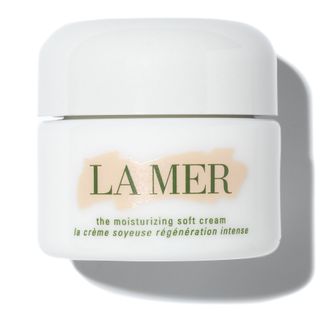
Crème de la Mer The Moisturizing Soft Cream by La Mer
Works for
1 of 1 advertised claim delivered
Moisturizing48 ingredients credited for this claimStrong support
“The Moisturizing Soft Cream by La Mer”
This product can help improve hydration of the skin with the two types of ingredients.
The first type is called “humectants”:
these ingredients help attract water.
When humectants are on the surface of the skin, they “pull in” the moisture from the outside environment, or from
within deeper layers of the skin. The following ingredients in this product do the job:
algae extract, glycerin.
This product also contains ingredients called “occlusives”. They help reduce the speed with which our skin loses moisture to the outside environment. These ingredients also help soften the upper layer of the skin, so it feels less tight and nicer to the touch. The following ingredients in this product do the job: butyrospermum parkii butter, dimethicone.
The following ingredients in this product are especially good for supporting the skin barrier and helping with the hydration level: acetyl hexapeptide-8, petrolatum, urea
Anti-oxidationNot advertised by the brand · 14 ingredients credited for this claimModerate support
This product contains antioxidants (creatine) that might be able to help neutralize free radicals in skin to lessen the damage it gets from the UV light (sun). There is not enough evidence to confirm their effectiveness in skin though.
Anti-agingNot advertised by the brand · 12 ingredients credited for this claimModerate support
This product contains acetyl hexapeptide-8, adenosine phosphate, creatine. These ingredients might be able to help reduce and prevent fine lines and wrinkles, improve skin elasticity and firmness, but there is not enough evidence that it actually works.
Can it cause trouble?
Irritancy8 strong irritants: Eucalyptus globulus leaf oil, Citrus aurantifolia peel extract + 6 more — patch-test recommendedHigh risk
Comedogenic10 ingredients rated 2 or more on the 0–5 pore-clogging scale10 flagged
User reviews
Be the first — your take helps the next person decide.
Ingredients
Filter by role to see what each ingredient is doing.
Algae extract~23–34%
- Irritation risk
- Low
- Comedogenicity
- 3/5
Plant extract that helps the skin to attract water and make it more smooth for touch. Also shows promise of anti-aging properties, but research is not extensive yet
More about Algae extractCyclopentasiloxane~4.9–7.4%
- Irritation risk
- Low
A silicone that helps improve the product texture and spreadability. Can absorb oil creating a short-term mattifying effect on the skin
More about CyclopentasiloxanePetrolatum~4.6–6.9%
- Irritation risk
- Low
One of the most effective and the most studied occlusive ingredients that creates a protective layer on top of the skin preventing moisture loss
More about PetrolatumGlyceryl distearate~3.5–5.3%
- Irritation risk
- Low
Phenyl trimethicone~2.7–4%
- Irritation risk
- Low
A type of silicone that can decrease loss of moisture from the skin surface. It helps create a nice product texture
More about Phenyl trimethiconeButylene glycol~1.7–2.6%
- Irritation risk
- Low
Used to create a nice product texture and help delivery of other ingredients. Might be somewhat helpful in attracting water to the upper layer of the skin
More about Butylene glycolHydrogenated vegetable oil~1.4–2.1%
- Irritation risk
- Low
- Comedogenicity
- 2/5
An oil from a mixture of different vegetables. Helps soften the upper layer of the skin
More about Hydrogenated vegetable oilCholesterol~1.1–1.6%
- Irritation risk
- Low
An emollient that is naturally found in skin
More about CholesterolButyrospermum parkii butter~1.1–1.6%
- Irritation risk
- Low
- Comedogenicity
- 3/5
A great moisturising ingredient that softens the skin and reduces water loss from its upper layer. It also can be helpful in protecting skin from free radicals
More about Butyrospermum parkii butterSteareth-10~0.55–1.3%
- Irritation risk
- Medium
- Comedogenicity
- 3/5
Helps oil and water mix together
More about Steareth-10Dimethicone~0.55–1.25%
- Irritation risk
- Low
A silicone that helps to reduce water loss from the surface of the skin. Can temporarily "fill in" lines and wrinkles, absorb oil, and create a nice product finish
More about DimethiconeGlyceryl stearate se~0.4–0.9%
- Irritation risk
- Low
- Comedogenicity
- 2/5
Used to stabilize the product formulations and works as an emollient
More about Glyceryl stearate sePolysilicone-11~0.4–0.95%
- Irritation risk
- Low
A silicone that forms a light film on the skin surface helping to bind water and temporarily absorb oils creating a matt and powdery feel
More about Polysilicone-11Sesamum indicum seed oil~0.35–0.8%
- Irritation risk
- Low
A good moisturizing plant oil. Due to the high linoleic acid content, it helps soften the upper layer of the skin, reduce water loss and support skin barrier function
More about Sesamum indicum seed oilMedicago sativa seed powder~0.2–0.7%
- Irritation risk
- Medium
Might help soften the upper layer of the skin and help thicken the product formulation. It might have some anti-oxidant effect
More about Medicago sativa seed powderHelianthus annuus seedcake~0.4–0.9%
Prunus amygdalus dulcis seed meal~0.35–0.8%
Eucalyptus globulus leaf oil~0.15–0.55%
- Irritation risk
- High
An essential oil that can be very irritating. Has some anti-bacterial properties
More about Eucalyptus globulus leaf oilSodium gluconate~0.15–0.55%
Copper gluconate~0.15–0.5%
- Irritation risk
- Medium
Typically used to stabilize the product formulations. It is a salt of polyhydroxy acid (PHA) and in larger concentrations, can help shed the dead cells from the skin surface revealing smoother skin. It can help attract water to the upper layer of the skin. Might to be helpful against acne and clogged pores. Could be helpful in neutralizing free radicals, but solid research is missing
More about Copper gluconateCalcium gluconate~0.15–0.55%
- Irritation risk
- Low
Helps attract water to the upper layer of the skin and helps to improve appearance of the product
More about Calcium gluconateMagnesium gluconate~0.1–0.45%
- Irritation risk
- Low
A mineral that might be able to support skin hydration, but convincing research on its effectiveness in topical skincare is lacking
More about Magnesium gluconateZinc gluconate~0.1–0.4%
- Irritation risk
- Medium
Typically used to stabilize the product formulations. It is a salt of a polyhydroxy acid (PHA) and in larger concentrations, can help shed the dead cells from the skin surface revealing smoother skin. It can help attract water to the upper layer of the skin. Might to be helpful against acne and clogged pores. Could be helpful in neutralizing free radicals, but solid research is missing. Due to the zinc content, might help calm down inflammation in skin
More about Zinc gluconateTocopheryl succinate~0.15–0.6%
Niacin~0.1–0.4%
- Irritation risk
- High
A form of vitamin B3. It is similar in action to niacinamide, but is more likely to cause red flashes in skin as the side effect
More about NiacinSesamum indicum seed powder~0.1–0.4%
- Irritation risk
- Low
Water~0.1–0.4%
Citrus aurantifolia peel extract~0.1–0.45%
- Irritation risk
- High
Laminaria digitata extract~0.1–0.4%
- Irritation risk
- Low
- Comedogenicity
- 3/5
Seaweed extract that helps the skin to attract water and make it more smooth for touch. Also shows promise of anti-aging properties, but good research is lacking at the moment
More about Laminaria digitata extractCrithmum maritimum extract~0.1–0.45%
- Irritation risk
- Low
- Comedogenicity
- 3/5
An algae extract that might have anti-oxidant properties
More about Crithmum maritimum extractSalicornia herbacea extract~0.1–0.5%
- Irritation risk
- Low
Plankton extract~0.15–0.5%
- Irritation risk
- Medium
- Comedogenicity
- 3/5
Can help attract water to the upper layer of the skin
More about Plankton extractChlorella vulgaris extract~0.1–0.5%
- Irritation risk
- Medium
- Comedogenicity
- 3/5
A plant extract that can help to attract water to the upper layer of the skin and might have some anti-oxidant and anti-inflammatory properties
More about Chlorella vulgaris extractGlycine soja seed extract~0.15–0.65%
- Irritation risk
- Medium
An emollient that helps soften the skin. Might be somewhat helpful in evening the skin tone.
More about Glycine soja seed extractGlycerin~0.15–0.55%
- Irritation risk
- Low
One of the best moisturizing ingredients. Naturally present in skin. It attracts water to the upper layer of the skin working as a humectant
More about GlycerinCaffeine~0.15–0.65%
- Irritation risk
- Medium
Might be helpful in neutralizing free radicals. Can have a dehydration effect that might somewhat decrease the look of puffy eyes
More about CaffeineSea salt~0.15–0.5%
- Irritation risk
- Medium
Used to thicken the product formulation and might help to add minerals to the surface of the skin. It is used in scrubs as a physical exfoliant. Can increase sensitivity to other ingredients if left on the skin or used in high concentration
More about Sea saltMaris sal~0.15–0.5%
- Irritation risk
- Medium
Used to thicken the product formulation and might help to add minerals to the surface of the skin. It is used in scrubs as a physical exfoliant. Can increase sensitivity to other ingredients if left on the skin or used in high concentration
More about Maris salMicrococcus lysate~0.15–0.5%
- Irritation risk
- Low
Consists of remains of dead bacteria cells. Is likely helpful in attracting water to the upper layer of the skin. Might be helpful in reducing inflammation and neutralizing free radicals in skin. It is claimed to be a "DNA repair enzyme"
More about Micrococcus lysateDiethylhexyl succinate~0.3–0.75%
- Irritation risk
- Low
Helps soften the upper layer of the skin and create a nice product texture
More about Diethylhexyl succinateAdenosine phosphate~0.15–0.5%
- Irritation risk
- Low
Might help improve cell turnover and reduce inflammation in skin. One study shows that the ingredients might be able to stimulate collagen production in skin
More about Adenosine phosphateCreatine~0.15–0.5%
- Irritation risk
- Low
Can support skin's ability to neutralize free radicals and produce collagen, though further research is needed to confirm effectiveness
More about CreatineHydrolyzed algin~0.15–0.5%
- Irritation risk
- Low
- Comedogenicity
- 3/5
Derived from brown algae. Helps attract water to the upper layer of the skin
More about Hydrolyzed alginIsocetyl stearoyl stearate~0.15–0.65%
- Irritation risk
- Low
Helps soften the upper layer of the skin
More about Isocetyl stearoyl stearateCetyl alcohol~0.2–0.7%
- Irritation risk
- Low
A non-drying alcohol that works to soften the skin and stabilize product formulations helping oil and water mix together
More about Cetyl alcoholSucrose~0.1–0.45%
- Irritation risk
- Low
Can help attract water to the upper layer of the skin. In crystal form, it can work as a gentle exfoliant, gentler than the salt scrub. Helps stabilize the emulsion
More about SucroseAcetyl hexapeptide-8~0.1–0.5%
- Irritation risk
- Low
A type of peptide. Peptides are excellent moisturizers and might be able support collagen production reducing fine lines and wrinkles
More about Acetyl hexapeptide-8Glucose oxidase~0.15–0.5%
- Irritation risk
- Low
Helps attract water to the upper layer of the skin
More about Glucose oxidasePolyacrylamide~0.15–0.65%
- Irritation risk
- Medium
Used to improve product texture and help oil and water mix together
More about PolyacrylamideAcetyl carnitine hcl~0.15–0.5%
- Irritation risk
- Low
Might be helpful in decreasing sebum production making the skin less oily. Is claimed to be able to support ceramide production in skin that leads to better hydration, but evidence is lacking. Is able to attract water to the upper layer of the skin
More about Acetyl carnitine hclGlucose~0.15–0.5%
- Irritation risk
- Low
Helps attract water to the upper layer of the skin. Could be helpful in restoring the skin barrier function
More about GlucoseCaprylic/capric triglyceride~0.2–0.7%
- Irritation risk
- Medium
A good mix of fatty acids that forms a protective layer on the skin. Improves the shelf life of products. Derived from coconut and glycerin
More about Caprylic/capric triglycerideC13-14 isoparaffin~0.15–0.65%
- Irritation risk
- Low
Helps soften the upper layer of the skin, dissolve other ingredients and create a thicker product consistency
More about C13-14 isoparaffinTocopheryl acetate~0.2–0.75%
- Irritation risk
- Medium
A more stable but less bio-available form of vitamin E compared to Tocopherol. Might help moisturize and protect the skin from free radicals, but mostly used in low concentrations to stabilize other ingredients.
More about Tocopheryl acetateTetrahexyldecyl ascorbate~0.2–0.7%
- Irritation risk
- Medium
Being a lipid soluble form of vitamin C, it is more stable than ascorbic acid, but still degrades quickly and needs to be stabilized in a formulation with another ingredient. It is claimed to penetrate skin better than pure vitamin C and have the the similar benefits, but solid studies of its effectiveness are lacking. Is likely to require a higher concentration in a product than pure vitamin C to be effective. It might be able to help reduce pore clogging.
More about Tetrahexyldecyl ascorbateSodium pca~0.1–0.5%
- Irritation risk
- Low
Naturally present in skin and helps to attract water to its upper layer
More about Sodium pcaGlycosaminoglycans~0.3–0.75%
- Irritation risk
- Low
Long sugars that help attract water to the upper layer of the skin
More about GlycosaminoglycansUrea~0.1–0.5%
- Irritation risk
- Low
Naturally present in skin (urea makes up about 7% of natural moisturizing factors in skin). Attracts water to the upper layer of the skin. Also has a positive effect on the skin barrier beyond the humectant action. Can enhance penetration of other ingredients. Is an exfoliating ingredient when used in high concentrations
More about UreaDistearyldimonium chloride~0.15–0.5%
- Irritation risk
- Low
Dipalmitoyl hydroxyproline~0.15–0.7%
- Irritation risk
- Low
Is claimed to stimulate collagen and elastin production, as well as work as an anti-oxidant. There is however not enough evidence for its effectiveness
More about Dipalmitoyl hydroxyprolineSodium hyaluronate~0.1–0.5%
- Irritation risk
- Low
One of the best moisturizing ingredients. Attracts water into the upper layer of the skin
More about Sodium hyaluronateLaureth-7~0.15–0.55%
Lecithin~0.15–0.7%
- Irritation risk
- Low
Used mostly for creating emulsions - helping oil and water mix together. Helps soften the upper layer of the skin
More about LecithinTrehalose~0.1–0.5%
- Irritation risk
- Low
A sugar that attracts water to the upper layer of the skin
More about TrehalosePolyquaternium-51~0.2–0.75%
- Irritation risk
- Low
An emollient that helps create a nice silky finish on the skin
More about Polyquaternium-51Lactoperoxidase~0.15–0.5%
- Irritation risk
- Low
Helps attract water to the upper layer of the skin. In theory, could support healthy skin's microbiome, but evidence of effectiveness in skin is lacking
More about LactoperoxidaseHydroxypropyl cyclodextrin~0.15–0.65%
- Irritation risk
- Medium
Used to stabilize product formulations and help soften the upper layer of the skin
More about Hydroxypropyl cyclodextrinCyanocobalamin~0.15–0.65%
- Irritation risk
- Low
Can support skin barrier function and reduce inflammation in skin
More about CyanocobalaminPentylene glycol~0.3–0.7%
- Irritation risk
- Medium
Used to preserve products, dissolve other ingredients and create a nice product texture
More about Pentylene glycolParfum~0.15–0.55%
- Irritation risk
- High
An aromatic blend of unspecified and possibly irritating ingredients
More about ParfumDisodium edta~0.15–0.6%
Bht~0.15–0.6%
Citronellol~0.15–0.5%
Hydroxycitronellal~0.1–0.45%
- Irritation risk
- High
A fragrance. A likely allergen and can be irritating
More about HydroxycitronellalGeraniol~0.1–0.4%
Linalool~0.1–0.45%
Limonene~0.1–0.4%
- Irritation risk
- High
A common frangrance that can easily irritate skin, especially if exposed to air, light or heat
More about LimonenePotassium sorbate~0.1–0.45%
Phenoxyethanol~0.1–0.45%
- Irritation risk
- Low
A preservative. It helps prevent bacterial growth in cosmetic products
More about PhenoxyethanolIngredient list view
Algae extract, Cyclopentasiloxane, Petrolatum, Glyceryl distearate, Phenyl trimethicone, Butylene glycol, Hydrogenated vegetable oil, Cholesterol, Butyrospermum parkii butter, Steareth-10, Dimethicone, Glyceryl stearate se, Polysilicone-11, Sesamum indicum seed oil, Medicago sativa seed powder, Helianthus annuus seedcake, Prunus amygdalus dulcis seed meal, Eucalyptus globulus leaf oil, Sodium gluconate, Copper gluconate, Calcium gluconate, Magnesium gluconate, Zinc gluconate, Tocopheryl succinate, Niacin, Sesamum indicum seed powder, Water, Citrus aurantifolia peel extract, Laminaria digitata extract, Crithmum maritimum extract, Salicornia herbacea extract, Plankton extract, Chlorella vulgaris extract, Glycine soja seed extract, Glycerin, Caffeine, Sea salt, Maris sal, Micrococcus lysate, Diethylhexyl succinate, Adenosine phosphate, Creatine, Hydrolyzed algin, Isocetyl stearoyl stearate, Cetyl alcohol, Sucrose, Acetyl hexapeptide-8, Glucose oxidase, Polyacrylamide, Acetyl carnitine hcl, Glucose, Caprylic/capric triglyceride, C13-14 isoparaffin, Tocopheryl acetate, Tetrahexyldecyl ascorbate, Sodium pca, Glycosaminoglycans, Urea, Distearyldimonium chloride, Dipalmitoyl hydroxyproline, Sodium hyaluronate, Laureth-7, Lecithin, Trehalose, Polyquaternium-51, Lactoperoxidase, Hydroxypropyl cyclodextrin, Cyanocobalamin, Pentylene glycol, Parfum, Disodium edta, Bht, Citronellol, Hydroxycitronellal, Geraniol, Linalool, Limonene, Potassium sorbate, Phenoxyethanol
Compare prices
Retailers ranked by price — lowest first.
Affiliate links · prices updated regularly · As an Amazon Associate, WIMJ earns from qualifying purchases.
Product summary
Based on the ingredients included, "Crème de la Mer - The Moisturizing Soft Cream by La Mer" works well for moisturizing the skin. This moisturizer uses a good combo of humectants and emollients. These both types of ingredients are essentials for improving the skin hydration and keeping the skin barrier healthy. Humectants in this product (acetyl hexapeptide-8, urea, algae extract, glycerin and sodium hyaluronate) help to increase the water content in the upper layer of the skin. (These ingredients do so by "capturing" water molecules from the outside air or from within the deeper layers of the skin). Emollients in this formulation (petrolatum, algae extract, cholesterol, glycosaminoglycans and sesamum indicum seed oil) help to reduce the moisture loss from the skin. They also soften the skin surface and relieve the feeling of dryness and tightness.
Ingredient callouts
- This moistruizer also contains peptides (acetyl hexapeptide-8 0.10% - 0.50%). Peptides is a very big group of ingredients. They all consist of a different combination of amino-acids. Our skin produces peptides naturally. Some of them work as natural anti-biotics, promote wound-healing and production of collagen. The scientists are still studying how effective the topical application of peptides is, but it is very likely that peptides in skincare are helpful. They might be able to support skin barrier restoration and even have an anti-aging benefit. At the very least, they certainly help attract water to the skin and support the hydration in this way.
Irritation risk
This moisturizer contains a bunch of common irritants, including ingredients that do not provide any known benefit for the skin. It might not be the best choice if your skin is sensitive. We assess the overall irritancy of this moisturizer to be high. For a detailed overview of all potential irritants: click here
You can see the detailed formula review with the breakdown of all actives in the product and the full ingredient list with estimated concentrations in the tables below.
Price
The product retails for 353.73CA$ in Canada, for 499.95A$ in Australia, for 108.00$ in the United States and from 78.00£ up to 163.00£ in the United Kingdom.
For a detailed price comparison: click here.
Sources cited in this review
Every concentration estimate and effectiveness label is anchored to one of these 32 studies and safety reviews.
- 1
- 2Final Report on the Safety Assessment of Dimethicone Copolyoljournals.sagepub.com
- 3
- 4Triglyceride composition of Sesamum indicum seed oilonlinelibrary.wiley.com
- 5
- 6

Affiliate links · As an Amazon Associate, WIMJ earns from qualifying purchases.