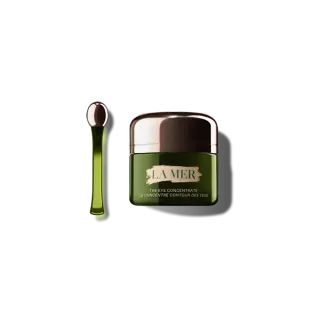
Crème de la Mer The Eye Concentrate
Works for
2 of 3 advertised claims delivered
Moisturizing44 ingredients credited for this claimStrong support
“Dual-action delivery system helps empower the eye area, introducing skin to rich, soothing hydration on contact while infusing skin with potent, ageless activity”
This product can help improve hydration of the skin with the two types of ingredients.
The first type is called “humectants”:
these ingredients help attract water.
When humectants are on the surface of the skin, they “pull in” the moisture from the outside environment, or from
within deeper layers of the skin. The following ingredients in this product do the job:
algae extract, glycerin.
This product also contains ingredients called “occlusives”. They help reduce the speed with which our skin loses moisture to the outside environment. These ingredients also help soften the upper layer of the skin, so it feels less tight and nicer to the touch. The following ingredients in this product do the job: caprylic/capric triglyceride, dimethicone.
The following ingredients in this product are especially good for supporting the skin barrier and helping with the hydration level: acetyl hexapeptide-8, dipeptide-2, palmitoyl tetrapeptide-7, tetraacetylphytosphingosine
Anti-aging9 ingredients credited for this claimModerate support
“Stabilizing treatment reduces the look of dark circles and lines in 21 days.”
This product contains acetyl hexapeptide-8, dipeptide-2, palmitoyl tetrapeptide-7. These ingredients might be able to help reduce and prevent fine lines and wrinkles, improve skin elasticity and firmness, but there is not enough evidence that it actually works.
Evens skin tone8 ingredients credited for this claimLimited support
“Soften the look of fine lines, wrinkles, dark circles, and uneven tone with this ultra-concentrated cream.”
This product contains ingredients (glycine soja protein, glycyrrhiza glabra root extract, yeast extract) that could help reduce hyperpigmentation (for example, post-acne marks or age spots) in theory, but there is not enough evidence that they actually work.
Anti-oxidationNot advertised by the brand · 16 ingredients credited for this claimModerate support
This product contains antioxidants (yeast extract) that might be able to help neutralize free radicals in skin to lessen the damage it gets from the UV light (sun). There is not enough evidence to confirm their effectiveness in skin though.
Can it cause trouble?
Irritancy4 strong irritants: Eucalyptus globulus leaf oil, Citrus aurantifolia peel extract + 2 more — patch-test recommendedHigh risk
Comedogenic5 ingredients rated 2 or more on the 0–5 pore-clogging scale5 flagged

User reviews
Be the first — your take helps the next person decide.
Ingredients
Filter by role to see what each ingredient is doing.
Algae extract~26–32%
- Irritation risk
- Low
- Comedogenicity
- 3/5
Plant extract that helps the skin to attract water and make it more smooth for touch. Also shows promise of anti-aging properties, but research is not extensive yet
More about Algae extractWater~13–16%
Dimethicone~6.1–7.5%
- Irritation risk
- Low
A silicone that helps to reduce water loss from the surface of the skin. Can temporarily "fill in" lines and wrinkles, absorb oil, and create a nice product finish
More about DimethiconeIsododecane~4.1–5.1%
- Irritation risk
- Low
An emollient that helps soften the skin and can decrease moisture loss. Helps create a nice product texture
More about IsododecaneGlycerin~3–3.7%
- Irritation risk
- Low
One of the best moisturizing ingredients. Naturally present in skin. It attracts water to the upper layer of the skin working as a humectant
More about GlycerinYeast extract~2–2.5%
- Irritation risk
- Low
Helps attract water to the upper layer of the skin and might have some anti-oxidant and skin lightening properties. It can help calm down inflammation in skin
More about Yeast extractHydrogenated polyisobutene~1.8–2.2%
- Irritation risk
- Low
Used to improve the product consistency and soften the upper layer of the skin
More about Hydrogenated polyisobuteneTrisiloxane~1.3–1.6%
Caprylic/capric/myristic/stearic triglyceride~1.3–1.6%
- Irritation risk
- Low
Helps to soften the upper layer of the skin
More about Caprylic/capric/myristic/stearic triglycerideVinyl dimethicone/methicone silsesquioxane crosspolymer~1.1–1.3%
- Irritation risk
- Low
A type of silicone that create a smooth product finish and can create an optical soft-focus effect on the skin. Helps to thicken the product consistency
More about Vinyl dimethicone/methicone silsesquioxane crosspolymerCaprylic/capric triglyceride~1–1.2%
- Irritation risk
- Medium
A good mix of fatty acids that forms a protective layer on the skin. Improves the shelf life of products. Derived from coconut and glycerin
More about Caprylic/capric triglycerideSea salt~0.7–1.05%
- Irritation risk
- Medium
Used to thicken the product formulation and might help to add minerals to the surface of the skin. It is used in scrubs as a physical exfoliant. Can increase sensitivity to other ingredients if left on the skin or used in high concentration
More about Sea saltSesamum indicum seed oil~0.7–1%
- Irritation risk
- Low
A good moisturizing plant oil. Due to the high linoleic acid content, it helps soften the upper layer of the skin, reduce water loss and support skin barrier function
More about Sesamum indicum seed oilMedicago sativa seed powder~0.6–0.9%
- Irritation risk
- Medium
Might help soften the upper layer of the skin and help thicken the product formulation. It might have some anti-oxidant effect
More about Medicago sativa seed powderHelianthus annuus seedcake~0.75–1.15%
Prunus amygdalus dulcis seed meal~0.7–1.05%
Eucalyptus globulus leaf oil~0.5–0.8%
- Irritation risk
- High
An essential oil that can be very irritating. Has some anti-bacterial properties
More about Eucalyptus globulus leaf oilSodium gluconate~0.5–0.75%
Copper gluconate~0.5–0.75%
- Irritation risk
- Medium
Typically used to stabilize the product formulations. It is a salt of polyhydroxy acid (PHA) and in larger concentrations, can help shed the dead cells from the skin surface revealing smoother skin. It can help attract water to the upper layer of the skin. Might to be helpful against acne and clogged pores. Could be helpful in neutralizing free radicals, but solid research is missing
More about Copper gluconateCalcium gluconate~0.5–0.75%
- Irritation risk
- Low
Helps attract water to the upper layer of the skin and helps to improve appearance of the product
More about Calcium gluconateMagnesium gluconate~0.45–0.7%
- Irritation risk
- Low
A mineral that might be able to support skin hydration, but convincing research on its effectiveness in topical skincare is lacking
More about Magnesium gluconateZinc gluconate~0.45–0.65%
- Irritation risk
- Medium
Typically used to stabilize the product formulations. It is a salt of a polyhydroxy acid (PHA) and in larger concentrations, can help shed the dead cells from the skin surface revealing smoother skin. It can help attract water to the upper layer of the skin. Might to be helpful against acne and clogged pores. Could be helpful in neutralizing free radicals, but solid research is missing. Due to the zinc content, might help calm down inflammation in skin
More about Zinc gluconateTocopheryl succinate~0.45–0.65%
Niacin~0.45–0.65%
- Irritation risk
- High
A form of vitamin B3. It is similar in action to niacinamide, but is more likely to cause red flashes in skin as the side effect
More about NiacinSesamum indicum seed powder~0.4–0.65%
- Irritation risk
- Low
Asparagopsis armata extract~0.45–0.65%
- Irritation risk
- Low
Red seaweed extract. Can help attract water to the upper layer of the skin and might have some antioxidant effect
More about Asparagopsis armata extractLaminaria digitata extract~0.45–0.65%
- Irritation risk
- Low
- Comedogenicity
- 3/5
Seaweed extract that helps the skin to attract water and make it more smooth for touch. Also shows promise of anti-aging properties, but good research is lacking at the moment
More about Laminaria digitata extractTrametes versicolor extract~0.4–0.65%
- Irritation risk
- Medium
A mushroom extract that might have some skin-lightening and moisturizing properties, but solid research is lacking. It is unlikely to be effective in the concentration used in skincare products
More about Trametes versicolor extractEcklonia cava extract~0.4–0.65%
- Irritation risk
- Low
- Comedogenicity
- 3/5
Sodium hyaluronate~0.4–0.65%
- Irritation risk
- Low
One of the best moisturizing ingredients. Attracts water into the upper layer of the skin
More about Sodium hyaluronateAspergillus ferment~0.4–0.65%
- Irritation risk
- Low
An extract from fungus (mold) that typically appears on rice. It can help attract water to the upper layer of the skin, might help neutralize free radicals and possibly somewhat reduce hyperpigmentation
More about Aspergillus fermentSigesbeckia orientalis extract~0.4–0.6%
- Irritation risk
- Medium
A plant extract that can contain an anti-inflammatory compound
More about Sigesbeckia orientalis extractBrassica campestris seed oil~0.4–0.65%
- Irritation risk
- Low
Helps soften the upper layer of the skin
More about Brassica campestris seed oilPolygonum fagopyrum seed extract~0.45–0.65%
- Irritation risk
- Low
Polyglyceryl-3 diisostearate~0.45–0.7%
- Irritation risk
- Medium
- Comedogenicity
- 3/5
Helps oil and water mix together
More about Polyglyceryl-3 diisostearateGlycyrrhiza glabra root extract~0.4–0.6%
- Irritation risk
- Medium
A plant extract that can help lighten the skin and calm down inflammation. Might be helpful in neutralizing free radicals
More about Glycyrrhiza glabra root extractCitrus aurantifolia peel extract~0.45–0.65%
- Irritation risk
- High
Ascophyllum nodosum extract~0.4–0.65%
- Irritation risk
- Low
Brown seaweed extract. Can help attract water to the upper layer of the skin and might have some antioxidant effect
More about Ascophyllum nodosum extractAcetyl hexapeptide-8~0.4–0.6%
- Irritation risk
- Low
A type of peptide. Peptides are excellent moisturizers and might be able support collagen production reducing fine lines and wrinkles
More about Acetyl hexapeptide-8Cucumis sativus fruit extract~0.4–0.65%
- Irritation risk
- Medium
Might be somewhat helpful in reducing hyperpigmentation and neutralizing free radicals but its typical concentration in a product is too low for having an effect
More about Cucumis sativus fruit extractAlthaea officinalis root extract~0.4–0.65%
- Irritation risk
- High
A plant extract that can help attract water to the upper layer of the skin and might help to reduce inflammation
More about Althaea officinalis root extractOryza sativa bran extract~0.4–0.65%
Helianthus annuus seed extract~0.4–0.65%
- Irritation risk
- Low
Tocopheryl acetate~0.45–0.65%
- Irritation risk
- Medium
A more stable but less bio-available form of vitamin E compared to Tocopherol. Might help moisturize and protect the skin from free radicals, but mostly used in low concentrations to stabilize other ingredients.
More about Tocopheryl acetateMacadamia integrifolia seed oil~0.45–0.7%
- Irritation risk
- Low
A plant oil that helps soften the upper layer of the skin
More about Macadamia integrifolia seed oilSaccharomyces lysate extract~0.4–0.65%
- Irritation risk
- Low
Helps attract water to the upper layer of the skin. Can have some anti-inflammatory effect
More about Saccharomyces lysate extractDipeptide-2~0.4–0.65%
- Irritation risk
- Low
A type of peptide. Peptides are excellent moisturizers and might be able support collagen production reducing fine lines and wrinkles
More about Dipeptide-2Glyceryl triacetyl ricinoleate~0.5–0.7%
- Irritation risk
- Low
Palmitoyl tetrapeptide-7~0.5–0.7%
- Irritation risk
- Low
A type of peptide. Peptides are excellent moisturizers and might be able support collagen production reducing fine lines and wrinkles
More about Palmitoyl tetrapeptide-7Caffeine~0.45–0.7%
- Irritation risk
- Medium
Might be helpful in neutralizing free radicals. Can have a dehydration effect that might somewhat decrease the look of puffy eyes
More about CaffeineTetraacetylphytosphingosine~0.4–0.65%
Whey protein~0.45–0.7%
- Irritation risk
- Low
A protein derived from milk. In skincare products, might help to soften the upper layer of the skin
More about Whey proteinTriethylhexanoin~0.35–0.65%
- Irritation risk
- Medium
Helps soften the upper layer of the skin
More about TriethylhexanoinSorbitol~0.4–0.65%
- Irritation risk
- Low
Helps attract water to the upper layer of the skin and improves the product texture
More about SorbitolHordeum vulgare extract~0.45–0.7%
- Irritation risk
- Medium
A plant extract that might have some anti-oxidant properties. Avoid if you are sensitive to gluten
More about Hordeum vulgare extractGlycine soja protein~0.45–0.7%
- Irritation risk
- Low
A plant extract that helps to attract water to the upper layer of the skin and soften it. It might be helpful in neutralizing free radicals. It might be somewhat helpful for evening out the skin tone. It might be able to support elastin production but solid research is lacking
More about Glycine soja proteinCholesterol~0.5–0.75%
- Irritation risk
- Low
An emollient that is naturally found in skin
More about CholesterolHydrolyzed yeast protein~0.4–0.65%
- Irritation risk
- Low
Isononyl isononanoate~0.45–0.7%
- Irritation risk
- Low
Forms a protective film on the surface of the skin to prevent moisture loss. Gives a velvety feel to products while reducing tackiness
More about Isononyl isononanoatePropylene glycol dicaprate~0.45–0.7%
- Irritation risk
- Low
An emollient that helps soften the upper layer of the skin
More about Propylene glycol dicaprateCetyl peg/ppg-10/1 dimethicone~0.45–0.65%
- Irritation risk
- Low
A type of silicone that helps water and oil mix together. Can help to soften upper layer of the skin
More about Cetyl peg/ppg-10/1 dimethiconeCaprylyl glycol~0.45–0.7%
- Irritation risk
- Medium
Helps preserve products and creates a nice product texture
More about Caprylyl glycolSucrose~0.4–0.6%
- Irritation risk
- Low
Can help attract water to the upper layer of the skin. In crystal form, it can work as a gentle exfoliant, gentler than the salt scrub. Helps stabilize the emulsion
More about SucrosePolysilicone-11~0.55–0.8%
- Irritation risk
- Low
A silicone that forms a light film on the skin surface helping to bind water and temporarily absorb oils creating a matt and powdery feel
More about Polysilicone-11Dimethicone crosspolymer~0.45–0.65%
- Irritation risk
- Low
Used to create a thicker product texture. Helps soften the upper layer of the skin and might be able to prevent moisture loss from its surface
More about Dimethicone crosspolymerDimethicone crosspolymer-3~0.4–0.65%
- Irritation risk
- Low
Silica~0.55–0.85%
Nylon-12~0.5–0.7%
Trimethylsiloxysilicate~0.45–0.7%
- Irritation risk
- Low
A type of silicone that helps create a nice product consistency and support the delivery of other ingredients
More about TrimethylsiloxysilicateSteareth-20~0.5–0.75%
Calcium chloride~0.4–0.6%
- Irritation risk
- Medium
Helps create a thicker product consistency. Might be irritating
More about Calcium chlorideHesperidin methyl chalcone~0.4–0.6%
- Irritation risk
- High
Might help neutralize free radicals in skin. Is claimed to be able to improve the appearance of undereye darkness but evidence is missing. Can be an allergen and cause irritation
More about Hesperidin methyl chalconePeg/ppg-18/18 dimethicone~0.45–0.65%
- Irritation risk
- Low
A silicone that mixes with water creating nice light-weight product texture
More about Peg/ppg-18/18 dimethiconeAlumina~0.55–0.8%
- Irritation risk
- Low
The same compound that is used safely in dental implants and bone cements. In cosmetics, it is used to improve the consistency of products
More about AluminaTriethoxycaprylylsilane~0.35–0.65%
- Irritation risk
- Low
A type of silicone that helps oil and water mix well together. Helps to disperse other ingredients, e.g. pigments, evenly in a formulation
More about TriethoxycaprylylsilaneHydrogenated vegetable oil~0.45–0.65%
- Irritation risk
- Low
- Comedogenicity
- 2/5
An oil from a mixture of different vegetables. Helps soften the upper layer of the skin
More about Hydrogenated vegetable oilAlcohol denat.~0.35–0.6%
- Irritation risk
- High
Produces temporary toning effect. Can help dissolve other ingredients or preserve products
More about Alcohol denat.Propanediol~0.35–0.6%
- Irritation risk
- Low
Acts as a solvent for other ingredients. Speeds up the absorption of other ingredients into the skin
More about PropanediolParfum~0.3–0.5%
- Irritation risk
- High
An aromatic blend of unspecified and possibly irritating ingredients
More about ParfumBht~0.3–0.55%
Phenoxyethanol~0.25–0.5%
- Irritation risk
- Low
A preservative. It helps prevent bacterial growth in cosmetic products
More about PhenoxyethanolPotassium sorbate~0.2–0.35%
Chlorhexidine digluconate~0.15–0.3%
Sodium benzoate~0.2–0.35%
Mica~0.2–0.4%
- Irritation risk
- Low
Creates an illusion of smoother and more radiant skin tone. Adds shimmer to the skin by reflecting light
More about MicaTitanium dioxide~0.15–0.3%
- Irritation risk
- Low
Works as a UV filter when used in high concentrations. It is photostable and is effective mostly against the UVB light, with some protection in the UVA range. In small concentrations, used for its ability to improve the color of cosmetic products. Is usually well tolerated by the skin
More about Titanium dioxideIngredient list view
Algae extract, Water, Dimethicone, Isododecane, Glycerin, Yeast extract, Hydrogenated polyisobutene, Trisiloxane, Caprylic/capric/myristic/stearic triglyceride, Vinyl dimethicone/methicone silsesquioxane crosspolymer, Caprylic/capric triglyceride, Sea salt, Sesamum indicum seed oil, Medicago sativa seed powder, Helianthus annuus seedcake, Prunus amygdalus dulcis seed meal, Eucalyptus globulus leaf oil, Sodium gluconate, Copper gluconate, Calcium gluconate, Magnesium gluconate, Zinc gluconate, Tocopheryl succinate, Niacin, Sesamum indicum seed powder, Asparagopsis armata extract, Laminaria digitata extract, Trametes versicolor extract, Ecklonia cava extract, Sodium hyaluronate, Aspergillus ferment, Sigesbeckia orientalis extract, Brassica campestris seed oil, Polygonum fagopyrum seed extract, Polyglyceryl-3 diisostearate, Glycyrrhiza glabra root extract, Citrus aurantifolia peel extract, Ascophyllum nodosum extract, Acetyl hexapeptide-8, Cucumis sativus fruit extract, Althaea officinalis root extract, Oryza sativa bran extract, Helianthus annuus seed extract, Tocopheryl acetate, Macadamia integrifolia seed oil, Saccharomyces lysate extract, Dipeptide-2, Glyceryl triacetyl ricinoleate, Palmitoyl tetrapeptide-7, Caffeine, Tetraacetylphytosphingosine, Whey protein, Triethylhexanoin, Sorbitol, Hordeum vulgare extract, Glycine soja protein, Cholesterol, Hydrolyzed yeast protein, Isononyl isononanoate, Propylene glycol dicaprate, Cetyl peg/ppg-10/1 dimethicone, Caprylyl glycol, Sucrose, Polysilicone-11, Dimethicone crosspolymer, Dimethicone crosspolymer-3, Silica, Nylon-12, Trimethylsiloxysilicate, Steareth-20, Calcium chloride, Hesperidin methyl chalcone, Peg/ppg-18/18 dimethicone, Alumina, Triethoxycaprylylsilane, Hydrogenated vegetable oil, Alcohol denat., Propanediol, Parfum, Bht, Phenoxyethanol, Potassium sorbate, Chlorhexidine digluconate, Sodium benzoate, Mica, Titanium dioxide
Compare prices
Retailers ranked by price — lowest first.


Worth comparing, line by line.
Match % combines shared ingredients, the first five ingredients, shared actives and hero ingredients, irritancy (lower counts in the alternative's favour), texture and body area. Only products in the same routine step are compared.
| Crème de la MerThe Eye ConcentrateYOUR PRODUCT | Drunk ElephantC-Tango Multivitamin Eye Cream | |
|---|---|---|
| Match | — | 50% |
| Price | $222.09 | $64.00−$158.09 |
| Shared key ingredients | — | 7 of 26 |
| Key difference | — | Ascorbyl Glucoside |
| Irritancy | High | Medium |
| Drying alcohol | Contains drying alcohol | — |
| View product | Shop |

Product summary
"Crème de la Mer - The Eye Concentrate" is effective for: Anti-aging, Moisturizing and Evens skin tone
Ingredient callouts
- Ceramides (tetraacetylphytosphingosine 0.40% - 0.65% and phytosphingosine 0.50% - 0.75%). Ceramides are an important part of our natural skin barrier. The Ceramides used in skincare are synthetic or come from plants. They help soften the skin and can help "fill the gaps" in the skin barrier, keeping the skin hydrated and resilient for longer.
- Peptides (palmitoyl tetrapeptide-7 0.50% - 0.70%, dipeptide-2 0.40% - 0.65% and acetyl hexapeptide-8 0.40% - 0.60%). There are many different kind of Peptides and they are naturally present in our skin. They all are a combination of aminoacids. Some of them work as natural antibiotics, promote wound-healing and production of collagen. The science is still not settled on how effective Peptides are in skincare, but it is very likely that they have a benefit. They might help restore the skin barrier and fight the signs of aging. At the very least, Peptides work as humectants: they attract water to the upper layer of the skin and improve its hydration.
- Humectants (sucrose 0.40% - 0.60%, acetyl glucosamine 0.40% - 0.60%, saccharomyces lysate extract 0.40% - 0.65%, acetyl hexapeptide-8 0.40% - 0.60%, sodium hyaluronate 0.40% - 0.65%, faex 0.60% - 0.90%, glycerin 3.00% - 3.70% and algae extract 26.00% - 32.00%). These ingredients help attract water to the upper layer of the skin and improve the skin hydration.
Price
The product retails from 36.95$ up to 340.00$ in the United States and from 160.93£ up to 215.00£ in the United Kingdom.
For a detailed price comparison: click here.
Sources cited in this review
Every concentration estimate and effectiveness label is anchored to one of these 35 studies and safety reviews.
- 1
- 2Final Report on the Safety Assessment of Dimethicone Copolyoljournals.sagepub.com
- 3
- 4
- 5
- 6

Affiliate links · As an Amazon Associate, WIMJ earns from qualifying purchases.