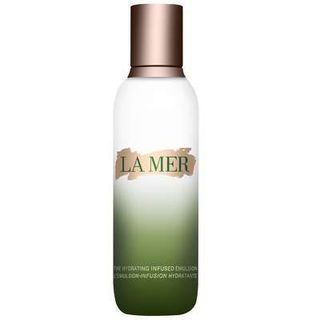
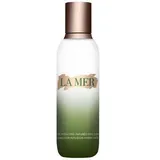
Crème de la Mer Face The Hydrating Infused Emulsion
Works for
1 of 1 advertised claim delivered
Moisturizing29 ingredients credited for this claimStrong support
“Face The Hydrating Infused Emulsion”
This product can help improve hydration of the skin with the two types of ingredients.
The first type is called “humectants”:
these ingredients help attract water.
When humectants are on the surface of the skin, they “pull in” the moisture from the outside environment, or from
within deeper layers of the skin. The following ingredients in this product do the job:
algae extract, glycerin.
This product also contains ingredients called “occlusives”. They help reduce the speed with which our skin loses moisture to the outside environment. These ingredients also help soften the upper layer of the skin, so it feels less tight and nicer to the touch. The following ingredients in this product do the job: bis-diglyceryl polyacyladipate-2, dimethicone.
The following ingredients in this product are especially good for supporting the skin barrier and helping with the hydration level: acetyl hexapeptide-8
Anti-agingNot advertised by the brand · 8 ingredients credited for this claimModerate support
This product contains acetyl hexapeptide-8. This ingredient might be able to help reduce and prevent fine lines and wrinkles, improve skin elasticity and firmness, but there is not enough evidence that it actually works.
Can it cause trouble?
Irritancy9 strong irritants: Eucalyptus globulus leaf oil, Citrus aurantifolia peel extract + 7 more — patch-test recommendedHigh risk
Comedogenic3 ingredients rated 2 or more on the 0–5 pore-clogging scale3 flagged
User reviews
Be the first — your take helps the next person decide.
Ingredients
Filter by role to see what each ingredient is doing.
Water~45–55%
Algae extract~5.8–7.1%
- Irritation risk
- Low
- Comedogenicity
- 3/5
Plant extract that helps the skin to attract water and make it more smooth for touch. Also shows promise of anti-aging properties, but research is not extensive yet
More about Algae extractSqualane~4.4–5.3%
- Irritation risk
- Low
An oil naturally present in skin. Works as an emollient to soften the skin and form a protective layer on its surface without a greasy feeling.
More about SqualaneButylene glycol~3–3.6%
- Irritation risk
- Low
Used to create a nice product texture and help delivery of other ingredients. Might be somewhat helpful in attracting water to the upper layer of the skin
More about Butylene glycolGlycerin~2.3–2.8%
- Irritation risk
- Low
One of the best moisturizing ingredients. Naturally present in skin. It attracts water to the upper layer of the skin working as a humectant
More about GlycerinLimnanthes alba seed oil~1.8–2.2%
- Irritation risk
- Low
This oil's cmposition is closest to rapeseed oil. It is a very stable oil and serves as an emoillient
More about Limnanthes alba seed oilBis-diglyceryl polyacyladipate-2~1.6–1.9%
- Irritation risk
- Low
Helps soften the upper layer of the skin and reduce water loss from its surface
More about Bis-diglyceryl polyacyladipate-2Phenyl trimethicone~1.3–1.6%
- Irritation risk
- Low
A type of silicone that can decrease loss of moisture from the skin surface. It helps create a nice product texture
More about Phenyl trimethiconeHydrogenated lecithin~1–1.2%
- Irritation risk
- Low
Helps to retain moisture by creating a protective barrier on the skin. Rich in fatty acids. Improves product texture and helps with the penetration of other ingredients.
More about Hydrogenated lecithinSesamum indicum seed oil~0.75–1.15%
- Irritation risk
- Low
A good moisturizing plant oil. Due to the high linoleic acid content, it helps soften the upper layer of the skin, reduce water loss and support skin barrier function
More about Sesamum indicum seed oilMedicago sativa seed powder~0.55–0.8%
- Irritation risk
- Medium
Might help soften the upper layer of the skin and help thicken the product formulation. It might have some anti-oxidant effect
More about Medicago sativa seed powderHelianthus annuus seedcake~0.65–1%
Prunus amygdalus dulcis seed meal~0.55–0.85%
Eucalyptus globulus leaf oil~0.3–0.55%
- Irritation risk
- High
An essential oil that can be very irritating. Has some anti-bacterial properties
More about Eucalyptus globulus leaf oilSodium gluconate~0.3–0.55%
Copper gluconate~0.3–0.55%
- Irritation risk
- Medium
Typically used to stabilize the product formulations. It is a salt of polyhydroxy acid (PHA) and in larger concentrations, can help shed the dead cells from the skin surface revealing smoother skin. It can help attract water to the upper layer of the skin. Might to be helpful against acne and clogged pores. Could be helpful in neutralizing free radicals, but solid research is missing
More about Copper gluconateCalcium gluconate~0.35–0.6%
- Irritation risk
- Low
Helps attract water to the upper layer of the skin and helps to improve appearance of the product
More about Calcium gluconateMagnesium gluconate~0.25–0.5%
- Irritation risk
- Low
A mineral that might be able to support skin hydration, but convincing research on its effectiveness in topical skincare is lacking
More about Magnesium gluconateZinc gluconate~0.25–0.45%
- Irritation risk
- Medium
Typically used to stabilize the product formulations. It is a salt of a polyhydroxy acid (PHA) and in larger concentrations, can help shed the dead cells from the skin surface revealing smoother skin. It can help attract water to the upper layer of the skin. Might to be helpful against acne and clogged pores. Could be helpful in neutralizing free radicals, but solid research is missing. Due to the zinc content, might help calm down inflammation in skin
More about Zinc gluconateTocopheryl succinate~0.25–0.45%
Niacin~0.2–0.4%
- Irritation risk
- High
A form of vitamin B3. It is similar in action to niacinamide, but is more likely to cause red flashes in skin as the side effect
More about NiacinSesamum indicum seed powder~0.2–0.35%
- Irritation risk
- Low
Macrocystis pyrifera extract~0.2–0.35%
- Irritation risk
- Low
- Comedogenicity
- 3/5
Hydrolyzed soy protein~0.2–0.35%
- Irritation risk
- Low
Helps attract water to the upper layer of the skin. Might have some anti-aging, anti-oxidant, and skin lightening properties, but solid evidence is missing
More about Hydrolyzed soy proteinSoy amino acids~0.2–0.35%
- Irritation risk
- Low
Help attract water to the upper layer of the skin
More about Soy amino acidsLaminaria digitata extract~0.2–0.35%
- Irritation risk
- Low
- Comedogenicity
- 3/5
Seaweed extract that helps the skin to attract water and make it more smooth for touch. Also shows promise of anti-aging properties, but good research is lacking at the moment
More about Laminaria digitata extractOlea europaea fruit oil~0.25–0.4%
- Irritation risk
- Medium
An emollient that helps soften the skin but is not effective for restoring its barrier function. Might be helpful to calm down inflammation
More about Olea europaea fruit oilHydrolyzed rice extract~0.2–0.4%
- Irritation risk
- Low
A plant extract that is claimed to be helpful in moisturizing and lightening the skin, but evidence is missing
More about Hydrolyzed rice extractAcetyl hexapeptide-8~0.2–0.4%
- Irritation risk
- Low
A type of peptide. Peptides are excellent moisturizers and might be able support collagen production reducing fine lines and wrinkles
More about Acetyl hexapeptide-8Citrus aurantifolia peel extract~0.25–0.4%
- Irritation risk
- High
Lactobacillus ferment~0.2–0.4%
- Irritation risk
- Low
A fermentation product created by bacteria Lactobacillus. The fermented product has anti-bacterial properties and might be helpful in calming down inflammation, but studies are lacking. Helps attract water to the upper layer of the skin. Can be used as a preservative
More about Lactobacillus fermentSodium hyaluronate~0.25–0.45%
- Irritation risk
- Low
One of the best moisturizing ingredients. Attracts water into the upper layer of the skin
More about Sodium hyaluronateOlea europaea fruit extract~0.25–0.5%
- Irritation risk
- Low
An emollient that helps soften the skin but is not effective for restoring its barrier function. Might be helpful to calm down inflammation
More about Olea europaea fruit extractCaffeine~0.25–0.45%
- Irritation risk
- Medium
Might be helpful in neutralizing free radicals. Can have a dehydration effect that might somewhat decrease the look of puffy eyes
More about CaffeineSigesbeckia orientalis extract~0.2–0.4%
- Irritation risk
- Medium
A plant extract that can contain an anti-inflammatory compound
More about Sigesbeckia orientalis extractCentaurium erythraea extract~0.25–0.45%
- Irritation risk
- Medium
A plant extract that can help calm down inflammation in skin
More about Centaurium erythraea extractTriticum vulgare bran extract~0.25–0.45%
- Irritation risk
- Low
Yeast extract~0.25–0.45%
- Irritation risk
- Low
Helps attract water to the upper layer of the skin and might have some anti-oxidant and skin lightening properties. It can help calm down inflammation in skin
More about Yeast extractTocopheryl acetate~0.25–0.5%
- Irritation risk
- Medium
A more stable but less bio-available form of vitamin E compared to Tocopherol. Might help moisturize and protect the skin from free radicals, but mostly used in low concentrations to stabilize other ingredients.
More about Tocopheryl acetateTrehalose~0.25–0.45%
- Irritation risk
- Low
A sugar that attracts water to the upper layer of the skin
More about TrehaloseDipotassium glycyrrhizate~0.25–0.45%
- Irritation risk
- Low
A salt derived from licorice. Works as an emollient to soften the upper layer of the skin and can help calm down inflammation. Might be helpful for skin lightening
More about Dipotassium glycyrrhizateCaprylic/capric triglyceride~0.3–0.55%
- Irritation risk
- Medium
A good mix of fatty acids that forms a protective layer on the skin. Improves the shelf life of products. Derived from coconut and glycerin
More about Caprylic/capric triglycerideAmmonium acryloyldimethyltaurate/vp copolymer~0.25–0.45%
- Irritation risk
- Low
Increases thickness of a product. Texture enhancer for oil-in-water emulsions
More about Ammonium acryloyldimethyltaurate/vp copolymerPolyacrylate crosspolymer-6~0.25–0.5%
- Irritation risk
- Low
Tetrahexyldecyl ascorbate~0.25–0.45%
- Irritation risk
- Medium
Being a lipid soluble form of vitamin C, it is more stable than ascorbic acid, but still degrades quickly and needs to be stabilized in a formulation with another ingredient. It is claimed to penetrate skin better than pure vitamin C and have the the similar benefits, but solid studies of its effectiveness are lacking. Is likely to require a higher concentration in a product than pure vitamin C to be effective. It might be able to help reduce pore clogging.
More about Tetrahexyldecyl ascorbateSucrose~0.2–0.4%
- Irritation risk
- Low
Can help attract water to the upper layer of the skin. In crystal form, it can work as a gentle exfoliant, gentler than the salt scrub. Helps stabilize the emulsion
More about SucroseDimethicone~0.3–0.55%
- Irritation risk
- Low
A silicone that helps to reduce water loss from the surface of the skin. Can temporarily "fill in" lines and wrinkles, absorb oil, and create a nice product finish
More about DimethiconeXanthan gum~0.25–0.45%
- Irritation risk
- Low
Used to create a thicker product consistency
More about Xanthan gumAlcohol denat.~0.25–0.45%
- Irritation risk
- High
Produces temporary toning effect. Can help dissolve other ingredients or preserve products
More about Alcohol denat.T-butyl alcohol~0.2–0.4%
- Irritation risk
- Medium
Used to dissolve other ingredients and to improve smell of products. It could be irritating
More about T-butyl alcoholParfum~0.2–0.35%
- Irritation risk
- High
An aromatic blend of unspecified and possibly irritating ingredients
More about ParfumLinalool~0.2–0.35%
Hydroxycitronellal~0.2–0.35%
- Irritation risk
- High
A fragrance. A likely allergen and can be irritating
More about HydroxycitronellalCitronellol~0.15–0.3%
Geraniol~0.15–0.25%
Limonene~0.15–0.25%
- Irritation risk
- High
A common frangrance that can easily irritate skin, especially if exposed to air, light or heat
More about LimoneneDisodium edta~0.15–0.3%
Bht~0.15–0.25%
Potassium sorbate~0.15–0.25%
Phenoxyethanol~0.15–0.25%
- Irritation risk
- Low
A preservative. It helps prevent bacterial growth in cosmetic products
More about PhenoxyethanolIngredient list view
Water, Algae extract, Squalane, Butylene glycol, Glycerin, Limnanthes alba seed oil, Bis-diglyceryl polyacyladipate-2, Phenyl trimethicone, Hydrogenated lecithin, Sesamum indicum seed oil, Medicago sativa seed powder, Helianthus annuus seedcake, Prunus amygdalus dulcis seed meal, Eucalyptus globulus leaf oil, Sodium gluconate, Copper gluconate, Calcium gluconate, Magnesium gluconate, Zinc gluconate, Tocopheryl succinate, Niacin, Sesamum indicum seed powder, Macrocystis pyrifera extract, Hydrolyzed soy protein, Soy amino acids, Laminaria digitata extract, Olea europaea fruit oil, Hydrolyzed rice extract, Acetyl hexapeptide-8, Citrus aurantifolia peel extract, Lactobacillus ferment, Sodium hyaluronate, Olea europaea fruit extract, Caffeine, Sigesbeckia orientalis extract, Centaurium erythraea extract, Triticum vulgare bran extract, Yeast extract, Tocopheryl acetate, Trehalose, Dipotassium glycyrrhizate, Caprylic/capric triglyceride, Ammonium acryloyldimethyltaurate/vp copolymer, Polyacrylate crosspolymer-6, Tetrahexyldecyl ascorbate, Sucrose, Dimethicone, Xanthan gum, Alcohol denat., T-butyl alcohol, Parfum, Linalool, Hydroxycitronellal, Citronellol, Geraniol, Limonene, Disodium edta, Bht, Potassium sorbate, Phenoxyethanol
Compare prices
Retailers ranked by price — lowest first.
Worth comparing, line by line.
Match % combines shared ingredients, the first five ingredients, shared actives and hero ingredients, irritancy (lower counts in the alternative's favour), texture and body area. Only products in the same routine step are compared.
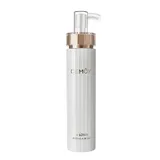
| Crème de la MerFace The Hydrating Infused EmulsionYOUR PRODUCT | Estée LauderRevitalizing Supreme+ Youth Power Soft Milky Lotion Moisturizer | CEMOYThe lotion | Lab Series For MenAge Rescue Face Lotion | |
|---|---|---|---|---|
| Match | — | 59% | 58% | 57% |
| Price | $224.68 | $100.00−$124.68 | $22.41−$202.27 | $55.00−$169.68 |
| Shared key ingredients | — | 9 of 21 | 4 of 21 | 8 of 21 |
| Key difference | — | Acetyl Glucosamine | Ceramide 3 | Niacinamide |
| Irritancy | High | Medium | Medium | Medium |
| Drying alcohol | Contains drying alcohol | — | — | — |
| View product | Shop | Shop | Shop |

Product summary
Based on the ingredient list, "Crème de la Mer - Face The Hydrating Infused Emulsion" can work well for skin moisturization. To work well, any moisturizer needs to include a combination of water-binding and emollient ingredients. Crème de la Mer - Face The Hydrating Infused Emulsion ticks this box. Acetyl hexapeptide-8, algae extract, faex, glycerin and lactobacillus ferment in this product (humectants) attract water molecules to the upper layer of the skin (the water comes from the outside air or from the deeper layers of the skin if the air is dry). Algae extract, limnanthes alba seed oil, sesamum indicum seed oil, bis-diglyceryl polyacyladipate-2 and dimethicone in this product help decrease the water evoporation from the skin, so that it stays hydrated for longer. These ingredients also soften the skin and take away the feeling of tightness and dryness.
Ingredient callouts
- This moisturizer also contains Peptides (acetyl hexapeptide-8 0.20% - 0.40%). Peptides are a very big group of ingredients. They all consist of a different combination of aminoacids. Our skin produces Peptides naturally. Some of them work as natural antibiotics, promote wound-healing and production of collagen. The scientists are still studying how effective the topical application of Peptides is, but it is very likely that they are helpful. Peptides might be able to support skin barrier restoration and even have an anti-aging benefit. At the very least, they certainly help attract water to the skin and support the hydration in this way.
Irritation risk
There are quite a few common irritants in this product, including ingredients without particular skin benefits. We would not recommend it for sensitive skin. We assess the overall irritancy of this moisturizer to be high. For a detailed overview of all potential irritants: click here
You can see the detailed formula review with the breakdown of all actives in the product and the full ingredient list with estimated concentrations in the tables below.
Price
The product retails from 169.95£ up to 1768.00£ in the United Kingdom.
For a detailed price comparison: click here.
Sources cited in this review
Every concentration estimate and effectiveness label is anchored to one of these 37 studies and safety reviews.
- 1
- 2
- 3
- 4Triglyceride composition of Sesamum indicum seed oilonlinelibrary.wiley.com
- 5
- 6

Affiliate links · As an Amazon Associate, WIMJ earns from qualifying purchases.