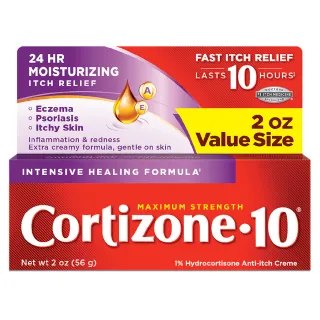
Cortizone 10 Intensive Healing Anti Itch Creme
Works for
1 of 1 advertised claim delivered
Moisturizing13 ingredients credited for this claimStrong support
“Maximum Strength Cortizone 10 Intensive Healing formula also contains seven moisturizers and vitamins A, C and E for soothing moisture that lasts all day.”
This product can help improve hydration of the skin with the two types of ingredients.
The first type is called “humectants”:
these ingredients help attract water.
When humectants are on the surface of the skin, they “pull in” the moisture from the outside environment, or from
within deeper layers of the skin. The following ingredients in this product do the job:
glycerin, hydrolyzed collagen.
This product also contains ingredients called “occlusives”. They help reduce the speed with which our skin loses moisture to the outside environment. These ingredients also help soften the upper layer of the skin, so it feels less tight and nicer to the touch. The following ingredients in this product do the job: dimethicone, hydrolyzed collagen.
The following ingredients in this product are especially good for supporting the skin barrier and helping with the hydration level: petrolatum
Can it cause trouble?
Irritancy3 strong irritants: Menthyl lactate, Diazolidinyl urea + 1 more — patch-test recommendedHigh risk
Comedogenic1 ingredient rated 2 or more on the 0–5 pore-clogging scale1 flagged

User reviews
Be the first — your take helps the next person decide.
Ingredients
Filter by role to see what each ingredient is doing.
Water~45–55%
Glycerin~4.6–5.6%
- Irritation risk
- Low
One of the best moisturizing ingredients. Naturally present in skin. It attracts water to the upper layer of the skin working as a humectant
More about GlycerinDimethicone~4.2–5.1%
- Irritation risk
- Low
A silicone that helps to reduce water loss from the surface of the skin. Can temporarily "fill in" lines and wrinkles, absorb oil, and create a nice product finish
More about DimethiconePetrolatum~3.1–3.8%
- Irritation risk
- Low
One of the most effective and the most studied occlusive ingredients that creates a protective layer on top of the skin preventing moisture loss
More about PetrolatumJojoba esters~2.4–2.9%
- Irritation risk
- Medium
An emollient made of jojoba oil. Helps soften the skin and support its barrier function
More about Jojoba estersCetyl alcohol~1.9–2.4%
- Irritation risk
- Low
A non-drying alcohol that works to soften the skin and stabilize product formulations helping oil and water mix together
More about Cetyl alcoholAloe barbadensis leaf juice~1.6–1.9%
- Irritation risk
- Medium
Traditionally used to treat sunburns, dermatitis and inflammation, but evidence for its effectiveness is lacking. The extract can contain humectants that help attract water into the skin
More about Aloe barbadensis leaf juiceStearyl alcohol~1.5–1.8%
- Irritation risk
- Low
An emollient that helps soften the skin
More about Stearyl alcoholDistearyldimonium chloride~1.2–1.4%
- Irritation risk
- Low
Cetearyl alcohol~1–1.3%
- Irritation risk
- Low
- Comedogenicity
- 2/5
A non-drying alcohol. Works as an emollient. Helps water and oil mix together and creates a nice product texture
More about Cetearyl alcoholSteareth-21~0.75–1.1%
Steareth-2~0.55–0.85%
Polysorbate 60~0.5–0.8%
Stearamidopropyl pg-dimonium chloride phosphate~0.45–0.7%
- Irritation risk
- Low
Methyl gluceth-20~0.4–0.65%
- Irritation risk
- Low
Helps attract water to the upper layer of the skin and soften it
More about Methyl gluceth-20Propylene glycol~0.4–0.6%
- Irritation risk
- High
Helps oil and water mix together and can enhance the penetration of other ingredients into the skin. It can be irritating
More about Propylene glycolChamomilla recutita flower extract~0.35–0.65%
- Irritation risk
- High
Plant extract that can have healing and anti-inflammatory properties. It is a potential allergen and can be irritating
More about Chamomilla recutita flower extractTocopheryl acetate~0.35–0.6%
- Irritation risk
- Medium
A more stable but less bio-available form of vitamin E compared to Tocopherol. Might help moisturize and protect the skin from free radicals, but mostly used in low concentrations to stabilize other ingredients.
More about Tocopheryl acetateMagnesium ascorbyl phosphate~0.3–0.55%
- Irritation risk
- Medium
A derivative of vitamin C that is more stable, but less bioavailable than the pure form of vitamin C. It does not penetrate the skin well, but has been shown to convert to pure vitamin C once in skin. It can be helpful in stimulating collagen production and lightening the skin tone, but the required concentration is likely to be very high
More about Magnesium ascorbyl phosphateHydrolyzed collagen~0.3–0.55%
- Irritation risk
- Low
A typically plant-derived compound that is supposed mimic human collagen. Cannot penetrate the skin barrier so is not particularly useful in skincare products beyond attracting water to the upper layer of the skin
More about Hydrolyzed collagenHydrolyzed elastin~0.3–0.55%
- Irritation risk
- Low
Hydrolyzed jojoba esters~0.25–0.45%
- Irritation risk
- Low
Helps soften the upper layer of the skin
More about Hydrolyzed jojoba estersGlyceryl stearate~0.3–0.5%
- Irritation risk
- Low
An emollient that softens the skin and forms a protective layer on its surface. Helps water and oil mix together
More about Glyceryl stearateEdta~0.2–0.4%
Ppg-12/smdi copolymer~0.25–0.5%
Potassium hydroxide~0.2–0.4%
Beta-glucan~0.2–0.35%
- Irritation risk
- Low
Helps attract water to the upper layer of the skin, calm down inflammation and irritation, restore the barrier function and support wound healing. It can be helpful in reducing fine lines and wrinkles
More about Beta-glucanMenthyl lactate~0.2–0.35%
Diazolidinyl urea~0.1–0.2%
- Irritation risk
- High
A preservative. Works by releasing formaldehyde. Can be irritating
More about Diazolidinyl ureaBenzyl alcohol~0.1–0.15%
- Irritation risk
- High
A preservative. Can be used to mask unpleasant smell. Can be irritating
More about Benzyl alcoholMethylparaben~0.1–0.2%
Bht~0.1–0.15%
Propylparaben~0.1–0.15%
Retinyl palmitate~0.05%
- Irritation risk
- High
Three steps removed from the active form of vitamin A - retinoic acid. To have an effect in the skin, it first needs to be converted twice to become the retinoic acid. This means it is less potent than retinol, but could also be less irritating. Once converted to the retinoic acid in the skin, it helps against all signs of aging, improves skin cell turnover and helps fight blemishes and clogged pores. However, in many cosmetic formulations, it is used in a concentration that is too low to have the full effect
More about Retinyl palmitateIngredient list view
Water, Glycerin, Dimethicone, Petrolatum, Jojoba esters, Cetyl alcohol, Aloe barbadensis leaf juice, Stearyl alcohol, Distearyldimonium chloride, Cetearyl alcohol, Steareth-21, Steareth-2, Polysorbate 60, Stearamidopropyl pg-dimonium chloride phosphate, Methyl gluceth-20, Propylene glycol, Chamomilla recutita flower extract, Tocopheryl acetate, Magnesium ascorbyl phosphate, Hydrolyzed collagen, Hydrolyzed elastin, Hydrolyzed jojoba esters, Glyceryl stearate, Edta, Ppg-12/smdi copolymer, Potassium hydroxide, Beta-glucan, Menthyl lactate, Diazolidinyl urea, Benzyl alcohol, Methylparaben, Bht, Propylparaben, Retinyl palmitate
Compare prices
Retailers ranked by price — lowest first.

Affiliate links · prices updated regularly
Worth comparing, line by line.
Match % combines shared ingredients, the first five ingredients, shared actives and hero ingredients, irritancy (lower counts in the alternative's favour), texture and body area. Only products in the same routine step are compared.
| Cortizone 10Intensive Healing Anti Itch CremeYOUR PRODUCT | Gold BondCracked Skin Relief Hand And Body Lotions | Gold Bond UltimateMen's Essentials Everyday Lotion | Up&UpExtra Repair Lotion | |
|---|---|---|---|---|
| Match | — | 57% | 56% | 50% |
| Price | $10.99 | $5.99−$5.00 | $12.49+$1.50 | $1.99−$9.00 |
| Shared key ingredients | — | 6 of 7 | 5 of 7 | 5 of 7 |
| Key difference | — | 3-O-Ethyl Ascorbic Acid | Niacinamide | Hydroxyethyl Urea |
| Irritancy | High | Medium | Medium | Medium |
| Drying alcohol | — | — | — | — |
| View product | Shop | Shop | Shop |


Product summary
"Cortizone 10 - Intensive Healing Anti Itch Creme" has a good moisturizing formula. To work well, any moisturizer needs to include a combination of water-binding and emollient ingredients. Cortizone 10 - Intensive Healing Anti Itch Creme ticks this box. Glycerin, hydrolyzed collagen, methyl gluceth-20 and propylene glycol in this product (humectants) attract water molecules to the upper layer of the skin (the water comes from the outside air or from the deeper layers of the skin if the air is dry). Emollients in this formulation (petrolatum, hydrolyzed collagen, jojoba esters, dimethicone and cetearyl alcohol) help to reduce the moisture loss from the skin. They also soften the skin surface and relieve the feeling of dryness and tightness.
Ingredient callouts
- this moisturizer includes a form of Retinoids (vitamin A) - retinyl palmitate 0.05% - 0.05%, but this type of vitamin A is not very effective. It could in theory help with fine lines and wrinkles, but the effect is most likely minimal.
Irritation risk
We assess the overall irritancy of this moisturizer to be high. For a detailed overview of all potential irritants: click here
You can see the detailed formula review with the breakdown of all actives in the product and the full ingredient list with estimated concentrations in the tables below.
Price
The product retails for 10.99$ in the United States.
For a detailed price comparison: click here.
Sources cited in this review
Every concentration estimate and effectiveness label is anchored to one of these 17 studies and safety reviews.
- 1
- 2
- 3Final Report on the Safety Assessment of Dimethicone Copolyoljournals.sagepub.com
- 4
- 5Surfactants and experimental irritant contact dermatitisncbi.nlm.nih.gov
- 6Propylene Glycolpubmed.ncbi.nlm.nih.gov

Affiliate links · As an Amazon Associate, WIMJ earns from qualifying purchases.