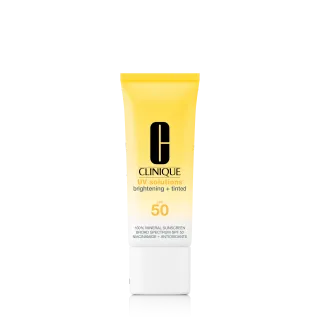
Clinique UV Solutions Brightening + Tinted Sunscreen Broad Spectrum SPF 50/PA+++
Works for
3 of 4 advertised claims delivered
Sun protectionSPF 50 · 1 UV filter · Partial spectrumWeak protectionLow filter dose
This product does not offer good protection against UVA rays.
This product can be considered "reef safe" because it does not contain the UV filters (oxybenzone and octinoxate) that can be harmful to coral reefs when present in the water in high concentrations.
Anti-aging2 ingredients credited for this claimStrong support
“Helps brighten the look of skin, plus visibly reduces dark spots and fine lines.”
This product can help reduce and prevent fine lines and wrinkles, improve skin elasticity and firmness because it contains niacinamide.
Keep in mind that it typically takes at least 6 weeks to notice any results because the changes that are needed to improve fine lines and elasticity happen in the deeper layers of the skin. No topical anti-aging product can “erase” wrinkles or fully reverse signs of aging.
Moisturizing20 ingredients credited for this claimStrong support
“Leaves skin with a soft, tinted glow”
This product can help improve hydration of the skin with the two types of ingredients.
The first type is called “humectants”:
these ingredients help attract water.
When humectants are on the surface of the skin, they “pull in” the moisture from the outside environment, or from
within deeper layers of the skin. The following ingredients in this product do the job:
biosaccharide gum-1, sodium hyaluronate.
This product also contains ingredients called “occlusives”. They help reduce the speed with which our skin loses moisture to the outside environment. These ingredients also help soften the upper layer of the skin, so it feels less tight and nicer to the touch. The following ingredients in this product do the job: dimethicone, isododecane.
The following ingredients in this product are especially good for supporting the skin barrier and helping with the hydration level: niacinamide
Evens skin tone1 ingredient credited for this claimStrong support
“Helps brighten the look of skin, plus visibly reduces dark spots and fine lines.”
This product can help reduce hypepigmentation and even out the skin tone because it contains the following effective ingredients: niacinamide
Keep in mind that you would need to apply any topical skincare targetted at hypigmentation consistently for a couple of months to get a result. No topical skincare product can help get rid of hyperpigmentation (including post-acne marks and age spots) instantly.
This product can also help with skin tone because it offers sun protection. Sun damage is the main factor causing age spots, darkening of post-acne marks and other discolorations. This is why sun protection is the best strategy for maintaining an even skin tone. We, however, do not recommend using this product as a sunscreen because the protection it offers is not strong enough).
Anti-blemishNot advertised by the brand · 1 ingredient credited for this claimStrong support
This product can help reduce breakouts and clogged pores because it contains the following ingredient: niacinamide. This ingredient is used for treating acne and can have a noticeable effect.
Can it cause trouble?
Irritancy10 flagged ingredientsLow risk
Comedogenic1 ingredient rated 2 or more on the 0–5 pore-clogging scale1 flagged


User reviews
Be the first — your take helps the next person decide.
Ingredients
Filter by role to see what each ingredient is doing.
Water~45–55%
Dicaprylyl ether~6.1–7.4%
- Irritation risk
- Low
Helps soften the upper layer of the skin while creating a non-greasy feel on the skin. Helps to dissolve other ingredients
More about Dicaprylyl etherIsododecane~4.5–5.6%
- Irritation risk
- Low
An emollient that helps soften the skin and can decrease moisture loss. Helps create a nice product texture
More about IsododecaneButyloctyl salicylate~3.2–3.9%
- Irritation risk
- Medium
A synthetic ester of salicylic acid that is used to help disperse pigments and boost effectiveness of sunscreen ingredients. It is able to absorb UV light (working as an organic, or chemical filter), but is not approved as a sunscreen ingredient on its own
More about Butyloctyl salicylateDimethicone/vinyl dimethicone crosspolymer~2.4–2.9%
- Irritation risk
- Low
Used to stabilize product formulations and create a nice product texture
More about Dimethicone/vinyl dimethicone crosspolymerNiacinamide~2–2.4%
- Irritation risk
- Low
Is proven to be effective in reducing blemishes, evening out skin tone and helping to improve lines and wrinkles. It helps the skin to repair sun damage, calm down inflammation and keep maintain good levels of moisture. The concentration of about 2% is effective for supporting the skin barrier and evening out the skin tone. Concentration of 4-6% is better for helping with acne and balancing the sebum production
More about NiacinamidePolyglyceryl-3 diisostearate~1.7–2.1%
- Irritation risk
- Medium
- Comedogenicity
- 3/5
Helps oil and water mix together
More about Polyglyceryl-3 diisostearateIsononyl isononanoate~1.6–2%
- Irritation risk
- Low
Forms a protective film on the surface of the skin to prevent moisture loss. Gives a velvety feel to products while reducing tackiness
More about Isononyl isononanoateDiethylhexyl succinate~1.3–1.6%
- Irritation risk
- Low
Helps soften the upper layer of the skin and create a nice product texture
More about Diethylhexyl succinateCetyl peg/ppg-10/1 dimethicone~1–1.2%
- Irritation risk
- Low
A type of silicone that helps water and oil mix together. Can help to soften upper layer of the skin
More about Cetyl peg/ppg-10/1 dimethiconeLauryl peg-9 polydimethylsiloxyethyl dimethicone~0.7–1.1%
- Irritation risk
- Low
A type of silicone that helps to soften upper layer of the skin and create a nice product texture
More about Lauryl peg-9 polydimethylsiloxyethyl dimethiconeButylene glycol~0.6–0.9%
- Irritation risk
- Low
Used to create a nice product texture and help delivery of other ingredients. Might be somewhat helpful in attracting water to the upper layer of the skin
More about Butylene glycolDiphenylsiloxy phenyl trimethicone~0.55–0.8%
- Irritation risk
- Low
Help improve the product's texture
More about Diphenylsiloxy phenyl trimethiconeSilica~0.75–1.15%
Polyhydroxystearic acid~0.5–0.75%
- Irritation risk
- Medium
Used to create a thicker product consistency and stabilize the formulation
More about Polyhydroxystearic acidSodium chloride~0.5–0.75%
- Irritation risk
- Low
Used to stabilize mixtures of oil and water, and create thicker, gel-like product textures
More about Sodium chlorideCaprylic/capric triglyceride~0.5–0.75%
- Irritation risk
- Medium
A good mix of fatty acids that forms a protective layer on the skin. Improves the shelf life of products. Derived from coconut and glycerin
More about Caprylic/capric triglycerideTrimethylsiloxysilicate~0.45–0.65%
- Irritation risk
- Low
A type of silicone that helps create a nice product consistency and support the delivery of other ingredients
More about TrimethylsiloxysilicateSodium hyaluronate~0.35–0.65%
- Irritation risk
- Low
One of the best moisturizing ingredients. Attracts water into the upper layer of the skin
More about Sodium hyaluronateLitchi chinensis seed extract~0.3–0.6%
- Irritation risk
- Low
Caffeine~0.3–0.55%
- Irritation risk
- Medium
Might be helpful in neutralizing free radicals. Can have a dehydration effect that might somewhat decrease the look of puffy eyes
More about CaffeineOryzanol~0.3–0.55%
- Irritation risk
- Low
An anti-oxidant that helps stabilize product formulations. Might help neutralise free radicals in skin
More about OryzanolDimethicone~0.35–0.6%
- Irritation risk
- Low
A silicone that helps to reduce water loss from the surface of the skin. Can temporarily "fill in" lines and wrinkles, absorb oil, and create a nice product finish
More about DimethiconeC12-15 alkyl benzoate~0.3–0.55%
- Irritation risk
- Low
Enhances the product texture and makes it more spreadable. Helps reduce water loss from the outer layer of skin. Extands the shelf life by preventing bacteria growth
More about C12-15 alkyl benzoateCaprylyl glycol~0.3–0.55%
- Irritation risk
- Medium
Helps preserve products and creates a nice product texture
More about Caprylyl glycolPolyglyceryl-3 polyricinoleate~0.3–0.55%
- Irritation risk
- Medium
Helps oil and water mix together
More about Polyglyceryl-3 polyricinoleateBiosaccharide gum-1~0.3–0.5%
- Irritation risk
- Low
Helps attract water to the upper layer of the skin and is claimed to provide a longer-lasting hydration because of its ability to create a water-binding film on the surface of the skin
More about Biosaccharide gum-17-dehydrocholesterol~0.25–0.5%
- Irritation risk
- Medium
Pro-vitamin D. It is claimed to have anti-inflammatory effect in skin, but there is no research available confirming that this compound converts to vitamin D in skin or has any other benefits apart from softening the upper layer of the skin. This compound is different from the Vitamin D3 analogues used in medicine to treat psoriasis
More about 7-dehydrocholesterolDisteardimonium hectorite~0.3–0.5%
- Irritation risk
- Low
A type of clay that is used to thicken the product consistency
More about Disteardimonium hectoriteDimethicone silylate~0.25–0.5%
- Irritation risk
- Low
Lecithin~0.3–0.55%
- Irritation risk
- Low
Used mostly for creating emulsions - helping oil and water mix together. Helps soften the upper layer of the skin
More about LecithinPropylene carbonate~0.3–0.55%
- Irritation risk
- Low
Is used to dissolve other ingredients and create nice product texture
More about Propylene carbonateXanthan gum~0.25–0.45%
- Irritation risk
- Low
Used to create a thicker product consistency
More about Xanthan gumPotassium hydroxide~0.25–0.45%
Isostearic acid~0.35–0.6%
- Irritation risk
- Low
Used to create a nice product texture
More about Isostearic acidDextrin~0.25–0.45%
- Irritation risk
- Low
A sugar that is used to stabilize the product formulation. Can help attract water to the upper layer of the skin
More about DextrinTriethoxycaprylylsilane~0.2–0.35%
- Irritation risk
- Low
A type of silicone that helps oil and water mix well together. Helps to disperse other ingredients, e.g. pigments, evenly in a formulation
More about TriethoxycaprylylsilaneTocopherol~0.2–0.35%
- Irritation risk
- Low
Pure form of vitamin E. Can help moisturise and protect the skin from free radicals. Often used to help stabilise other ingredients or the formula itself
More about TocopherolDisodium edta~0.15–0.3%
Phenoxyethanol~0.2–0.35%
- Irritation risk
- Low
A preservative. It helps prevent bacterial growth in cosmetic products
More about PhenoxyethanolIron oxides~0.1–0.25%
- Irritation risk
- Low
An umbrella term for the following three colorants: CI 77491, CI 77492, CI 77499. They might be able to offer some protection against visible light, but the degree of the protection is not clear
More about Iron oxidesIron oxides~0.1–0.2%
- Irritation risk
- Low
An umbrella term for the following three colorants: CI 77491, CI 77492, CI 77499. They might be able to offer some protection against visible light, but the degree of the protection is not clear
More about Iron oxidesIngredient list view
Water, Dicaprylyl ether, Isododecane, Butyloctyl salicylate, Dimethicone/vinyl dimethicone crosspolymer, Niacinamide, Polyglyceryl-3 diisostearate, Isononyl isononanoate, Diethylhexyl succinate, Cetyl peg/ppg-10/1 dimethicone, Lauryl peg-9 polydimethylsiloxyethyl dimethicone, Butylene glycol, Diphenylsiloxy phenyl trimethicone, Silica, Polyhydroxystearic acid, Sodium chloride, Caprylic/capric triglyceride, Trimethylsiloxysilicate, Sodium hyaluronate, Litchi chinensis seed extract, Caffeine, Oryzanol, Dimethicone, C12-15 alkyl benzoate, Caprylyl glycol, Polyglyceryl-3 polyricinoleate, Biosaccharide gum-1, 7-dehydrocholesterol, Disteardimonium hectorite, Dimethicone silylate, Lecithin, Propylene carbonate, Xanthan gum, Potassium hydroxide, Isostearic acid, Dextrin, Triethoxycaprylylsilane, Tocopherol, Disodium edta, Phenoxyethanol, Iron oxides, Iron oxides
Compare prices
Retailers ranked by price — lowest first.
Affiliate links · prices updated regularly
Worth comparing, line by line.
Match % combines shared ingredients, the first five ingredients, shared actives and hero ingredients, irritancy (lower counts in the alternative's favour), texture and body area. Only products in the same routine step are compared.
| CliniqueUV Solutions Brightening + Tinted Sunscreen Broad Spectrum SPF 50/PA+++YOUR PRODUCT | KinloGolden Rays Sunscreen SPF 50+ | Heliocare360 Pediatric Mineral SPF 50+ | CeraVeHydrating Mineral Face Sunscreen Lotion SPF 50 with Zinc Oxide | |
|---|---|---|---|---|
| Match | — | 84% | 84% | 83% |
| Price | $44.00 | — | $26.36−$17.64 | $18.49−$25.51 |
| Shared key ingredients | — | 4 of 9 | 5 of 9 | 5 of 9 |
| Key difference | — | Bisabolol | 3-O-Ethyl Ascorbic Acid | Panthenol |
| Irritancy | Low | Low | Low | Low |
| SPF | SPF 50 | SPF 50 | SPF 50 | SPF 50 |
| Drying alcohol | — | — | — | — |
| View product | Shop | Shop | Shop |

Sources cited in this review
Every concentration estimate and effectiveness label is anchored to one of these 14 studies and safety reviews.
- 1
- 2
- 3
- 4Hyaluronic acid: A key molecule in skin agingncbi.nlm.nih.gov
- 5
- 6

Affiliate links · As an Amazon Associate, WIMJ earns from qualifying purchases.