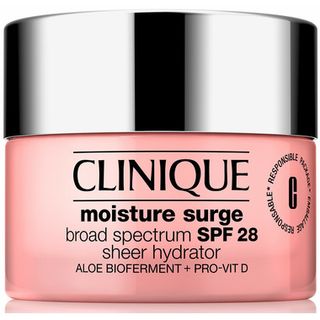
Clinique Moisture Surge SPF 28 Sheer Hydrator
Works for
1 of 2 advertised claims delivered
Sun protectionSPF 28 · 5 UV filters · Broad spectrumWeak protectionSPF under 30
This product offers broad spectrum sun protection, but it is weak. We recommend to use a broad spectrum sunscreen with at least SPF 30.
MoisturizingGlycerin, Dimethicone + 12 moreGood evidence
“Moisture Surge SPF 28 Sheer Hydrator”
This product can help improve hydration of the skin with the two types of ingredients.
The first type is called “humectants”:
these ingredients help attract water.
When humectants are on the surface of the skin, they “pull in” the moisture from the outside environment, or from
within deeper layers of the skin. The following ingredients in this product do the job:
glycerin, hydroxyethyl urea.
This product also contains ingredients called “occlusives”. They help reduce the speed with which our skin loses moisture to the outside environment. These ingredients also help soften the upper layer of the skin, so it feels less tight and nicer to the touch. The following ingredients in this product do the job: dimethicone, caprylyl glycol.
ExfoliationNot advertised by the brand · Hydroxyethyl ureaStrong evidence
This product can help exfoliate the skin. In other words, it helps break down the bonds between dead cells on the surface of the skin and speed up the skin turnover. Skin often appears softer and brighter after exfoliation, but overdoing it can result in disrupted skin barrier. The following ingredient is doing the exfoliating job in this product: hydroxyethyl urea.
Can it cause trouble?
Irritancy23 flagged ingredientsMedium risk
ComedogenicClean of flagged comedogenic ingredientsNone flagged
User reviews
Be the first — your take helps the next person decide.
Ingredients
Filter by role to see what each ingredient is doing.
Butyl methoxydibenzoylmethane3%
- Irritation risk
- Medium
Avobenzone. An organic, or so-called "chemical" UV filter. Protects against both UVA and UVB rays. Needs to be combined with other filters in a formulation to be stable.
More about Butyl methoxydibenzoylmethaneHomosalate7%
- Irritation risk
- Medium
A weak sunscreen that offers some protection against the sun rays that cause sunburn (UVB), but does not offer meaningful protection against protect against the most aging sun rays (UVA). It loses its effectiveness quickly when exposed to sunlight. It is an organic, or so called "chemical" sunscreen. When used in low concentrations, helps to stabilize the product formulation
More about HomosalateEthylhexyl methoxycinnamate7%
- Irritation risk
- High
Octinoxate. When used in higher concentrations, works as a sunscreen protecting the skin from UVB rays. When used in lower concentration, helps to preserve the product formulation. Is shown to be harmful to coral reefs - consider avoiding bathing in coral reef areas when wearing a product with this ingredient. It can be irritating
More about Ethylhexyl methoxycinnamateEthylhexyl salicylate4.5%
- Irritation risk
- Low
Octisalate. A UV filter. It offers some protection against the sun rays that cause sunburn (UVB), but does not protect against the most aging sun rays (UVA). It loses its effectiveness quickly when exposed to sunlight. It is an organic, or so called "chemical" sunscreen
More about Ethylhexyl salicylateWater~45–55%
Butylene glycol~6–7.3%
- Irritation risk
- Low
Used to create a nice product texture and help delivery of other ingredients. Might be somewhat helpful in attracting water to the upper layer of the skin
More about Butylene glycolEthylhexyl methoxycrylene~5.7–7%
- Irritation risk
- Medium
Helps improve stability of sunscreen filters and boost their effectiveness
More about Ethylhexyl methoxycryleneButyloctyl salicylate~4.4–5.4%
- Irritation risk
- Medium
A synthetic ester of salicylic acid that is used to help disperse pigments and boost effectiveness of sunscreen ingredients. It is able to absorb UV light (working as an organic, or chemical filter), but is not approved as a sunscreen ingredient on its own
More about Butyloctyl salicylateDextrin palmitate~3.1–3.8%
- Irritation risk
- Medium
Helps water and oil mix together
More about Dextrin palmitatePolymethylsilsesquioxane~2.3–2.8%
- Irritation risk
- Low
A silicone that improves product texture and helps dissolve other ingredients. Can form a non-greasy film on the skin to prevent moisture loss
More about PolymethylsilsesquioxaneGlycerin~1.8–2.3%
- Irritation risk
- Low
One of the best moisturizing ingredients. Naturally present in skin. It attracts water to the upper layer of the skin working as a humectant
More about GlycerinLactobacillus ferment lysate~1.5–1.9%
- Irritation risk
- Low
A "broth" with parts of dead cells of lactobacteria. Might be helpful supporting diverse microbiome in skin, but evidence is lacking
More about Lactobacillus ferment lysateAloe barbadensis leaf polysaccharides~1.5–1.8%
- Irritation risk
- Low
Sodium hyaluronate~1–1.3%
- Irritation risk
- Low
One of the best moisturizing ingredients. Attracts water into the upper layer of the skin
More about Sodium hyaluronateCaffeine~0.75–1.1%
- Irritation risk
- Medium
Might be helpful in neutralizing free radicals. Can have a dehydration effect that might somewhat decrease the look of puffy eyes
More about CaffeineSodium polyaspartate~0.65–0.95%
- Irritation risk
- Medium
Helps attract water to the upper layer of the skin and can help stabilize the product formulation
More about Sodium polyaspartate7-dehydrocholesterol~0.6–0.9%
- Irritation risk
- Medium
Pro-vitamin D. It is claimed to have anti-inflammatory effect in skin, but there is no research available confirming that this compound converts to vitamin D in skin or has any other benefits apart from softening the upper layer of the skin. This compound is different from the Vitamin D3 analogues used in medicine to treat psoriasis
More about 7-dehydrocholesterolCaprylyl glycol~0.6–0.9%
- Irritation risk
- Medium
Helps preserve products and creates a nice product texture
More about Caprylyl glycolAcrylates copolymer~0.6–0.85%
- Irritation risk
- Medium
Used to stabilize product formulation, help create an even product layer over skin (for example, in sunscreen) and create a thicker product consistency
More about Acrylates copolymerSorbitol~0.5–0.75%
- Irritation risk
- Low
Helps attract water to the upper layer of the skin and improves the product texture
More about SorbitolDimethicone~0.6–0.9%
- Irritation risk
- Low
A silicone that helps to reduce water loss from the surface of the skin. Can temporarily "fill in" lines and wrinkles, absorb oil, and create a nice product finish
More about DimethiconePolyglyceryl-2 stearate~0.5–0.75%
- Irritation risk
- Medium
Helps water and oil mix together
More about Polyglyceryl-2 stearateSucrose~0.4–0.6%
- Irritation risk
- Low
Can help attract water to the upper layer of the skin. In crystal form, it can work as a gentle exfoliant, gentler than the salt scrub. Helps stabilize the emulsion
More about SucroseSaccharide isomerate~0.35–0.65%
- Irritation risk
- Low
Helps attract water to the upper layer of the skin
More about Saccharide isomerateHydroxyethyl urea~0.35–0.6%
- Irritation risk
- Low
A derivative of urea, a compound that is naturally present in skin. Attracts water to the upper layer of the skin. Can enhance penetration of other ingredients
More about Hydroxyethyl ureaPpg-8-ceteth-20~0.4–0.65%
Sorbeth-30 tetraisostearate~0.35–0.6%
Glyceryl stearate~0.45–0.7%
- Irritation risk
- Low
An emollient that softens the skin and forms a protective layer on its surface. Helps water and oil mix together
More about Glyceryl stearateSorbitan sesquiisostearate~0.35–0.6%
Potassium hydroxide~0.35–0.6%
Carbomer~0.3–0.6%
- Irritation risk
- Low
Helps create a thicker or gel-like product texture. It is not a surfactant but can be used in gentle cleansing formulations
More about CarbomerDipropylene glycol~0.3–0.55%
- Irritation risk
- Low
Helps to dissolve other ingredients in a formulation. Slows down the rate of product drying
More about Dipropylene glycolDehydroxanthan gum~0.45–0.7%
- Irritation risk
- Low
Helps create thicker product formulations and stabilize emulsions
More about Dehydroxanthan gumStearyl alcohol~0.45–0.7%
- Irritation risk
- Low
An emollient that helps soften the skin
More about Stearyl alcoholSodium polyacryloyldimethyl taurate~0.3–0.6%
- Irritation risk
- Medium
Helps oil and water mix together
More about Sodium polyacryloyldimethyl taurateHexylene glycol~0.3–0.55%
- Irritation risk
- Medium
Helps create a more spreadable product texture
More about Hexylene glycolAcrylates/beheneth-25 methacrylate copolymer~0.3–0.6%
- Irritation risk
- Low
Acrylates/c10-30 alkyl acrylate crosspolymer~0.45–0.7%
- Irritation risk
- Medium
Maintains the texture of skincare products. Allows the product to spread evenly. Helps oil and water mix together
More about Acrylates/c10-30 alkyl acrylate crosspolymerTocopheryl acetate~0.3–0.6%
- Irritation risk
- Medium
A more stable but less bio-available form of vitamin E compared to Tocopherol. Might help moisturize and protect the skin from free radicals, but mostly used in low concentrations to stabilize other ingredients.
More about Tocopheryl acetateBht~0.3–0.55%
Disodium edta~0.3–0.55%
Sodium citrate~0.25–0.5%
- Irritation risk
- Medium
Helps to control the skin's pH level. Maintains the skin's natural film of amino-lactic acids and oils. Helps to preserve products
More about Sodium citrateCitric acid~0.25–0.45%
- Irritation risk
- Medium
Can work as an exfoliant but is typically used to adjust the product pH
More about Citric acidPotassium sorbate~0.25–0.5%
Sodium benzoate~0.25–0.45%
Phenoxyethanol~0.25–0.45%
- Irritation risk
- Low
A preservative. It helps prevent bacterial growth in cosmetic products
More about PhenoxyethanolCi 14700~0.2–0.4%
Ingredient list view
Butyl methoxydibenzoylmethane, Homosalate, Ethylhexyl methoxycinnamate, Ethylhexyl salicylate, Water, Butylene glycol, Ethylhexyl methoxycrylene, Butyloctyl salicylate, Dextrin palmitate, Polymethylsilsesquioxane, Glycerin, Lactobacillus ferment lysate, Aloe barbadensis leaf polysaccharides, Sodium hyaluronate, Caffeine, Sodium polyaspartate, 7-dehydrocholesterol, Caprylyl glycol, Acrylates copolymer, Sorbitol, Dimethicone, Polyglyceryl-2 stearate, Sucrose, Saccharide isomerate, Hydroxyethyl urea, Ppg-8-ceteth-20, Sorbeth-30 tetraisostearate, Glyceryl stearate, Sorbitan sesquiisostearate, Potassium hydroxide, Carbomer, Dipropylene glycol, Dehydroxanthan gum, Stearyl alcohol, Sodium polyacryloyldimethyl taurate, Hexylene glycol, Acrylates/beheneth-25 methacrylate copolymer, Acrylates/c10-30 alkyl acrylate crosspolymer, Tocopheryl acetate, Bht, Disodium edta, Sodium citrate, Citric acid, Potassium sorbate, Sodium benzoate, Phenoxyethanol, Ci 14700
Compare prices
Retailers ranked by price — lowest first.
Affiliate links · prices updated regularly · As an Amazon Associate, WIMJ earns from qualifying purchases.
Product summary
"Clinique - Moisture Surge SPF 28 Sheer Hydrator" offers broad spectrum protection. It means that it protects from both UVA and UVB rays (you can remember UVB as "burning" sunlight - they cause sunburn. You can remember UVA rays as "aging" - they do not lead to sunburn, but they cause photodamage and contribute to early signs of skin aging and hyperpigmentation). On the negative side, the SPF of this product is not high enough. We recommend to use a sunscreen with at least SPF 30 daily.
This sunscreen should also be hydrating enough to use without an additional moisturizer during the day.
Sunscreen filters
This sunscreen uses so-called "chemical", or organic UV filters (organic simply means that their molecules contain atoms of carbon). These filters typically give good sun protection and rarely leave a white cast, but they can be irritating for sensitive skin. Here are the exact UV filters in this sunscreen: avobenzone 3.00% (declared), butyloctyl salicylate 4.40% - 5.40%, octinoxate 7.00% (declared), octisalate 4.50% (declared) and homosalate 7.00% (declared).
Irritation risk
This sunscreen contains actives that can be irritating. We assess the overall irritancy of this sunscreen to be medium. For a detailed overview of all potential irritants: click here
You can see the detailed formula review with the breakdown of all actives in the product and the full ingredient list with estimated concentrations in the tables below.
Price
The product retails for 62.00CA$ in Canada.
For a detailed price comparison: click here.
Sources cited in this review
Every concentration estimate and effectiveness label is anchored to one of these 16 studies and safety reviews.
- 1
- 2
- 3
- 4
- 5Hyaluronic acid: A key molecule in skin agingncbi.nlm.nih.gov
- 6

Affiliate links · As an Amazon Associate, WIMJ earns from qualifying purchases.