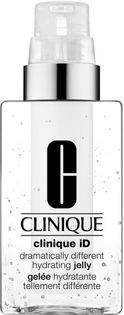
Clinique iD Dramatically Different For Uneven Skin Tone
Works for
1 of 2 advertised claims delivered
Moisturizing22 ingredients credited for this claimGood support
“Dramatically Different Moisturizing Lotion+ hydrates all day.”
This product contains good ingredients to attract water to the upper layer of the skin. These ingredients are called "humectants": glycerin, hydroxyethyl urea.
When humectants are on the surface of the skin, they “pull in” the moisture from the outside environment, or from within deeper layers of the skin. If the air is dry, humectants can speed up the moisture loss from the skin. This is why it is a good idea to use another product on top of this one to help "seal in" the moisture (look for ingredients like dimethicone, squalane, oils and butters).
Evens skin tone5 ingredients credited for this claimLimited support
“Concentrated actives in the cartridge help even tone and brighten.”
This product might help improve the skin tone through exfoliation. In other words, it helps to speed up the shedding of cells from the upper layer of the skin, and this might help reduce hyperpigmentation.
ExfoliationNot advertised by the brand · 2 ingredients credited for this claimStrong support
This product can help exfoliate the skin. In other words, it helps break down the bonds between dead cells on the surface of the skin and speed up the skin turnover. Skin often appears softer and brighter after exfoliation, but overdoing it can result in disrupted skin barrier. The following ingredient is doing the exfoliating job in this product: hydroxyethyl urea.
Can it cause trouble?
Irritancy1 strong irritant: Gelidiella acerosa extractMedium risk
Comedogenic2 ingredients rated 2 or more on the 0–5 pore-clogging scale2 flagged


User reviews
Be the first — your take helps the next person decide.
Ingredients
Filter by role to see what each ingredient is doing.
Water~45–55%
Bis-peg-18 methyl ether dimethyl silane~5.1–6.3%
- Irritation risk
- Low
A type of silicone that helps soften the upper layer of the skin and create a nice product texture
More about Bis-peg-18 methyl ether dimethyl silaneButylene glycol~4.1–5%
- Irritation risk
- Low
Used to create a nice product texture and help delivery of other ingredients. Might be somewhat helpful in attracting water to the upper layer of the skin
More about Butylene glycolGlycerin~3–3.7%
- Irritation risk
- Low
One of the best moisturizing ingredients. Naturally present in skin. It attracts water to the upper layer of the skin working as a humectant
More about GlycerinCucumis sativus fruit extract~2.2–2.7%
- Irritation risk
- Medium
Might be somewhat helpful in reducing hyperpigmentation and neutralizing free radicals but its typical concentration in a product is too low for having an effect
More about Cucumis sativus fruit extractHypnea musciformis extract~1.8–2.2%
- Irritation risk
- Low
- Comedogenicity
- 3/5
Might help to attract water to the upper layer of the skin
More about Hypnea musciformis extractGelidiella acerosa extract~1.5–1.9%
- Irritation risk
- High
An algae extract that can help attract water to the upper layer of the skin and have some anti-oxidant properties
More about Gelidiella acerosa extractHordeum vulgare extract~1.3–1.6%
- Irritation risk
- Medium
A plant extract that might have some anti-oxidant properties. Avoid if you are sensitive to gluten
More about Hordeum vulgare extractPadina pavonica thallus extract~1–1.2%
- Irritation risk
- Low
- Comedogenicity
- 3/5
Might help to soften the upper layer of the skin. Is claimed to have anti-oxidant properties, but evidence in missing
More about Padina pavonica thallus extractHelianthus annuus seedcake~1–1.3%
Sucrose~0.45–0.65%
- Irritation risk
- Low
Can help attract water to the upper layer of the skin. In crystal form, it can work as a gentle exfoliant, gentler than the salt scrub. Helps stabilize the emulsion
More about SucroseCaffeine~0.5–0.75%
- Irritation risk
- Medium
Might be helpful in neutralizing free radicals. Can have a dehydration effect that might somewhat decrease the look of puffy eyes
More about CaffeineSodium hyaluronate~0.45–0.65%
- Irritation risk
- Low
One of the best moisturizing ingredients. Attracts water into the upper layer of the skin
More about Sodium hyaluronateHydroxyethyl urea~0.35–0.65%
- Irritation risk
- Low
A derivative of urea, a compound that is naturally present in skin. Attracts water to the upper layer of the skin. Can enhance penetration of other ingredients
More about Hydroxyethyl ureaHydrolyzed rice extract~0.3–0.55%
- Irritation risk
- Low
A plant extract that is claimed to be helpful in moisturizing and lightening the skin, but evidence is missing
More about Hydrolyzed rice extractSorbitol~0.3–0.55%
- Irritation risk
- Low
Helps attract water to the upper layer of the skin and improves the product texture
More about SorbitolSodium polyaspartate~0.3–0.55%
- Irritation risk
- Medium
Helps attract water to the upper layer of the skin and can help stabilize the product formulation
More about Sodium polyaspartatePpg-6-decyltetradeceth-30~0.3–0.55%
Ethylhexylglycerin~0.25–0.45%
Propylene glycol dicaprate~0.25–0.5%
- Irritation risk
- Low
An emollient that helps soften the upper layer of the skin
More about Propylene glycol dicaprateCaprylyl glycol~0.25–0.45%
- Irritation risk
- Medium
Helps preserve products and creates a nice product texture
More about Caprylyl glycolTrehalose~0.2–0.4%
- Irritation risk
- Low
A sugar that attracts water to the upper layer of the skin
More about TrehalosePolysorbate 80~0.25–0.4%
Carbomer~0.2–0.4%
- Irritation risk
- Low
Helps create a thicker or gel-like product texture. It is not a surfactant but can be used in gentle cleansing formulations
More about CarbomerSodium hydroxide~0.2–0.4%
Hexylene glycol~0.2–0.4%
- Irritation risk
- Medium
Helps create a more spreadable product texture
More about Hexylene glycolCitric acid~0.2–0.4%
- Irritation risk
- Medium
Can work as an exfoliant but is typically used to adjust the product pH
More about Citric acidSodium citrate~0.25–0.4%
- Irritation risk
- Medium
Helps to control the skin's pH level. Maintains the skin's natural film of amino-lactic acids and oils. Helps to preserve products
More about Sodium citrateDisodium edta~0.25–0.4%
Phenoxyethanol~0.25–0.45%
- Irritation risk
- Low
A preservative. It helps prevent bacterial growth in cosmetic products
More about PhenoxyethanolWater~0.25–0.45%
Butylene glycol~0.25–0.45%
- Irritation risk
- Low
Used to create a nice product texture and help delivery of other ingredients. Might be somewhat helpful in attracting water to the upper layer of the skin
More about Butylene glycolAscorbyl glucoside~0.25–0.45%
- Irritation risk
- Medium
A vitamin C derivative that is more stable but less potent than pure form of vitamin C. Has a potential to boost collagen production, nutralise free radicals and reduce hyperpigmentation, but the required concentration is likely to be much higher than for the pure form of vitamin C, limiting the ingredient's effectiveness in products
More about Ascorbyl glucosideCaffeine~0.25–0.4%
- Irritation risk
- Medium
Might be helpful in neutralizing free radicals. Can have a dehydration effect that might somewhat decrease the look of puffy eyes
More about CaffeineAngelica acutiloba root extract~0.2–0.4%
- Irritation risk
- Low
Pyrus malus fruit extract~0.2–0.4%
- Irritation risk
- Medium
Can have some moisturizing properties due to its sugar content
More about Pyrus malus fruit extractCucumis sativus fruit extract~0.25–0.45%
- Irritation risk
- Medium
Might be somewhat helpful in reducing hyperpigmentation and neutralizing free radicals but its typical concentration in a product is too low for having an effect
More about Cucumis sativus fruit extractSaccharum officinarum extract~0.2–0.4%
- Irritation risk
- Low
Sugar extract that helps attract water to the upper layer of the skin
More about Saccharum officinarum extractScutellaria baicalensis root extract~0.2–0.4%
- Irritation risk
- High
A plant extract that might contain a compound baicalin that could be helpful in neutralizing free radicals and reducing inflammation in skin. The baicalin concentration in skincare products is often too low for an effective action. Can be used for its fragrant properties
More about Scutellaria baicalensis root extractSalicylic acid~0.2–0.4%
- Irritation risk
- High
Used for skin exfoliation. It has an anti-inflammatory and anti-bacterial effect, helps to unclog pores, prevent blemishes and speed up healing of the existing ones. Sometimes referred to as a BHA (beta-hydroxy acid)
More about Salicylic acidPhospholipids~0.25–0.45%
- Irritation risk
- Low
Emollients that are naturaly present in skin. In addition, they help water and oil mix together in the product
More about PhospholipidsStearamidopropyl dimethylamine~0.25–0.45%
Stearic acid~0.35–0.65%
- Irritation risk
- Low
Helps oil and water mix together and works as an emollient
More about Stearic acidCaprylyl glycol~0.25–0.5%
- Irritation risk
- Medium
Helps preserve products and creates a nice product texture
More about Caprylyl glycolDipotassium glycyrrhizate~0.25–0.4%
- Irritation risk
- Low
A salt derived from licorice. Works as an emollient to soften the upper layer of the skin and can help calm down inflammation. Might be helpful for skin lightening
More about Dipotassium glycyrrhizateSodium hydroxide~0.2–0.4%
Xanthan gum~0.25–0.4%
- Irritation risk
- Low
Used to create a thicker product consistency
More about Xanthan gumTaurine~0.2–0.4%
- Irritation risk
- Medium
Could be helpful in reducing inflammation in skin, evening out the skin tone and neutralizing free radicals, but more research is needed to confirm its effectiveness
More about TaurineSodium citrate~0.15–0.3%
- Irritation risk
- Medium
Helps to control the skin's pH level. Maintains the skin's natural film of amino-lactic acids and oils. Helps to preserve products
More about Sodium citrateDisodium edta~0.15–0.25%
Sodium sulfite~0.1–0.2%
Sodium metabisulfite~0.1–0.2%
Potassium sorbate~0.15–0.3%
Phenoxyethanol~0.15–0.25%
- Irritation risk
- Low
A preservative. It helps prevent bacterial growth in cosmetic products
More about PhenoxyethanolIngredient list view
Water, Bis-peg-18 methyl ether dimethyl silane, Butylene glycol, Glycerin, Cucumis sativus fruit extract, Hypnea musciformis extract, Gelidiella acerosa extract, Hordeum vulgare extract, Padina pavonica thallus extract, Helianthus annuus seedcake, Sucrose, Caffeine, Sodium hyaluronate, Hydroxyethyl urea, Hydrolyzed rice extract, Sorbitol, Sodium polyaspartate, Ppg-6-decyltetradeceth-30, Ethylhexylglycerin, Propylene glycol dicaprate, Caprylyl glycol, Trehalose, Polysorbate 80, Carbomer, Sodium hydroxide, Hexylene glycol, Citric acid, Sodium citrate, Disodium edta, Phenoxyethanol, Water, Butylene glycol, Ascorbyl glucoside, Caffeine, Angelica acutiloba root extract, Pyrus malus fruit extract, Cucumis sativus fruit extract, Saccharum officinarum extract, Scutellaria baicalensis root extract, Salicylic acid, Phospholipids, Stearamidopropyl dimethylamine, Stearic acid, Caprylyl glycol, Dipotassium glycyrrhizate, Sodium hydroxide, Xanthan gum, Taurine, Sodium citrate, Disodium edta, Sodium sulfite, Sodium metabisulfite, Potassium sorbate, Phenoxyethanol
Compare prices
Retailers ranked by price — lowest first.
Worth comparing, line by line.
Match % combines shared ingredients, the first five ingredients, shared actives and hero ingredients, irritancy (lower counts in the alternative's favour), texture and body area. Only products in the same routine step are compared.
| CliniqueiD Dramatically Different For Uneven Skin ToneYOUR PRODUCT | Paula's choiceInvisible Finish Moisture Gel | Emma STreatment Niacinamide Formula | TulaAcne Clearing + Tone Correcting Gel | |
|---|---|---|---|---|
| Match | — | 88% | 87% | 86% |
| Price | $41.00 | $42.00+$1.00 | — | $36.00−$5.00 |
| Shared key ingredients | — | 3 of 11 | 3 of 11 | 3 of 11 |
| Key difference | — | Niacinamide | Niacinamide | Azelaic Acid |
| Irritancy | Medium | Low | Low | Low |
| Drying alcohol | — | — | — | — |
| View product | Shop | Shop | Shop |


Sources cited in this review
Every concentration estimate and effectiveness label is anchored to one of these 24 studies and safety reviews.
- 1
- 2Marine Bioactive Compounds and Their Health Benefits: A Reviewonlinelibrary.wiley.com
- 3
- 4Celiac Disease & Skin Care Productsbadgut.org
- 5
- 6

Affiliate links · As an Amazon Associate, WIMJ earns from qualifying purchases.