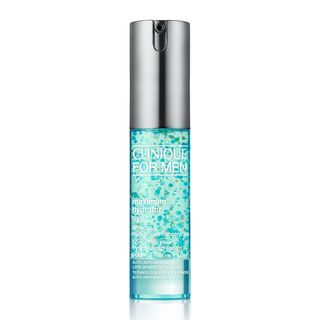
Clinique For Men Maximum Hydrator Eye 96-Hour Hydro-Filler Concentrate
Works for
2 of 2 advertised claims delivered
Moisturizing28 ingredients credited for this claimStrong support
“For Men Maximum Hydrator Eye 96-Hour Hydro-Filler Concentrate”
This product can help improve hydration of the skin with the two types of ingredients.
The first type is called “humectants”:
these ingredients help attract water.
When humectants are on the surface of the skin, they “pull in” the moisture from the outside environment, or from
within deeper layers of the skin. The following ingredients in this product do the job:
algae extract, glycerin.
This product also contains ingredients called “occlusives”. They help reduce the speed with which our skin loses moisture to the outside environment. These ingredients also help soften the upper layer of the skin, so it feels less tight and nicer to the touch. The following ingredients in this product do the job: cocos nucifera oil, phenyl trimethicone.
The following ingredients in this product are especially good for supporting the skin barrier and helping with the hydration level: acetyl glucosamine, acetyl hexapeptide-8, palmitoyl hexapeptide-12
Anti-aging7 ingredients credited for this claimStrong support
“Skin Type Normal, Dry, Combination, and Oily Skincare Concerns Fine Lines, Wrinkles, and Dryness Formulation Lightweight Gel Ingredient Callouts Free of parabens and phthalates. This product is also gluten-free.”
This product can help reduce and prevent fine lines and wrinkles, improve skin elasticity and firmness because it contains acetyl glucosamine, palmitoyl hexapeptide-12.
These ingredients in the product can also be helpful, even though there is less evidence for their effectiveness: acetyl hexapeptide-8.
Keep in mind that it typically takes at least 6 weeks to notice any results because the changes that are needed to improve fine lines and elasticity happen in the deeper layers of the skin. No topical anti-aging product can “erase” wrinkles or fully reverse signs of aging.
Evens skin toneNot advertised by the brand · 5 ingredients credited for this claimStrong support
This product can help reduce hypepigmentation and even out the skin tone because it contains the following effective ingredients: acetyl glucosamine, hydroxyethyl urea
Keep in mind that you would need to apply any topical skincare targetted at hypigmentation consistently for a couple of months to get a result. No topical skincare product can help get rid of hyperpigmentation (including post-acne marks and age spots) instantly.
ExfoliationNot advertised by the brand · 2 ingredients credited for this claimStrong support
This product can help exfoliate the skin. In other words, it helps break down the bonds between dead cells on the surface of the skin and speed up the skin turnover. Skin often appears softer and brighter after exfoliation, but overdoing it can result in disrupted skin barrier. The following ingredient is doing the exfoliating job in this product: hydroxyethyl urea.
Anti-oxidationNot advertised by the brand · 7 ingredients credited for this claimModerate support
This product contains antioxidants (camellia sinensis leaf extract) that might be able to help neutralize free radicals in skin to lessen the damage it gets from the UV light (sun). There is not enough evidence to confirm their effectiveness in skin though.
Can it cause trouble?
Irritancy1 strong irritant: Gelidiella acerosa extractMedium risk
Comedogenic4 ingredients rated 2 or more on the 0–5 pore-clogging scale4 flagged


User reviews
Be the first — your take helps the next person decide.
Ingredients
Filter by role to see what each ingredient is doing.
Water~45–55%
Glycerin~4.4–5.3%
- Irritation risk
- Low
One of the best moisturizing ingredients. Naturally present in skin. It attracts water to the upper layer of the skin working as a humectant
More about GlycerinButylene glycol~3.9–4.8%
- Irritation risk
- Low
Used to create a nice product texture and help delivery of other ingredients. Might be somewhat helpful in attracting water to the upper layer of the skin
More about Butylene glycolPropanediol~3–3.6%
- Irritation risk
- Low
Acts as a solvent for other ingredients. Speeds up the absorption of other ingredients into the skin
More about PropanediolPhenyl trimethicone~2.3–2.8%
- Irritation risk
- Low
A type of silicone that can decrease loss of moisture from the skin surface. It helps create a nice product texture
More about Phenyl trimethiconeSucrose~1.7–2%
- Irritation risk
- Low
Can help attract water to the upper layer of the skin. In crystal form, it can work as a gentle exfoliant, gentler than the salt scrub. Helps stabilize the emulsion
More about SucroseHydroxyethyl urea~1.5–1.9%
- Irritation risk
- Low
A derivative of urea, a compound that is naturally present in skin. Attracts water to the upper layer of the skin. Can enhance penetration of other ingredients
More about Hydroxyethyl ureaCamellia sinensis leaf extract~1.4–1.7%
- Irritation risk
- Low
Can contain potent anti-oxidant compounds (abbreviated ECG, GCG, EGC, and EGCG) that might help protect the skin from free radicals. Can help calm down inflammation and has some anti-bacterial properties. Unfortunately, these antioxidants are unstable and lose their effectiveness very quickly in products. The concentration of the antioxidant compounds in the extract also tends to be low to be effective in topical formulation
More about Camellia sinensis leaf extractHypnea musciformis extract~1.1–1.3%
- Irritation risk
- Low
- Comedogenicity
- 3/5
Might help to attract water to the upper layer of the skin
More about Hypnea musciformis extractGelidiella acerosa extract~0.8–1.2%
- Irritation risk
- High
An algae extract that can help attract water to the upper layer of the skin and have some anti-oxidant properties
More about Gelidiella acerosa extractAloe barbadensis leaf extract~0.7–1.05%
- Irritation risk
- Medium
Traditionally used to treat sunburns, dermatitis and inflammation, but evidence for its effectiveness is lacking. The extract can contain humectants that help attract water into the skin
More about Aloe barbadensis leaf extractChlorella vulgaris extract~0.5–0.75%
- Irritation risk
- Medium
- Comedogenicity
- 3/5
A plant extract that can help to attract water to the upper layer of the skin and might have some anti-oxidant and anti-inflammatory properties
More about Chlorella vulgaris extractAlteromonas ferment extract~0.45–0.7%
- Irritation risk
- Low
A marine extract that helps attract water to the upper layer of the skin. It is claimed to have anti-inflammatory properties but research is lacking
More about Alteromonas ferment extractCucumis sativus fruit extract~0.45–0.65%
- Irritation risk
- Medium
Might be somewhat helpful in reducing hyperpigmentation and neutralizing free radicals but its typical concentration in a product is too low for having an effect
More about Cucumis sativus fruit extractNiacinamide~0.35–0.65%
- Irritation risk
- Low
Is proven to be effective in reducing blemishes, evening out skin tone and helping to improve lines and wrinkles. It helps the skin to repair sun damage, calm down inflammation and keep maintain good levels of moisture. The concentration of about 2% is effective for supporting the skin barrier and evening out the skin tone. Concentration of 4-6% is better for helping with acne and balancing the sebum production
More about NiacinamideAcetyl glucosamine~0.35–0.6%
- Irritation risk
- Low
An effective moisturizing ingredient that also has been shown to be effective in evening out the skin tone and reducing hyperpigmentation. It can help somewhat reduce wrinkles in skin
More about Acetyl glucosamineCholesterol~0.45–0.65%
- Irritation risk
- Low
An emollient that is naturally found in skin
More about CholesterolCocos nucifera oil~0.3–0.55%
- Irritation risk
- Low
- Comedogenicity
- 3/5
An emollient. Found to be as effective as a moisturizer for dry skin as mineral oil. Could be comedogenic
More about Cocos nucifera oilHydrolyzed rice extract~0.25–0.5%
- Irritation risk
- Low
A plant extract that is claimed to be helpful in moisturizing and lightening the skin, but evidence is missing
More about Hydrolyzed rice extractAcetyl hexapeptide-8~0.25–0.45%
- Irritation risk
- Low
A type of peptide. Peptides are excellent moisturizers and might be able support collagen production reducing fine lines and wrinkles
More about Acetyl hexapeptide-8Trehalose~0.25–0.45%
- Irritation risk
- Low
A sugar that attracts water to the upper layer of the skin
More about TrehaloseAlgae extract~0.3–0.55%
- Irritation risk
- Low
- Comedogenicity
- 3/5
Plant extract that helps the skin to attract water and make it more smooth for touch. Also shows promise of anti-aging properties, but research is not extensive yet
More about Algae extractPalmitoyl hexapeptide-12~0.2–0.4%
- Irritation risk
- Low
A type of peptide. Peptides are excellent moisturizers and might be able support collagen production reducing fine lines and wrinkles
More about Palmitoyl hexapeptide-12Caffeine~0.2–0.4%
- Irritation risk
- Medium
Might be helpful in neutralizing free radicals. Can have a dehydration effect that might somewhat decrease the look of puffy eyes
More about CaffeineSodium hyaluronate~0.2–0.4%
- Irritation risk
- Low
One of the best moisturizing ingredients. Attracts water into the upper layer of the skin
More about Sodium hyaluronatePeg-8~0.25–0.4%
- Irritation risk
- Medium
Used to create a nice product consistency
More about Peg-8Acrylates/c10-30 alkyl acrylate crosspolymer~0.25–0.45%
- Irritation risk
- Medium
Maintains the texture of skincare products. Allows the product to spread evenly. Helps oil and water mix together
More about Acrylates/c10-30 alkyl acrylate crosspolymerSorbitol~0.2–0.4%
- Irritation risk
- Low
Helps attract water to the upper layer of the skin and improves the product texture
More about SorbitolAloe barbadensis leaf water~0.2–0.4%
- Irritation risk
- Medium
Traditionally used to treat sunburns, dermatitis and inflammation, but data on its effectiveness is lacking. While the majority of the content is plain water, it can contain some goodies like vitamins, enzymes, minerals, and humectants that help attract water into the skin
More about Aloe barbadensis leaf waterDextrin palmitate~0.25–0.45%
- Irritation risk
- Medium
Helps water and oil mix together
More about Dextrin palmitatePentaerythrityl tetraethylhexanoate~0.25–0.5%
- Irritation risk
- Low
Used to create a nice product consistency while softening the upper layer of the skin
More about Pentaerythrityl tetraethylhexanoateSodium polyaspartate~0.2–0.4%
- Irritation risk
- Medium
Helps attract water to the upper layer of the skin and can help stabilize the product formulation
More about Sodium polyaspartateTocopheryl acetate~0.25–0.45%
- Irritation risk
- Medium
A more stable but less bio-available form of vitamin E compared to Tocopherol. Might help moisturize and protect the skin from free radicals, but mostly used in low concentrations to stabilize other ingredients.
More about Tocopheryl acetateGlyceryl polymethacrylate~0.25–0.45%
- Irritation risk
- Low
Used to create a nice product texture
More about Glyceryl polymethacrylatePeg-7m~0.25–0.4%
- Irritation risk
- Low
Carbomer~0.2–0.4%
- Irritation risk
- Low
Helps create a thicker or gel-like product texture. It is not a surfactant but can be used in gentle cleansing formulations
More about CarbomerTriethoxycaprylylsilane~0.2–0.4%
- Irritation risk
- Low
A type of silicone that helps oil and water mix well together. Helps to disperse other ingredients, e.g. pigments, evenly in a formulation
More about TriethoxycaprylylsilaneDehydroxanthan gum~0.25–0.4%
- Irritation risk
- Low
Helps create thicker product formulations and stabilize emulsions
More about Dehydroxanthan gumTetrahexyldecyl ascorbate~0.2–0.4%
- Irritation risk
- Medium
Being a lipid soluble form of vitamin C, it is more stable than ascorbic acid, but still degrades quickly and needs to be stabilized in a formulation with another ingredient. It is claimed to penetrate skin better than pure vitamin C and have the the similar benefits, but solid studies of its effectiveness are lacking. Is likely to require a higher concentration in a product than pure vitamin C to be effective. It might be able to help reduce pore clogging.
More about Tetrahexyldecyl ascorbatePentaerythrityl tetra-di-t-butyl hydroxyhydrocinnamate~0.2–0.4%
- Irritation risk
- Low
Used to increase stability of product formulations
More about Pentaerythrityl tetra-di-t-butyl hydroxyhydrocinnamateSodium hydroxide~0.2–0.35%
Citric acid~0.2–0.35%
- Irritation risk
- Medium
Can work as an exfoliant but is typically used to adjust the product pH
More about Citric acidSodium citrate~0.2–0.35%
- Irritation risk
- Medium
Helps to control the skin's pH level. Maintains the skin's natural film of amino-lactic acids and oils. Helps to preserve products
More about Sodium citrateDisodium edta~0.15–0.3%
Bht~0.15–0.3%
Potassium sorbate~0.1–0.2%
Phenoxyethanol~0.1–0.2%
- Irritation risk
- Low
A preservative. It helps prevent bacterial growth in cosmetic products
More about PhenoxyethanolChlorphenesin~0.1–0.2%
Ci 19140~0.1–0.2%
Blue 1 lake~0.05–0.1%
Ci 42090~0.05–0.1%
Ingredient list view
Water, Glycerin, Butylene glycol, Propanediol, Phenyl trimethicone, Sucrose, Hydroxyethyl urea, Camellia sinensis leaf extract, Hypnea musciformis extract, Gelidiella acerosa extract, Aloe barbadensis leaf extract, Chlorella vulgaris extract, Alteromonas ferment extract, Cucumis sativus fruit extract, Niacinamide, Acetyl glucosamine, Cholesterol, Cocos nucifera oil, Hydrolyzed rice extract, Acetyl hexapeptide-8, Trehalose, Unknown, Algae extract, Palmitoyl hexapeptide-12, Caffeine, Sodium hyaluronate, Peg-8, Acrylates/c10-30 alkyl acrylate crosspolymer, Sorbitol, Aloe barbadensis leaf water, Dextrin palmitate, Pentaerythrityl tetraethylhexanoate, Sodium polyaspartate, Tocopheryl acetate, Glyceryl polymethacrylate, Peg-7m, Carbomer, Triethoxycaprylylsilane, Dehydroxanthan gum, Tetrahexyldecyl ascorbate, Pentaerythrityl tetra-di-t-butyl hydroxyhydrocinnamate, Sodium hydroxide, Citric acid, Sodium citrate, Disodium edta, Bht, Potassium sorbate, Phenoxyethanol, Chlorphenesin, Ci 19140, Blue 1 lake, Ci 42090
Compare prices
Retailers ranked by price — lowest first.

Affiliate links · prices updated regularly
Worth comparing, line by line.
Match % combines shared ingredients, the first five ingredients, shared actives and hero ingredients, irritancy (lower counts in the alternative's favour), texture and body area. Only products in the same routine step are compared.
| CliniqueFor Men Maximum Hydrator Eye 96-Hour Hydro-Filler ConcentrateYOUR PRODUCT | SWANICOCOPeptine Biome Eye Cream | SupereggPhyto Bounce Eye Contour Solution | Lab Series Skincare for MenDaily Rescue Energising Face Lotion | |
|---|---|---|---|---|
| Match | — | 73% | 72% | 71% |
| Price | $37.00 | $18.00−$19.00 | $50.00+$13.00 | $65.44+$28.44 |
| Shared key ingredients | — | 5 of 17 | 6 of 17 | 9 of 17 |
| Key difference | — | Acetyl Dipeptide-1 Cetyl Ester | Copper Tripeptide-1 | Ascorbyl Glucoside |
| Irritancy | Medium | Medium | Medium | Medium |
| Drying alcohol | — | — | — | — |
| View product | Shop | Shop | Shop |


Product summary
"Clinique - For Men Maximum Hydrator Eye 96-Hour Hydro-Filler Concentrate" is effective for: Moisturizing, Evens skin tone, Exfoliation and Anti-aging
Ingredient callouts
- We like that this moisturizer contains peptides (acetyl hexapeptide-8 0.25% - 0.45% and palmitoyl hexapeptide-12 0.20% - 0.40%). There are many different kind of Peptides and they are naturally present in our skin. They all are a combination of aminoacids. Some of them work as natural antibiotics, promote wound-healing and production of collagen. The science is still not settled on how effective Peptides are in skincare, but it is very likely that they have a benefit. Peptides might help restore the skin barrier and fight the signs of aging. At the very least, Peptides work as humectants: they attract water to the upper layer of the skin and improve its hydration.
Price
The product retails from 29.00£ up to 35.34£ in the United Kingdom, for 60.00A$ in Australia, from 47.00CA$ up to 53.10CA$ in Canada and for 37.00$ in the United States.
For a detailed price comparison: click here.
Sources cited in this review
Every concentration estimate and effectiveness label is anchored to one of these 20 studies and safety reviews.
- 1
- 2
- 3Marine Bioactive Compounds and Their Health Benefits: A Reviewonlinelibrary.wiley.com
- 4
- 5
- 6

Affiliate links · As an Amazon Associate, WIMJ earns from qualifying purchases.