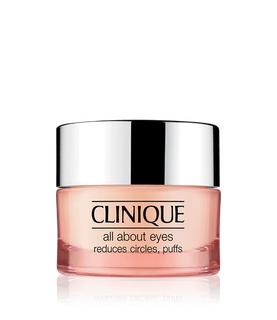
Clinique All About Eyes
Works for
1 of 3 advertised claims delivered
Moisturizing17 ingredients credited for this claimStrong support
“Hydrates, brightens, and reduces the look of puffiness.”
This product can help improve hydration of the skin with the two types of ingredients.
The first type is called “humectants”:
these ingredients help attract water.
When humectants are on the surface of the skin, they “pull in” the moisture from the outside environment, or from
within deeper layers of the skin. The following ingredients in this product do the job:
glycerin, sucrose.
This product also contains ingredients called “occlusives”. They help reduce the speed with which our skin loses moisture to the outside environment. These ingredients also help soften the upper layer of the skin, so it feels less tight and nicer to the touch. The following ingredients in this product do the job: dimethicone, cholesterol.
The following ingredients in this product are especially good for supporting the skin barrier and helping with the hydration level: linoleic acid, phytosphingosine
Anti-aging2 ingredients credited for this claimLimited support
“An award-winning, lightweight eye cream-gel that diminishes the appearance of eye puffiness, darkness, and fine lines.”
This product does not contain ingredients that are able to reduce fine lines and wrinkles or help with skin elasticity, but it can improve the look of the skin temporarily through moisturization. Well-moisturized skin might also be able to repair the sun damage better.This ingredient - camellia sinensis leaf extract - could be helpful for preventing or repairing signs of aging in theory, but there is no evidence that it actually works.
This ingredient camellia sinensis leaf extract might be able to help neutralize free radicals in skin and help it fight off some of the sun damage.
Evens skin tone3 ingredients credited for this claimLimited support
“This brightening eye cream is packed with powerhouse ingredients, including vitamin C, caffeine, and whey protein.”
This product contains ingredients (morus bombycis root extract) that could help reduce hyperpigmentation (for example, post-acne marks or age spots) in theory, but there is not enough evidence that they actually work.
Anti-oxidationNot advertised by the brand · 5 ingredients credited for this claimModerate support
This product contains antioxidants (camellia sinensis leaf extract) that might be able to help neutralize free radicals in skin to lessen the damage it gets from the UV light (sun). There is not enough evidence to confirm their effectiveness in skin though.
Can it cause trouble?
Irritancy10 flagged ingredientsMedium risk
ComedogenicClean of flagged comedogenic ingredientsNone flagged
User reviews
Ingredients
Filter by role to see what each ingredient is doing.
Cyclopentasiloxane~23–34%
- Irritation risk
- Low
A silicone that helps improve the product texture and spreadability. Can absorb oil creating a short-term mattifying effect on the skin
More about CyclopentasiloxaneWater~11–17%
Isostearyl palmitate~4.5–6.7%
- Irritation risk
- Low
Polyethylene~3.5–5.2%
Butylene glycol~2.4–3.6%
- Irritation risk
- Low
Used to create a nice product texture and help delivery of other ingredients. Might be somewhat helpful in attracting water to the upper layer of the skin
More about Butylene glycolPolysilicone-11~1.8–2.8%
- Irritation risk
- Low
A silicone that forms a light film on the skin surface helping to bind water and temporarily absorb oils creating a matt and powdery feel
More about Polysilicone-11Ethylene/acrylic acid copolymer~1.5–2.2%
- Irritation risk
- Low
Morus bombycis root extract~1.2–1.9%
- Irritation risk
- High
A plant extract that might contain arbutin, a compound that has skin-lightening properties. Might have some anti-oxidant activity. Is unlikely to be effective though in the concentrations typically used in skincare products
More about Morus bombycis root extractCaffeine~1–1.45%
- Irritation risk
- Medium
Might be helpful in neutralizing free radicals. Can have a dehydration effect that might somewhat decrease the look of puffy eyes
More about CaffeinePhytosphingosine~0.95–1.4%
- Irritation risk
- Low
A type of lipid that is naturally present in skin. It might help in repairing skin barrier function and has anti-bacterial effect
More about PhytosphingosineTriticum vulgare bran extract~0.5–1.15%
- Irritation risk
- Low
Scutellaria baicalensis root extract~0.4–0.9%
- Irritation risk
- High
A plant extract that might contain a compound baicalin that could be helpful in neutralizing free radicals and reducing inflammation in skin. The baicalin concentration in skincare products is often too low for an effective action. Can be used for its fragrant properties
More about Scutellaria baicalensis root extractWhey protein~0.4–0.95%
- Irritation risk
- Low
A protein derived from milk. In skincare products, might help to soften the upper layer of the skin
More about Whey proteinOlea europaea fruit extract~0.4–0.9%
- Irritation risk
- Low
An emollient that helps soften the skin but is not effective for restoring its barrier function. Might be helpful to calm down inflammation
More about Olea europaea fruit extractCamellia sinensis leaf extract~0.35–0.85%
- Irritation risk
- Low
Can contain potent anti-oxidant compounds (abbreviated ECG, GCG, EGC, and EGCG) that might help protect the skin from free radicals. Can help calm down inflammation and has some anti-bacterial properties. Unfortunately, these antioxidants are unstable and lose their effectiveness very quickly in products. The concentration of the antioxidant compounds in the extract also tends to be low to be effective in topical formulation
More about Camellia sinensis leaf extractCholesterol~0.35–0.85%
- Irritation risk
- Low
An emollient that is naturally found in skin
More about CholesterolLinoleic acid~0.4–0.9%
- Irritation risk
- Low
An excellent emollient. Helps soften the skin, restore its barrier function, and can help to calm down inflammation. It can be helpful to prevent blemishes and clogged pores
More about Linoleic acidTocopheryl acetate~0.2–0.75%
- Irritation risk
- Medium
A more stable but less bio-available form of vitamin E compared to Tocopherol. Might help moisturize and protect the skin from free radicals, but mostly used in low concentrations to stabilize other ingredients.
More about Tocopheryl acetateMagnesium ascorbyl phosphate~0.15–0.65%
- Irritation risk
- Medium
A derivative of vitamin C that is more stable, but less bioavailable than the pure form of vitamin C. It does not penetrate the skin well, but has been shown to convert to pure vitamin C once in skin. It can be helpful in stimulating collagen production and lightening the skin tone, but the required concentration is likely to be very high
More about Magnesium ascorbyl phosphatePyridoxine dipalmitate~0.15–0.55%
- Irritation risk
- Medium
Sucrose~0.1–0.5%
- Irritation risk
- Low
Can help attract water to the upper layer of the skin. In crystal form, it can work as a gentle exfoliant, gentler than the salt scrub. Helps stabilize the emulsion
More about SucroseGlycerin~0.15–0.6%
- Irritation risk
- Low
One of the best moisturizing ingredients. Naturally present in skin. It attracts water to the upper layer of the skin working as a humectant
More about GlycerinDimethicone~0.15–0.6%
- Irritation risk
- Low
A silicone that helps to reduce water loss from the surface of the skin. Can temporarily "fill in" lines and wrinkles, absorb oil, and create a nice product finish
More about DimethiconeGlyceryl laurate~0.15–0.55%
- Irritation risk
- Medium
Helps water and oil mix together and has an anti-microbial effect helping to preserve product formulations
More about Glyceryl lauratePeg/ppg-18/18 dimethicone~0.15–0.5%
- Irritation risk
- Low
A silicone that mixes with water creating nice light-weight product texture
More about Peg/ppg-18/18 dimethiconeQuaternium-18 bentonite~0.1–0.45%
- Irritation risk
- Low
Petrolatum~0.15–0.6%
- Irritation risk
- Low
One of the most effective and the most studied occlusive ingredients that creates a protective layer on top of the skin preventing moisture loss
More about PetrolatumCetyl peg/ppg-10/1 dimethicone~0.1–0.5%
- Irritation risk
- Low
A type of silicone that helps water and oil mix together. Can help to soften upper layer of the skin
More about Cetyl peg/ppg-10/1 dimethiconePropylene carbonate~0.1–0.5%
- Irritation risk
- Low
Is used to dissolve other ingredients and create nice product texture
More about Propylene carbonateSodium chloride~0.1–0.4%
- Irritation risk
- Low
Used to stabilize mixtures of oil and water, and create thicker, gel-like product textures
More about Sodium chlorideDisodium edta~0.05–0.25%
Sodium sulfite~0.1–0.2%
Sodium metabisulfite~0.05–0.2%
Iron oxides~0.05–0.15%
- Irritation risk
- Low
An umbrella term for the following three colorants: CI 77491, CI 77492, CI 77499. They might be able to offer some protection against visible light, but the degree of the protection is not clear
More about Iron oxidesIngredient list view
Cyclopentasiloxane, Water, Isostearyl palmitate, Polyethylene, Butylene glycol, Polysilicone-11, Ethylene/acrylic acid copolymer, Morus bombycis root extract, Caffeine, Phytosphingosine, Triticum vulgare bran extract, Scutellaria baicalensis root extract, Whey protein, Olea europaea fruit extract, Camellia sinensis leaf extract, Cholesterol, Linoleic acid, Tocopheryl acetate, Magnesium ascorbyl phosphate, Pyridoxine dipalmitate, Sucrose, Glycerin, Dimethicone, Glyceryl laurate, Peg/ppg-18/18 dimethicone, Quaternium-18 bentonite, Petrolatum, Cetyl peg/ppg-10/1 dimethicone, Propylene carbonate, Sodium chloride, Disodium edta, Sodium sulfite, Sodium metabisulfite, Iron oxides
Compare prices
Retailers ranked by price — lowest first.


Worth comparing, line by line.
Match % combines shared ingredients, the first five ingredients, shared actives and hero ingredients, irritancy (lower counts in the alternative's favour), texture and body area. Only products in the same routine step are compared.
| CliniqueAll About EyesYOUR PRODUCT | Dr Dennis GrossHyaluronic Marine™ Dew It Right™ Eye Gel Deluxe | |
|---|---|---|
| Match | — | 54% |
| Price | $35.70 | — |
| Shared key ingredients | — | 5 of 11 |
| Key difference | — | Retinol |
| Irritancy | Medium | Medium |
| Drying alcohol | — | — |
| View product | Shop |


Product summary
"Clinique - All About Eyes" has a good moisturizing formula. To work well, any moisturizer needs to include a combination of water-binding and emollient ingredients. Clinique - All About Eyes ticks this box. Glycerin, sucrose, butylene glycol and scutellaria baicalensis root extract in this product (humectants) attract water molecules to the upper layer of the skin (the water comes from the outside air or from the deeper layers of the skin if the air is dry). Phytosphingosine, cholesterol, dimethicone, cyclopentasiloxane and olea europaea fruit extract in this product help decrease the water evoporation from the skin, so that it stays hydrated for longer. These ingredients also soften the skin and take away the feeling of tightness and dryness.
Ingredient callouts
- Another benefit is that this moisturizer contain ceramides (phytosphingosine 0.95% - 1.40%). Ceramides are an important part of our natural skin barrier. The ceramides used in skincare are synthetic or come from plants. They help soften the skin and can help "fill the gaps" in the skin barrier, keeping the skin hydrated and resilient for longer.
- Another helpful ingredient in this moisturizer is Linoleic Acid. It is one of the fatty acids naturally present in skin. It is part of the skin barrier. Preliminary research shows that it might be able to reduce clogged pores.
Irritation risk
There are actives in this product that can be irritating. We assess the overall irritancy of this moisturizer to be medium. For a detailed overview of all potential irritants: click here
You can see the detailed formula review with the breakdown of all actives in the product and the full ingredient list with estimated concentrations in the tables below.
Price
The product retails from 25.93$ up to 37.00$ in the United States, from 25.89£ up to 49.50£ in the United Kingdom, from 44.78CA$ up to 47.00CA$ in Canada, from 59.00A$ up to 120.75A$ in Australia and for 79.00NZ$ in New Zealand.
For a detailed price comparison: click here.
Sources cited in this review
Every concentration estimate and effectiveness label is anchored to one of these 14 studies and safety reviews.
- 1Physiological and Whitening Effects of Morus alba Extractskoreascience.or.kr
- 2
- 3Flavonoids in Treating Psoriasissciencedirect.com
- 4
- 5
- 6TOPICAL COMPOSITIONS CONTAINING WHEY PROTEINS patentimages.storage.googleapis.com

Affiliate links · As an Amazon Associate, WIMJ earns from qualifying purchases.