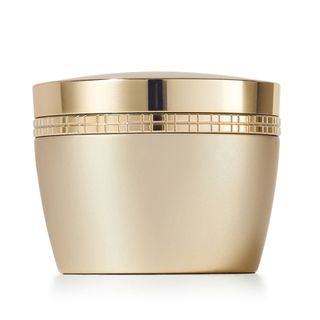
Elizabeth Arden Ceramide Premiere Intense Moisture and Renewal Regeneration Eye Cream
Works for
2 of 2 advertised claims delivered
MoisturizingPhytosphingosine, Ceramide 6 ii + 22 moreStrong evidence
“Ceramide Premiere Intense Moisture and Renewal Regeneration Eye Cream”
This product can help improve hydration of the skin with the two types of ingredients.
The first type is called “humectants”:
these ingredients help attract water.
When humectants are on the surface of the skin, they “pull in” the moisture from the outside environment, or from
within deeper layers of the skin. The following ingredients in this product do the job:
glycerin, soy amino acids.
This product also contains ingredients called “occlusives”. They help reduce the speed with which our skin loses moisture to the outside environment. These ingredients also help soften the upper layer of the skin, so it feels less tight and nicer to the touch. The following ingredients in this product do the job: butyrospermum parkii butter, caprylic/capric triglyceride.
The following ingredients in this product are especially good for supporting the skin barrier and helping with the hydration level: acetyl tetrapeptide-5, ceramide 1, ceramide 3, ceramide 6 ii, phytosphingosine
Anti-agingAcetyl tetrapeptide-5, Butyrospermum parkii butter + 1 moreModerate evidence
“Regenerates the look of the eye area while reducing the appearance of puffiness, dark circles, fine lines and crow's feet.”
This product contains acetyl tetrapeptide-5. This ingredient might be able to help reduce and prevent fine lines and wrinkles, improve skin elasticity and firmness, but there is not enough evidence that it actually works.
Can it cause trouble?
Irritancy13 flagged ingredientsMedium risk
Comedogenic4 ingredients rated 2 or more on the 0–5 pore-clogging scale4 flagged

User reviews
Be the first — your take helps the next person decide.
Ingredients
Filter by role to see what each ingredient is doing.
Water~45–55%
Cetearyl alcohol~5–6.1%
- Irritation risk
- Low
- Comedogenicity
- 2/5
A non-drying alcohol. Works as an emollient. Helps water and oil mix together and creates a nice product texture
More about Cetearyl alcoholCetyl ricinoleate~4.1–5.1%
- Irritation risk
- Low
An emollient that helps soften the upper layer of the skin
More about Cetyl ricinoleateIsononyl isononanoate~3.2–3.9%
- Irritation risk
- Low
Forms a protective film on the surface of the skin to prevent moisture loss. Gives a velvety feel to products while reducing tackiness
More about Isononyl isononanoateButylene glycol~2.2–2.7%
- Irritation risk
- Low
Used to create a nice product texture and help delivery of other ingredients. Might be somewhat helpful in attracting water to the upper layer of the skin
More about Butylene glycolGlycerin~2–2.4%
- Irritation risk
- Low
One of the best moisturizing ingredients. Naturally present in skin. It attracts water to the upper layer of the skin working as a humectant
More about GlycerinHydrogenated polyisobutene~1.7–2.1%
- Irritation risk
- Low
Used to improve the product consistency and soften the upper layer of the skin
More about Hydrogenated polyisobuteneStearyl heptanoate~1.4–1.7%
Butyrospermum parkii butter~1.2–1.4%
- Irritation risk
- Low
- Comedogenicity
- 3/5
A great moisturising ingredient that softens the skin and reduces water loss from its upper layer. It also can be helpful in protecting skin from free radicals
More about Butyrospermum parkii butterCaprylic/capric triglyceride~0.9–1.1%
- Irritation risk
- Medium
A good mix of fatty acids that forms a protective layer on the skin. Improves the shelf life of products. Derived from coconut and glycerin
More about Caprylic/capric triglycerideDimethicone~0.65–1%
- Irritation risk
- Low
A silicone that helps to reduce water loss from the surface of the skin. Can temporarily "fill in" lines and wrinkles, absorb oil, and create a nice product finish
More about DimethiconeEthylene/acrylic acid copolymer~0.5–0.75%
- Irritation risk
- Low
Ppg-2 isoceteth-20 acetate~0.4–0.6%
- Irritation risk
- Medium
Helps water and oil mix together
More about Ppg-2 isoceteth-20 acetateMyristyl myristate~0.45–0.65%
- Irritation risk
- Medium
- Comedogenicity
- 3/5
An emollient. Is not recommended for acne-prone skin as it can be comedogenic
More about Myristyl myristatePentylene glycol~0.3–0.6%
- Irritation risk
- Medium
Used to preserve products, dissolve other ingredients and create a nice product texture
More about Pentylene glycolPolymethylsilsesquioxane~0.3–0.55%
- Irritation risk
- Low
A silicone that improves product texture and helps dissolve other ingredients. Can form a non-greasy film on the skin to prevent moisture loss
More about PolymethylsilsesquioxaneBehenyl alcohol~0.3–0.6%
- Irritation risk
- Low
Non-drying alcohol that helps water and oil mix together. Also serves as an emollient
More about Behenyl alcohol3-aminopropane sulfonic acid~0.25–0.45%
Acetyl tetrapeptide-5~0.2–0.4%
- Irritation risk
- Low
A type of peptide. Peptides are excellent moisturizers and might be able support collagen production reducing fine lines and wrinkles
More about Acetyl tetrapeptide-5Calcium hydroxymethionine~0.2–0.35%
- Irritation risk
- Low
Carbomer~0.2–0.35%
- Irritation risk
- Low
Helps create a thicker or gel-like product texture. It is not a surfactant but can be used in gentle cleansing formulations
More about CarbomerCeramide 1~0.2–0.4%
- Irritation risk
- Low
A type of lipid similar to ceramides naturally present in skin. Helps to soften the upper layer of the skin and supports the skin barrier function to keep it hydrated. Can help to prevent inflammation in skin
More about Ceramide 1Ceramide 3~0.2–0.35%
- Irritation risk
- Low
A type of lipid similar to ceramides naturally present in skin. Helps to soften the upper layer of the skin and supports the skin barrier function to keep it hydrated. Can help to prevent inflammation in skin
More about Ceramide 3Ceramide 6 ii~0.2–0.35%
- Irritation risk
- Low
A type of lipid similar to ceramides naturally present in skin. Helps to soften the upper layer of the skin and supports the skin barrier function to keep it hydrated. Can help to prevent inflammation in skin
More about Ceramide 6 iiCetearyl dimethicone crosspolymer~0.15–0.3%
- Irritation risk
- Low
Helps create a nice product texture and soften the upper layer of the skin
More about Cetearyl dimethicone crosspolymerCetearyl glucoside~0.15–0.3%
- Irritation risk
- Medium
Helps water and oil in the product mix well together and improves product texture
More about Cetearyl glucosideCholesterol~0.2–0.35%
- Irritation risk
- Low
An emollient that is naturally found in skin
More about CholesterolDisodium edta~0.15–0.25%
Fucus serratus extract~0.15–0.25%
- Irritation risk
- Low
Hydrolyzed soy protein~0.15–0.25%
- Irritation risk
- Low
Helps attract water to the upper layer of the skin. Might have some anti-aging, anti-oxidant, and skin lightening properties, but solid evidence is missing
More about Hydrolyzed soy proteinHydroxyethyl acrylate/sodium acryloyldimethyl taurate copolymer~0.15–0.25%
- Irritation risk
- Medium
A gelling agent that thickens the product consistency and leaves the skin with a velvety finish
More about Hydroxyethyl acrylate/sodium acryloyldimethyl taurate copolymerHydroxyethylcellulose~0.15–0.3%
- Irritation risk
- Low
Used to thicken product formulations and create gel-like textures
More about HydroxyethylcelluloseMica~0.15–0.3%
- Irritation risk
- Low
Creates an illusion of smoother and more radiant skin tone. Adds shimmer to the skin by reflecting light
More about MicaMyristyl laurate~0.15–0.25%
Phytosphingosine~0.2–0.35%
- Irritation risk
- Low
A type of lipid that is naturally present in skin. It might help in repairing skin barrier function and has anti-bacterial effect
More about PhytosphingosinePolysorbate 20~0.15–0.3%
Polysorbate 60~0.15–0.3%
Punica granatum sterols~0.15–0.25%
- Irritation risk
- Low
Retinyl linoleate~0.15–0.25%
- Irritation risk
- High
An ester of a retinoid and linoleic acid. Three steps removed from the bioactive form of retinoid, retinoic acid. Once converted to retinoic acid in skin, it can help reduce wrinkles, stimulate collagen production, even out skin tone and reduce blemishes. The concentrations used in cosmetic products are often not high enough to have a positive effect in skin.
More about Retinyl linoleateSodium lauroyl lactylate~0.15–0.3%
- Irritation risk
- Medium
Helps water and oil mix together
More about Sodium lauroyl lactylateSorbitan isostearate~0.15–0.3%
- Irritation risk
- Low
Helps oil and water mix together
More about Sorbitan isostearateSoy amino acids~0.15–0.25%
- Irritation risk
- Low
Help attract water to the upper layer of the skin
More about Soy amino acidsTin oxide~0.25–0.5%
- Irritation risk
- Low
A colorant that can add a pearl-like appearance to the formulation
More about Tin oxideTocopheryl acetate~0.2–0.35%
- Irritation risk
- Medium
A more stable but less bio-available form of vitamin E compared to Tocopherol. Might help moisturize and protect the skin from free radicals, but mostly used in low concentrations to stabilize other ingredients.
More about Tocopheryl acetateXanthan gum~0.2–0.35%
- Irritation risk
- Low
Used to create a thicker product consistency
More about Xanthan gumYeast extract~0.15–0.3%
- Irritation risk
- Low
Helps attract water to the upper layer of the skin and might have some anti-oxidant and skin lightening properties. It can help calm down inflammation in skin
More about Yeast extractBht~0.15–0.3%
Methylparaben~0.1–0.2%
Phenoxyethanol~0.15–0.25%
- Irritation risk
- Low
A preservative. It helps prevent bacterial growth in cosmetic products
More about PhenoxyethanolPotassium sorbate~0.15–0.3%
Propylparaben~0.15–0.25%
Sodium benzoate~0.1–0.25%
Titanium dioxide~0.1–0.2%
- Irritation risk
- Low
Works as a UV filter when used in high concentrations. It is photostable and is effective mostly against the UVB light, with some protection in the UVA range. In small concentrations, used for its ability to improve the color of cosmetic products. Is usually well tolerated by the skin
More about Titanium dioxideIngredient list view
Water, Cetearyl alcohol, Cetyl ricinoleate, Isononyl isononanoate, Butylene glycol, Glycerin, Hydrogenated polyisobutene, Stearyl heptanoate, Butyrospermum parkii butter, Caprylic/capric triglyceride, Dimethicone, Ethylene/acrylic acid copolymer, Ppg-2 isoceteth-20 acetate, Myristyl myristate, Pentylene glycol, Polymethylsilsesquioxane, Behenyl alcohol, Unknown, 3-aminopropane sulfonic acid, Acetyl tetrapeptide-5, Calcium hydroxymethionine, Carbomer, Ceramide 1, Ceramide 3, Ceramide 6 ii, Cetearyl dimethicone crosspolymer, Cetearyl glucoside, Cholesterol, Disodium edta, Fucus serratus extract, Hydrolyzed soy protein, Hydroxyethyl acrylate/sodium acryloyldimethyl taurate copolymer, Hydroxyethylcellulose, Mica, Myristyl laurate, Phytosphingosine, Polysorbate 20, Polysorbate 60, Punica granatum sterols, Retinyl linoleate, Sodium lauroyl lactylate, Sorbitan isostearate, Soy amino acids, Tin oxide, Tocopheryl acetate, Xanthan gum, Yeast extract, Bht, Methylparaben, Phenoxyethanol, Potassium sorbate, Propylparaben, Sodium benzoate, Titanium dioxide
Compare prices
Retailers ranked by price — lowest first.
Affiliate links · prices updated regularly · As an Amazon Associate, WIMJ earns from qualifying purchases.
Worth comparing, line by line.
Match % combines shared ingredients, the first five ingredients, shared actives and hero ingredients, irritancy (lower counts in the alternative's favour), texture and body area. Only products in the same routine step are compared.
| Elizabeth ArdenCeramide Premiere Intense Moisture and Renewal Regeneration Eye CreamYOUR PRODUCT | SkinCeuticalsEye Cream | |
|---|---|---|
| Match | — | 51% |
| Price | $68.74 | $125.00+$56.26 |
| Shared key ingredients | — | 7 of 15 |
| Key difference | — | Dipeptide-2 |
| Irritancy | Medium | Low |
| Drying alcohol | — | — |
| View product | Shop |

Product summary
"Elizabeth Arden - Ceramide Premiere Intense Moisture and Renewal Regeneration Eye Cream" is a well-rounded moisturizing product. This moisturizer uses a good combo of humectants and emollients. These both types of ingredients are essentials for improving the skin hydration and keeping the skin barrier healthy. Humectants in this product (acetyl tetrapeptide-5, faex, glycerin, soy amino acids and hydrolyzed soy protein) help to increase the water content in the upper layer of the skin. (These ingredients do so by "capturing" water molecules from the outside air or from within the deeper layers of the skin). Emollients in this formulation (ceramide 1, ceramide 3, ceramide 6 ii, phytosphingosine and cholesterol) help to reduce the moisture loss from the skin. They also soften the skin surface and relieve the feeling of dryness and tightness.
Ingredient callouts
- this moisturizer contains an effective form of Retinoids (vitamin A): retinyl linoleate 0.15% - 0.25%. Retinoids are potent multitasking actives. They work to improve and prevent early signs of aging, reduce hyperpigmentation (age spots and post-acne marks), and prevent inflamed blemishes and clogged pores. The downside of Retinoids is that they can be irritating. If you are not already using a Retinoid in your routine, it is best to start slowly and apply the Retinoid product only a few times per week. If your skin tolerates it well, you can gradually increase the frequency to daily. Because of the irritation risk of Retinoids, we recommend to have another, retinoid-free moisturizer in your routine to use on the alternate days or when your skin feels dry.
- Another benefit is that this moisturizer contain ceramides (ceramide 6 ii 0.15% - 0.30%, ceramide 3 0.15% - 0.30%, ceramide 1 0.15% - 0.30% and phytosphingosine 0.20% - 0.35%). Ceramides are an important part of our natural skin barrier. The Ceramides used in skincare are synthetic or come from plants. They help soften the skin and can help "fill the gaps" in the skin barrier, keeping the skin hydrated and resilient for longer.
- We like that this moisturizer contains peptides (acetyl tetrapeptide-5 0.20% - 0.35%). There are many different kind of Peptides and they are naturally present in our skin. They all are a combination of aminoacids. Some of them work as natural antibiotics, promote wound-healing and production of collagen. The science is still not settled on how effective Peptides are in skincare, but it is very likely that they have a benefit. Peptides might help restore the skin barrier and fight the signs of aging. At the very least, Peptides work as humectants: they attract water to the upper layer of the skin and improve its hydration.
Irritation risk
There are actives in this product that can be irritating. We assess the overall irritancy of this moisturizer to be medium. For a detailed overview of all potential irritants: click here
You can see the detailed formula review with the breakdown of all actives in the product and the full ingredient list with estimated concentrations in the tables below.
Price
The product retails from 50.00£ up to 56.00£ in the United Kingdom.
For a detailed price comparison: click here.
Sources cited in this review
Every concentration estimate and effectiveness label is anchored to one of these 13 studies and safety reviews.
- 1
- 2
- 3
- 4Final Report on the Safety Assessment of Dimethicone Copolyoljournals.sagepub.com
- 5
- 6Extracts from Glycine max (soybean) induce elastin synthesis and inhibit elastase activityonlinelibrary.wiley.com

Affiliate links · As an Amazon Associate, WIMJ earns from qualifying purchases.