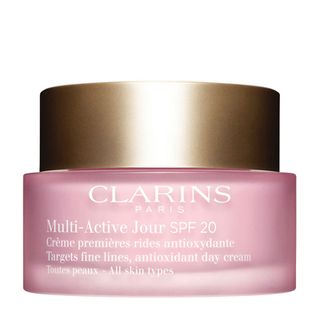
Clarins Multi-Active Day Cream SPF20
Works for
2 of 3 advertised claims delivered
Sun protectionSPF 20 · 5 UV filters · Broad spectrumWeak protectionSPF under 30
This product offers broad spectrum sun protection, but it is weak. We recommend to use a broad spectrum sunscreen with at least SPF 30.
This product can be considered "reef safe" because it does not contain the UV filters (oxybenzone and octinoxate) that can be harmful to coral reefs when present in the water in high concentrations.
Moisturizing15 ingredients credited for this claimStrong support
“Multi-Active Day Cream SPF20”
This product can help improve hydration of the skin with the two types of ingredients.
The first type is called “humectants”:
these ingredients help attract water.
When humectants are on the surface of the skin, they “pull in” the moisture from the outside environment, or from
within deeper layers of the skin. The following ingredients in this product do the job:
glycerin, sodium hyaluronate.
This product also contains ingredients called “occlusives”. They help reduce the speed with which our skin loses moisture to the outside environment. These ingredients also help soften the upper layer of the skin, so it feels less tight and nicer to the touch. The following ingredients in this product do the job: dimethicone, dimethiconol.
The following ingredients in this product are especially good for supporting the skin barrier and helping with the hydration level: copper palmitoyl heptapeptide-14, heptapeptide-15 palmitate
Anti-aging9 ingredients credited for this claimStrong support
“BENEFITS Combats the first signs of ageing Leaves the skin smooth, fresh and plumped Instantly illuminates and enhances the complexion Fights free radicals to protect the skin from premature ageing SPF 20 UVA/UVB protection”
This product can help reduce and prevent fine lines and wrinkles, improve skin elasticity and firmness because it contains glycolic acid, heptapeptide-15 palmitate.
These ingredients in the product can also be helpful, even though there is less evidence for their effectiveness: copper palmitoyl heptapeptide-14.
Keep in mind that it typically takes at least 6 weeks to notice any results because the changes that are needed to improve fine lines and elasticity happen in the deeper layers of the skin. No topical anti-aging product can “erase” wrinkles or fully reverse signs of aging.
ExfoliationNot advertised by the brand · 4 ingredients credited for this claimStrong support
This product can help exfoliate the skin. In other words, it helps break down the bonds between dead cells on the surface of the skin and speed up the skin turnover. Skin often appears softer and brighter after exfoliation, but overdoing it can result in disrupted skin barrier. The following ingredient is doing the exfoliating job in this product: glycolic acid.
Evens skin toneNot advertised by the brand · 3 ingredients credited for this claimStrong support
This product can help reduce hypepigmentation and even out the skin tone because it contains the following effective ingredients: glycolic acid
Keep in mind that you would need to apply any topical skincare targetted at hypigmentation consistently for a couple of months to get a result. No topical skincare product can help get rid of hyperpigmentation (including post-acne marks and age spots) instantly.
This product can also help with skin tone because it offers sun protection. Sun damage is the main factor causing age spots, darkening of post-acne marks and other discolorations. This is why sun protection is the best strategy for maintaining an even skin tone. We, however, do not recommend using this product as a sunscreen because the protection it offers is not strong enough).
Can it cause trouble?
Irritancy5 strong irritants: Parfum, Dipsacus sylvestris extract + 3 more — patch-test recommendedHigh risk
Comedogenic1 ingredient rated 2 or more on the 0–5 pore-clogging scale1 flagged

User reviews
Be the first — your take helps the next person decide.
Ingredients
Filter by role to see what each ingredient is doing.
Ci 77891~44–54%
- Irritation risk
- Low
Titanium dioxide~8.2–10%
- Irritation risk
- Low
Works as a UV filter when used in high concentrations. It is photostable and is effective mostly against the UVB light, with some protection in the UVA range. In small concentrations, used for its ability to improve the color of cosmetic products. Is usually well tolerated by the skin
More about Titanium dioxideButyl methoxydibenzoylmethane3%
- Irritation risk
- Medium
Avobenzone. An organic, or so-called "chemical" UV filter. Protects against both UVA and UVB rays. Needs to be combined with other filters in a formulation to be stable.
More about Butyl methoxydibenzoylmethaneHomosalate9%
- Irritation risk
- Medium
A weak sunscreen that offers some protection against the sun rays that cause sunburn (UVB), but does not offer meaningful protection against protect against the most aging sun rays (UVA). It loses its effectiveness quickly when exposed to sunlight. It is an organic, or so called "chemical" sunscreen. When used in low concentrations, helps to stabilize the product formulation
More about HomosalateOctocrylene2.7%
- Irritation risk
- Medium
A weak sunscreen that protects against the sun rays that cause sunburn (UVB) and is somewhat effective against the UVA rays. It is quite stable and can help stabilize other, more vulnerable, sunscreen ingredients like Avobenzone. It is an organic, or so called "chemical" sunscreen
More about OctocryleneWater~4.8–5.9%
Glycerin~3.4–4.2%
- Irritation risk
- Low
One of the best moisturizing ingredients. Naturally present in skin. It attracts water to the upper layer of the skin working as a humectant
More about GlycerinButyloctyl salicylate~2.7–3.2%
- Irritation risk
- Medium
A synthetic ester of salicylic acid that is used to help disperse pigments and boost effectiveness of sunscreen ingredients. It is able to absorb UV light (working as an organic, or chemical filter), but is not approved as a sunscreen ingredient on its own
More about Butyloctyl salicylateDimethicone~2.3–2.9%
- Irritation risk
- Low
A silicone that helps to reduce water loss from the surface of the skin. Can temporarily "fill in" lines and wrinkles, absorb oil, and create a nice product finish
More about DimethiconeC12-15 alkyl benzoate~2–2.4%
- Irritation risk
- Low
Enhances the product texture and makes it more spreadable. Helps reduce water loss from the outer layer of skin. Extands the shelf life by preventing bacteria growth
More about C12-15 alkyl benzoateCetearyl alcohol~1.8–2.1%
- Irritation risk
- Low
- Comedogenicity
- 2/5
A non-drying alcohol. Works as an emollient. Helps water and oil mix together and creates a nice product texture
More about Cetearyl alcoholPropanediol~1.4–1.7%
- Irritation risk
- Low
Acts as a solvent for other ingredients. Speeds up the absorption of other ingredients into the skin
More about PropanediolPotassium cetyl phosphate~1.2–1.4%
- Irritation risk
- Medium
Helps oil and water mix together
More about Potassium cetyl phosphateParfum~0.9–1.1%
- Irritation risk
- High
An aromatic blend of unspecified and possibly irritating ingredients
More about ParfumCellulose~0.95–1.15%
- Irritation risk
- Low
Can be used to help absorb oil as well as add volume and imporve texture of products.
More about CelluloseCetearyl glucoside~0.7–1.05%
- Irritation risk
- Medium
Helps water and oil in the product mix well together and improves product texture
More about Cetearyl glucosideDipsacus sylvestris extract~0.65–0.95%
- Irritation risk
- High
A plant extract traditionally used for anti-bacterial properties. Can be irritating.
More about Dipsacus sylvestris extractPhenoxyethanol~0.6–0.95%
- Irritation risk
- Low
A preservative. It helps prevent bacterial growth in cosmetic products
More about PhenoxyethanolAcrylates/c10-30 alkyl acrylate crosspolymer~0.6–0.95%
- Irritation risk
- Medium
Maintains the texture of skincare products. Allows the product to spread evenly. Helps oil and water mix together
More about Acrylates/c10-30 alkyl acrylate crosspolymerCaprylyl glycol~0.6–0.95%
- Irritation risk
- Medium
Helps preserve products and creates a nice product texture
More about Caprylyl glycolCi 77891~0.6–0.9%
- Irritation risk
- Low
Titanium dioxide~0.6–0.9%
- Irritation risk
- Low
Works as a UV filter when used in high concentrations. It is photostable and is effective mostly against the UVB light, with some protection in the UVA range. In small concentrations, used for its ability to improve the color of cosmetic products. Is usually well tolerated by the skin
More about Titanium dioxideTromethamine~0.5–0.75%
Synthetic fluorphlogopite~0.5–0.75%
- Irritation risk
- Low
A mineral that is used as an optical filter (makes the skin looks nicer through light reflection) and to improve the texture of cosmetic products
More about Synthetic fluorphlogopiteDisodium edta~0.5–0.7%
Tocopheryl acetate~0.45–0.7%
- Irritation risk
- Medium
A more stable but less bio-available form of vitamin E compared to Tocopherol. Might help moisturize and protect the skin from free radicals, but mostly used in low concentrations to stabilize other ingredients.
More about Tocopheryl acetateXanthan gum~0.5–0.7%
- Irritation risk
- Low
Used to create a thicker product consistency
More about Xanthan gumSodium hyaluronate~0.45–0.7%
- Irritation risk
- Low
One of the best moisturizing ingredients. Attracts water into the upper layer of the skin
More about Sodium hyaluronateDimethiconol~0.5–0.75%
- Irritation risk
- Low
A silicone that makes products more spreadable and keeps skin smooth. Helps to add gloss to skin and may visually fill in fine lines/wrinkles for short time
More about DimethiconolTocopherol~0.45–0.7%
- Irritation risk
- Low
Pure form of vitamin E. Can help moisturise and protect the skin from free radicals. Often used to help stabilise other ingredients or the formula itself
More about TocopherolButylene glycol~0.45–0.7%
- Irritation risk
- Low
Used to create a nice product texture and help delivery of other ingredients. Might be somewhat helpful in attracting water to the upper layer of the skin
More about Butylene glycolDiospyros mespiliformis leaf extract~0.45–0.7%
- Irritation risk
- High
Can have some anti-bacterial properties
More about Diospyros mespiliformis leaf extractMaltodextrin~0.45–0.7%
- Irritation risk
- Low
Used to stabilize the product formulation and can help absorb oil
More about MaltodextrinSanicula europaea extract~0.45–0.65%
- Irritation risk
- High
Claimed to be helpful for restoring skin barrier function but solid research is lacking
More about Sanicula europaea extractMyrothamnus flabellifolia extract~0.45–0.7%
- Irritation risk
- High
A fragrant plant extract with some antibacterial properties. Can be irritating
More about Myrothamnus flabellifolia extractCitric acid~0.45–0.7%
- Irritation risk
- Medium
Can work as an exfoliant but is typically used to adjust the product pH
More about Citric acidLapsana communis flower/leaf/stem extract~0.45–0.65%
- Irritation risk
- High
Used for its fragrance. Can be irritating
More about Lapsana communis flower/leaf/stem extractFurcellaria lumbricalis extract~0.45–0.65%
- Irritation risk
- Medium
Might be able to support collagen production, but no solid research is available
More about Furcellaria lumbricalis extractSodium citrate~0.45–0.65%
- Irritation risk
- Medium
Helps to control the skin's pH level. Maintains the skin's natural film of amino-lactic acids and oils. Helps to preserve products
More about Sodium citratePotassium sorbate~0.3–0.6%
Ascorbic acid~0.45–0.65%
- Irritation risk
- High
The most well-researched antioxidant that works in skin. Helps neutralize free radicals supporting collagen production, helping to even out the skin tone and preventing early signs of aging
More about Ascorbic acidGlycolic acid~0.45–0.65%
- Irritation risk
- High
An alpha-hydroxy acid (AHA) that helps to remove the dead skin cells on the surface of the skin reveling a more even, smoother complexation. It is also able to stimulate collagen production with long-term use. Could help to reduce pore congestion. It can be irritating to the skin. Apply sunscreen daily if using products with glycolic acid
More about Glycolic acidLactic acid~0.4–0.6%
- Irritation risk
- Medium
An exfoliating and moisturizing alpha-hydroxy acid (AHA). Typically causes less irritation than other AHAs, for example, glycolic acid. At high concentrations (about 15%), lactic acid can help reduce lines and wrinkles. Recent studies show that lactic acid can support the "good" bacteria living on skin's surface (healthy skin microbiome)
More about Lactic acidMaris sal~0.35–0.6%
- Irritation risk
- Medium
Used to thicken the product formulation and might help to add minerals to the surface of the skin. It is used in scrubs as a physical exfoliant. Can increase sensitivity to other ingredients if left on the skin or used in high concentration
More about Maris salSea salt~0.3–0.6%
- Irritation risk
- Medium
Used to thicken the product formulation and might help to add minerals to the surface of the skin. It is used in scrubs as a physical exfoliant. Can increase sensitivity to other ingredients if left on the skin or used in high concentration
More about Sea saltCi 14700~0.25–0.45%
Ci 17200~0.2–0.4%
Polyvinyl alcohol~0.2–0.4%
Copper palmitoyl heptapeptide-14~0.2–0.35%
- Irritation risk
- Low
The copper palmitoyl heptapeptide-14 is a synthetic peptide developed by ingredient supplier Infinitec, which claims that it can increase collagen production in skin when combined with Heptapeptide-15 Palmitate. The complex was tested in vitro (in a lab) and in a clinical test with 30 volunteers, but the latter wasn't placebo-controlled. The manufacturer reported wrinkle reduction after 28 days of use, but the details of the study aren't publicly available.
More about Copper palmitoyl heptapeptide-14Heptapeptide-15 palmitate~0.15–0.25%
- Irritation risk
- Low
A type of peptide. Peptides are excellent moisturizers and might be able support collagen production reducing fine lines and wrinkles
More about Heptapeptide-15 palmitateIngredient list view
Ci 77891, Titanium dioxide, Butyl methoxydibenzoylmethane, Homosalate, Octocrylene, Water, Glycerin, Butyloctyl salicylate, Dimethicone, C12-15 alkyl benzoate, Cetearyl alcohol, Propanediol, Potassium cetyl phosphate, Parfum, Cellulose, Cetearyl glucoside, Dipsacus sylvestris extract, Phenoxyethanol, Acrylates/c10-30 alkyl acrylate crosspolymer, Caprylyl glycol, Ci 77891, Titanium dioxide, Tromethamine, Synthetic fluorphlogopite, Disodium edta, Tocopheryl acetate, Xanthan gum, Sodium hyaluronate, Dimethiconol, Tocopherol, Butylene glycol, Diospyros mespiliformis leaf extract, Maltodextrin, Sanicula europaea extract, Myrothamnus flabellifolia extract, Citric acid, Lapsana communis flower/leaf/stem extract, Furcellaria lumbricalis extract, Sodium citrate, Potassium sorbate, Ascorbic acid, Glycolic acid, Lactic acid, Maris sal, Sea salt, Ci 14700, Ci 17200, Polyvinyl alcohol, Copper palmitoyl heptapeptide-14, Heptapeptide-15 palmitate
Compare prices
Retailers ranked by price — lowest first.


Worth comparing, line by line.
Match % combines shared ingredients, the first five ingredients, shared actives and hero ingredients, irritancy (lower counts in the alternative's favour), texture and body area. Only products in the same routine step are compared.
| ClarinsMulti-Active Day Cream SPF20YOUR PRODUCT | ObagiMedical Vitamin C Broad Spectrum Sun Cream SPF30 | ZO Skin HealthBroad Spectrum Sunscreen SPF 50 | Swiss BotanyDay Protect SPF 22 Daily Sun Protectant for Aging Skin | |
|---|---|---|---|---|
| Match | — | 66% | 62% | 62% |
| Price | $49.76 | $60.00+$10.24 | $60.00+$10.24 | $17.55−$32.21 |
| Shared key ingredients | — | 5 of 15 | 4 of 15 | 3 of 15 |
| Key difference | — | Oxybenzone | Retinyl Palmitate | Hexapeptide-3 |
| Irritancy | High | High | Medium | Low |
| SPF | SPF 20 | SPF 30 | SPF 50 | SPF 22 |
| Drying alcohol | — | — | — | — |
| View product | Shop | Shop | Shop |


Product summary
"Clarins - Multi-Active Day Cream SPF20" offers broad spectrum protection. It means that it protects from both UVA and UVB rays (you can remember UVB as "burning" sunlight - they cause sunburn. You can remember UVA rays as "aging" - they do not lead to sunburn, but they cause photodamage and contribute to early signs of skin aging and hyperpigmentation). On the negative side, the SPF of this moisturizer is not high enough. We recommend to use a sunscreen with at least SPF 30 daily.
It also works as a moisturizer, so you do not have to use an additional hydrating product. Like all broad-spectrum sunscreens, this product has an anti-aging benefit.
Sunscreen filters
This sunscreen uses a mixture of both mineral and organic (so-called "chemical") UV filters. The organic filters in the product are: avobenzone, butyloctyl salicylate, homosalate and octocrylene. As for the mineral filters, this sunscreen uses titanium dioxide.
Irritation risk
This moisturizer contains a bunch of common irritants, including ingredients that do not provide any known benefit for the skin. It might not be the best choice if your skin is sensitive. We assess the overall irritancy of this moisturizer to be high. For a detailed overview of all potential irritants: click here
You can see the detailed formula review with the breakdown of all actives in the product and the full ingredient list with estimated concentrations in the tables below.
Price
The product retails from 43.97£ up to 55.46£ in the United Kingdom and from 49.76$ up to 58.00$ in the United States.
For a detailed price comparison: click here.
Sources cited in this review
Every concentration estimate and effectiveness label is anchored to one of these 17 studies and safety reviews.
- 1
- 2
- 3
- 4
- 5Final Report on the Safety Assessment of Dimethicone Copolyoljournals.sagepub.com
- 6Safety Assessment of Tromethamine as Used in Cosmeticscir-safety.org

Affiliate links · As an Amazon Associate, WIMJ earns from qualifying purchases.