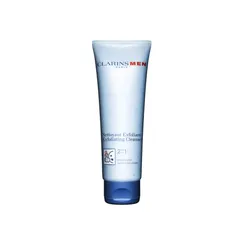
Works for:
based on ingredients and %- Cleansing
Doesn't work for:
based on ingredients and %- Exfoliation
Can it cause trouble?
- Irritation risk: high
- Comedogenic risk ingredients: 0
Key actives
Cleansing
What does the product description say?
CLARINSMEN Exfoliator Cleanser
Source: From product name
This product works by removing dirt and oil from the surface of the skin. It uses a combination of mild cleansing agents (glyceryl behenate, glycol distearate, hydroxypropyl methylcellulose, potassium laurate, potassium myristate, potassium stearate, sodium lauroyl sarcosinate, tipa-laureth sulfate) and should be able to cleanse the skin gently. Still keep in mind that any cleansing can disrupt the skin barrier, and most people do not need to cleanse their skin more than once per day.
Used to create a thicker product consistency and help soften the upper layer of the skin
Helps water and oil mix together
Used to create a thicker product consistency and stabilize the formulation
Helps water and oil mix together
Helps oil and water mix together and works as a cleansing agent
Exfoliation
What does the product description say?
CLARINSMEN Exfoliator Cleanser
Source: From product name
This product does not contain effective exfoliating ingredients. It might be able to deliver physical exfoliation, that is scrub off some of the dead cells on the surface of the skin. We do not recommend physical exfoliation, because it is not uniform (some bits of skin can get exfoliated too much while others not at all). It can also traumatize the skin and aggrevate acne and other skin conditions.
Typically used to stabilize the product formulations. It is a salt of a polyhydroxy acid (PHA) and in larger concentrations, can help shed the dead cells from the skin surface revealing smoother skin. It can help attract water to the upper layer of the skin. Might to be helpful against acne and clogged pores. Could be helpful in neutralizing free radicals, but solid research is missing. Due to the zinc content, might help calm down inflammation in skin
How honest is this product?
| Promise | Can it deliver? |
|---|---|
| Cleansing | |
| Exfoliation |
Total Promises Fulfilled score: 50/100.
Potential irritants
Comedogenic ingredients
No comedogenic ingredients detected
User reviews (0)
Averages from community submissions.
No reviews yet for this product.
Be the first to share your experience!
Tried this product?
Help capture what the ingredient list can't—texture, finish, pilling, scent, and more. Answer what you can, skip the rest.
Takes ~30 seconds.
Reviews are shown in aggregate. No personal details.
| Product | Similarity | Price | Irritancy |
|---|---|---|---|
 Clarins CLARINSMEN Exfoliator Cleanser | Current | - | |
 La Roche-Posay Toleriane Purifying Foaming Cream Facial Cleanser for Sensitive Skin with Glycerin | 32% | - | |
 Clean & Clear Morning Burst Hydrating Facial Cleanser | 30% | $5.37 | |
 Clinique Rinse-Off Foaming Cleanser | 30% | $9.00 | |
 Rosette Rice Bran Face Wash Paste | 30% | $13.20 | |
 CHANEL LA MOUSSE Anti-Pollution Cleansing Cream-to-Foam | 29% | - |
Key Actives
Typically used to stabilize the product formulations. It is a salt of a polyhydroxy acid (PHA) and in larger concentrations, can help shed the dead cells from the skin surface revealing smoother skin. It can help attract water to the upper layer of the skin. Might to be helpful against acne and clogged pores. Could be helpful in neutralizing free radicals, but solid research is missing. Due to the zinc content, might help calm down inflammation in skin
A silicone that helps to reduce water loss from the surface of the skin. Can temporarily "fill in" lines and wrinkles, absorb oil, and create a nice product finish
One of the best moisturizing ingredients. Naturally present in skin. It attracts water to the upper layer of the skin working as a humectant
Helps oil and water mix together and works as a cleansing agent
Used to create a thicker product consistency and help soften the upper layer of the skin
Works as a UV filter when used in high concentrations. It is photostable and is effective mostly against the UVB light, with some protection in the UVA range. In small concentrations, used for its ability to improve the color of cosmetic products. Is usually well tolerated by the skin
Helps to attract water to the upper layer of the skin
Used to create a thicker product consistency and stabilize the formulation
Potential irritants
An aromatic blend of unspecified and possibly irritating ingredients
Helps oil and water mix together and can enhance the penetration of other ingredients into the skin. It can be irritating
A common frangrance that can easily irritate skin, especially if exposed to air, light or heat
A fragrance. Can trigger allergic reactions and be irritating
A fragrance. Potential allergen and can be irritating
Fragrance with sweet balsamic smell. Help to preserve products and dissolve other ingredients. Could trigger allergic reactions and be irritating
A preservative. Is a frequent allergen in cosmetics
Helps oil and water mix together and works as a cleansing agent
Used to create a thicker product consistency and help soften the upper layer of the skin
Typically used to stabilize the product formulations. It is a salt of a polyhydroxy acid (PHA) and in larger concentrations, can help shed the dead cells from the skin surface revealing smoother skin. It can help attract water to the upper layer of the skin. Might to be helpful against acne and clogged pores. Could be helpful in neutralizing free radicals, but solid research is missing. Due to the zinc content, might help calm down inflammation in skin
The salt of salicylic acid. Helps exfoliate the upper layer of the skin. Can also work to preserve cosmetic products
Used to create a thicker product consistency and stabilize the formulation
Comedogenic ingredients
We couldn't find any comedogenic ingredients in this product
All ingredients
One of the best moisturizing ingredients. Naturally present in skin. It attracts water to the upper layer of the skin working as a humectant
A silicone that helps to reduce water loss from the surface of the skin. Can temporarily "fill in" lines and wrinkles, absorb oil, and create a nice product finish
Helps oil and water mix together and works as a cleansing agent
Used to create a thicker product consistency and help soften the upper layer of the skin
An aromatic blend of unspecified and possibly irritating ingredients
Works as a UV filter when used in high concentrations. It is photostable and is effective mostly against the UVB light, with some protection in the UVA range. In small concentrations, used for its ability to improve the color of cosmetic products. Is usually well tolerated by the skin
Helps oil and water mix together and can enhance the penetration of other ingredients into the skin. It can be irritating
Can be used to help absorb oil as well as add volume and imporve texture of products.
A common frangrance that can easily irritate skin, especially if exposed to air, light or heat
Typically used to stabilize the product formulations. It is a salt of a polyhydroxy acid (PHA) and in larger concentrations, can help shed the dead cells from the skin surface revealing smoother skin. It can help attract water to the upper layer of the skin. Might to be helpful against acne and clogged pores. Could be helpful in neutralizing free radicals, but solid research is missing. Due to the zinc content, might help calm down inflammation in skin
A fragrance. Can trigger allergic reactions and be irritating
The salt of salicylic acid. Helps exfoliate the upper layer of the skin. Can also work to preserve cosmetic products
A fragrance. Potential allergen and can be irritating
Fragrance with sweet balsamic smell. Help to preserve products and dissolve other ingredients. Could trigger allergic reactions and be irritating
A preservative. It helps prevent bacterial growth in cosmetic products
Used to create a thicker product consistency and stabilize the formulation
A preservative. Is a frequent allergen in cosmetics
Ingredient list view
Water, Glycerin, Potassium stearate, Potassium myristate, Dimethicone, Potassium laurate, Sodium lauroyl sarcosinate, Bambusa arundinacea stem extract, Tipa-laureth sulfate, Glycol distearate, Glyceryl behenate, Ozokerite, Parfum, Pumice, Ci 77891, Titanium dioxide, Mannitol, Propylene glycol, Cellulose, Limonene, Tetrasodium edta, Hierochloe odorata extract, Zinc gluconate, Linalool, Saponaria officinalis root extract, Ci 77007, Ultramarines, Butylphenyl methylpropional, Sodium salicylate, Hexyl cinnamal, Alpha-isomethyl ionone, Benzyl benzoate, Benzyl salicylate, Phenoxyethanol, Acrylates/ammonium methacrylate copolymer, Triethyl citrate, Hydroxypropyl methylcellulose, Potassium sorbate, Methylchloroisothiazolinone, Methylisothiazolinone, Bht
- Glycerol and the skin: holistic approach to its origin and functions
- Dimethicone as a protective ingredient in topical medications
- Final Report on the Safety Assessment of Dimethicone Copolyol
- Surfactants and experimental irritant contact dermatitis
- Propylene Glycol
- Skin-sensitizing and irritant properties of propylene glycol
- Zinc salts in dermatology
- An overview of zinc and its importance in dermatology-Part II: The association of zinc with some dermatologic disorders
- Zinc, copper and manganese enhanced keratinocyte migration through a functional modulation of keratinocyte integrins
- Evaluation of the effects of topical zinc gluconate in wound healing
- A polyhydroxy acid skin care regimen provides antiaging effects comparable to an alpha-hydroxyacid regimen
- Applications of hydroxy acids: classification, mechanisms, and photoactivity
- Three clinical studies showing the anti-aging benefits of sodium salicylate in human skin
- Citric Acid, Inorganic Citrate Salts and Alkyl Citrate Esters As Used in Cosmetics
- Methylisothiazolinone contact allergy: a review