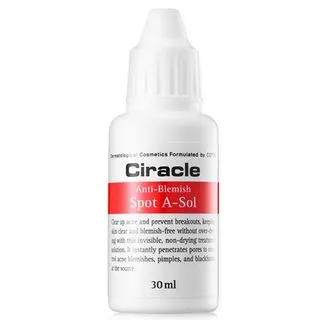
Ciracle Anti-Blemish Spot A-Sol

Ciracle Anti-Blemish Spot A-Sol

Efficacy100/100IrritancyHigh

Works for

Anti-blemish
Salicylic acid, Glycolic acid + 3 more
Works well
What the product description says
“Anti-Blemish Spot A-Sol”
Source: Yesstyle

This product can help reduce breakouts and clogged pores because it contains the following ingredient: salicylic acid. This ingredient is used for treating acne and can have a noticeable effect.

The following ingredient (ingredients) in this product might be helpful, but there is no evidence to confirm that it actually works: glycolic acid, zinc pca

Salicylic acidHeroEffect: HighUsed for skin exfoliation. It has an anti-inflammatory and anti-bacterial effect, helps to unclog pores, prevent blemishes and speed up healing of the existing ones. Sometimes referred to as a BHA (beta-hydroxy acid)~0.85–1.25%
Glycolic acidKey activeEffect: MediumAn alpha-hydroxy acid (AHA) that helps to remove the dead skin cells on the surface of the skin reveling a more even, smoother complexation. It is also able to stimulate collagen production with long-term use. Could help to reduce pore congestion. It can be irritating to the skin. Apply sunscreen daily if using products with glycolic acid~1.7–2.5%
Zinc pcaKey activeEffect: MediumA compound that combines zinc with a hydrating ingredient PCA. Might to be helpful against acne and clogged pores. Can help calm down inflammation in skin. Could be helpful in reducing the formation of free radicals in skin. Might help to reduce fine lines in wrinkles, but solid evidence is missing~0.4–0.95%
Beta-glucanEffect: LowHelps attract water to the upper layer of the skin, calm down inflammation and irritation, restore the barrier function and support wound healing. It can be helpful in reducing fine lines and wrinkles~0.1–0.3%
Retinyl palmitateUnder-dosedThree steps removed from the active form of vitamin A - retinoic acid. To have an effect in the skin, it first needs to be converted twice to become the retinoic acid. This means it is less potent than retinol, but could also be less irritating. Once converted to the retinoic acid in the skin, it helps against all signs of aging, improves skin cell turnover and helps fight blemishes and clogged pores. However, in many cosmetic formulations, it is used in a concentration that is too low to have the full effect~0.1–0.4%
Anti-aging
Side benefit the brand mentions · Glycolic acid, Lactic acid + 5 more
Works well
What the product description says
“The Korean brand addresses past, present and future skin conditions such as acne and blemishes, uneven skin tone and scars, and visible signs of aging with their extensive range of products.”
Source: Yesstyle

This product can help reduce and prevent fine lines and wrinkles, improve skin elasticity and firmness because it contains glycolic acid.

These ingredients in the product can also be helpful, even though there is less evidence for their effectiveness: lactic acid.

Keep in mind that it typically takes at least 6 weeks to notice any results because the changes that are needed to improve fine lines and elasticity happen in the deeper layers of the skin. No topical anti-aging product can “erase” wrinkles or fully reverse signs of aging.

Glycolic acidKey activeEffect: HighAn alpha-hydroxy acid (AHA) that helps to remove the dead skin cells on the surface of the skin reveling a more even, smoother complexation. It is also able to stimulate collagen production with long-term use. Could help to reduce pore congestion. It can be irritating to the skin. Apply sunscreen daily if using products with glycolic acid~1.7–2.5%
Lactic acidKey activeEffect: MediumAn exfoliating and moisturizing alpha-hydroxy acid (AHA). Typically causes less irritation than other AHAs, for example, glycolic acid. At high concentrations (about 15%), lactic acid can help reduce lines and wrinkles. Recent studies show that lactic acid can support the "good" bacteria living on skin's surface (healthy skin microbiome)~1.4–2.1%
Zinc pcaEffect: LowA compound that combines zinc with a hydrating ingredient PCA. Might to be helpful against acne and clogged pores. Can help calm down inflammation in skin. Could be helpful in reducing the formation of free radicals in skin. Might help to reduce fine lines in wrinkles, but solid evidence is missing~0.4–0.95%
Beta-glucanEffect: LowHelps attract water to the upper layer of the skin, calm down inflammation and irritation, restore the barrier function and support wound healing. It can be helpful in reducing fine lines and wrinkles~0.1–0.3%
TocopherolEffect: Low, below effective dosePure form of vitamin E. Can help moisturise and protect the skin from free radicals. Often used to help stabilise other ingredients or the formula itself~0.05–0.15%
Retinyl palmitateUnder-dosedThree steps removed from the active form of vitamin A - retinoic acid. To have an effect in the skin, it first needs to be converted twice to become the retinoic acid. This means it is less potent than retinol, but could also be less irritating. Once converted to the retinoic acid in the skin, it helps against all signs of aging, improves skin cell turnover and helps fight blemishes and clogged pores. However, in many cosmetic formulations, it is used in a concentration that is too low to have the full effect~0.1–0.4%
Ascorbic acidUnder-dosedThe most well-researched antioxidant that works in skin. Helps neutralize free radicals supporting collagen production, helping to even out the skin tone and preventing early signs of aging~0.05–0.2%
Evens skin tone
Side benefit the brand mentions · Glycolic acid, Lactic acid + 6 more
Works well
What the product description says
“The Korean brand addresses past, present and future skin conditions such as acne and blemishes, uneven skin tone and scars, and visible signs of aging with their extensive range of products.”
Source: Yesstyle

This product can help reduce hypepigmentation and even out the skin tone because it contains the following effective ingredients: glycolic acid, lactic acid, salicylic acid

The following ingredient (ingredients) in this product might be helpful, but there is no evidence to confirm that it actually can help even out the skin tone: glycyrrhiza inflata root extract, glycyrrhiza uralensis root extract.

Keep in mind that you would need to apply any topical skincare targetted at hypigmentation consistently for a couple of months to get a result. No topical skincare product can help get rid of hyperpigmentation (including post-acne marks and age spots) instantly.

Glycolic acidKey activeEffect: HighAn alpha-hydroxy acid (AHA) that helps to remove the dead skin cells on the surface of the skin reveling a more even, smoother complexation. It is also able to stimulate collagen production with long-term use. Could help to reduce pore congestion. It can be irritating to the skin. Apply sunscreen daily if using products with glycolic acid~1.7–2.5%
Lactic acidKey activeEffect: HighAn exfoliating and moisturizing alpha-hydroxy acid (AHA). Typically causes less irritation than other AHAs, for example, glycolic acid. At high concentrations (about 15%), lactic acid can help reduce lines and wrinkles. Recent studies show that lactic acid can support the "good" bacteria living on skin's surface (healthy skin microbiome)~1.4–2.1%
Salicylic acidEffect: LowUsed for skin exfoliation. It has an anti-inflammatory and anti-bacterial effect, helps to unclog pores, prevent blemishes and speed up healing of the existing ones. Sometimes referred to as a BHA (beta-hydroxy acid)~0.85–1.25%
Glycyrrhiza uralensis root extractEffect: LowLicorice root extract. Might be helpful in reducing hyperpigmentation~0.35–0.8%
Glycyrrhiza inflata root extractEffect: LowA plant extract that can help lighten the skin and calm down inflammation. Might be helpful in neutralizing free radicals~0.15–0.5%
Dipotassium glycyrrhizateEffect: Low, below effective doseA salt derived from licorice. Works as an emollient to soften the upper layer of the skin and can help calm down inflammation. Might be helpful for skin lightening~0.3–0.7%
Retinyl palmitateUnder-dosedThree steps removed from the active form of vitamin A - retinoic acid. To have an effect in the skin, it first needs to be converted twice to become the retinoic acid. This means it is less potent than retinol, but could also be less irritating. Once converted to the retinoic acid in the skin, it helps against all signs of aging, improves skin cell turnover and helps fight blemishes and clogged pores. However, in many cosmetic formulations, it is used in a concentration that is too low to have the full effect~0.1–0.4%
Ascorbic acidUnder-dosedThe most well-researched antioxidant that works in skin. Helps neutralize free radicals supporting collagen production, helping to even out the skin tone and preventing early signs of aging~0.05–0.2%
Exfoliation
Side benefit · Glycolic acid, Lactic acid + 2 more
Works well

This product can help exfoliate the skin. In other words, it helps break down the bonds between dead cells on the surface of the skin and speed up the skin turnover. Skin often appears softer and brighter after exfoliation, but overdoing it can result in disrupted skin barrier. The following ingredient is doing the exfoliating job in this product: glycolic acid, lactic acid, salicylic acid.

Glycolic acidKey activeEffect: HighAn alpha-hydroxy acid (AHA) that helps to remove the dead skin cells on the surface of the skin reveling a more even, smoother complexation. It is also able to stimulate collagen production with long-term use. Could help to reduce pore congestion. It can be irritating to the skin. Apply sunscreen daily if using products with glycolic acid~1.7–2.5%
Lactic acidKey activeEffect: HighAn exfoliating and moisturizing alpha-hydroxy acid (AHA). Typically causes less irritation than other AHAs, for example, glycolic acid. At high concentrations (about 15%), lactic acid can help reduce lines and wrinkles. Recent studies show that lactic acid can support the "good" bacteria living on skin's surface (healthy skin microbiome)~1.4–2.1%
Salicylic acidKey activeEffect: HighUsed for skin exfoliation. It has an anti-inflammatory and anti-bacterial effect, helps to unclog pores, prevent blemishes and speed up healing of the existing ones. Sometimes referred to as a BHA (beta-hydroxy acid)~0.85–1.25%
Retinyl palmitateEffect: Low, below effective doseThree steps removed from the active form of vitamin A - retinoic acid. To have an effect in the skin, it first needs to be converted twice to become the retinoic acid. This means it is less potent than retinol, but could also be less irritating. Once converted to the retinoic acid in the skin, it helps against all signs of aging, improves skin cell turnover and helps fight blemishes and clogged pores. However, in many cosmetic formulations, it is used in a concentration that is too low to have the full effect~0.1–0.4%
Moisturizing
Side benefit · Sodium lactate, Glycerin + 6 more
Works

This product contains good ingredients to attract water to the upper layer of the skin. These ingredients are called "humectants": glycerin, lactic acid.

When humectants are on the surface of the skin, they “pull in” the moisture from the outside environment, or from within deeper layers of the skin. If the air is dry, humectants can speed up the moisture loss from the skin. This is why it is a good idea to use another product on top of this one to help "seal in" the moisture (look for ingredients like dimethicone, squalane, oils and butters).

Sodium lactateKey active· HumectantEffect: HighHelps attract water to the upper layer of the skin. Is often used to adjust the pH level of the product~2.7–4.1%
GlycerinKey active· HumectantEffect: HighOne of the best moisturizing ingredients. Naturally present in skin. It attracts water to the upper layer of the skin working as a humectant~2.2–3.2%
Lactic acidKey active· HumectantEffect: HighAn exfoliating and moisturizing alpha-hydroxy acid (AHA). Typically causes less irritation than other AHAs, for example, glycolic acid. At high concentrations (about 15%), lactic acid can help reduce lines and wrinkles. Recent studies show that lactic acid can support the "good" bacteria living on skin's surface (healthy skin microbiome)~1.4–2.1%
Zinc pcaKey active· HumectantEffect: HighA compound that combines zinc with a hydrating ingredient PCA. Might to be helpful against acne and clogged pores. Can help calm down inflammation in skin. Could be helpful in reducing the formation of free radicals in skin. Might help to reduce fine lines in wrinkles, but solid evidence is missing~0.4–0.95%
Beta-glucanKey activeEffect: HighHelps attract water to the upper layer of the skin, calm down inflammation and irritation, restore the barrier function and support wound healing. It can be helpful in reducing fine lines and wrinkles~0.1–0.3%
Butylene glycol· HumectantEffect: LowUsed to create a nice product texture and help delivery of other ingredients. Might be somewhat helpful in attracting water to the upper layer of the skin~3.7–5.6%
TocopherolEffect: Low, below effective dosePure form of vitamin E. Can help moisturise and protect the skin from free radicals. Often used to help stabilise other ingredients or the formula itself~0.05–0.15%
Dipotassium glycyrrhizateUnder-dosedA salt derived from licorice. Works as an emollient to soften the upper layer of the skin and can help calm down inflammation. Might be helpful for skin lightening~0.3–0.7%

Can it cause trouble?

Irritancy
5 strong irritants: Alcohol, Citrus aurantium dulcis peel oil + 3 more — patch-test recommended
High risk
We flagged 17 ingredients with irritancy potential. Severity depends on your sensitivity threshold; the table lists the worst offenders first.
IngredientFunctionIrritationEst. amount
AlcoholCan be drying and contribute to skin irritation. Used in formulars to dissolve other ingredients, create a thinner product consistency or for its antibacterial propertiesHigh~7.2–10.8%est.
Glycolic acidAn alpha-hydroxy acid (AHA) that helps to remove the dead skin cells on the surface of the skin reveling a more even, smoother complexation. It is also able to stimulate collagen production with long-term use. Could help to reduce pore congestion. It can be irritating to the skin. Apply sunscreen daily if using products with glycolic acidHigh~1.7–2.5%est.
Salicylic acidUsed for skin exfoliation. It has an anti-inflammatory and anti-bacterial effect, helps to unclog pores, prevent blemishes and speed up healing of the existing ones. Sometimes referred to as a BHA (beta-hydroxy acid)High~0.85–1.25%est.
Citrus aurantium dulcis peel oilAn essentil oil from orange peel. Potential allergen and can be irritatingHigh~0.2–0.75%est.
Melaleuca alternifolia leaf oilAn essential oil that can be irritating. Has some anti-bacterial propertiesHigh~0.1–0.4%est.
Retinyl palmitateThree steps removed from the active form of vitamin A - retinoic acid. To have an effect in the skin, it first needs to be converted twice to become the retinoic acid. This means it is less potent than retinol, but could also be less irritating. Once converted to the retinoic acid in the skin, it helps against all signs of aging, improves skin cell turnover and helps fight blemishes and clogged pores. However, in many cosmetic formulations, it is used in a concentration that is too low to have the full effectHigh~0.1–0.4%est.
Ascorbic acidThe most well-researched antioxidant that works in skin. Helps neutralize free radicals supporting collagen production, helping to even out the skin tone and preventing early signs of agingHigh~0.05–0.2%est.
LimoneneA common frangrance that can easily irritate skin, especially if exposed to air, light or heatHigh~0.01–0.1%est.
Sodium lactateHelps attract water to the upper layer of the skin. Is often used to adjust the pH level of the productMedium~2.7–4.1%est.
Lactic acidAn exfoliating and moisturizing alpha-hydroxy acid (AHA). Typically causes less irritation than other AHAs, for example, glycolic acid. At high concentrations (about 15%), lactic acid can help reduce lines and wrinkles. Recent studies show that lactic acid can support the "good" bacteria living on skin's surface (healthy skin microbiome)Medium~1.4–2.1%est.
Peg-60 hydrogenated castor oilHelps oil and water mix togetherMedium~1.2–1.8%est.
Ppg-1-peg-9 lauryl glycol etherHelps oil and water mix togetherMedium~0.6–1.4%est.
Coceth-7Helps water and oil mix togetherMedium~0.45–1.1%est.
Glycyrrhiza uralensis root extractLicorice root extract. Might be helpful in reducing hyperpigmentationMedium~0.35–0.8%est.
1,2-hexanediolA preservativeMedium~0.2–0.7%est.
Peg-40 hydrogenated castor oilHelps oil and water mix togetherMedium~0.15–0.65%est.
Glycyrrhiza inflata root extractA plant extract that can help lighten the skin and calm down inflammation. Might be helpful in neutralizing free radicalsMedium~0.15–0.5%est.
Comedogenic
Clean of flagged comedogenic ingredients
None flagged

User reviews

Would you recommend?
No community reviews yet.

Be the first — your take helps the next person decide.

Ingredients

Filter by role to see what each ingredient is doing.

Water~40–60%
Formula
Irritation risk
Low

Plain old water

More about Water
Alcohol~7.2–10.8%
Irritant · high
Irritation risk
High
Works for
Antibacterial

Can be drying and contribute to skin irritation. Used in formulars to dissolve other ingredients, create a thinner product consistency or for its antibacterial properties

More about Alcohol
Butylene glycol~3.7–5.6%
Formula
Irritation risk
Low
Works for
Moisturizing

Used to create a nice product texture and help delivery of other ingredients. Might be somewhat helpful in attracting water to the upper layer of the skin

More about Butylene glycol
Sodium lactate~2.7–4.1%
Key activeIrritant · medium
Irritation risk
Medium
Works for
Moisturizing

Helps attract water to the upper layer of the skin. Is often used to adjust the pH level of the product

More about Sodium lactate
Glycerin~2.2–3.2%
Key active
Irritation risk
Low
Works for
Moisturizing

One of the best moisturizing ingredients. Naturally present in skin. It attracts water to the upper layer of the skin working as a humectant

More about Glycerin
Glycolic acid~1.7–2.5%
Key activeIrritant · high
Irritation risk
High
Works for
Anti-agingEvens skin toneExfoliationAnti-blemish

An alpha-hydroxy acid (AHA) that helps to remove the dead skin cells on the surface of the skin reveling a more even, smoother complexation. It is also able to stimulate collagen production with long-term use. Could help to reduce pore congestion. It can be irritating to the skin. Apply sunscreen daily if using products with glycolic acid

More about Glycolic acid
Lactic acid~1.4–2.1%
Key activeIrritant · medium
Irritation risk
Medium
Works for
Evens skin toneMoisturizingExfoliationAnti-aging

An exfoliating and moisturizing alpha-hydroxy acid (AHA). Typically causes less irritation than other AHAs, for example, glycolic acid. At high concentrations (about 15%), lactic acid can help reduce lines and wrinkles. Recent studies show that lactic acid can support the "good" bacteria living on skin's surface (healthy skin microbiome)

More about Lactic acid
Peg-60 hydrogenated castor oil~1.2–1.8%
Irritant · medium
Irritation risk
Medium
Works for
Cleansing

Helps oil and water mix together

More about Peg-60 hydrogenated castor oil
Salicylic acid~0.85–1.25%
Hero · Anti-blemishIrritant · high
Irritation risk
High
Works for
Anti-blemishExfoliationAnti-inflammatoryAntibacterialEvens skin tone

Used for skin exfoliation. It has an anti-inflammatory and anti-bacterial effect, helps to unclog pores, prevent blemishes and speed up healing of the existing ones. Sometimes referred to as a BHA (beta-hydroxy acid)

More about Salicylic acid
Ppg-1-peg-9 lauryl glycol ether~0.6–1.4%
Irritant · medium
Irritation risk
Medium
Works for
Cleansing

Helps oil and water mix together

More about Ppg-1-peg-9 lauryl glycol ether
Coceth-7~0.45–1.1%
Irritant · medium
Irritation risk
Medium
Works for
Cleansing

Helps water and oil mix together

More about Coceth-7
Zinc pca~0.4–0.95%
Key active
Irritation risk
Low
Works for
Anti-inflammatoryMoisturizingAnti-blemishAnti-agingAnti-oxidation

A compound that combines zinc with a hydrating ingredient PCA. Might to be helpful against acne and clogged pores. Can help calm down inflammation in skin. Could be helpful in reducing the formation of free radicals in skin. Might help to reduce fine lines in wrinkles, but solid evidence is missing

More about Zinc pca
Glycyrrhiza uralensis root extract~0.35–0.8%
Irritant · medium
Irritation risk
Medium
Works for
Evens skin tone

Licorice root extract. Might be helpful in reducing hyperpigmentation

More about Glycyrrhiza uralensis root extract
Dipotassium glycyrrhizate~0.3–0.7%
Under-dosed
Irritation risk
Low
Works for
MoisturizingAnti-inflammatoryEvens skin tone

A salt derived from licorice. Works as an emollient to soften the upper layer of the skin and can help calm down inflammation. Might be helpful for skin lightening

More about Dipotassium glycyrrhizate
Citrus aurantium dulcis peel oil~0.2–0.75%
Irritant · high
Irritation risk
High

An essentil oil from orange peel. Potential allergen and can be irritating

More about Citrus aurantium dulcis peel oil
1,2-hexanediol~0.2–0.7%
Irritant · medium
Irritation risk
Medium

A preservative

More about 1,2-hexanediol
Peg-40 hydrogenated castor oil~0.15–0.65%
Irritant · medium
Irritation risk
Medium
Works for
Cleansing

Helps oil and water mix together

More about Peg-40 hydrogenated castor oil
Glycyrrhiza inflata root extract~0.15–0.5%
Irritant · medium
Irritation risk
Medium
Works for
Anti-oxidationEvens skin tone

A plant extract that can help lighten the skin and calm down inflammation. Might be helpful in neutralizing free radicals

More about Glycyrrhiza inflata root extract
Melaleuca alternifolia leaf oil~0.1–0.4%
Irritant · high
Irritation risk
High
Works for
Antibacterial

An essential oil that can be irritating. Has some anti-bacterial properties

More about Melaleuca alternifolia leaf oil
Retinyl palmitate~0.1–0.4%
Under-dosedIrritant · high
Irritation risk
High
Works for
Evens skin toneAnti-blemishAnti-agingExfoliation

Three steps removed from the active form of vitamin A - retinoic acid. To have an effect in the skin, it first needs to be converted twice to become the retinoic acid. This means it is less potent than retinol, but could also be less irritating. Once converted to the retinoic acid in the skin, it helps against all signs of aging, improves skin cell turnover and helps fight blemishes and clogged pores. However, in many cosmetic formulations, it is used in a concentration that is too low to have the full effect

More about Retinyl palmitate
Arachis hypogaea oil~0.1–0.4%
Formula
Beta-glucan~0.1–0.3%
Key active
Irritation risk
Low
Works for
MoisturizingAnti-inflammatoryReduces irritationAnti-agingAnti-blemishAnti-oxidation

Helps attract water to the upper layer of the skin, calm down inflammation and irritation, restore the barrier function and support wound healing. It can be helpful in reducing fine lines and wrinkles

More about Beta-glucan
Wine extract~0.05–0.3%
Formula
Irritation risk
Low
More about Wine extract
Ascorbic acid~0.05–0.2%
Under-dosedIrritant · high
Irritation risk
High
Works for
Anti-agingEvens skin toneAnti-oxidation

The most well-researched antioxidant that works in skin. Helps neutralize free radicals supporting collagen production, helping to even out the skin tone and preventing early signs of aging

More about Ascorbic acid
Tocopherol~0.05–0.15%
Formula
Irritation risk
Low
Works for
Anti-oxidationMoisturizingAnti-inflammatoryAnti-aging

Pure form of vitamin E. Can help moisturise and protect the skin from free radicals. Often used to help stabilise other ingredients or the formula itself

More about Tocopherol
Limonene~0.01–0.1%
Irritant · high
Irritation risk
High

A common frangrance that can easily irritate skin, especially if exposed to air, light or heat

More about Limonene
Ingredient list view

Water, Alcohol, Butylene glycol, Sodium lactate, Glycerin, Glycolic acid, Lactic acid, Peg-60 hydrogenated castor oil, Salicylic acid, Ppg-1-peg-9 lauryl glycol ether, Coceth-7, Zinc pca, Glycyrrhiza uralensis root extract, Dipotassium glycyrrhizate, Citrus aurantium dulcis peel oil, 1,2-hexanediol, Peg-40 hydrogenated castor oil, Glycyrrhiza inflata root extract, Melaleuca alternifolia leaf oil, Retinyl palmitate, Arachis hypogaea oil, Beta-glucan, Wine extract, Ascorbic acid, Tocopherol, Limonene

Worth comparing, line by line.

Match % combines shared ingredients, the first five ingredients, shared actives and hero ingredients, irritancy (lower counts in the alternative's favour), texture and body area. Only products in the same routine step are compared.

Side-by-side comparison of this product against its closest alternatives
CiracleAnti-Blemish Spot A-SolYOUR PRODUCTKiehl'sTruly Targeted Acne-Clearing Pimple Patch with Salicylic AcidTransparent LabPIE Acne Red Spot Fading TreatmentMizonGood Bye Blemish Pink Spot
Match—75%74%73%
Price—$28.34$19.28$8.45
Shared key ingredients—3 of 93 of 93 of 9
Key difference—NiacinamideNiacinamideSalvia Hispanica Seed Extract
Irritancy High Low Low High
Drying alcohol Contains drying alcohol —— Contains drying alcohol
View product Shop Shop Shop

More alternatives: Makari Acne Control Spot TreatmentDCL Skincare Spot Therapy

Cheaper alternatives? See how this stacks up against similar formulas.
We compare ingredient profiles across our catalog — pick the closest match for your budget.
Open dupe finder

Product summary

"Ciracle - Anti-Blemish Spot A-Sol" is effective for: Anti-aging, Evens skin tone, Anti-blemish and Exfoliation

This product could be helpful for: Moisturizing, but its actives are not the most effective or are not well-studied.

Ingredient callouts

  • This product contains acids (lactic acid 1.40% - 2.10% and glycolic acid 1.70% - 2.50%). Their concentration is low, and they will not have a strong exfoliating effect. Instead, they work to support the skin natural acid mantle and to attract water (as humectants). Lactic acid is particularly good in attracting water to the upper layer of the skin and improving the skin barrier.
  • This product also contains Vitamin C (Ascorbic Acid). It can be an effective active for anti-aging and evening out the skin tone, but in this product it is used for stabilizing other ingredients in the formulation. In this concentration (0.05% - 0.20%) it cannot have a noticeable benefit for the skin.
  • This product includes a form of Retinoids (vitamin A) - retinyl palmitate 0.10% - 0.40%, but this type of vitamin A is not very effective. It could in theory help with fine lines and wrinkles, but the effect is most likely minimal.
  • Salicylic acid (0.85% - 1.25%). This is an oil-soluble exfoliating acid. Because of this property, it can work inside pores and help reduce the congestion. It has an anti-inflammatory effect and is used to treat acne. Because it is a quite strong exfoliator, be careful with using this product too often: it could result in over-exfoliation.
  • Humectants (zinc pca 0.40% - 0.95%, glycerin 2.20% - 3.20% and sodium lactate 2.70% - 4.10%). These ingredients help attract water to the upper layer of the skin and improve the skin hydration.

Price

The product retails from 11.20$ up to 18.50$ in the United States.

For a detailed price comparison: click here.

Sources cited in this review

Every concentration estimate and effectiveness label is anchored to one of these 26 studies and safety reviews.

  1. 1
  2. 2
  3. 3
  4. 4
  5. 5
  6. 6
Ciracle Anti-Blemish Spot A-Sol
CiracleAnti-Blemish Spot A-Sol