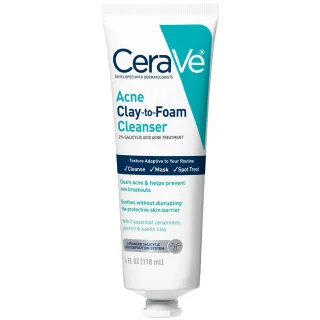
CeraVe Acne Clay To Foam Cleanser For Acne-Prone Skin
Works for
CleansingSodium cocoyl isethionate, Glyceryl stearate se + 5 moreCleanses gently
“Acne Clay To Foam Cleanser For Acne-Prone Skin”
This product works by removing dirt and oil from the surface of the skin. It uses a combination of mild cleansing agents (carbomer, cetyl alcohol, cholesterol, glyceryl stearate se, sodium cocoyl isethionate, sodium lauroyl lactylate, xanthan gum) and should be able to cleanse the skin gently. Still keep in mind that any cleansing can disrupt the skin barrier, and most people do not need to cleanse their skin more than once per day.
Anti-blemishNiacinamide, Chitosan + 3 moreWorks well
“Acne Clay To Foam Cleanser For Acne-Prone Skin”
This product can help reduce breakouts and clogged pores because it contains the following ingredient: niacinamide. This ingredient is used for treating acne and can have a noticeable effect.
In addition, this product contains chitosan. It can help in reducing blemishes, even though it is less effective.
Can it cause trouble?
Irritancy9 flagged ingredientsLow risk
Comedogenic2 ingredients rated 2 or more on the 0–5 pore-clogging scale2 flagged


User reviews
Be the first — your take helps the next person decide.
Ingredients
Filter by role to see what each ingredient is doing.
Water~40–60%
Glycerin~4–6.1%
- Irritation risk
- Low
One of the best moisturizing ingredients. Naturally present in skin. It attracts water to the upper layer of the skin working as a humectant
More about GlycerinKaolin~3.7–5.6%
- Irritation risk
- Low
A type of clay that consists mainly of aluminum silicate. Helps absorb oil and creates a thicker product consistency. Can be used to add a white color
More about KaolinSodium cocoyl isethionate~3.3–4.9%
- Irritation risk
- Medium
Helps water and oil mix together. Can be used as a cleansing agent
More about Sodium cocoyl isethionateGlyceryl stearate se~2–3%
- Irritation risk
- Low
- Comedogenicity
- 2/5
Used to stabilize the product formulations and works as an emollient
More about Glyceryl stearate seCetyl alcohol~1.7–2.6%
- Irritation risk
- Low
A non-drying alcohol that works to soften the skin and stabilize product formulations helping oil and water mix together
More about Cetyl alcoholNiacinamide~1.4–2.1%
- Irritation risk
- Low
Is proven to be effective in reducing blemishes, evening out skin tone and helping to improve lines and wrinkles. It helps the skin to repair sun damage, calm down inflammation and keep maintain good levels of moisture. The concentration of about 2% is effective for supporting the skin barrier and evening out the skin tone. Concentration of 4-6% is better for helping with acne and balancing the sebum production
More about NiacinamideGlycolipids~1.2–1.9%
- Irritation risk
- Low
Carrageenan~1.1–1.6%
- Irritation risk
- Medium
- Comedogenicity
- 3/5
Helps thicken the product formula and create a nice product formulation
More about CarrageenanBeta-glucan~0.8–1.2%
- Irritation risk
- Low
Helps attract water to the upper layer of the skin, calm down inflammation and irritation, restore the barrier function and support wound healing. It can be helpful in reducing fine lines and wrinkles
More about Beta-glucanCeramide np~0.55–1.25%
- Irritation risk
- Low
A type of lipid similar to ceramides naturally present in skin. Helps to soften the upper layer of the skin and supports the skin barrier function to keep it hydrated. Can help to prevent inflammation in skin
More about Ceramide npCeramide ap~0.45–1%
- Irritation risk
- Low
A type of lipid similar to ceramides naturally present in skin. Helps to soften the upper layer of the skin and supports the skin barrier function to keep it hydrated. Can help to prevent inflammation in skin
More about Ceramide apCeramide eop~0.4–0.95%
- Irritation risk
- Low
A type of lipid similar to ceramides naturally present in skin. Helps to soften the upper layer of the skin and supports the skin barrier function to keep it hydrated. Can help to prevent inflammation in skin
More about Ceramide eopCarbomer~0.35–0.8%
- Irritation risk
- Low
Helps create a thicker or gel-like product texture. It is not a surfactant but can be used in gentle cleansing formulations
More about CarbomerTriethyl citrate~0.2–0.75%
Sodium hydroxide~0.2–0.8%
Sodium benzoate~0.25–0.5%
Sodium lauroyl lactylate~0.15–0.6%
- Irritation risk
- Medium
Helps water and oil mix together
More about Sodium lauroyl lactylateCholesterol~0.15–0.65%
- Irritation risk
- Low
An emollient that is naturally found in skin
More about CholesterolCaprylyl glycol~0.15–0.55%
- Irritation risk
- Medium
Helps preserve products and creates a nice product texture
More about Caprylyl glycolTrisodium ethylenediamine disuccinate~0.1–0.4%
- Irritation risk
- Medium
Used to improve stability of the formulation
More about Trisodium ethylenediamine disuccinateLactic acid~0.1–0.35%
- Irritation risk
- Medium
An exfoliating and moisturizing alpha-hydroxy acid (AHA). Typically causes less irritation than other AHAs, for example, glycolic acid. At high concentrations (about 15%), lactic acid can help reduce lines and wrinkles. Recent studies show that lactic acid can support the "good" bacteria living on skin's surface (healthy skin microbiome)
More about Lactic acidChitosan~0.1–0.3%
- Irritation risk
- Medium
Inhibits acne-causing bacteria on the surface of the skin. Can help to reduce inflammation caused by bacteria. Helps neutralize free radicals in skin. Helps to attract water to the upper layer of the skin
More about ChitosanPhytosphingosine~0.1–0.35%
- Irritation risk
- Low
A type of lipid that is naturally present in skin. It might help in repairing skin barrier function and has anti-bacterial effect
More about PhytosphingosineXanthan gum~0.05–0.2%
- Irritation risk
- Low
Used to create a thicker product consistency
More about Xanthan gumBenzoic acid~0.05–0.2%
Ingredient list view
Water, Glycerin, Kaolin, Sodium cocoyl isethionate, Glyceryl stearate se, Cetyl alcohol, Niacinamide, Glycolipids, Carrageenan, Beta-glucan, Ceramide np, Ceramide ap, Ceramide eop, Carbomer, Triethyl citrate, Sodium hydroxide, Sodium benzoate, Sodium lauroyl lactylate, Cholesterol, Caprylyl glycol, Trisodium ethylenediamine disuccinate, Lactic acid, Chitosan, Phytosphingosine, Xanthan gum, Benzoic acid
Compare prices
Retailers ranked by price — lowest first.


Worth comparing, line by line.
Match % combines shared ingredients, the first five ingredients, shared actives and hero ingredients, irritancy (lower counts in the alternative's favour), texture and body area. Only products in the same routine step are compared.
| CeraVeAcne Clay To Foam Cleanser For Acne-Prone SkinYOUR PRODUCT | e.l.f. CosmeticsPure Skin Cleanser | NativeSensitive Facial Cleanser | La Roche-PosayLipikar AP+ Body & Face Wash | |
|---|---|---|---|---|
| Match | — | 80% | 78% | 77% |
| Price | $8.99 | — | $9.95+$0.96 | $16.74+$7.75 |
| Shared key ingredients | — | 10 of 16 | 3 of 16 | 2 of 16 |
| Key difference | — | Allantoin | Panthenol | Butyrospermum Parkii Butter |
| Irritancy | Low | Low | Low | Low |
| Drying alcohol | — | — | — | — |
| View product | Shop | Shop | Shop |
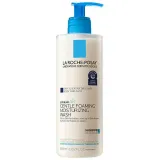
More alternatives: SVR Sebiaclear Cleansing CreamCetaphil Gentle Skin Cleanser - Dry to Normal, Sensitive Skin
Sources cited in this review
Every concentration estimate and effectiveness label is anchored to one of these 22 studies and safety reviews.
- 1
- 2Final Report on the Safety Assessment of Sodium Cocoyl Isethionatejournals.sagepub.com
- 3
- 4
- 5β-Glucans: Multi-Functional Modulator of Wound Healingncbi.nlm.nih.gov
- 6

Affiliate links · As an Amazon Associate, WIMJ earns from qualifying purchases.