Works for
2 of 2 advertised claims delivered
Anti-aging4 ingredients credited for this claimStrong support
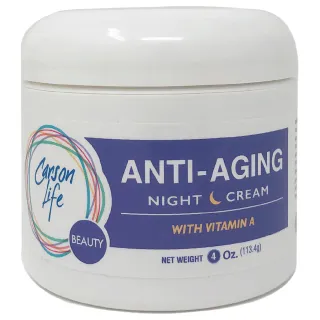
“Carson Life Anti Aging Night Cream with Vitamin A is a moisturizing cream that may help reduce the signs of aging.”
This product can help reduce and prevent fine lines and wrinkles, improve skin elasticity and firmness because it contains hydroxypinacolone retinoate.
Keep in mind that it typically takes at least 6 weeks to notice any results because the changes that are needed to improve fine lines and elasticity happen in the deeper layers of the skin. No topical anti-aging product can “erase” wrinkles or fully reverse signs of aging.
Moisturizing11 ingredients credited for this claimGood support
“Carson Life Anti Aging Night Cream with Vitamin A is a moisturizing cream that may help reduce the signs of aging.”
This product can help improve hydration of the skin with the two types of ingredients.
The first type is called “humectants”:
these ingredients help attract water.
When humectants are on the surface of the skin, they “pull in” the moisture from the outside environment, or from
within deeper layers of the skin. The following ingredients in this product do the job:
glycerin, hyaluronic acid.
This product also contains ingredients called “occlusives”. They help reduce the speed with which our skin loses moisture to the outside environment. These ingredients also help soften the upper layer of the skin, so it feels less tight and nicer to the touch. The following ingredients in this product do the job: glycine soja oil, hydrolyzed collagen.
Evens skin toneNot advertised by the brand · 1 ingredient credited for this claimStrong support
This product can help reduce hypepigmentation and even out the skin tone because it contains the following effective ingredients: hydroxypinacolone retinoate.
Keep in mind that you would need to apply any topical skincare targetted at hypigmentation consistently for a couple of months to get a result. No topical skincare product can help get rid of hyperpigmentation (including post-acne marks and age spots) instantly.
Anti-blemishNot advertised by the brand · 2 ingredients credited for this claimStrong support
This product can help reduce breakouts and clogged pores because it contains the following ingredient: hydroxypinacolone retinoate. This ingredient is used for treating acne and can have a noticeable effect.
Anti-oxidationNot advertised by the brand · 4 ingredients credited for this claimStrong support
This product contains antioxidants (ubiquinone) that can help neutralize free radicals in skin. By doing so, they can lessen the damage the skin gets from the UV light (sun).
The following ingredients - ginkgo biloba leaf extract also can have an antioxidant effect, but there is less evidence to confirm their effectiveness in skin.
Can it cause trouble?
Irritancy2 strong irritants: Hydroxypinacolone retinoate, ParfumMedium risk
Comedogenic3 ingredients rated 2 or more on the 0–5 pore-clogging scale3 flagged
User reviews
Be the first — your take helps the next person decide.
Ingredients
Filter by role to see what each ingredient is doing.
Water~40–60%
Glyceryl stearate~5–7.5%
- Irritation risk
- Low
An emollient that softens the skin and forms a protective layer on its surface. Helps water and oil mix together
More about Glyceryl stearateCetearyl alcohol~3.3–4.9%
- Irritation risk
- Low
- Comedogenicity
- 2/5
A non-drying alcohol. Works as an emollient. Helps water and oil mix together and creates a nice product texture
More about Cetearyl alcoholStearic acid~2.5–3.7%
- Irritation risk
- Low
Helps oil and water mix together and works as an emollient
More about Stearic acidSodium cocoyl glutamate~2–3.1%
- Irritation risk
- Medium
Helps oil and water mix together
More about Sodium cocoyl glutamateGlycerin~1.7–2.5%
- Irritation risk
- Low
One of the best moisturizing ingredients. Naturally present in skin. It attracts water to the upper layer of the skin working as a humectant
More about GlycerinIsopropyl palmitate~1.3–2%
- Irritation risk
- Medium
- Comedogenicity
- 3/5
Helps soften the upper layer of the skin and create a thicker product consistency
More about Isopropyl palmitateRuta graveolens leaf extract~1.1–1.6%
- Irritation risk
- Low
Ginkgo biloba leaf extract~0.95–1.4%
- Irritation risk
- High
A plant extract that might help neutralize free radicals and reduce inflammation in skin. It can be irritating
More about Ginkgo biloba leaf extractAesculus hippocastanum extract~0.6–1.35%
- Irritation risk
- High
A plant extract. Benefits of topical application are not confirmed
More about Aesculus hippocastanum extractPrunus amygdalus dulcis oil~0.45–1.1%
- Irritation risk
- Low
An emollient that softens the skin
More about Prunus amygdalus dulcis oilGlycine soja oil~0.4–0.9%
- Irritation risk
- Medium
- Comedogenicity
- 2/5
A good emollient that helps soften the skin and helps repair its barrier function. It can clog pores if used in high concentrations.
More about Glycine soja oilHydrolyzed elastin~0.35–0.8%
- Irritation risk
- Low
Tocopheryl acetate~0.2–0.8%
- Irritation risk
- Medium
A more stable but less bio-available form of vitamin E compared to Tocopherol. Might help moisturize and protect the skin from free radicals, but mostly used in low concentrations to stabilize other ingredients.
More about Tocopheryl acetateHydrolyzed collagen~0.2–0.75%
- Irritation risk
- Low
A typically plant-derived compound that is supposed mimic human collagen. Cannot penetrate the skin barrier so is not particularly useful in skincare products beyond attracting water to the upper layer of the skin
More about Hydrolyzed collagenHyaluronic acid~0.15–0.7%
- Irritation risk
- Low
One of the best moisturizing ingredients. Attracts water into the upper layer of the skin. Naturally present in skin. Typically has large molecule size unless advertised otherwise on the product label. Helps support skin's barrier function and may help to reduce inflammation
More about Hyaluronic acidDimethyl isosorbide~0.15–0.55%
- Irritation risk
- Low
Used to dissolve other ingredients in a product and can enhance their ability to penetrate the skin
More about Dimethyl isosorbideHydroxypinacolone retinoate~0.01–0.05%
- Irritation risk
- High
A derivative of the most potent form of vitamin A, retinoic acid. The ingredient can be sold under name Granactive Retinoid. Note that if a skincare brand discloses the concentration of Granactive Retinoid in a product, the concentration refers to a diluted form of Hydroxypinacolone Retinoate: 1% of Granactive Retinoid corresponds to 0.1% of Hydroxypinacolone Retinoate. Hydroxypinacolone Retinoate (HPR) is a unique derivative of retinoic acid because it can directly work in the skin and does not require additional conversion steps. According to studies done by the manufacturer on models of human skin (not real people), this derivative is more effective than other cosmetic versions of retinoids (such as retinol, retinaldehyde, and retinyl palmitate), and, at the same time, causes less irritation. It has been also demonstrated to be more stable than retinol which makes formulating with easier and increases the chances that a product with it will maintain its effectiveness after opening. The packaging should still ideally be air-tight. HPR is available over the counter in the EU, UK, Asia, Australia and New Zealand, but is only with a prescription in Canada.
More about Hydroxypinacolone retinoateUbiquinone~0.1–0.45%
- Irritation risk
- Low
Coenzyme Q10. It helps neutralize free radicals in skin, improves skin hydration and might be helpful agains fine lines and wrinkles. It can be an allergen
More about UbiquinoneParfum~0.1–0.3%
- Irritation risk
- High
An aromatic blend of unspecified and possibly irritating ingredients
More about ParfumAcrylamide/sodium acrylate copolymer~0.1–0.35%
- Irritation risk
- Low
Paraffinum liquidum~0.1–0.35%
- Irritation risk
- Low
Mineral oil. One of the most effective and well studied occlusive and emollient moisturizing ingredients. Helps reduce moisture loss in skin and repair skin barrier function
More about Paraffinum liquidumTrideceth-6~0.05–0.2%
Triethanolamine~0.05–0.15%
- Irritation risk
- Medium
Used to adjust pH of the product and can help improve the product's smell
More about TriethanolamineIngredient list view
Water, Glyceryl stearate, Cetearyl alcohol, Stearic acid, Sodium cocoyl glutamate, Glycerin, Isopropyl palmitate, Unknown, Ruta graveolens leaf extract, Ginkgo biloba leaf extract, Aesculus hippocastanum extract, Prunus amygdalus dulcis oil, Glycine soja oil, Hydrolyzed elastin, Tocopheryl acetate, Hydrolyzed collagen, Hyaluronic acid, Dimethyl isosorbide, Hydroxypinacolone retinoate, Ubiquinone, Parfum, Acrylamide/sodium acrylate copolymer, Paraffinum liquidum, Trideceth-6, Triethanolamine, Unknown, Unknown
Compare prices
Retailers ranked by price — lowest first.
Affiliate links · prices updated regularly · As an Amazon Associate, WIMJ earns from qualifying purchases.
Worth comparing, line by line.
Match % combines shared ingredients, the first five ingredients, shared actives and hero ingredients, irritancy (lower counts in the alternative's favour), texture and body area. Only products in the same routine step are compared.
| Carson LifeAnti-Aging Night CreamYOUR PRODUCT | BiopelleEmepelle Night Cream | HickapBedtime Magic Repairing Night Cream | Seriøst Bedre HudA-vitamincremen | |
|---|---|---|---|---|
| Match | — | 75% | 73% | 72% |
| Price | $12.49 | $195.00+$182.51 | — | — |
| Shared key ingredients | — | 1 of 8 | 4 of 8 | 2 of 8 |
| Key difference | — | Niacinamide | Bakuchiol | Niacinamide |
| Irritancy | Medium | Low | Medium | Medium |
| Drying alcohol | — | — | — | — |
| View product | Shop | Shop | Shop |


Sources cited in this review
Every concentration estimate and effectiveness label is anchored to one of these 14 studies and safety reviews.
- 1
- 2
- 3
- 4Final Report on the Safety Assessment of Isopropyl Isostearatejournals.sagepub.com
- 5
- 6Cosmeceutical Critique: Ginkgo Bilobamdedge.com

Affiliate links · As an Amazon Associate, WIMJ earns from qualifying purchases.